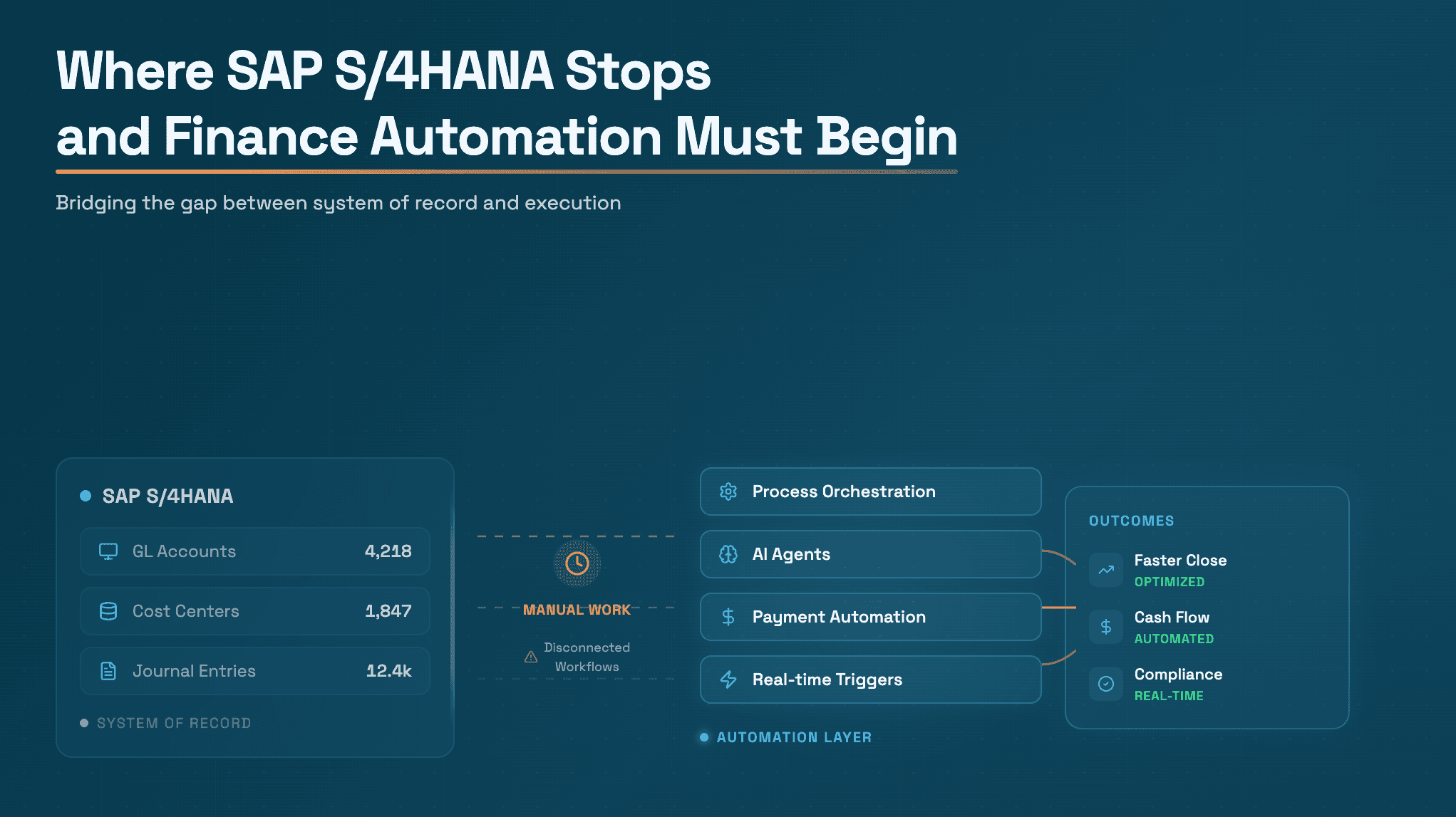
Change Management in SAP S/4HANA: The Finance Impact No One Plans For
Why overlooked change management in SAP S/4HANA creates hidden disruption for finance teams post go-live.
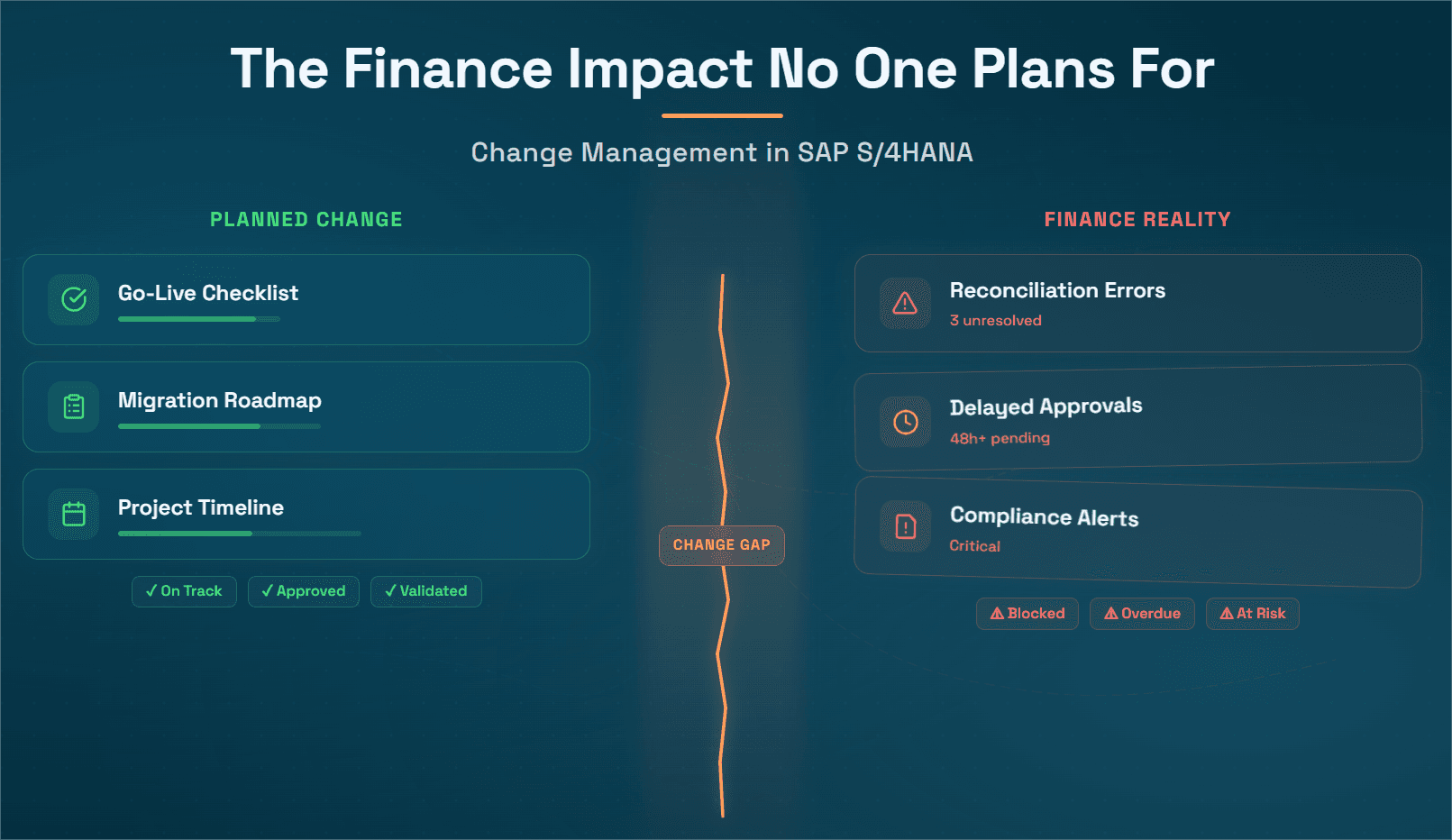
Every SAP S/4HANA transformation programme has a change management workstream. It sits in the project plan, somewhere between training and communications. It has a budget line typically 5–10% of the total programme cost. It produces stakeholder maps, communication plans, and a training schedule. And in the vast majority of cases, it is not nearly enough.
According to EY's December 2025 research in collaboration with the University of Oxford's Saïd Business School, organizations face a 67% failure rate in transformation programmes, and SAP S/4HANA initiatives are no exception. Success hinges not just on technology but on human factors like adaptive leadership, psychological safety, and disciplined freedom.
The finance function bears a disproportionate share of this failure cost. When an S/4HANA transformation stumbles on the human side, it is rarely the IT team that absorbs the impact. It is the AP team processing invoices manually because the new matching process is not trusted. It is the controller running month-end close in a spreadsheet because the SAP accruals configuration produces numbers no one can explain. It is the collections team working from a system they were trained on for half a day, six weeks ago, and have largely reverted away from since.
According to the Horváth Business Transformation Unlocked study, based on a survey of more than 200 executives from SAP-using companies, 65% of leaders acknowledged that they missed their initial targets for quality, 60% suffered overruns in planning, and on average SAP S/4HANA implementations take 30% longer than originally anticipated. These are not technology failures. They are impact failures, the visible surface of an organization that underestimated how deeply process change in SAP S/4HANA reaches into the daily work of the finance team.
This blog maps the specific ways change impact lands on finance teams in S/4HANA transformations such as the process change costs that nobody budgets for, the human dynamics that no Gantt chart captures, and how Hyperbots AI Co-pilots provide the practical solution that change management programmes alone cannot: making the new SAP-based processes so demonstrably better that adoption becomes the rational choice rather than a managed compliance exercise.
Why Finance Bears the Disproportionate Change Impact of S/4HANA
Change management theory, whether Kotter's 8-Step Model, Prosci's ADKAR framework, or McKinsey's 7-S, treats the organization as a whole. In practice, the change impact of an S/4HANA transformation is not evenly distributed. Finance absorbs far more of it than any other function.
The reason is structural. SAP S/4HANA transformations often touch multiple end-to-end processes and teams, also impacting edge systems and tools. The wider organization must be brought along and engaged in the change journey. Finance sits at the intersection of every one of those end-to-end processes. Every purchase order procurement raises creates an AP invoice finance must process. Every sales order the commercial team books creates an AR item finance must collect. Every month-end requires finance to close the books on data generated by every other function in the business.
If success means adoption, that the organisation has embraced and embedded new ways of thinking and working, then the people's aspects of change must be addressed with the same weight as process, technology and data. SAP S/4HANA is a significant investment and its success depends on the organisation's readiness and commitment to adopt and embed new ways of thinking and working.
And yet, in most programmes, finance's change readiness is assessed once in a stakeholder survey, addressed in a two-day training programme, and then assumed to be complete. The result is a finance function that is technically live on S/4HANA but operationally still running significant portions of its process on the systems, workarounds, and habits it had before the transformation began.
The Six Dimensions of Finance Change Impact in SAP S/4HANA
Dimension 1– Process Change Across Every Finance Workflow Simultaneously
The most fundamental change impact on finance is the simultaneity of process change. In an S/4HANA transformation, the AP process changes. The AR process changes. The GL posting logic changes. The month-end close sequence changes. The reporting landscape changes. The vendor master management process changes. All of these change at the same time, at go-live.
SAP S/4HANA transformations require business and functional leaders to make cross-functional decisions. Enterprise business process owners and global process owners may need to decide in real time about future operating model and functions' processes, policies and ways of working.
For an AP controller who has processed invoices in SAP ECC for fifteen years, the change is not just a new screen layout. It is a new mental model for how the system works, new transaction paths, new exception handling logic, and new escalation routes for the exceptions the system cannot handle. Multiply this across every finance role like AP analyst, AR analyst, collections specialist, treasury analyst, financial controller, management accountant and the aggregate change impact is enormous.
The process change dimension is made worse by the fact that finance professionals are not change recipients in the abstract, they have quarterly close deadlines, audit deliverables, and operational SLAs that do not pause for transformation programmes. The processes that are changing are the processes they are simultaneously required to execute at full performance.
Dimension 2 – The Productivity Dip That Is Never Budgeted
Every change management framework acknowledges the productivity dip, the period immediately following a major change during which performance drops as users move from unconscious competence in the old system to conscious incompetence in the new one. Research from Prosci shows that projects with excellent change management are 7x more likely to succeed than those with poor change management.
The productivity dip in finance is real, measurable, and almost never budgeted for. In the first month post-go-live, invoice processing times typically double. Month-end close extends by three to five days. AR aging grows because the collections team is learning the new system rather than running collections calls. Bank reconciliation takes twice as long because the bank integration produces exceptions that nobody knows how to resolve yet.
Finance leadership that was promised a transformation that would free up their team for strategic work discovers instead that go-live has temporarily made their team less productive than they were on ECC. This outcome, entirely predictable and extensively documented in change management literature, is experienced as a failure by finance leaders who were not adequately prepared for it.
The budget implication that nobody plans for: The productivity dip has a financial cost. Extra hours worked by AP analysts processing invoices manually. Month-end close that runs into the first week of the new period. DSO that increases in the first quarter post-go-live because the collections team is struggling with the new system. These costs are real and quantifiable and they are rarely included in the transformation business case.
Dimension 3 – The Emotional Reality of Process Change for Finance Professionals
Change management programmes spend considerable energy on stakeholder communication, telling finance teams why the transformation is happening, what the benefits are, and what support is available. They spend much less energy on the emotional dimension of asking a skilled professional to become a beginner again.
According to Prosci's ERP Change Management research, a US-based multinational food corporation implementing SAP found that the change lead needed to engage in direct conversations with impacted individuals, especially those resistant to the new system, transforming them into supporters and trainers. The project was successfully launched on time, achieving its objectives but this required sustained, individual-level engagement that is rarely planned at the scale required.
For finance professionals, the emotional dimension of process change is particularly acute because their professional identity is closely tied to their expertise. An AP manager who has been regarded as a SAP expert for a decade is not eager to become a beginner. A controller who knows every formula in the accruals workbook does not naturally trust an automated system they did not build. A collections analyst who has cultivated customer relationships through their personal workflow is not comfortable handing that workflow to an AI agent.
SAP S/4HANA transformations are not just IT upgrades, they are business reinventions. Leaders must simultaneously orchestrate business redesign, technical enablement and organizational change. The emotional reality of this reinvention for the individual finance professional, the loss of expertise-based identity, the anxiety of the learning curve, the fear of making errors in a compliance-critical environment, is the most consistently underestimated dimension of finance change impact.
Dimension 4 – Change Impact From Processes That Finance Does Not Control
Finance's change impact in an S/4HANA transformation extends well beyond the finance module. Finance receives the output of every other function's process change and when those processes change in ways that produce poor-quality inputs to finance, finance bears the operational cost.
When the procurement team changes how purchase orders are raised, different document types, different cost center assignment logic, different goods receipt processes, the AP team receives different invoice matching scenarios than they were trained for. When the sales team changes how sales orders are booked and how customer invoices are generated, the AR team faces new dunning exclusion scenarios and payment allocation challenges. When the logistics team changes how goods receipts are processed, the accruals calculation changes and the controller's month-end close produces different numbers than the UAT testing predicted.
This cross-functional change impact is the dimension of process change that is most consistently missed in finance-focused change management planning. SAP S/4HANA transformations often touch multiple end-to-end processes and teams, also impacting edge systems and tools. The wider organization must be brought along and engaged in the change journey. Finance change management planning that focuses only on the finance module misses the processes upstream and downstream that determine what arrives in the finance team's inbox every day.
Dimension 5 – The Compliance and Audit Exposure During the Transition Period
SAP S/4HANA transformations create a compliance risk window, the period between go-live and full, confident adoption during which finance processes are being executed by users who are not yet fully proficient, using configurations that may not yet be fully validated, in a system that may not yet be fully integrated with all its dependent tools.
According to OCM Solution's SAP S/4HANA change management guide, the real challenge of transitioning to SAP S/4HANA lies not in the technology itself but in how people adapt to the change. This includes ensuring that finance processes remain compliant and auditable during the transition, a challenge that is often underestimated.
For finance, this compliance exposure is not hypothetical. Invoices posted with incorrect GL codes during the learning curve create management account variances that need explanation. Tax mispostings during the transition period create compliance exposure that requires retrospective correction. Dunning letters sent to customers with disputed invoices create relationships and legal risk. Every manual workaround that finance teams deploy during the transition period creates an audit trail gap because workarounds by definition happen outside the system.
Dimension 6 – Post-Go-Live Change Fatigue and Regression
On average, SAP S/4HANA implementations take 30% longer than originally anticipated. By the time go-live arrives, the finance team has been living through transformation for 12 to 24 months. They have participated in workshops, reviewed design documents, provided requirements, participated in UAT, and attended training, all while running the existing business at full pace. The cumulative effect is change fatigue.
Change fatigue in finance manifests as regression: the gradual reversion to familiar behaviours as the intensity of post-go-live monitoring decreases. In week one of go-live, every AP analyst processes invoices in SAP because the project team is watching. In month three, the AP analyst who finds SAP matching logic confusing for a specific supplier format has reverted to a manual spreadsheet for that supplier type. In month six, the pattern has generalised and the spreadsheet handles 15% of invoice volume.
This regression is not malicious. It is rational behaviour from professionals who are under performance pressure and have found a path of least resistance. Addressing it requires either sustained monitoring and enforcement, expensive and demoralizing, or a fundamental change in the system experience that makes the new SAP-based process demonstrably easier than the regression behaviour. The latter is what Hyperbots AI Co-pilots deliver.
What Effective Change Management in SAP Finance Actually Requires
According to Prosci, projects with excellent change management are 7x more likely to succeed than those with poor change management. The question is what "excellent change management" looks like specifically for finance in an S/4HANA transformation.
Start the change impact assessment in the Explore phase. Finance change management that begins at go-live minus twelve weeks is already late. Change impact assessment for finance, figuring out in mapping which roles are affected by which process changes and to what degree should begin during the Explore phase when process design decisions are being made. Every fit-to-standard workshop decision that deviates from the current finance process is a change impact. Capturing and quantifying these impacts in Explore allows the change management plan to be built from real data, not from generic role categories.
Plan for the productivity dip explicitly and budget for it. The finance productivity dip after go-live is predictable and quantifiable. It should appear in the transformation business case as a known cost, not as an unexpected variance. Planning for it explicitly allows the programme to make provision: parallel running for the first close cycle, extra resource support during the hypercare period, and adjusted KPI expectations for the first quarter post-go-live.
Deploy role-based, scenario-based training – not system-based feature training. Finance users do not need to know every feature of SAP S/4HANA. They need to know how to complete their specific job tasks in the new system, end-to-end, with exceptions, in scenarios that reflect the real diversity of what arrives in their inbox every day. Training built around process scenarios rather than system features produces finance professionals who can operate independently in the new system rather than professionals who attended training and are now lost when the first exception appears.
Create super-user networks that are genuinely empowered. The super-user network, finance team members with deeper SAP knowledge who support their peers, is a standard change management tool. In most programmes, super-users are identified late, trained inadequately, and given no time allocation to provide support in the post-go-live period. A super-user who is supporting twenty of their colleagues while still running their own job at full pace is not a super-user, they are a stretched colleague with an extra responsibility.
Address shadow systems as a change management priority. The existence of shadow systems in finance is one of the clearest signals of incomplete change adoption and one of the most consistently ignored. A change management programme that declares success at go-live without auditing whether finance teams are actually using SAP for their core processes has measured the wrong thing.
How Hyperbots AI Co-Pilots Transform the Change Impact Equation
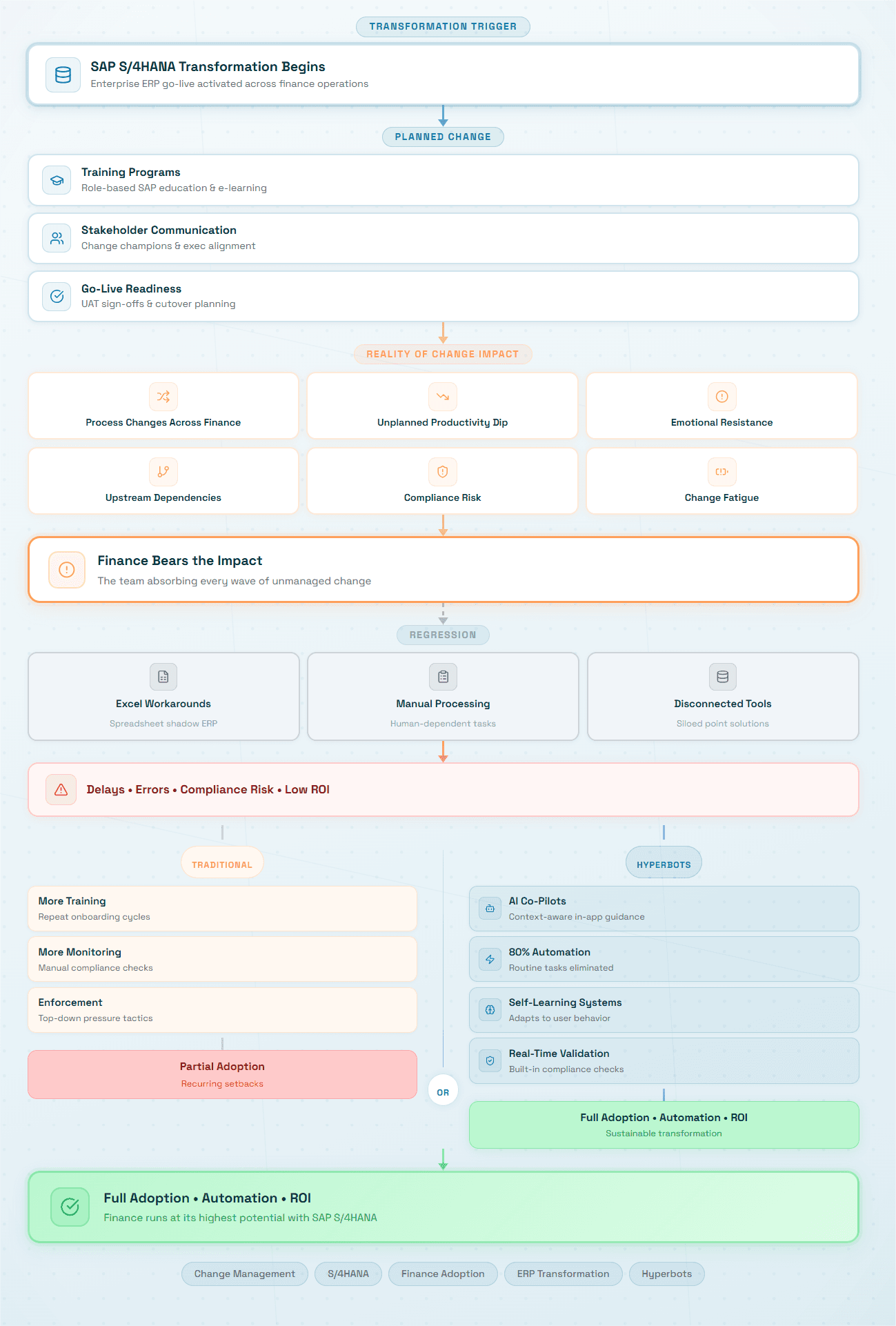
Here is the insight that most change management programmes miss entirely: the most effective change management intervention for finance in an S/4HANA transformation is not better training or better communication. It is a better process.
When one organization applied Prosci change management to a complex SAP implementation, the key to success was not just the training programme, it was that the new system eliminated legacy systems, streamlined payment processes, and provided granular data for improved decision-making. The focus on the people side of change was key but so was the fact that the new process was demonstrably better than what it replaced.
Hyperbots AI Co-pilots make the new SAP-based finance processes demonstrably better than any process the finance team was running before, eliminating the root causes of resistance, regression, and shadow system persistence simultaneously. The change impact of moving to Hyperbots-powered SAP is categorically different from the change impact of moving to unconfigured SAP, because the finance team does not have more work to do in a new system, they have less work to do, with better outcomes.
This is adoption driven by outcome superiority, the most durable form of change adoption there is, and the one that requires the least sustained monitoring and enforcement to maintain.
Hyperbots AI Co-Pilots – Removing the Change Impact Root Causes
Procure-to-Pay – Eliminating P2P Change Resistance
The process change from ECC-based AP to S/4HANA AP is significant, new matching logic, new exception workflows, new GL coding rules. The change impact is compounded when users discover that SAP's native matching configuration still requires manual intervention for a significant proportion of invoices. The Hyperbots Invoice Processing Co-pilot eliminates the manual burden entirely: 80% of invoices process autonomously, from email to SAP GL posting, with cycle time from 11 days to under one minute. When AP analysts experience that the new process requires dramatically less manual work than any ECC-era process, the change impact becomes positive. Resistance dissolves when the new system is demonstrably better.
Vendor master management process change is one of the highest-friction areas of S/4HANA transformation for finance teams because the SAP Business Partner data model is different from ECC's vendor master, and because new vendor onboarding processes that take longer than what the team previously knew breed immediate resistance. The Vendor Management Co-pilot reduces onboarding time 8x, from nine days to under one day and cuts vendor data errors from ~6% to under 1%. The change impact of a faster, more accurate process is adoption.
The PR-to-PO process change in S/4HANA is among the most visible to the procurement team and the quality of that process directly affects the AP team downstream. Hyperbots automates the full lifecycle: auto-filling forms in five minutes, converting PRs to POs automatically, and dispatching to vendors. A self-learning GL recommender eliminates the GL coding errors that generate finance exceptions. The process change becomes a process improvement rather than a disruption.
The month-end accruals process change is the single highest-anxiety change impact for finance controllers in an S/4HANA transformation. The accruals workbook they have built over years represents institutional knowledge, personal expertise, and a close relationship between the controller and the numbers. Asking them to trust an automated system with this process requires either substantial evidence of accuracy or prolonged coercion. The Accruals Co-pilot provides the evidence: close compresses from days to hours, variance to actual consistently under 5%. When the automated process is demonstrably more reliable than the workbook it replaces, the controller's change resistance dissolves naturally.
Payment process change in S/4HANA, new payment run configurations, new bank file formats, new reconciliation logic, is a high-risk change for treasury teams because payment errors have immediate, visible consequences. The Hyperbots Payment Co-pilot manages the complete payment run: scheduling, approval routing, bank file generation, fraud detection, and bank-to-SAP reconciliation. By validating vendor bank details before every payment and detecting fraud signals in real time, it makes the new payment process safer than the ECC-era process, not just different from it.
Sales Tax Verification Co-pilot
Tax configuration process change in S/4HANA is a compliance anxiety trigger for AP teams who are aware that tax errors have financial and regulatory consequences. The Sales Tax Verification Co-pilot validates tax on every invoice at line-item level before SAP posting across all U.S. states, continuously updated. By removing the compliance anxiety from the tax configuration change, it converts a high-resistance process change into a low-risk adoption.
Order-to-Cash – Eliminating O2C Change Resistance
Collections process change in S/4HANA is particularly challenging because the collections team's identity is tied to their customer relationships and their personal judgement about who to call when. An AI-driven prioritization system that replaces personal judgement with algorithmic ranking feels threatening rather than helpful unless the algorithm demonstrably outperforms personal judgement on DSO and productivity. The Hyperbots Collections Co-pilot does exactly that: 70% of collections happen automatically, delivering 40% DSO reduction and 70% reduction in cost to collect. When collections analysts see their DSO performance improve and their routine follow-up burden disappear, resistance to the process change converts to advocacy.
Cash application process change is one of the most visible post-go-live pain points because if the bank integration produces unexpected results and unapplied cash builds up, finance leadership notices immediately. The Hyperbots Cash Application Co-pilot achieves 80%+ straight-through processing, reducing unapplied cash to less than 10% and cutting reconciliation costs by up to 80%. By making the new cash application process more accurate and less effortful than any manual alternative, it converts a high-anxiety process change into a positive experience.
How Hyperbots Differentiates in the Change Management Context
Dimension | Training Programmes | Change Management Consulting | Point Finance Tools | Hyperbots AI Co-pilots |
Addresses productivity dip | Partially | Partially | Partially | Yes; automation absorbs the dip |
Reduces process change resistance | Sometimes | Sometimes | Sometimes | Yes; outcome superiority |
Eliminates shadow systems | No | No | Partially | Yes; makes SAP demonstrably better |
Prevents post-go-live regression | Monitoring required | Monitoring required | Monitoring required | Self-reinforcing adoption |
Reduces compliance exposure during transition | No | No | No | Yes; validates every posting |
Delivers demonstrable process improvement | No | No | Partially | Yes; immediate, measurable |
Works in parallel with SAP build | N/A | N/A | Partially | Yes; full parallel deployment |
Deployment timeline | 4–8 weeks | 3–6 months | 2–3 months | 3–4 weeks |
Self-learning improvement | No | No | No | Yes; continuous |
The decisive differentiator is what drives adoption. Training and change management create conditions for adoption. Hyperbots creates the outcome that makes adoption the rational choice: a finance process that is faster, more accurate, and less manual than anything the team operated before. Prosci's research shows that projects with excellent change management are 7x more likely to succeed and Hyperbots amplifies that success multiplier by giving the change management programme a concrete, demonstrable outcome to point to rather than just a communication and training wrapper around a process that still requires significant manual work.
Hyperbots Platform Capabilities – Transformational Change Impact Reduction
Agentic AI That Absorbs the Productivity Dip: When 80% of invoice processing is autonomous from day one of go-live, the AP team's productivity dip is structurally contained. The automated processes do not experience a learning curve. Only the 20% of exceptions that require human judgment are affected by the change impact which means the total finance operational disruption is a fraction of what it would be in a manual environment.
Configurable Human-in-the-Loop – Change at the Right Pace: Above a confidence threshold, actions are autonomous. Below it, the co-pilot surfaces the item for human review with full context and an AI recommendation. This configurable design means finance teams can start with higher human oversight and progressively increase automation confidence as their trust in the system builds. The change management journey is paced to the team's actual readiness rather than imposed by a go-live date.
Self-Learning That Makes the System Better Over Time: Every transaction processed improves Hyperbots' models for the specific organization. GL coding accuracy improves as the system learns approval patterns. Matching rates improve as the system learns supplier formats. This continuous improvement creates a change management dynamic where the system gets demonstrably better the longer it is used, reinforcing adoption rather than requiring it to be sustained through external monitoring.
SOX-Ready Audit Trail – Reducing Compliance Anxiety: Every autonomous action is logged in a tamper-proof, timestamped audit trail meeting SOX, PCI-DSS, and FedRAMP standards. For finance professionals whose primary change resistance is compliance anxiety, fear of being responsible for errors they cannot explain, the complete, explainable audit trail is a specific, practical antidote to that anxiety.
24/7 Operation – Absorbing the Change Impact of Global Finance Operations: Finance teams in global organizations face compounded change impact: process change in multiple time zones, multiple languages, and multiple regulatory environments simultaneously. Hyperbots co-pilots run continuously, processing invoices overnight, applying cash on weekends, running collections follow-ups across geographies and hence, absorbing the operational demand that would otherwise fall on finance teams who are simultaneously learning a new system.
ROI – The Change Impact Dividend When Finance Gets the Right Automation Layer
Procure-to-Pay ROI
Tangible:
80% straight-through processing on AP invoices – the productivity dip is absorbed autonomously rather than by manual workaround
Invoice cycle time from 11 days to under one minute – finance teams adopt the new process because it is demonstrably faster than the old one
99.8% GL coding accuracy – compliance anxiety from the process change is eliminated through verified, explainable postings
Vendor onboarding 8x faster – the most common resistance trigger in vendor master process change is resolved
Month-end close from days to hours – the highest-anxiety process change in finance produces a better outcome than the ECC-era process
Near-zero sales tax errors – compliance exposure during the transition period is eliminated
Deployment in 3–4 weeks – change impact reduction available simultaneously with SAP go-live
Intangible:
Finance team confidence in the new system builds faster because the system produces better outcomes from day one
Change fatigue is reduced because the new process is less work, not more
Resistance converts to advocacy finance teams that see their workload decrease and accuracy increase become champions of the new system
Shadow system persistence is reduced because the automated process outperforms the shadow
Order-to-Cash ROI
Tangible:
40% reduction in DSO – the collections process change delivers better outcomes than the pre-transformation process
70% reduction in cost to collect – 70% of routine follow-up is automated, reducing the personal workload impact of process change
80%+ STP on cash application – cash application process change produces better results than any manual predecessor
80% reduction in reconciliation costs – bank reconciliation change impact absorbed through AI-powered matching
Collections productivity up 80% – individual performance improves rather than declining through the change
Intangible:
Collections team adapts faster because AI handles the routine work they previously did manually
Customer relationships protected asAI-driven dunning exclusion prevents incorrect communications during the learning curve
Revenue assurance maintained through the transition since no AR items fall through the cracks during the process change period
Frequently Asked Questions (FAQs)
Q1: Why does finance bear a disproportionate share of the change impact in S/4HANA transformations?
Because finance sits at the intersection of every other function's process. Every process change in procurement, sales, logistics, and HR produces a downstream effect on a finance workflow, a different invoice format, a different GL posting pattern, a different collections scenario. Finance is not just managing the change impact of its own processes; it is managing the accumulated change impact of every upstream function. SAP S/4HANA transformations often touch multiple end-to-end processes and teams, also impacting edge systems and tools and the wider organization must be brought along and engaged in the change journey.
Q2: How long does the finance productivity dip typically last after S/4HANA go-live?
For organizations without intelligent automation on top of SAP, the finance productivity dip typically lasts six to twelve weeks before teams reach pre-go-live performance levels and in some process areas, particularly collections and cash application, the dip can persist longer if system configuration issues are not resolved quickly. Organizations that deploy Hyperbots co-pilots in parallel with the SAP go-live experience a significantly shallower and shorter dip because the automated processes are not affected by the user learning curve.
Q3: What is the single most important thing a finance leader can do to reduce change impact in an S/4HANA transformation?
Demand that the change management plan specifically addresses the productivity dip in writing with a cost estimate, a mitigation strategy, and an explicit budget allocation for post-go-live support resources. The finance productivity dip is predictable, quantifiable, and preventable through the right combination of preparation, training, and intelligent automation. The single biggest mistake is treating it as an unavoidable cost of transformation rather than a manageable risk.
Q4: How does Prosci's ADKAR model apply specifically to finance teams in an S/4HANA transformation?
The Prosci ADKAR methodology (Awareness, Desire, Knowledge, Ability, Reinforcement) is a sequential approach that enables individuals to progress through change, with emphasis on individual ownership. Applied to finance: Awareness means understanding why the AP/AR/close processes are changing and what the business case is. Desire means wanting to change which requires finance professionals to believe the new process will be better for them personally. Knowledge means knowing specifically how to complete their job tasks in the new system. Ability means being able to do so accurately under production conditions. Reinforcement means sustaining the new behaviour over time. Hyperbots supports the Desire and Reinforcement steps most powerfully by making the new process demonstrably better, it creates the desire to change and reinforces the behaviour through superior outcomes.
Q5: Can Hyperbots be deployed before S/4HANA go-live to reduce change impact?
Yes and this is one of the most practical change management interventions available. Deploying Hyperbots on the existing ECC system before S/4HANA go-live allows finance teams to begin experiencing AI-automated processes before the ERP migration adds change fatigue to the equation. By the time S/4HANA goes live, finance teams have already adopted autonomous invoice processing, automated accruals, and AI-driven collections. The ERP migration becomes a platform upgrade rather than a complete process reinvention, dramatically reducing the net change impact.
Q6: Why do 67% of transformation programmes fail, and what does this mean for SAP finance change management?
According to EY and Oxford's Saïd Business School research, organizations face a 67% failure rate in transformation programmes. Success hinges not just on technology but on human factors such as adaptive leadership, psychological safety, and disciplined freedom. For finance change management, this means that a technically successful S/4HANA implementation is a necessary but not sufficient condition for transformation success. Finance teams that go live on a technically correct system but do not fully adopt it represent a 67% failure in the change dimension, regardless of what the go-live dashboard shows.
Q7: What role does AI automation play in sustaining change adoption in finance?
AI automation addresses the most fundamental cause of change adoption failure: when the new process requires more effort than the old one, rational professionals find ways to avoid it. Hyperbots co-pilots flip this equation, the new automated process requires dramatically less manual effort than any ECC-era process, making sustained adoption the path of least resistance rather than an outcome that requires monitoring and enforcement. Prosci research confirms that projects with excellent change management are 7x more likely to succeed. Hyperbots multiplies this by making the case for change self-evident in the daily experience of every finance user.
The Change Impact Finance Cannot Afford to Ignore
Organizations face a 67% failure rate in transformation programmes and SAP S/4HANA initiatives are no exception. Success hinges not just on technology but on human factors. For finance leaders entering an S/4HANA transformation, this statistic should be read as a direct warning: the technical success of your implementation does not guarantee the operational success of your finance function.
The change impact that lands on finance simultaneously across AP, AR, close, treasury, and tax, is the most concentrated, most compliance-sensitive, and most operationally consequential change impact in the entire programme. It manifests as productivity dips, shadow system persistence, compliance exposure during transition, and post-go-live regression. It is real, it is costly, and it is almost always under-planned and under-resourced.
The organizations that manage this most effectively are the ones that address the root cause rather than the symptom and deploy Hyperbots AI Co-pilots alongside their SAP go-live so that the new finance process is demonstrably better than what it replaces from day one. When 80% of invoices process autonomously, when month-end close takes hours instead of days, when 70% of collections follow-up happens without human intervention, the change management problem largely solves itself. Finance teams do not need to be persuaded to adopt a system that is making their working lives measurably better.
The change impact no one plans for becomes the competitive advantage no one expected.