Coupa AP Automation vs Hyperbots: Which Platform Achieves Higher Straight-Through Processing?
Understand where Coupa AP automation delivers value and where Hyperbots surpasses it with autonomous AI and higher STP.
Finance leaders want automation that does more than shuffle work from one screen to another. They want straight through processing that removes human intervention, keeps costs predictable, and accelerates financial close cycles. Coupa AP automation improves visibility and speeds up approvals for many enterprises, especially those transitioning from manual tools. But when teams look for deeper AI driven processing, exception resolution, and autonomous decisioning, a noticeable gap appears.
Hyperbots fills that gap with an AI first design that reduces processing effort, improves matching accuracy, and handles exceptions without constantly sending work back to the AP queue. It is the difference between a system that assists your team and a system that works like an extra teammate who never gets tired.
What This Comparison Is Really About
Coupa and Hyperbots help finance teams in very different ways. Coupa accelerates workflows and makes processes more structured, while Hyperbots focuses on autonomous execution and precision.
To keep this useful for CFOs, controllers, and finance leaders, this review focuses on three practical questions:
Which platform reduces manual AP effort more effectively?
Which system handles complex matches and exceptions without slowing the team down?
Which platform delivers measurable straight through processing gains?
If you have ever wondered whether automation is supposed to feel easier than this, this comparison is written for you.
A Quick Look at Coupa: What It Does Well and Where It Slows Down
Coupa is often the first major step enterprises take when modernizing AP. It replaces legacy systems with digital workflows, structured processes, and centralized supplier management. Companies using Coupa frequently see faster approval cycles and better spend insights because the system enforces clean process discipline.
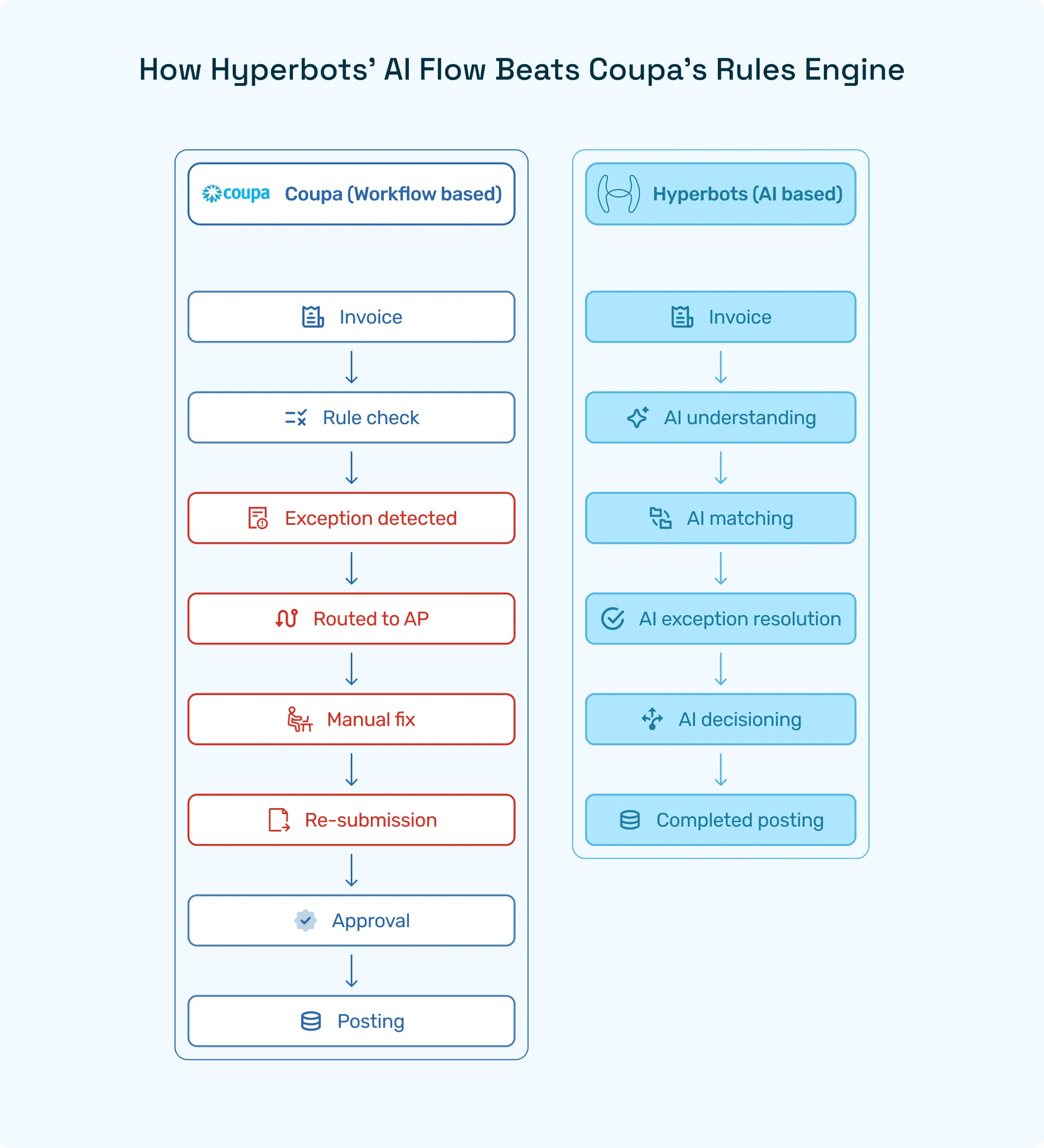
Where Coupa becomes more challenging is in scenarios that require deep AI reasoning instead of rules. The platform relies heavily on configured workflows and human validation. When an invoice or purchase order does not match perfectly, it tends to be routed back to AP. This happens often enough that many teams see a pattern: strong visibility but limited autonomy.
This is where Coupa straight through processing gaps, becomes more visible. AP teams still handle exceptions manually, and 3-way match issues remain a common bottleneck. As a result, finance leaders get structure and compliance, but not the full lights out processing they hoped for.
Meet Hyperbots: The AI Platform Built for Real Straight Through Processing
Hyperbots takes a different approach. Instead of automating the workflow around AP tasks, it automates the task itself. The platform evaluates invoices, matches documents, reasons through inconsistencies, and decides on the next best action using multi agent AI.
Enterprises typically notice two things quickly. First, invoice handling becomes substantially cheaper because the system handles most of the work end to end. Second, accuracy increases, which reduces the back and forth that normally interrupts AP flow.
A standout advantage is how Hyperbots manages exceptions. The AI does not pause the process. It analyzes the issue, resolves it when possible, and moves the transaction forward. When teams compare this to traditional workflow tools, the difference becomes obvious. It feels like the system understands the work instead of merely routing it.
Alongside invoice processing, Hyperbots also improves procurement cycles and payments. In several use cases, PR creation time drops to just a few minutes, and payment cycles become more predictable.
Coupa AP Automation vs Hyperbots: The Side by Side Breakdown
Feature | Coupa AP Automation | Hyperbots |
Processing Model | Workflow and rules driven | Autonomous multi-agent AI |
Exception Handling | Routed back to AP teams | Resolved by AI whenever possible |
Matching Accuracy | Dependent on rules and templates | Near perfect accuracy supported by AI reasoning |
Straight Through Processing | Limited in complex cases | 99.8% STP even with irregular documents |
Cost Efficiency | Gains depend on workflow compliance | Significant reduction through autonomy |
Cycle Time Impact | Faster approvals and visibility | Faster processing from start to finish |
This table reflects what enterprises typically experience when comparing structured workflow automation to autonomous AI powered execution.
The Real Talk on Coupa Straight Through Processing Gaps
Coupa’s design philosophy works well for organizations that want strong control, compliance, and structured workflows. But when teams try to extend the platform toward deeper, autonomous automation, the limitations become more noticeable.
One recurring challenge is document matching.
3-way matching often breaks down when invoice formats change or when line items do not map cleanly. As soon as the system encounters something unfamiliar, it routes the exception back to an AP analyst. Over time, this repeated dependency on human intervention is what causes Coupa AP automation maturity to stall.
Exception handling follows a similar pattern. Coupa identifies the issue, but it does not actually resolve it. AP teams still carry the responsibility of interpreting mismatches, correcting incomplete data, and cleaning up anomalies. This slows down processing, adds pressure during month close, and increases operational cost.
Here is how these gaps usually show up inside finance teams:
Matching inconsistencies are flagged but not fixed.
Exceptions quickly accumulate during peak periods.
AP analysts spend hours untangling the same types of issues.
Close timelines stretch because unresolved items keep returning.
Automation exists, but it rarely feels autonomous.
Hyperbots approaches this pain point differently. Its multi-agent AI is built to not only detect issues but to interpret context and resolve them autonomously. This is why enterprises using Hyperbots consistently reach more than 80% straight through processing even when invoice formats vary. It is a level of autonomy that workflow driven platforms simply cannot replicate.
Why Hyperbots Nails STP While Traditional Tools Struggle
Straight through processing is not just a speed metric. It is a reflection of how intelligently a system can interpret variations, resolve inconsistencies, and move transactions forward without relying on AP teams to do the heavy lifting.
Coupa’s workflow centered design helps surface issues quickly, but it still requires human decisioning. Hyperbots, on the other hand, uses multi-agent AI that actively reasons through mismatches. Instead of waiting for a perfect PO or textbook invoice structure, it adapts to the document in front of it.
This is why enterprises experience a dramatic leap in autonomy.
Hyperbots does not hesitate when data is imperfect. It analyzes context, fills the gap, and completes the transaction. It is like having a system that is comfortable with real world mess instead of ideal examples from a playbook.
What this means in practice:
Higher STP
Fewer processing delays
Lower exception queues
Faster monthly close
Smaller AP workload without adding headcount
Businesses often describe the shift as a move from “monitoring automation” to “trusting automation.”
The AI Flow Behind Hyperbots: How It Actually Works (Without the Tech Overload)
Hyperbots uses a multi AI agent architecture, which means different AI agents handle different stages of the process. Each agent specializes in a task, then passes its interpretation forward, similar to an expert assembly line powered by intelligence instead of instructions.
Here is a simple way to understand it:
Document Understanding Agent
Interprets invoices, POs, receipts, and even non standard formats.Matching and Validation Agent
Analyzes context, compares fields, and identifies inconsistencies.Decisioning Agent
Determines the best route forward - resolve, validate, flag, or complete.Exception Resolution Agent
Handles mismatches autonomously whenever confidence is high.Execution Agent
Posts entries, updates status, and completes processing.
Each agent communicates continuously, which is why Hyperbots recovers from irregularities that traditional workflow tools struggle with.
Impact That CFOs Actually Feel: Cost, Time, Accuracy, and ROI
Finance leaders are ultimately measured by financial predictability, operational efficiency, and clean close cycles. That is why the differences between Coupa’s workflow automation and Hyperbots’ autonomous processing are felt deeply at the business level.
Here is how the impact translates to CFO-level outcomes:
1. Predictable Processing Cost
With Hyperbots, invoice handling cost drops significantly and stays consistent because the system performs most of the work itself. Instead of fluctuating with volume spikes, the process becomes stable.
2. Higher Accuracy and Fewer Errors
Hyperbots’ contextual reasoning is what enables near perfect accuracy. Teams report fewer reworks, fewer vendor disputes, and fewer last mile cleanup tasks.
3. Faster Close Cycles
Autonomous matching means fewer exceptions sitting unresolved. AP pipelines stay clear, and month end feels less like a scramble and more like a controlled finish.
4. Lower Operational Load
With around 80% straight through processing, AP teams can redirect their time toward strategic analysis rather than repetitive correction work.
CFOs often summarize the difference like this:
With Coupa, we manage the workflow.
With Hyperbots, the workflow manages itself.
Putting It All Together: Which Platform Delivers Higher Straight Through Processing
Straight Through Processing is not a vague aspiration anymore. It is a measurable outcome - and this is where the difference between Coupa and Hyperbots becomes unmistakable.
Hyperbots consistently delivers ~80% straight through processing across invoice volumes, even when data is incomplete, formats vary, or exceptions arise. This is possible because its autonomous, multi-agent AI resolves issues instead of routing them back to humans. Invoices are interpreted, validated, and completed end to end with minimal manual touch.
Coupa, by contrast, does not publish or commit to any comparable STP benchmark. The reason is structural. Coupa’s AP automation is rules-driven, and rules break the moment invoices deviate from expected patterns. When that happens, processing stops and work returns to AP teams. Automation improves order and visibility, but it does not sustain high straight through processing at scale.
This distinction matters.
Coupa optimizes control and compliance
Hyperbots optimizes completion and throughput
If the goal is cleaner workflows, Coupa helps.
If the goal is processing the majority of invoices without human intervention, Hyperbots operates at a level Coupa does not claim and cannot reliably reach with a rules-based design.
In modern finance operations, efficiency is not about how well work is routed.
It is about how often work disappears entirely.
Ready to See Hyperbots in Action?
Watch our platform, process any finance document of any complexity with 99.8% accuracy, 80% of the time.
👉 Explore the Hyperbots platform
https://www.hyperbots.com/platform
👉 Schedule a Demo
https://www.hyperbots.com/request-demo
FAQ
1. What makes Hyperbots different from Coupa AP automation?
Hyperbots uses autonomous multi agent AI that resolves mismatches on its own. Coupa uses rules and workflows, which still rely heavily on human intervention.
2. Does Hyperbots really achieve around 80% straight through processing?
Yes. Enterprises report high STP even with irregular formats because the AI interprets context rather than following rigid templates.
3. Why do Coupa 3-way match problems still happen?
Because Coupa routes mismatches back to AP instead of resolving them. Rules based tools struggle when documents aren’t perfectly structured.
4. Is Hyperbots only for large enterprises?
No. Mid market companies often see the fastest ROI because they can reduce manual workload without adding headcount.
5. Does Hyperbots replace Coupa?
Hyperbots can complement or outperform it depending on your AP goals. If the priority is autonomy and straight through processing, Hyperbots has a clear advantage.