Coupa for Tech vs Hyperbots: Project-Based Procurement & Milestone Invoice Automation
A definitive comparison of Coupa for technology companies versus Hyperbots for project-based procurement and milestone billing automation.
Technology companies operate with rapid project cycles, shifting vendor needs, and milestone based payments that must move as quickly as engineering teams do. Many firms still rely on Coupa for these processes, but its rules-based workflows often slow down procurement and delay milestone approvals at moments when speed matters most. Teams end up managing exceptions, revisiting data entries, or waiting for manual reviews that interrupt project momentum.
Hyperbots approaches the same challenges with autonomous agents that understand documents, validate project changes, and take action without sending every task back to finance users. This gives tech teams a noticeable improvement in cycle speed and accuracy, especially in PR creation, PO dispatch, and milestone invoice management. Procurement and AP functions benefit from fewer handoffs and significantly lower processing effort.
This summary frames the central idea of the comparison. Coupa is designed around structured workflows while Hyperbots is built for autonomous execution. The sections that follow break down how each platform performs when managing complex project procurement and milestone billing for technology companies.
Why Tech Teams Feel the Gap Between Coupa and Hyperbots
Technology companies work in an environment where project requirements shift fast, engineering timelines change without warning, and milestone based invoices arrive in formats that rarely fit a predefined template. Coupa for technology companies is often positioned as a solution for these needs, yet its rules based structure struggles to keep up with the pace of real project execution. Teams end up navigating approval loops, reworking data entries, or waiting for exceptions to be cleared, which slows down procurement and delays payment cycles.
Hyperbots enters the same workflows with an entirely different engine. Autonomous agents read documents, understand milestone logic, validate vendor submissions, and execute actions that Coupa typically hands back to finance teams. The result is a process that feels lighter, faster, and far more aligned with how tech companies actually operate. Procurement leaders see immediate improvements in cycle time and accuracy because the platform works proactively instead of reactively.
Both platforms are built on different foundations. Hyperbots aims to remove work from users, while Coupa still relies on users to complete work.
The Hidden Bottlenecks Tech Companies Face With Coupa
Technology firms often discover that Coupa’s workflow driven structure becomes harder to manage as projects scale. The platform was built around predictable purchasing patterns, so when engineering teams submit requests with evolving specifications or when milestone documentation varies from vendor to vendor, Coupa requires more manual oversight than expected. This creates delays in PR creation, slows down PO approvals, and increases the number of exceptions finance teams must resolve.
Coupa services procurement issues become even more visible during multi phase projects. Milestones may need revised quantities, updated timelines, or revalidated deliverables. Coupa does not adapt to these changes on its own, which means teams must step in to correct data, reroute approvals, or reconcile mismatches between contracts and invoices.
For technology companies that operate in rapid cycles, these limitations are not small. They add friction at every stage of procurement and billing. The result is a system that feels structured but not agile, organized but not intelligent, which is exactly what slows down project velocity.
Feature-by-Feature Comparison
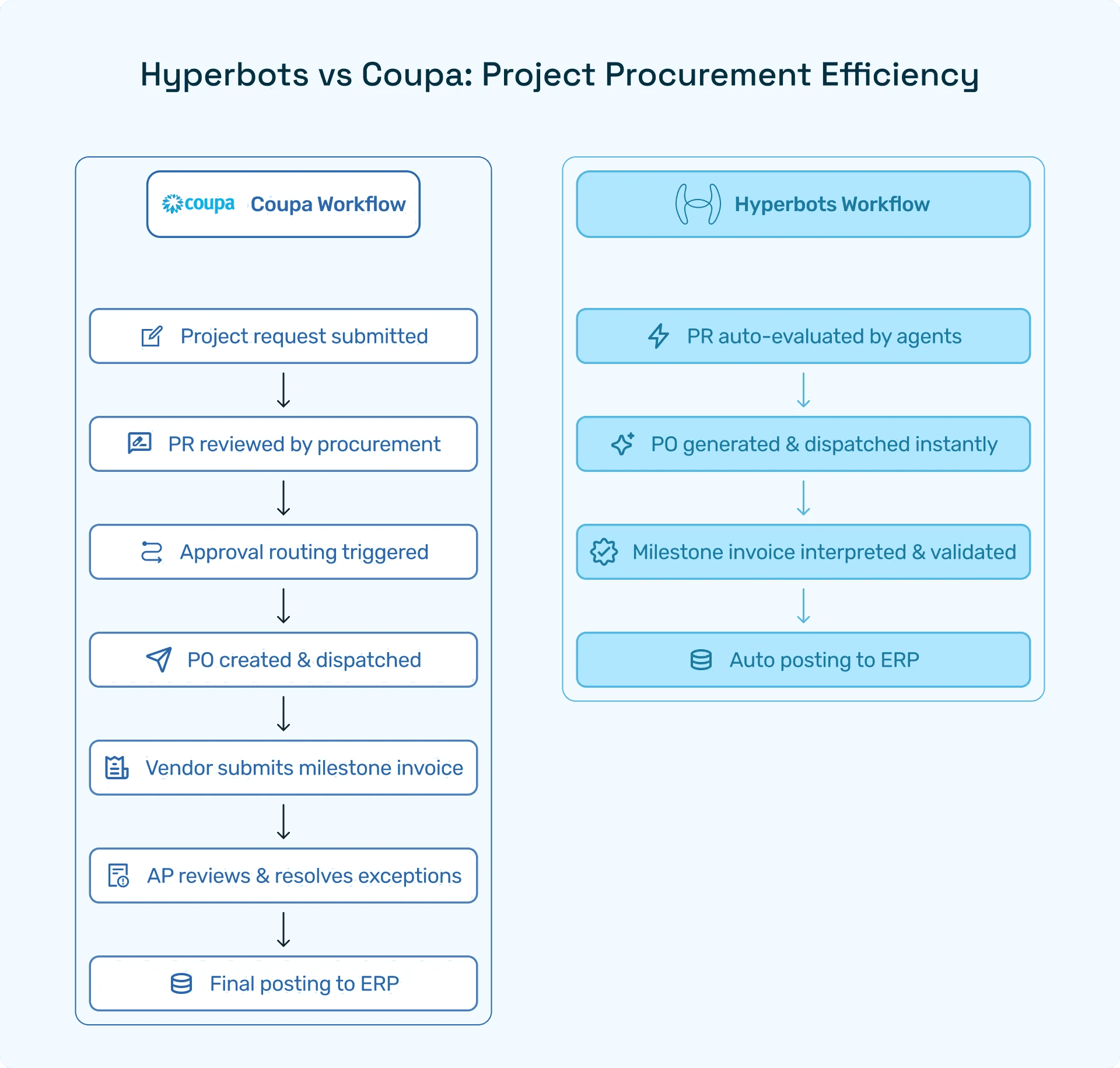
A direct comparison between Coupa for technology companies and Hyperbots shows a clear difference in how each platform approaches automation and project execution. Coupa relies heavily on predefined rules and structured workflows, which work well when processes are stable. Hyperbots uses autonomous agents that adapt to changes, understand documents, and complete tasks without routing work back to users. This contrast becomes especially visible in project based procurement, milestone billing, and vendor collaboration.
Procurement Creation and Dispatch
Technology teams often submit requests with shifting requirements. Coupa treats every change as a new workflow condition, which slows down cycle time. Hyperbots handles dynamic inputs more gracefully and generates PRs and POs faster because agents process documents and complete validations without manual routing.
Hyperbots cuts PR creation time to roughly five minutes.
Coupa users often encounter added approvals when project details change.
Milestone Invoice Automation
Milestone billing is one of the most common Coupa pain points for tech firms. Coupa requires clear templates and structured documentation, which makes irregular invoices difficult to process. Hyperbots interprets text, tables, and attachments and matches them to contracted milestones with higher accuracy.
Hyperbots achieves near straight through processing due to its autonomous validation.
Coupa frequently sends exceptions back to AP teams for manual resolution.
Document Intelligence and Context Understanding
Coupa’s AI primarily assists with routing and insights, but it does not fully execute tasks. Hyperbots reads documents, understands context, identifies discrepancies, and completes actions automatically, which reduces handling effort across the entire procurement lifecycle.
Hyperbots maintains accuracy levels that support reliable downstream posting.
Coupa depends on human review for non standard formats or incomplete data.
Cost Efficiency and Operational Impact
Cost savings are not only about licensing. They reflect how much time and effort teams must spend on corrections, approvals, or manual reviews. Hyperbots reduces operational workload significantly because agents do the work that Coupa passes back to users.
Hyperbots lowers processing effort across procurement and AP tasks.
Coupa stabilizes workflows but does not eliminate manual tasks.
In every category, Hyperbots demonstrates deeper automation depth and stronger adaptability, which is what technology companies need when projects move quickly and documentation varies throughout the lifecycle.
Coupa vs Hyperbots Comparison Table
Category | Coupa for Technology Companies | Hyperbots Autonomous Platform |
Procurement Speed | Workflow driven routing slows PR and PO creation when project details change. | Autonomous agents generate PRs and POs quickly and adapt to shifting inputs. |
Milestone Invoice Handling | Struggles with unstructured invoices and requires manual exception review. | Matches invoices to milestones with high accuracy and minimizes human involvement. |
Document Intelligence | AI supports routing but does not execute tasks end to end. | Agents read, understand, and act on documents across procurement and AP. |
Project Based Procurement Fit | Best suited for predictable purchasing. Complex projects cause delays. | Built for multi stage projects with variable deliverables and dynamic timelines. |
Exception Management | High exception volume for non standard formats and milestone changes. | Exceptions drop significantly because agents resolve variations automatically. |
Operational Efficiency | Teams spend time correcting data and rerouting approvals. | Workload decreases because the system takes action, not users. |
Scalability for Tech Firms | More volume creates more approvals and more human oversight. | Higher volume improves automation quality as agents learn patterns. |
How Hyperbots Redefines Project Based Procurement for Tech Companies
Technology projects rarely move in straight lines. Deliverables shift, milestone timelines adjust, and vendor documentation arrives in formats that are anything but consistent. Hyperbots is designed for this exact environment. Instead of relying on predefined rules or static workflows, its autonomous agents operate more like digital team members who understand context, interpret documents, and take action without waiting for humans.
The platform reads milestone schedules, identifies dependencies, validates vendor submissions, and updates procurement documents as projects evolve. This gives technology companies the flexibility they need without sacrificing accuracy or control. Coupa attempts to manage similar tasks through conditional workflows, but the system does not interpret changing project data on its own, which is why tech teams spend time clearing exceptions or rerouting approvals.
Hyperbots creates a different experience with these core capabilities:
Context aware procurement automation
Agents evaluate PR details, detect inconsistencies, and generate POs that reflect the latest project conditions. This reduces friction for engineering and procurement teams who often make mid cycle adjustments.
Accurate milestone invoice interpretation
The platform interprets line items, tables, progress summaries, and attachments. Instead of flagging irregularities for human review, it resolves most cases automatically and escalates only when needed.
Continuous validation across project stages
Hyperbots tracks deliverables across phases and adjusts validations as new information appears. This gives CFOs and procurement leaders better visibility into project health and spending accuracy.
Reduced dependency on manual oversight
Since agents execute tasks rather than route them, finance teams experience lower workload and faster cycle times. Coupa still depends on users for decisions that Hyperbots handles autonomously.
The result is a procurement and AP system that behaves more like an intelligent collaborator and less like a workflow tool. For technology companies with fast moving projects, this shift creates a noticeable improvement in speed, reliability, and overall operational efficiency.
ROI and Automation Impact for Technology Companies
The ROI difference between Coupa for technology companies and Hyperbots becomes clear as soon as teams start managing project-based procurement and milestone invoices. Coupa improves routing, but its rules based structure still pushes exceptions and document reviews back to finance teams, which slows down projects and increases cost.
Hyperbots delivers stronger financial impact because autonomous agents complete tasks without relying on human intervention. Procurement moves faster, documents require fewer corrections, and teams spend less time resolving issues created by shifting project data.
Procurement Efficiency
Hyperbots accelerates early-stage procurement by generating PRs in about 5 minutes and reducing PO creation time by nearly 80%. This helps tech teams move projects forward without waiting on repeated approvals or manual edits.Milestone Invoice Accuracy
The platform interprets milestone invoices with 99.8% accuracy and supports more than 80% straight through processing. This lowers the number of invoices routed back to AP teams and improves vendor turnaround time.Accrual Reliability
Hyperbots reduces manual accrual effort by about 80% and keeps variation between accrual and actual cost below 5%, which creates a smoother and more predictable month-end close.Financial Gains in Payments
Cleaner upstream validations help companies capture up to 10% savings on payments through better timing and reduced rework.
Across every stage of procurement and AP, the pattern remains consistent. Coupa organizes work. Hyperbots removes it, reducing cost and increasing the operational speed technology companies depend on.
Conclusion
Technology companies need procurement and AP systems that move as fast as their projects. Coupa brings structure and visibility, but its workflow model still depends on users to clear exceptions and interpret milestone documents. This slows down project cycles and adds manual effort at the wrong time.
Hyperbots offers a different experience. Autonomous agents read documents, validate milestones, and complete tasks without relying on human intervention. This creates faster procurement cycles, more accurate milestone billing, and lower operational cost across finance teams.
What stands out most:
PRs generated in minutes, not days
Fewer exceptions during milestone invoice processing
More consistent and reliable accrual outcomes
In the end, Coupa organizes work while Hyperbots completes it. If you want to see these capabilities in action, you can request a demo here https://www.hyperbots.com/request-demo or explore the Hyperbots platform and copilots in more detail at https://www.hyperbots.com
FAQ
1. Why do technology companies struggle with Coupa for project based procurement?
A: Coupa relies on rigid workflows, so shifting project scopes and irregular milestone invoices often turn into exceptions that require manual fixes and slow down operations.
2. How does Hyperbots improve milestone invoice automation?
A: Hyperbots reads and validates milestone invoices autonomously, resolves most variations on its own, and significantly reduces the number of items routed back to AP teams.
3. Is Hyperbots more cost effective than Coupa?
A: Yes. Hyperbots removes manual effort across procurement, invoicing, and accruals, which lowers processing cost and speeds up every stage of the cycle.
4. Can Hyperbots adapt when project timelines or milestones change?
A: Yes. Autonomous agents adjust validations and document checks automatically, so teams do not have to restart approvals or correct data manually.
5. How does Hyperbots support teams managing multiple vendors and milestones?
A: Hyperbots handles variations in vendor documents and milestone structures automatically, allowing teams to manage complex projects without adding manual review work.