Payment
Methods
Optimize Vendor Payment Timing: Balance Early Discounts, Late Fees, and Cash Flow with AI Insights
Boost vendor relations and cash flow by strategically timing payments with data and AI-driven insights.
Managing vendor payments is a critical task for any company. With numerous invoices to process and a variety of payment terms to consider, businesses must make decisions carefully to maintain healthy cash flows and foster strong vendor relationships.
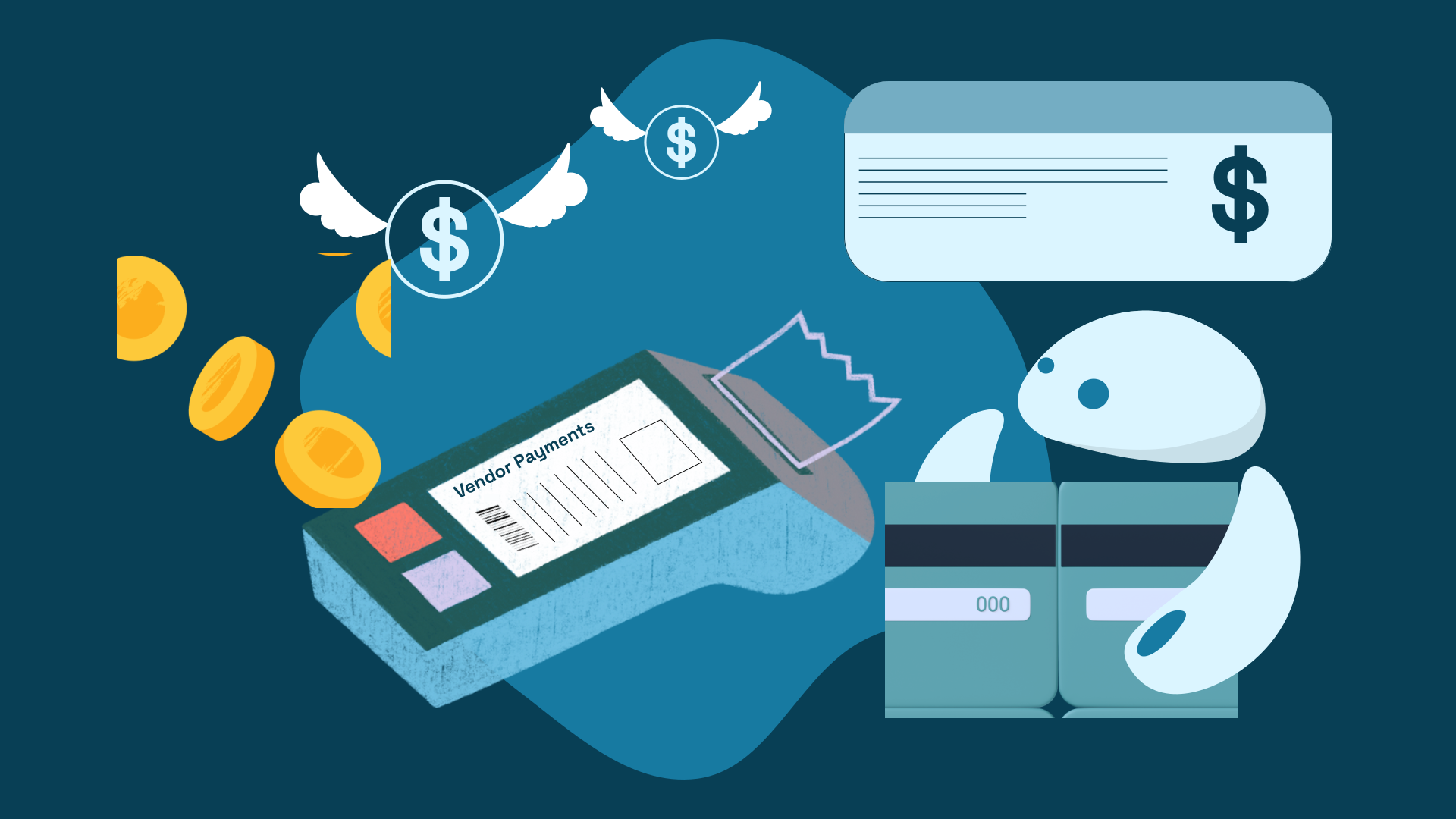
Why Vendor Payment Timing Is a Strategic Lever for Cash Flow Optimization
Managing vendor payments is a critical task for any company. With numerous invoices to process and a variety of payment terms to consider, businesses must make decisions carefully to maintain healthy cash flows and foster strong vendor relationships. This blog outlines the strategic considerations of early payment discounts and late payment charges and introduces a decision-making framework to optimize payment timings. We also explore the emerging role of artificial intelligence (AI) in streamlining this process.
1. Understanding Vendor Payment Terms and Their Financial Implications
Payment terms define the agreement between buyers and vendors regarding the payment schedule for goods or services. Common terms include Net-15, Net-30, Net-45, Net-60, and Net-90, where Net refers to the total number of days within which payment is due. While Net-30 is a standard in many B2B businesses, the specific terms can vary widely across industries and individual vendor relationships.
2. Maximizing Savings with Early Payment Discounts
To incentivize timely or early payments, many vendors offer discounts. For example, a term like 2/10 Net-30 means a 2% discount is available if payment is made within 10 days; otherwise, the full amount is due in 30 days. Another term, 5/10, 2/30, Net 60, offers a 5% discount for payments within 10 days, a 2% discount within 30 days, and no discount if payment is made between 31 and 60 days. These discounts can lead to significant savings and optimize cash outflow.
3. Evaluating the Risks and Costs of Late Payment Charges
Conversely, some vendors impose interest charges on late payments to discourage delinquency. The conditions for these charges, their rates, and the strictness of enforcement vary widely. Some vendors may overlook occasional delays, while others may enforce strict penalties or even halt supply for repeated late payments, impacting business operations.
4. Strategic Framework for Deciding When to Pay Invoices
To strategically manage the timing of vendor payments, businesses must evaluate the cost of capital against the potential savings from early payment discounts or the costs associated with late payment penalties. Below are different scenarios with calculations and a summary table to guide these decisions.
When to Pay Early – Calculate Annualized Discount Rate vs Cost of Capital
Scenario: An invoice of $10,000 with terms of 2/10, Net-30
Criteria: Choose early payment if the annualized discount rate is higher than the company’s cost of capital.
Calculation:
Discount Offered: 2% for payment within 10 days.
Savings: $10,000 * 2% = $200.
Annualized Discount Rate:
=(0.02/(10/365))?100
=(0.02/(10/365))?100 ? 73%.
Given a cost of capital at 7% annually, the substantial annualized return of 73% from taking the discount clearly justifies paying early.
When to Pay On Time – No Discount or Low Discount Situations
A. No Discount Offered
Scenario: An invoice of $10,000 with Net-30 terms, without any early payment discount.
Decision: Since there's no discount, paying on the due date makes sense to better manage cash flow.
B. Discount Rate Lower Than Cost of Capital
Scenario: An invoice of $10,000 with terms of 0.5/30, Net-60.
Criteria: The early payment discount is less than the company's cost of capital.
Calculation:
Discount: 0.5% for payment within 30 days.
Savings: $10,000 * 0.5% = $50.
Annualized Discount Rate:
=(0005/(30/365))?100
=(0005/(30/365))?100 ? 6.08%.
Decision: The discount rate is lower than the 7% cost of capital, suggesting it's financially smarter to pay on time.
When to Delay Payment — Comparing Late Fees to Opportunity Cost
Scenario: An invoice of $10,000 with Net-30 terms and a 0.5% monthly late payment fee.
Criteria: Evaluate the opportunity cost of capital versus the late payment fee.
Calculation:
Late Payment Fee: 0.5% per month, or a 6% annualized rate
Cost of Capital: 7%
Decision: The late payment interest rate is lower than the 7% cost of capital, suggesting it's financially smarter to pay late.
While it might be tempting to delay payments to use capital elsewhere, this approach should be carefully weighed against potential relationship and financial costs.
Summary Table: Payment Timing Decision at a Glance
SCENARIO | TERMS | DECISION CRITERIA | CALCULATION | DECISION |
Early Payment | 2/10, Net-30 | 2/10, Net-30 | 2/10, Net-30 | Pay early |
On-Time Payment | Net-30, no discount | No financial incentive to pay early | N/A | Pay on time |
On-Time Payment (Discount Lower Than Cost of Capital) | 0.5/30, Net-60 | Discount rate < cost of capital | Annualized discount rate = 6.0% Cost of capital =7.0% | Pay on time |
Delayed Payment | Net-30, 0.5% monthly late fee | Late fee < opportunity cost of capital | Late fee annualized = 6% Cost of capital = 7% | Evaluate carefully; generally pay on time |
5. How AI Enhances Vendor Payment Strategy and Decision-Making
AI technologies can automate the analysis of payment terms, discounts, and penalties across thousands of invoices and vendors. By integrating historical payment data, AI can also forecast the impact of payment decisions on cash flow and vendor relations, offering recommendations for each invoice based on maximizing financial efficiency and strategic value.
Align Vendor Payments with Business Strategy and Financial Health
Deciding when to pay vendor invoices is more than a matter of following terms; it's about strategically managing financial resources to benefit the company's bottom line while maintaining strong vendor relationships. By considering early payment discounts, late payment charges, and utilizing AI, businesses can optimize their payment strategies for improved financial health and operational efficiency.