Product
PRs/POs Assistant
How Hyperbots Refined Its Finance MVP with 70+ Hours of Co-Design Sessions with CFOs
Co-design with CFOs helped Hyperbots shape its AI finance MVP and validate product-market fit.
Unless you have a functional product in the form and shape of a Minimum Viable Product (MVP), which you test and iterate with real users in real-world scenarios over time, it is hard for a 0-1 startup to achieve product market fit.
Why Product-Market Fit Requires Real-World Testing
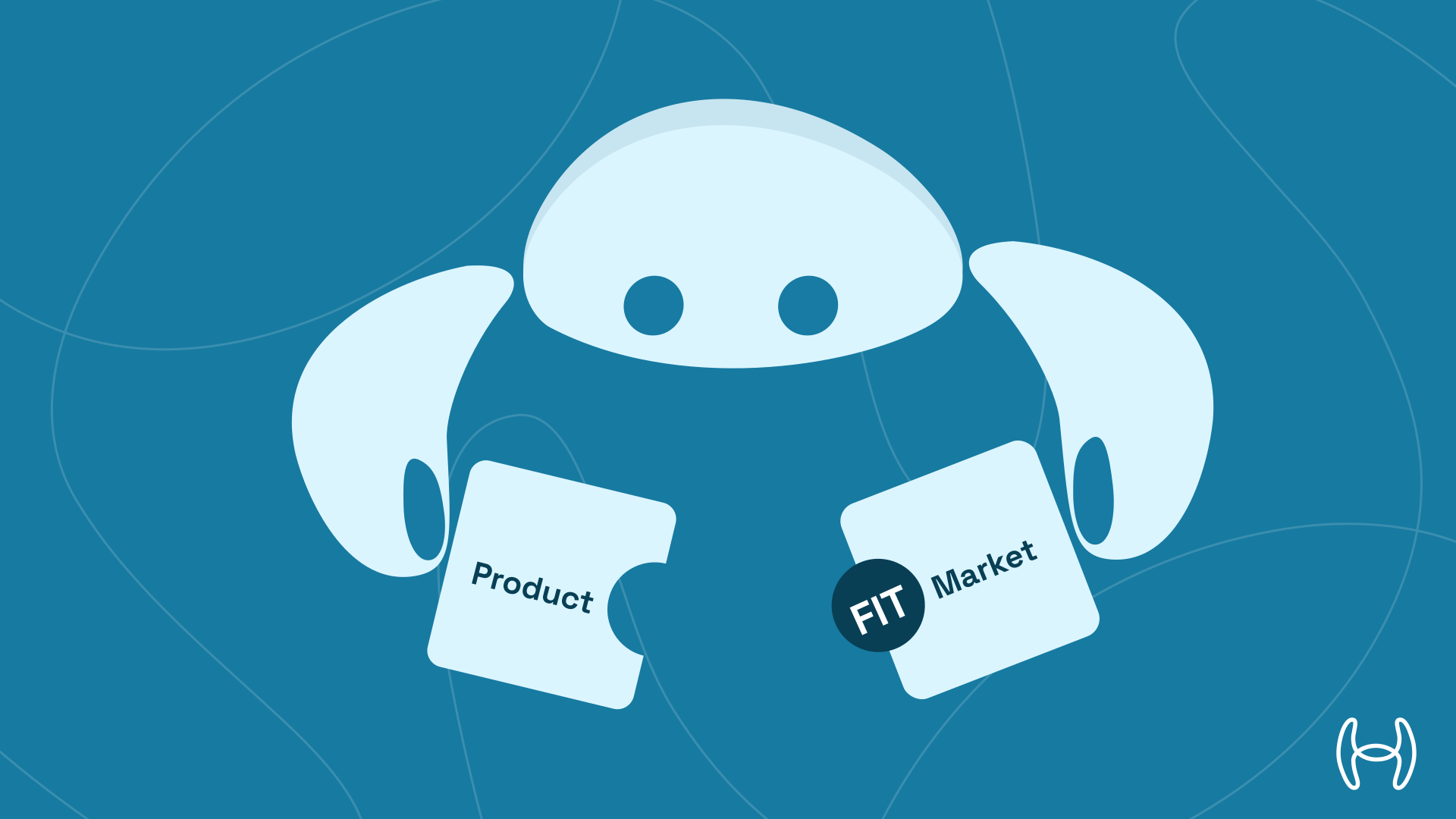
Unless you have a functional product in the form and shape of a Minimum Viable Product (MVP), which you test and iterate with real users in real-world scenarios over time, it is hard for a 0-1 startup to achieve product-market fit.
Simply put, you achieve product-market fit when:
Your product solves customer problems and helps them achieve their goals consistently.
It scales to meet the emerging needs of your customer base cost-effectively.
Lastly, it generates enough demand for it to be profitable.
Once you have an MVP, you can then start measuring PMF. There are plenty of frameworks out there to measure it. We won't get into that. At this point, you might ask, “How do you decide what goes into an MVP?” That's the crucial first step that we'll discuss in this article.
The Role of Design Thinking in MVP Validation
Of course, no entrepreneur would try to fit a square peg in a round hole. In all probability, you have an idea about who your customer is, what specific customer needs you want to address, and which market segment you want to tap into. Let's assume you also have an idea about how you can differentiate your product offering from the competition and what your USP is.
At best, all of the above is slightly better than a hunch until you validate your assumptions.
At this early stage in your thinking, documents, PRDs, concept notes, elevator pitches, slide decks, and Excel sheets can only impress investors, if at all. What you need are concept sketches, storyboards, task flows, and customer journey maps that will move the needle towards envisioning an MVP and seeking validation from your stakeholders, your investors, and most importantly, from your key customer personas. Validation of value pre-position, validation of functionality, and eventually, validation and prioritization of the MVP feature-set.
Here’s where enlisting the help of designers can work wonders. If you have a fledgling design team already, great! If not, get hold of an experienced hands-on Principal Designer who will essentially be responsible for the core product design thinking along with you, as you define the functionality, concept-testing objectives, and scope for the MVP.
Where to start? Ask any designer, and they will say to start with discovery. Grab a stack of post-its and markers, walk up to a whiteboard, and begin with sense-making.
And that's what we did at Hyperbots because it made sense (pun intended). We started by first running a brand strategy workshop with the main internal stakeholders, the founders. The brand strategy workshop helped us with these objectives:
Articulating our vision, mission, and values
The development of the branding and visual identity system that you see today on our new website is a parallel activity.
Identifying our target audience, our competition, and our differentiated value proposition are important factors in defining our product functionality.
Early product concepts, task flows, and UI prototyping.
Launching the Design Partnership Program with CFOs
Next, we set up the Design Partnership Program with our main customer personnel, the CFO. Without input from CFOs, how were we to claim that we are building the best AI for finance? How could we stay true to our stated mission to free up humans from mundane and repetitive finance tasks with AI without getting an intimate understanding of the CFO's objectives, pain points, and challenges?
Product thinking and design happened in rapid whiteboarding sessions where we fleshed out the core functionality, mocked up screens in Figma, and got them ready for the CFO sessions over Zoom.
We enlisted participation from 1, then 3, and eventually from 12 CFOs for conducting weekly remote co-design sessions with them. We gathered crucial insights about finance processes like Accounts Payable (AP), expense processing, and Procure-to-Pay (P2P). Together, we delved deep into how finance operations differ in different organizational contexts. We learned about business logic, task flows, finance roles and their needs, the importance of control, audits, and compliance from a CFO's standpoint, and in turn, we demonstrated through our designs how AI can transform finance operations with natively developed AI assistants to bring new strategic advantages for their companies if they choose to adopt AI-led automation. We showed them how invoice processing and accruals can be completely automated, how analytics can be accessed instantly through a conversational AI chatbot, and how it all can be configured to suit their specific business needs.
What's more, we encouraged participation from the rest of our product, design, engineering, and sales teams as observers during these sessions, so that they could hear directly from their customers and learn about the finance domain.
Key Learnings from 70+ Hours of CFO Co-Design Sessions
In parallel, the product and design team continued to refine and sharpen the way our value proposition was being articulated and the product described on our new website. It wasn't easy, and it's still hard to explain the difference between AI-led automation and traditional finance automation.
At last count, we had 70+ video recordings of the co-design and review sessions, amassing a ton of feedback. Based on this feedback, the design team continues to iterate towards a well-thought-out MVP feature set that can be adopted right off the bat by CFOs and their teams.
CFO Collaboration as the Key to Building Finance AI That Works
As we develop the MVP feature set, we are confident we have a strong product USP and clear differentiation not just from a technology and AI standpoint but also from a UX perspective. With the Design Partnership Program, we were able to validate our hypotheses with enough rigor. We deeply appreciate the close collaboration from our CFOs and are proud to say that they designed the AI assistants for finance ground up with us!