AI in Finance
AI Fraud Detection in Vendor Payments: Preventing Duplicate Invoices, Overcharging & Unauthorized
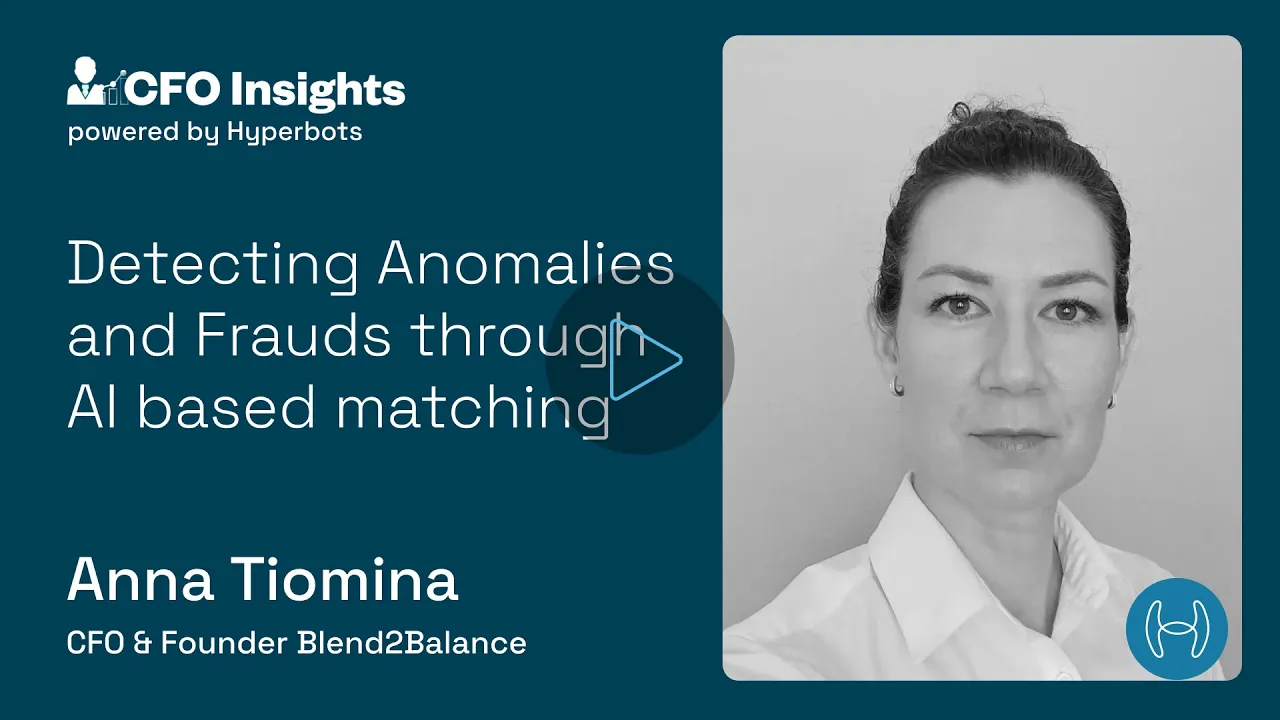
Find out interesting insights with Anna Tiomina CFO & Founder, Blend2Balance.
Moderated by Emily, Digital Transformation Consultant at Hyperbots
Don't want to watch a video? Read the interview transcript below.
Emily: Hey, everyone, this is Emily, and I am a digital transformation consultant at Hyperbots today, on the call with me. I'm extremely happy to have Anna. Anna Tiomina is the founder of Blend to Balance LLC, with over a decade of experience in senior finance roles. Anna is also the leader of AI innovators in finance and beyond, a community dedicated to merging tech innovations with traditional finance.
Emily: Happy to have you, Anna.
Anna: Thanks for having me.
Why Fraud Detection in Vendor Payments Is a CFO Priority
Emily: Excited to hear your insights on how AI is revolutionizing the detection of fraud and anomalies in vendor payments. So let's dive right in as a CFO. Anna, how do you see the importance of detecting fraud and anomalies in vendor payments?
Anna: Yeah. So, detecting fraud and ensuring compliance is one of the key functions of financial operations. In recent years, we have seen much more fraud in this area. So it is challenging for CFOs to keep up with the technology and to always be ready to react to new ways. The fraud actors are trying to reach the companies. So it is a really critical and very challenging task nowadays.
Common Types of Fraud and Anomalies in Vendor Invoices
Emily: Correct. So, Anna, what are some of the most common types of fraud and anomalies you've seen or heard in vendor payments?
Anna: Yeah, so there are simple ones like replacing the bank account number on an invoice with a fraudulent bank account number. It can be as simple as sending the invoice that was never approved for payment, and the service or product was never received. It can also be inflated invoices, either through the pricing or through the quantities of products or services on the invoices, or, for example, demanding a payment before the product or service was delivered or received. So these are the most common risks. Listed vendors, and sometimes, if the company has some processes in place, the requester. The payment requester splits the invoice to get to a lower approval level. Sometimes it is a fraud, and sometimes it's just a mistake or an attempt to speed things up, so it can really vary. But each of these events represents a risk. The funds that the company mistakenly or fraudulently sent cannot be revoked in many cases. So I mean, that's a huge thing for the company to be able to keep things in order in this space.
Limitations of Traditional Fraud Prevention Methods
Emily: And how can these frauds and anomalies be prevented with traditional methods per se?
Anna: Well, so what companies do they implement internal controls in? They implement processes. They implement things like freeway mention. Right? So you have a PO that has to be approved. Then you have an invoice that has to be made to the PO, and then the invoice has to be approved by a different approver. Flow? Some companies don't have POs. They have things like the ice principle, for example, like no payment gets released until at least 2 people take a look at that. So you need 2 approvers on any payment going out. Also, companies try to make sure that the processes and these rules are followed. So there are things like internal audits. Kind of like processes that make sure that the forest principle is followed. For example, the right, or the person who is sending the funds, does the verification of the vendor before the funds are sent. Still, all of this is very time-consuming. This is prone to human error. This involves a lot of people in the company, and it doesn't guarantee that the fraud or mistake will not happen.
Emily: Got it. Got it. So, Anna, how does AI enhance the detection of these frauds and anomalies compared to the traditional methods?
Anna: Oh, yeah. So the way I look at that is that AI is another pair of hands or another pair of eyes on your team that doesn't get biased. That doesn't get tired. That doesn't cheat, right? So this is another level of control that really helps to correct the bias that your team might have or spot the patterns that can be missed by humans. So AI, for example, can detect subtle differences in the invoices, or flag the duplicated invoices, or spot the difference between the original purchase order and the invoice, or compare the current invoice with the historical data, and make sure that the mistakes that happened in the past don't go forward into the future. So, having an AI complement, your team is a really helpful tool.
AI in Preventing Duplicate Payments and Overcharging
Emily: Got it understood. And can you please help me understand, you know, how AI can help prevent duplicate payments and overcharging, and vendor invoices?
Anna: Yeah. So that's a great question, because duplicate payments are a little bit hard to catch. After all, the invoice looks correct, right? And unless you have good controls in place. You might miss that. This is a duplicate invoice, and has been paid twice, either by mistake or as a result of fraud. So AI can compare the invoices and identify these duplicated invoices better than humans can. Also, AI is really great at comparing the invoice against the PO. If the company has a PO or a contract, or the SOQ, making sure that the vendor hasn't overcharged the company, and that the agreed terms in the original documents are followed. This can be a very time-consuming task for people to find the correct document to find the right line on this document, etc. So AI really shines here, and it saves a lot of time and effort for the human team.
Ensuring Payments Only After Goods or Services Are Received
Emily: That's pretty incredible. So, Anna, what role does AI play in ensuring that payments are made only after you know the goods or services are received?
Anna: Well, in a classic case, right, you would have a 3-way match process, and the Requester would have to push some button in your software that you're using to confirm that the goods or services have been received, sometimes. This process doesn't work. Sometimes the requester wants to really push the payment forward to enhance their relationship with the vendor, or like for other reasons. So AI can really track the history of the relationship with the vendor, and also make sure that, I mean, if there was a certain amount of time where the service was expected to be delivered, all timelines are followed. So again, this is another level of control, another pair of eyes that can be really helpful.
Detecting and Blocking Payments to Unlisted or Fraudulent Vendors
Emily: Got it, and how does AI help in detecting payments made to unlisted or fraudulent vendors, per se?
Anna: Well, yeah, that's an excellent question, because like, usually, the companies have some controls in place to make sure that the payment doesn't go to an unlisted vendor, and you will have to add each new vendor manually. But what sometimes happens is that you have, for example, an improved vendor. But then the invoice kind of duplicates the name, but that has other payment details. And this is how you send the funds to the wrong account. Number right, so AI can help verify that the original payment details correspond to what you received from your vendor when the vendor was listed and approved. Also, there are public databases of fraudulent vendors. So AI is great, too, you know, to be tasked with monitoring these databases and flagging. You know the fact that you might be paying someone who is not on your approved vendor database. So again, because there is such a rise in fraud nowadays, it is very difficult to keep track of everything that's going on. So, having technology as a complement, your team is really helpful and increases the team's efficiency, too.
The Future of AI in Vendor Payment Fraud Detection
Emily: Got it, and just to summarize everything, Anna, you know, looking ahead, how do you see the role of AI evolving in the area of vendor payment management?
Anna: Yeah. So I think that now we see just the beginning of AI complementing the AP teams, I think that it's gonna be used more and more, because this is just so efficient and handy, and also, honestly. After all, the fraud actors are using a lot of AI. It is impossible to really like, offset this effort without having technology on your side, too. So it's like a race of technologies in a way. And I think that at some point, it's gonna be like a must-have for the companies to have some level of AI in internal fraud. Detection process.Not immediately. But we are getting there.
Emily: Definitely. Thank you so much, Anna, for joining us today and talking to us about, you know, such an important topic. Thank you for the valuable insight. AI is transforming the way we manage and protect our financial operations, especially in the realm of vendor payments. So, thank you once again.
Anna: Thank you for having me.