Digital Invoice Storage: The Complete 2026 Playbook for Finance & Audit Teams
How modern invoice storage systems handle capture, compliance, and audit trails — so your finance team isn't scrambling when auditors ask.
Most finance teams aren't looking for a better filing system. They're looking for a way to survive the next audit without spending a week hunting down invoices across email threads, shared drives, and someone's desktop folder.
That's the problem digital invoice storage is supposed to solve. Done right, it handles everything from first capture to long-term compliance archiving, with a full audit trail baked in. This guide covers what a modern system actually needs to do, what the compliance requirements look like by region, and how AI-powered platforms like Hyperbots are changing what's possible at the capture layer.
Why Digital Invoice Storage Matters
According to Ardent Partners, a significant share of finance teams still rely on manual or semi-manual methods to retrieve invoice backups during audits. Paper archives cost roughly $25 per square foot annually in urban office space. Lost and duplicate invoices account for close to 1% of total AP spend on average, per IOFM research. And ESG scorecards increasingly include paper reduction as a measurable metric.
Gartner projects that by 2028, companies using AI-ready digital invoice storage will close their books four days faster than peers still running on legacy document management.
Gartner also predicts that finance organizations using cloud ERP applications with embedded AI assistants will see a 30% faster financial close by 2028.
The cost of doing nothing is rising. So is the complexity of doing it right.
WHAT DIGITAL INVOICE STORAGE ACTUALLY MEANS
At its most basic, digital invoice storage means keeping invoices in a system that can find them, prove they haven't been tampered with, and delete them on schedule when retention periods expire.
What that looks like in practice varies widely. A shared Google Drive folder technically qualifies. So does a purpose-built AI capture platform with blockchain anchoring. The gap between those two options is where most audit failures live.
The shift happening now isn't just from paper to digital. It's from passive storage (files you dump somewhere) to active storage (systems that extract structured data, validate it, and make it queryable). That distinction matters more every year as audit standards, tax regulations, and AI-readiness requirements tighten.
Compliance Landscape: From IRS to GDPR
Region | Retention Period | Key Requirements |
|---|---|---|
US IRS | 7 years | Readable, retrievable, tamper-evident |
EU VAT | 10 years | Authenticity & integrity (eIDAS) |
India GST | 8 years | Digital signatures, timestamping |
SOX | 7 years | Immutable audit trails |
GDPR | As needed | Right to be forgotten (vendor PII) |
Why Paper Scans Alone Fail
Scanned PDFs without metadata can't prove integrity. The IRS specifically addresses this in Rev. Proc. 97-22, which requires that electronic storage systems produce legible, accurate reproductions and include an audit trail showing any alterations. A scanned PDF in a shared drive meets neither condition. Most invoice platforms that call themselves "digital" don't either.
Hyperbots embeds SHA-256 hashes and blockchain anchors to satisfy IRS Rev. Proc. 97-22 and EU eIDAS Article 24.
Core Building Blocks of an Invoice Storage System
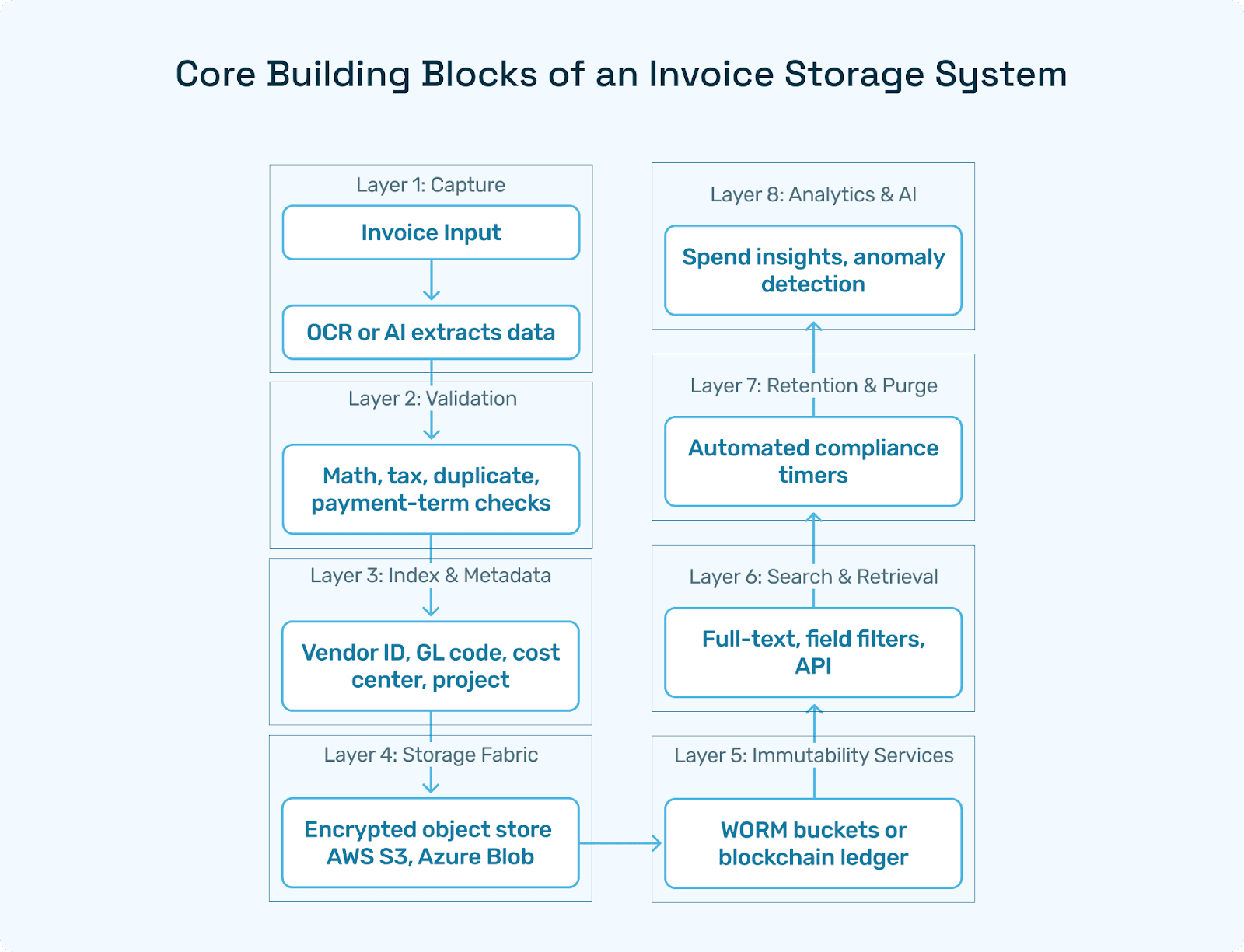
A well-designed system moves invoices through several distinct layers, each with a specific job:
The capture layer handles OCR or AI-based extraction of invoice data from whatever format it arrives in: PDF, image, EDI, or portal submission.
The validation layer checks the extracted data against business rules, including math, tax rates, payment terms, and duplicate detection.
Index and metadata tie each invoice to vendor ID, GL code, cost center, and project so it can actually be found later.
The storage fabric keeps files in encrypted object storage (AWS S3, Azure Blob, or equivalent) with access controls.
An immutability service applies WORM (Write Once Read Many) bucket policies or blockchain anchoring to prevent tampering.
Search and retrieval gives finance teams full-text search, field-level filters, and API access for downstream systems.
The retention and purge engine automates compliance timers so records are held for the required period and then deleted, without manual intervention.
Finally, analytics and AI layer on top to surface spend insights and flag anomalies before they become problems.
Hyperbots Architecture: Capture → Validate → Store
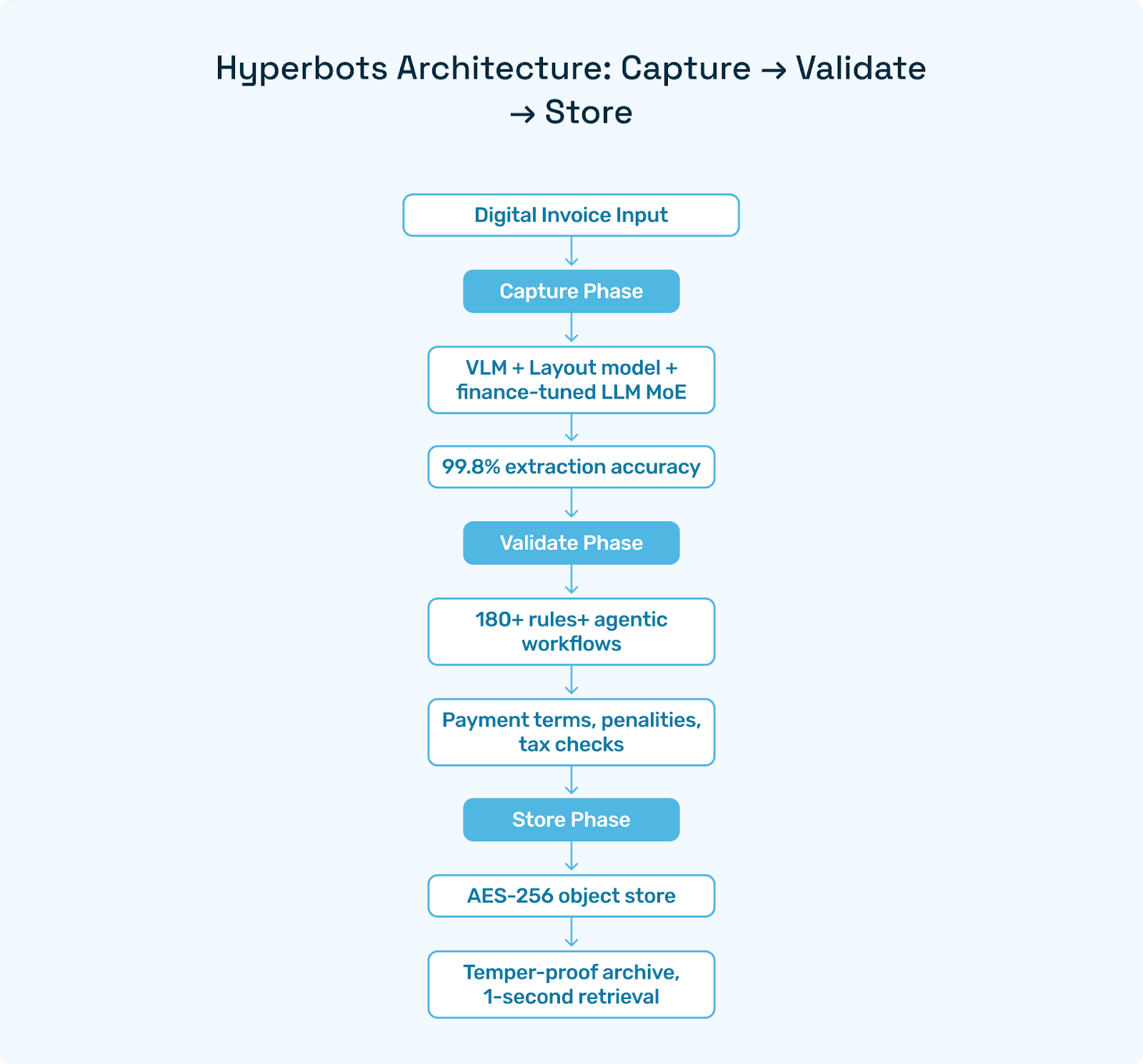
Hyperbots streamlines digital invoice storage in three autonomous phases:
Phase | Tech Stack | Outcome |
|---|---|---|
Capture | VLM + Layout model + finance-tuned LLM (MoE) | 99.8 % extraction accuracy |
Validate | 180+ rules + agentic workflows | Payment terms, penalties, tax checks |
Store | AES-256 object store | Tamper-proof archive, 1-second retrieval |
Paragraph-Level Payment Instruction Parsing
Generic OCR ignores “2% / 10, Net 30” clauses. Hyperbots’ agents extract them, store them as JSON, and surface in search, turning unstructured scrap into AI-ready data.
11 Functional Capabilities You’ll Actually Use
Email & Portal Ingestion — Auto-discovers inbound invoices.
Intelligent Field Extraction — Header and unlimited line items.
Dynamic GL Coding — Learns from ERP history.
2-, 3-Way Matching — PO, GRN, contract.
Tax & Payment-Term Validation — Penalties & discounts flagged.
Exception Workflow — Routes only unresolved flags.
Real-Time ERP Integration — NetSuite, SAP S/4, Dynamics.
Continuous Learning Loop — Nightly micro-model retraining.
Agentic AI Orchestration — Tasks split among specialised bots.
Multi-Currency & Multi-Language — FX gains/losses posted.
SOX-Ready Audit Log — Immutable hash chain.
Security & Immutable Audit Trails
SOC 2 Type II + ISO 27001 certified infrastructure.
AES-256 encryption at rest, TLS 1.3 in transit.
Field-level PII redaction for GDPR/CCPA.
WORM buckets or blockchain anchoring for tamper evidence.
Role-based access control with SSO/SAML.
Each invoice’s SHA-256 root hash is written to a private Ethereum side-chain. Any byte-level change voids the hash, meeting SEC Rule 17a-4(f) immutability.
Cost & ROI Benchmarks
KPI | Paper/Shared Drive | Hyperbots Digital Vault | Impact |
|---|---|---|---|
Retrieval time (avg) | 9 min | < 5 sec | – 95% |
Duplicate-payment rate | 1.1% | 0.1% | – 1 pp |
Annual storage cost | $18k (rent) | $2k (S3) | – 89% |
Audit prep hours | 400 | 60 | – 85% |
Environmental footprint | 50k pages/yr | 0 | – 7 trees/yr |
Implementation Roadmap
Week | Phase | Deliverables |
|---|---|---|
1 | Discovery | Map data sources, retention policies, and KPIs |
2 – 3 | Pilot | 5,000 historic invoices → Baseline accuracy |
4 – 5 | Integration | REST/SOAP plugins to ERP & S3/Blob |
6 | UAT & Training | Two-hour virtual workshop |
7 | Go-Live | HyperCare Slack: daily accuracy report |
8 + | Scale | Add entities; automate purge schedules |
Change-management tip: Appoint an “audit champion,” run quarterly fire-drill retrieval tests.
Wrap-Up
Spreadsheets and shared drives can’t keep pace with today’s audit, ESG, and AI demands. Modern Digital Invoice Storage frees finance teams from paper drag, unlocks instant analytics, and slashes risk. With 11 battle-tested capabilities and a 99.8% accurate capture engine, Hyperbots turns invoice storage from a clerical chore into a strategic advantage.
Ready to swap dusty filing cabinets for an immutable, AI-ready vault? Book a live demo and watch Hyperbots streamline capture, validation, and secure storage, within weeks, not quarters.
Become more efficient and reduce risks with a 99.8% accurate capture engine