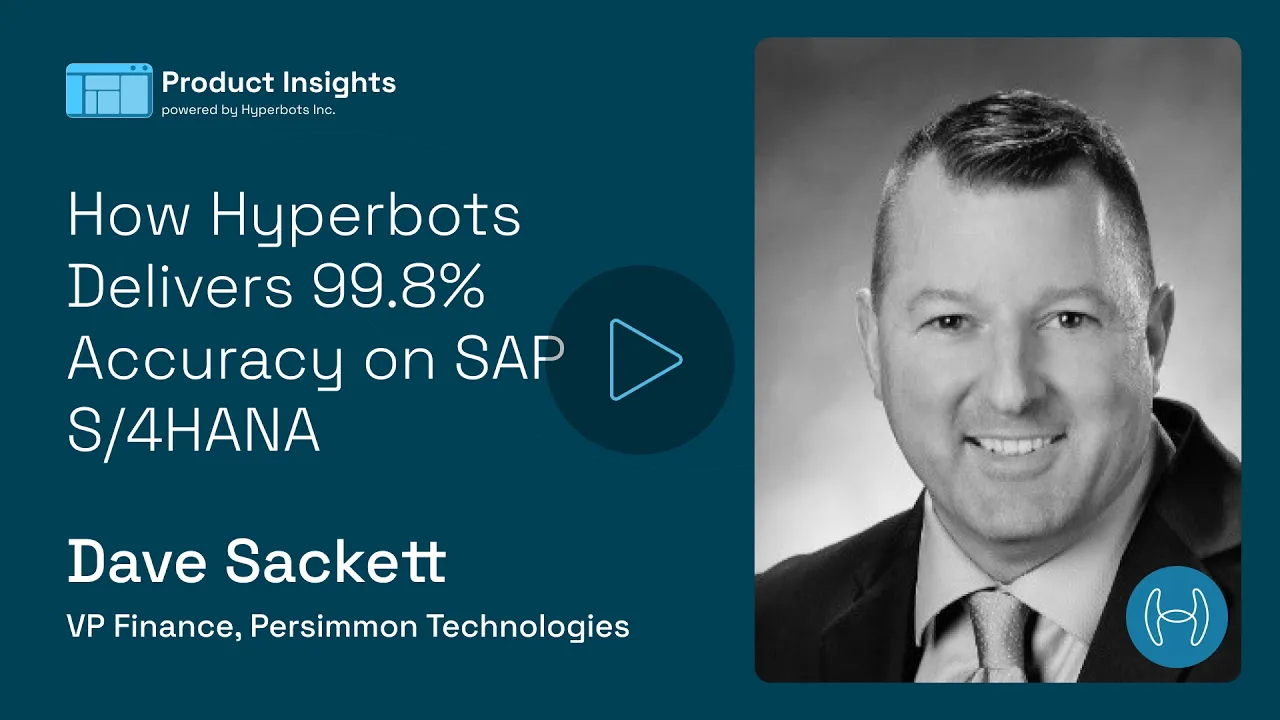
How Hyperbots Delivers 99.8% Accuracy on SAP S/4HANA
A deep dive into the architecture, data models, and validation frameworks that power Hyperbots’ near-perfect accuracy inside SAP S/4HANA environments.
A conversation with Dave Sackett, VP Finance at Persimmon Technologies, about his experience in Hyperbots implementation on SAP S/4 Hana
Brad:
Hey, Dave, thanks for joining us here today. I'm excited to speak with you. This is Dave Sackett from Persimmon Technologies. I'm Brad Boehmke, Senior Account Executive, Hyperbots.
Today, we're focusing this interview on how Hyperbots AI co-pilots can be integrated into SAP S/4 HANA.
What Makes Hyperbots AI Co-Pilots a Natural Fit for SAP S/4HANA?
Brad: So, what makes Hyperbots AI co-pilots a natural fit for SAP S/4HANA?
Dave: Hyperbots comes with a certified plug-and-play connector for S/4HANA, whether you're running it in the cloud or on-premises. I use Epicor on-premises myself, but if I were using SAP, I'd probably leverage the on-premises option as well.
The connector gives co-pilots secure read and write access to everything finance and procurement teams need. We're talking company structures, vendors, material data, purchase orders, goods receipts, invoices, payments, and custom fields, which are really cool to leverage.
SAP stays as the single source of truth, and Hyperbots executes the repetitive work around it. It essentially sits on top of your SAP environment. handling all those manual, time-consuming processes.
How Long Does Implementation Take?
Brad: How long does it take to get a co-pilot live on S/4HANA?
Dave: Yeah, it's quick. Most projects land within three to five weeks, and that covers connection setup, mapping to the sandbox, user acceptance testing, and production cutover. The tooling is already prebuilt, so the elapsed time is mainly just for internal approvals.
Brad: That's huge. I've seen implementations of software between the two take months, sometimes six months. So three to five weeks is quite fast.
Dave: Exactly. And you have full-time jobs to do as well, right?
How Does Data Sync Work and What Cadence Should We Use?
Brad: Let's elaborate a bit further on syncing data with S/4HANA. How often does Hyperbots sync data with SAP S/4 Hana, and what cadence would you recommend?
Dave: That's the cool thing, because it's a real-time system, you can get company structures and Chart of Accounts (COA), vendor material, and cost center masters. You can get POs and receipts, invoices. All of those operations, PO, invoice, journal entry, and accrual, could all be real-time if you're asking what I would suggest.
I'm thinking company structures and the Chart of Accounts don't change that often, but weekly might make sense for vendor and material cost masters. Daily, for sure, you want to capture PPV. And all other write operations should be in real-time to show that everyone has material inside your company.
Brad: Right, so not everything needs to be real-time necessarily, even though Hyperbots allows for that. Being able to say "these are the different types of data that need to sync at these different time periods" based on what's realistic makes sense.
Dave: And every company is different. You're gonna have different priorities. My priority is capturing receipts. I want to know the second it comes in - “Did I have my product so that I can ship it off to the manufacturing floor?”
How Do the Co-Pilots Actually Automate Tasks?
Brad: How would you say each co-pilot automates with S/4HANA tasks?
Dave: The Invoice Processing Co-Pilot, for example, reads the PDF, matches it to the PO and receipt, auto-codes tax, and posts the invoices. About 80% of those can go through without any human touch.
The Accruals Co-Pilot looks at open POs, looks at receipts without invoices, books the month-end accrual entries automatically, and reverses them when the real invoice comes in.
For purchase requests and purchase PO approval, the co-pilot creates purchase requests from contracts, checks them against budget routes for approval in teams, and converts the requests into POs.
The Vendor Management Co-Pilot validates tax IDs, bank details, and handles onboarding and approvals.
The Payments Co-Pilot handles payment runs. And there's also a Sales Tax Verification Co-Pilot that interprets tax rules and item tax and categorizes it before the invoice posts, preventing over- or underpayment of tax.
How Does Hyperbots Handle Exceptions and Failures?
Brad: How does Hyperbots handle exceptions or write failures back to S/4HANA?
Dave: So every time the AI writes something, it's immediately read back, and the fields are compared. If SAP returns an error, say a closed posting period, the connector retries a few times. If it still fails, the record lands on the integration exceptions queue, and the finance department gets an alert. There are no silent errors. When something doesn't work, people will know.
What About Security, Data Integrity, and Customization?
Brad: And on top of that, what safeguards exist for security, data integrity, and customization?
Dave: Excellent question, one that my company was very keen on learning. The platform is SOC 2 Type 2 compliant and ISO 27001 certified. Access uses short-lived tokens tied to your SAP role. No hard-coded passwords are needed.
Data is encrypted at rest and in transit. Hyperbots goes through a discovery process to map custom fields automatically and supports multi-currency and multiple reporting ledgers within SAP.
A single dashboard shows the health of every company code and plan.
Brad: That's awesome. Security is obviously important. When data is being handled, you'd want to make sure things are secure. The depth of that is important, and I think you laid that out clearly.
How Do Co-Pilots Cope with Custom Fields and Business Rules?
Brad: As far as SAP landscapes, they're typically famously customized. How do the co-pilots cope with client-specific fields and rules?
Dave: During onboarding, Hyperbots scans the metadata so that any custom fields that have been added can be read and written just like a standard field.
If you've got custom posting rules, say a special segment field, the AI learns from your historical posting patterns and then fills that in every time, just as if it were a standard field.
What Happens During SAP Upgrades or Migrations?
Brad: What would happen if you upgraded to a new S/4HANA release or migrated from ECC?
Dave: Each connector is versioned, so we handle both scenarios carefully. For an ECC migration, Hyperbots has dual write mode so that both ledgers stay in sync during the cutover. That's critical during the transition period.
For S/4HANA release waves, they're handled behind the connector, so the co-pilots continue to run with zero code changes.
Brad: That's huge. Being able to have flexibility and a smooth migration without losing momentum is really valuable.
Dave: Absolutely. And people worry that if you're going to have custom fields.
How Do You Guarantee Transaction Success?
Brad: How do you guarantee that each write transaction actually succeeds in SAP?
Dave: Success isn't just "no error message." Hyperbots will post a transaction, then immediately read the record back and compare key fields, amounts, currency, company code, and other critical data.
Only a perfect match earns the green "posted" badge. Otherwise, it's retried and escalated to your team for investigation.
How Is Hyperbots Different from Other AI Add-Ons?
Brad: How is Hyperbots Agentic AI on S/4HANA different from other AI add-ons or SAP's own machine learning features?
Dave: Many tools stop at OCR or reporting. Hyperbots delivers agentic workflow AI, meaning it actually acts. It creates purchase orders, books journals, reverses accruals, requests vendor credit memos, reconciles payments, closes POs, and verifies tax end-to-end. That's all action.
That’s where you’re allowing an AI agent to act on your behalf as an employee would act.
So, Hyperbots has finance-trained models that can reach 99.8% accuracy and drive about 80% productivity gains, far more than the 30% you typically see from basic OCR or standard RPA bots.
Every step is logged as an immutable trail that keeps auditors happy. Everything's logged and can be researched again if needed.
Brad: That's outstanding.
Wrapping Up
Brad: Well, we appreciate you elaborating on all of this. I think it's important to understand how Hyperbots works not only with any solution generally, but specifically with S/4HANA, which is hugely popular in the SAP ecosystem.
Walking through the different areas, how things sync, the security behind it, how frequently these processes run, the different co-pilots available, and how they handle customization, really shows the depth here. Thanks again for taking the time to share all this.
Dave: Thanks, Brad. You, too, have a good one.
This conversation highlights the practical experience of implementing Hyperbots AI co-pilots in an SAP S/4HANA environment, from initial setup through the specific co-pilots available, security considerations, and real-world deployment scenarios.