On Premise ERP – A Comprehensive Guide for Modern Businesses
Future-proof your on-premise ERP with AI-driven automation, efficiency, and performance using Hyperbots Co-pilots.
Enterprise Resource Planning (ERP) is the backbone of business operations. While cloud ERP solutions dominate recent headlines, many companies, especially in manufacturing, healthcare, logistics, and financial services, continue to rely on on premise ERP systems. This blog explores the benefits, trade-offs, and future of ERP on premise vs cloud, and how Hyperbots’ AI Co-pilots help modernize on premise ERPs with next-generation automation.
Introduction to On Premise ERP
On premise ERP refers to enterprise software that is installed locally on a company’s own servers and maintained in-house. Unlike cloud ERP systems, which are hosted on third-party servers, on premise ERP gives organizations complete control over their infrastructure, data, and security.
Companies like SAP ECC, Microsoft Dynamics NAV (classic), Infor LN, and legacy Oracle E-Business Suite are classic examples of on premise ERP deployments.
ERP On Premise vs Cloud ERP – Key Differences
Let’s compare ERP on premise vs cloud based on multiple dimensions:
Feature | On Premise ERP | Cloud ERP |
Deployment | Installed locally | Hosted on vendor servers |
Accessibility | Limited to internal network | Accessible from anywhere |
Security | Fully controlled in-house | Depends on cloud vendor |
Maintenance | In-house IT required | Handled by vendor |
CapEx vs OpEx | High upfront CapEx | Subscription-based OpEx |
Customization | Highly customizable | Often limited |
Updates | Manual, less frequent | Automatic, frequent |
If your organization handles sensitive data or has strict regulatory requirements, on premise ERP may still be the preferred model.
Why Companies Still Prefer On Premise ERP
Despite the growing adoption of cloud systems, many large organizations choose on premise ERP for these reasons:
Data sovereignty: Localized data storage complies with industry-specific regulations.
Custom control: More flexibility in software modifications, critical for industries like manufacturing or pharma.
Security: Sensitive data never leaves internal servers.
Performance: High-speed internal network reduces latency issues.
Industry Use Cases for On Premise ERP
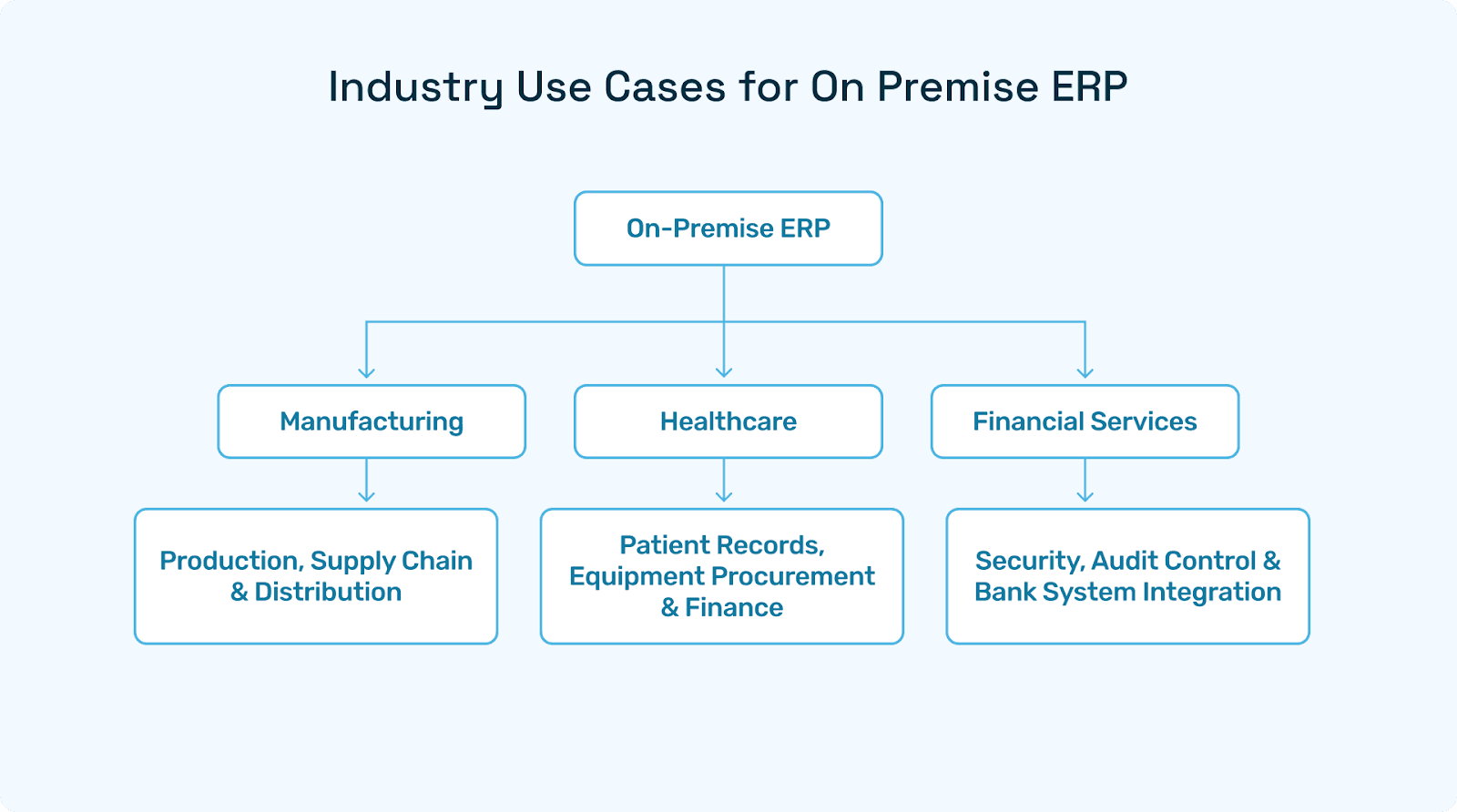
Manufacturing
Legacy systems like SAP ECC or Infor LN are widely used to manage production, supply chain, and distribution. Manufacturers prefer on premise ERP for its ability to be tailored to complex Bill of Materials (BOMs) and shop-floor integrations.
Healthcare
Hospitals and clinical trial companies use on premise ERPs to manage patient records, equipment procurement, and finance. HIPAA compliance is easier when data remains on internal servers.
Financial Services
Banks and large finance institutions often keep ERP functions in-house to ensure security, audit control, and integration with core banking systems.
Hyperbots AI Co-pilots for On Premise ERP
Hyperbots delivers the most advanced AI co-pilots for on premise ERP environments, transforming traditional systems into intelligent, autonomous platforms. These co-pilots sit on top of ERPs like SAP ECC, Oracle EBS, or Dynamics NAV without needing cloud migration.
Here’s how they help:
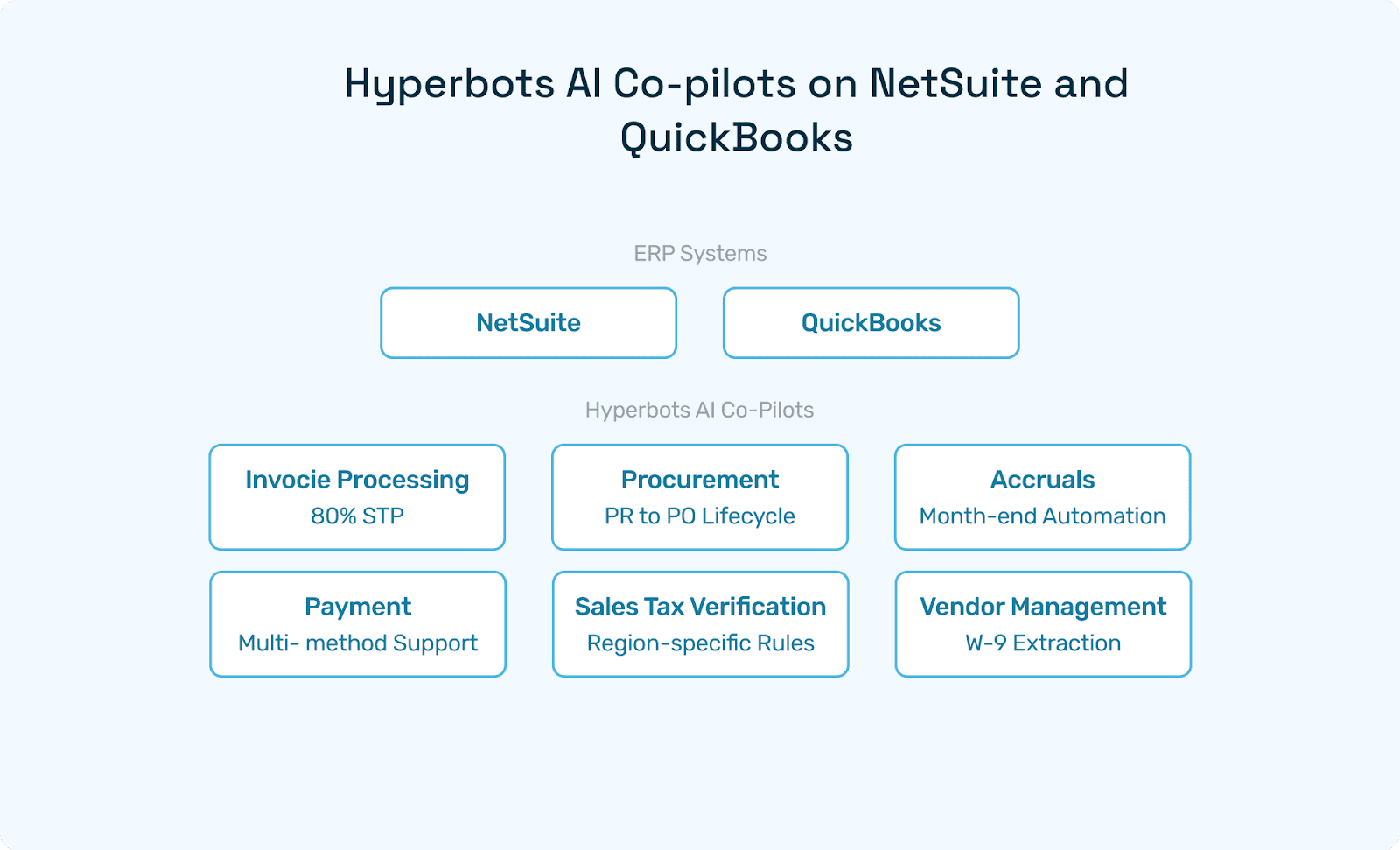
Invoice Processing Co-pilot
Automates invoice discovery, extraction, validation, 2-way/3-way matching, GL coding, and posting, achieving 80% STP (straight-through processing).
Procurement Co-pilot
Creates purchase requisitions, manages workflows, enforces policy compliance, and converts PRs to POs — all within your ERP.
Accruals Co-pilot
Accurately identifies unbooked liabilities and automates month-end accruals and reversals.
Payments Co-pilot
Recommends optimal payment timing, routes approvals, and supports ACH, check, and wire methods.
Sales Tax Verification Co-pilot
Verifies tax compliance on invoices based on regional rules — drastically reducing financial risk.
Vendor Management Co-pilot
Manages onboarding, document verification (e.g., W-9), and provides vendors a portal to track invoices, POs, and payments.
How Hyperbots Integrates with On Premise ERP
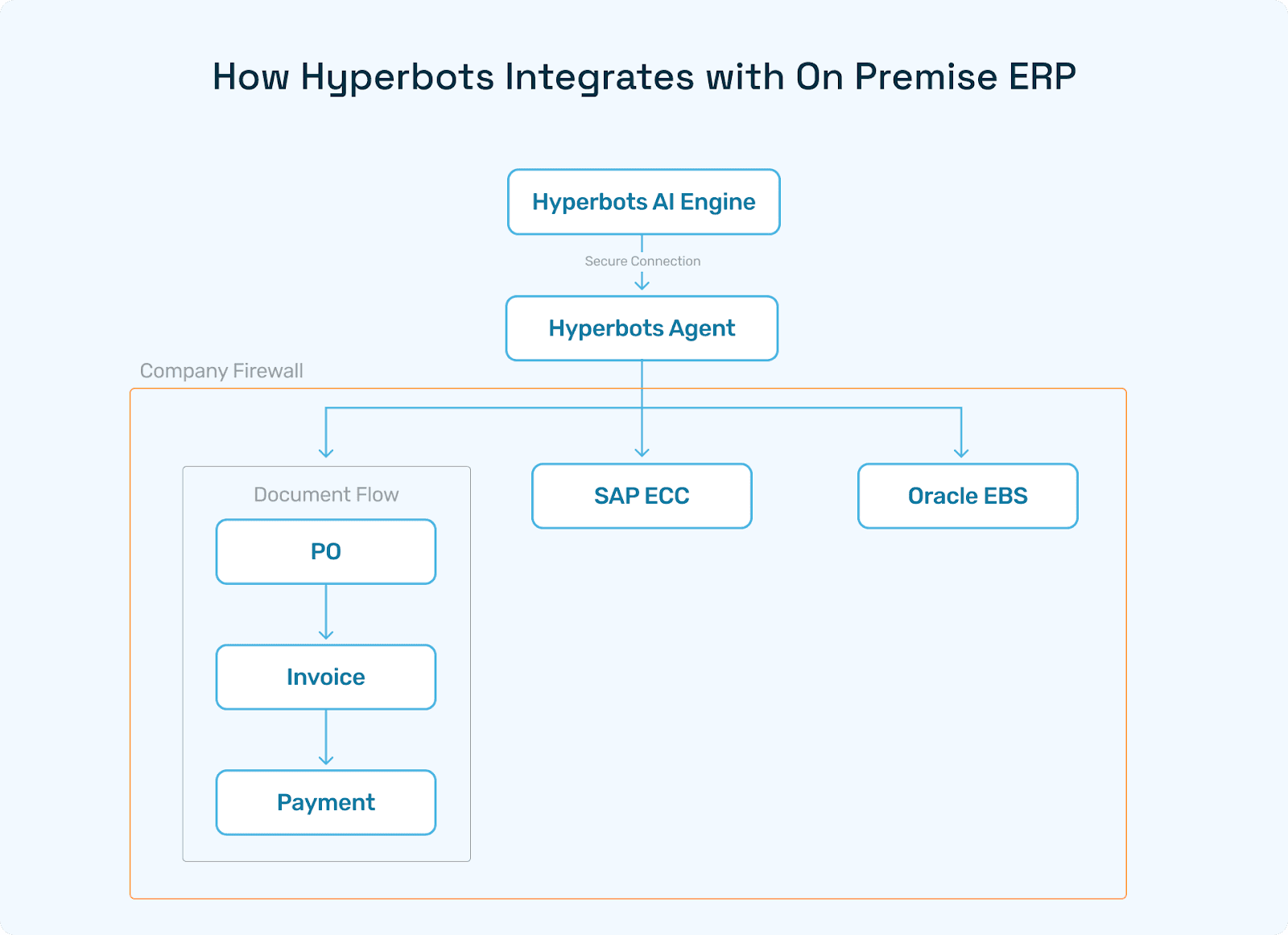
Hyperbots uses an on premise agent-based integration model that works even in air-gapped or firewall-restricted environments.
Key Features:
Works entirely within your network
No data leaves your firewall
Lightweight agent connects ERP to Hyperbots’ AI engine
Zero-trust security model ensures safe communication
Supports real-time read/write of POs, invoices, vendors, GL codes
Read more on Hyperbots On Premise Integrations.
ERP vs Cloud ERP – Strategic Considerations
The debate of ERP vs cloud ERP goes beyond technology. It’s about your business strategy.
Question | Go On Premise If | Go Cloud If |
Data Privacy | You need full control | You’re okay with vendor control |
Infrastructure | You already have strong IT | You want to reduce IT overhead |
Customization | You need deep custom workflows | You can adapt to vendor’s features |
Cost | You prefer CapEx | You prefer OpEx/subscription |
Regulations | You’re subject to audit/sovereignty laws | You operate globally without restrictions |
Benefits of On Premise ERP When Paired with Hyperbots
When you add Hyperbots AI to on premise ERPs, the benefits multiply:
✅ 80%+ straight-through processing of invoices
✅ 90% reduction in manual procurement steps
✅ 10x faster month-end closings
✅ Real-time tax compliance
✅ Intelligent vendor and payment decisioning
✅ Integration without security compromise
Future of On Premise ERP in Hybrid Models
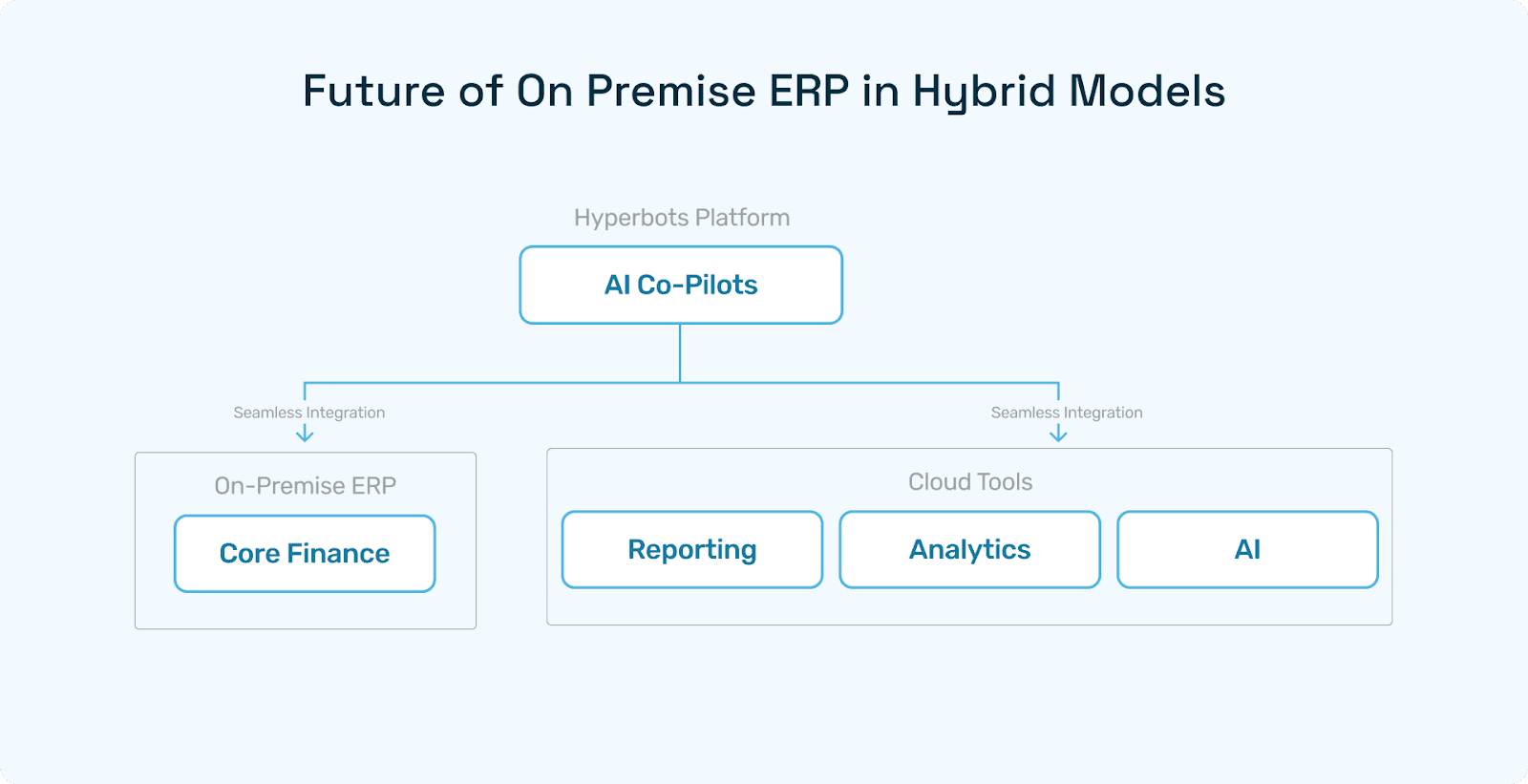
Gartner and IDC predict that hybrid ERP will be the norm, with on premise ERP handling core finance, and cloud tools handling reporting, analytics, and AI.
Hyperbots is purpose-built for this future. Its agentic platform lets AI co-pilots work across both on premise and cloud, seamlessly.
Conclusion
On premise ERP systems remain critical for organizations prioritizing control, compliance, and performance. And with Hyperbots’ AI Co-pilots, these legacy systems no longer have to lag behind cloud ERPs in intelligence or automation.
Whether you're on SAP ECC, Oracle EBS, Dynamics, or any other on premise ERP, Hyperbots makes it smarter, faster, and future-ready.