NetSuite Pricing vs QuickBooks: A Detailed Comparison for Modern Businesses
Hyperbots enhances QuickBooks or NetSuite with AI-driven automation, reducing manual work and boosting efficiency.
Overview
In the world of accounting and ERP software, NetSuite and QuickBooks often dominate the conversation. While both serve core finance functions, their pricing, features, scalability, and integrations differ significantly. This blog dives deep into a comparison of NetSuite pricing vs QuickBooks, breaking down use cases, cost structures, and suitability for various businesses. We also explore how Hyperbots' AI Co-pilots maximize the ROI on both platforms for companies seeking automation and efficiency in finance and accounting.
Introduction
As businesses scale, they often face a pivotal decision: stay with a user-friendly small business solution like QuickBooks, or migrate to an enterprise-grade ERP like NetSuite? Understanding the nuances of NetSuite pricing vs QuickBooks cost helps make a smarter, long-term decision. This blog not only compares costs but also highlights where Hyperbots adds transformational value across both platforms.
Overview of NetSuite and QuickBooks
NetSuite
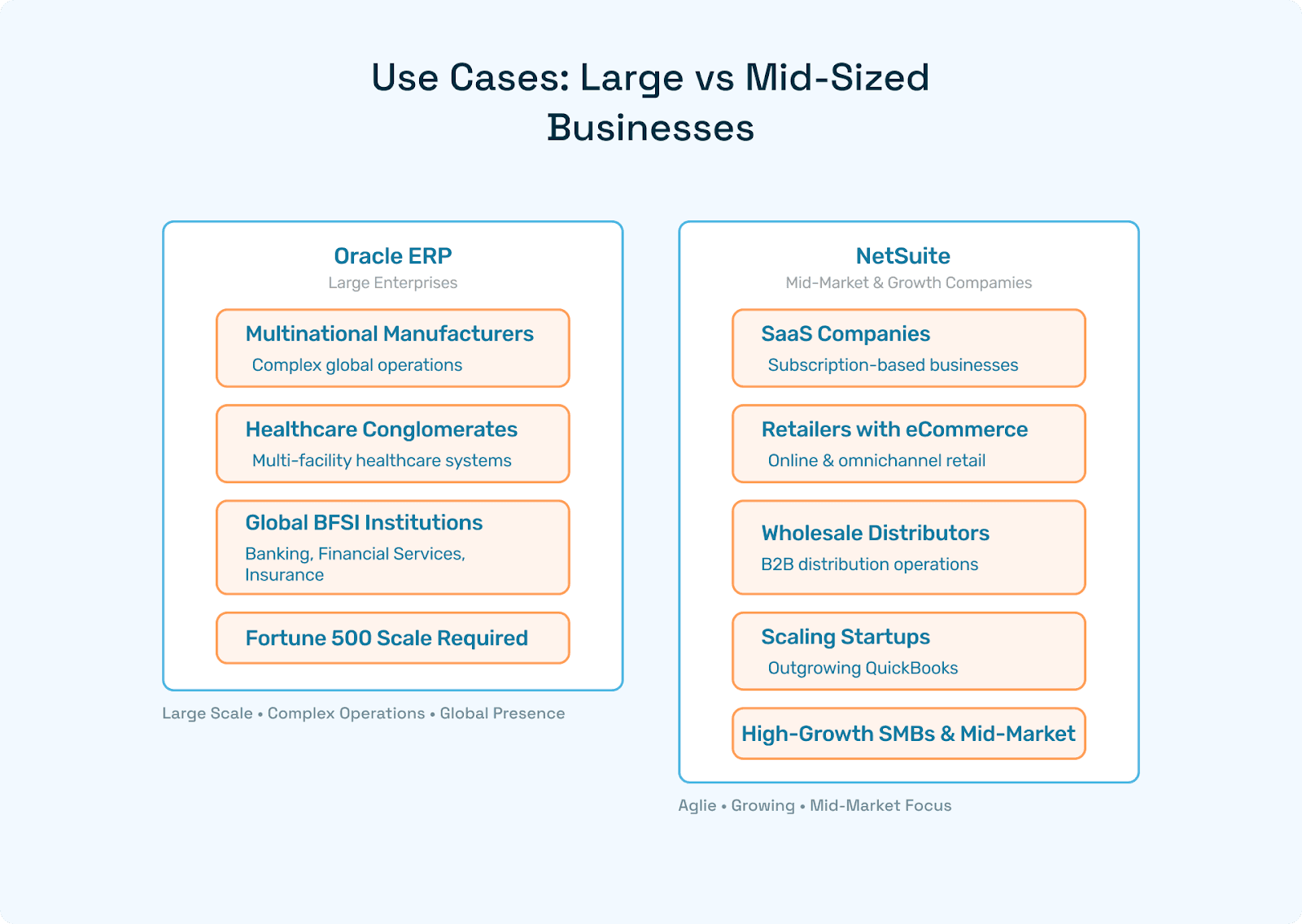
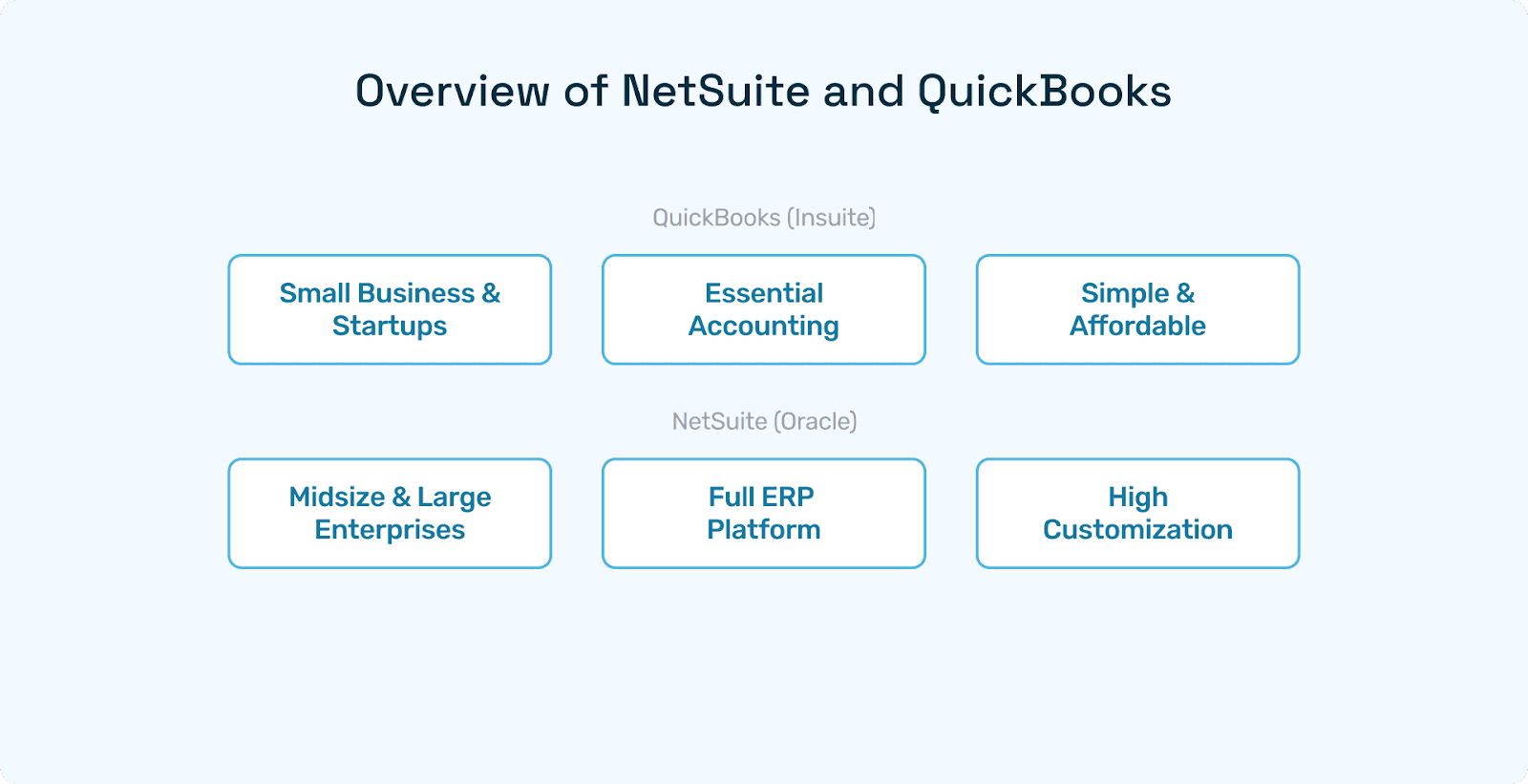
Owned by Oracle, NetSuite is a cloud-based ERP that caters to midsize and large enterprises. It offers modules for finance, CRM, supply chain, eCommerce, and HR, all unified on a single platform. It’s ideal for businesses requiring cross-functional visibility, multi-entity consolidation, and high customization.
QuickBooks
QuickBooks, developed by Intuit, is a favorite for startups, freelancers, and small businesses. It’s known for simplicity, affordability, and essential accounting features such as invoicing, bank reconciliation, and reporting. QuickBooks Online has evolved into a cloud platform but lacks advanced ERP functionalities.
Feature Comparison
Feature | NetSuite | QuickBooks |
Core Accounting | ✅ Advanced, multi-entity | ✅ Basic and mid-tier |
Reporting & Analytics | ✅ Real-time, customizable | ✅ Standard templates |
Multi-currency Support | ✅ Full capabilities | ⚠️ Limited |
Inventory Management | ✅ Native, scalable | ⚠️ Add-on required |
Workflow Automation | ✅ Extensive | ⚠️ Limited |
Integrations | ✅ 1000+ apps + API | ✅ Good for SMB tools |
User Limits | Unlimited (license-based) | Tiered (based on plan) |
Mobile Support | ✅ Yes | ✅ Yes |
Customizations | ✅ Highly customizable (SuiteScript, etc.) | ⚠️ Limited |
NetSuite’s strength lies in handling complexity. QuickBooks excels in ease-of-use and fast adoption.
Pricing Models Explained
NetSuite Pricing
Base Cost: Starts at ~$999/month (includes core platform)
Per User License: ~$99/month per user
Modules: Add-ons like advanced financials, warehouse management, CRM cost extra
Implementation: Typically $10K–$100K depending on size and complexity
Total annual cost for a mid-size business can range between $25,000–$150,000+.
QuickBooks Pricing
Simple Start: $30/month (1 user)
Essentials: $60/month (3 users)
Plus: $90/month (5 users)
Advanced: $200/month (25 users)
Add-ons: Payroll, time tracking, etc.
Total annual cost for QuickBooks (Advanced plan) is ~$2,400 plus add-ons.
NetSuite vs QuickBooks Cost: A Breakdown by Business Size
Business Type | QuickBooks Cost (Year) | NetSuite Cost (Year) | Recommendation |
Freelancer/Solo | $360 | ❌ Too expensive | ✅ QuickBooks |
Small Biz (<10 users) | $1,200–$2,400 | ❌ Unviable | ✅ QuickBooks |
Midsize (10–100 users) | $2,400–$6,000+ | $25,000–$100,000+ | Depends on complexity |
Large Enterprise | ❌ Not scalable | ✅ Tailored pricing | ✅ NetSuite |
Implementation, Support & Hidden Costs
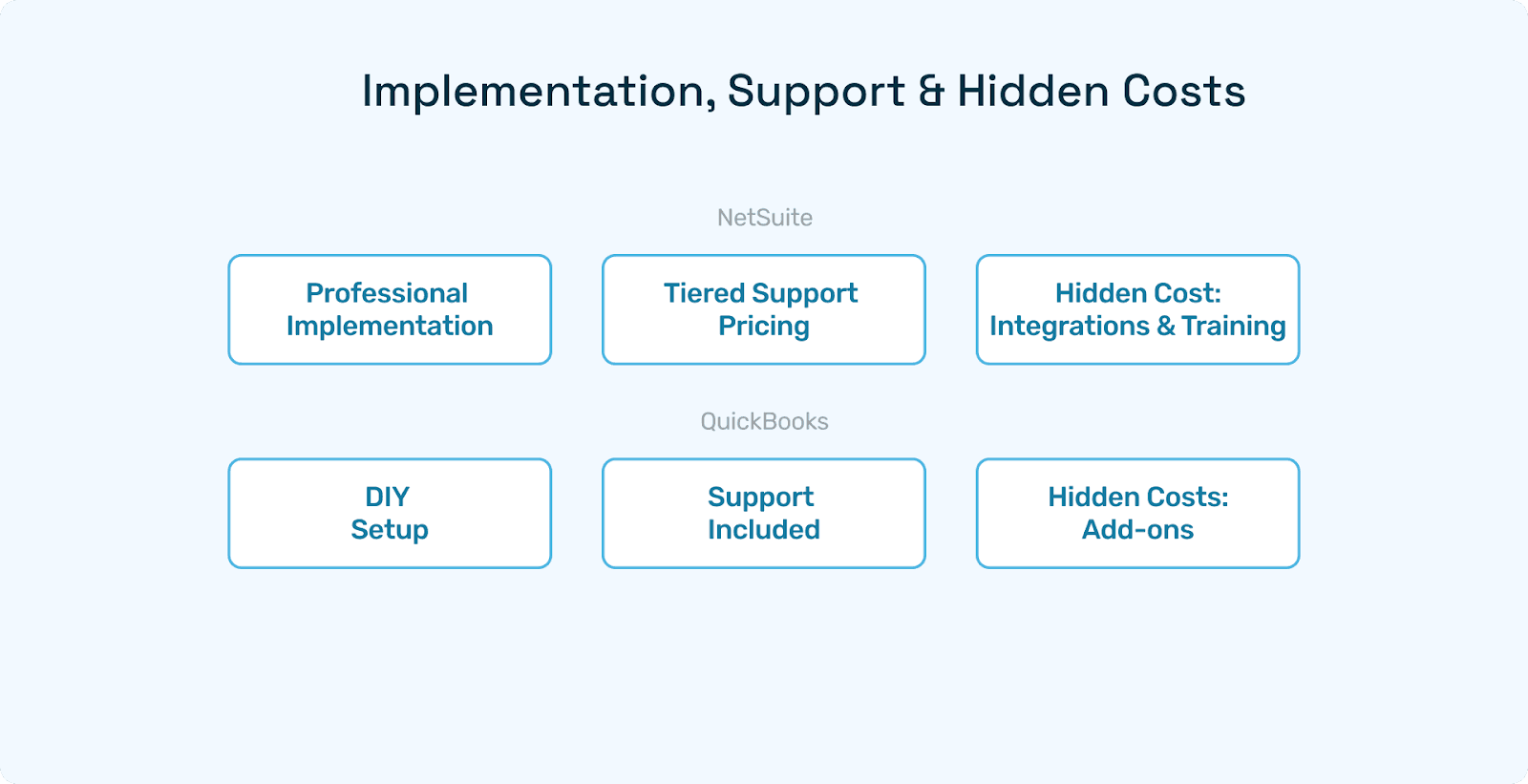
QuickBooks:
DIY setup possible
Support: Included in paid plans
Hidden Costs: Add-ons can pile up (e.g., inventory, project tracking, advanced reporting)
NetSuite:
Professional Implementation Required
Support: Additional tiered pricing (Standard, Premium, Advanced)
Hidden Costs: Integrations, training, customizations
Best for Which Type of Business?
Business Scenario | Recommendation |
Startup or Freelance | ✅ QuickBooks |
Rapidly Scaling eCommerce Biz | ⚠️ QuickBooks (Short-term) |
Multi-subsidiary, Multi-currency Org | ✅ NetSuite |
Complex Manufacturing or Supply Chain | ✅ NetSuite |
Nonprofit or Government | ✅ Depends on size & compliance needs |
Hyperbots AI Co-pilots on NetSuite and QuickBooks
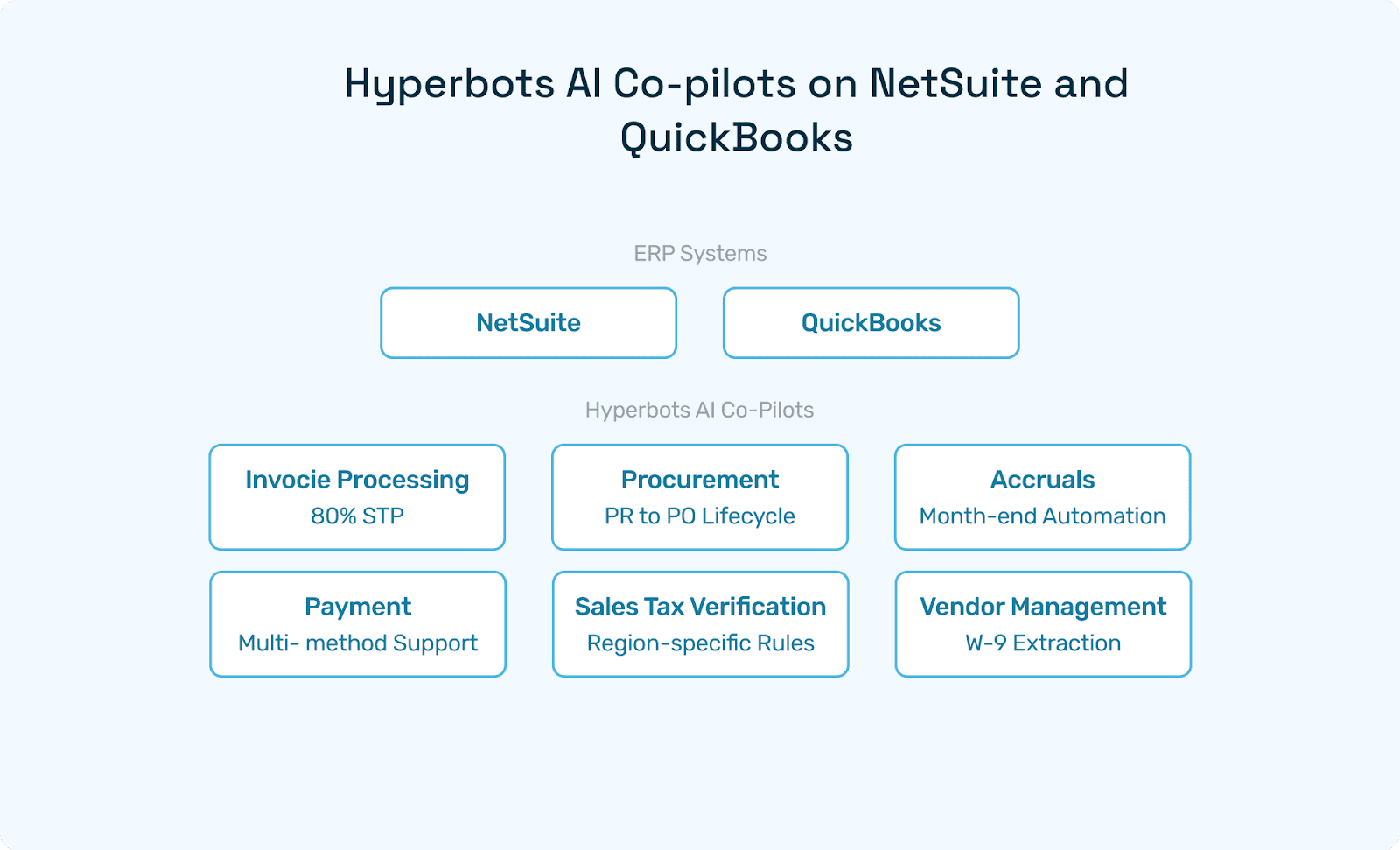
Hyperbots runs natively on both NetSuite and QuickBooks, helping organizations automate finance workflows that go far beyond native ERP capabilities. Hyperbots Co-pilots include:
✅ Invoice Processing Co-pilot
80% STP (Straight Through Processing)
AI extraction, validation, matching, GL coding
✅ Procurement Co-pilot
AI-led PR to PO lifecycle
Policy enforcement, duplicate detection
✅ Accruals Co-pilot
AI-powered month-end automation
Booking and reversal suggestions
✅ Payment Co-pilot
AI-guided payment timing
Multi-method support: ACH, check, wire
✅ Sales Tax Verification Co-pilot
Verifies rates, applies region-specific rules
Reduces tax errors and risk exposure
✅ Vendor Management Co-pilot
Onboarding via W-9 extraction
Access to invoices, payments, and PO status
Enhancing ROI with Hyperbots
Regardless of whether you're on NetSuite or QuickBooks, Hyperbots boosts ROI by automating manual finance tasks and enforcing compliance:
Task | Time Saved | Accuracy Boost |
Invoice Processing | 70–90% | 99.8% |
Procurement Workflow | 60–80% | High |
Accrual Booking | 80% | 99% |
Payment Recommendations | 50–70% | High |
Sales Tax Verification | 90% | 100% (AI-aided) |
Hyperbots uses LLMs, VLMs, OCR, and MoE agents, all trained specifically for finance and accounting tasks, not generic AI models.
Conclusion
In the battle of NetSuite pricing vs QuickBooks cost, there is no one-size-fits-all answer. QuickBooks is perfect for small businesses that need basic accounting without the complexity. NetSuite is a powerhouse for larger, growing businesses that require unified visibility across functions and scalability.
However, no matter which ERP you choose, Hyperbots AI Co-pilots unlock automation, reduce human effort, and deliver financial accuracy and control. Whether you're just starting out or scaling fast, augmenting QuickBooks or NetSuite with Hyperbots puts your finance operations on autopilot.