Oracle ERP vs NetSuite: A Comprehensive Comparison for Modern Enterprises
For NetSuite or Oracle, Hyperbots AI ensures seamless, compliant, and accurate finance automation at any scale.
Introduction
As businesses scale, choosing the right ERP platform becomes a pivotal decision. Two of the most well-known players in this space are Oracle ERP and NetSuite. While both solutions fall under the Oracle umbrella, they are built for different business sizes and operational needs. This article compares Oracle ERP vs NetSuite, helping you decide which platform suits your business needs and how Hyperbots' suite of AI Co-pilots can amplify their value.
Oracle ERP vs NetSuite: A Quick Overview
Feature | Oracle ERP Cloud | NetSuite ERP |
|---|---|---|
Company Size | Large Enterprises | Midsize Businesses |
Deployment | Primarily On-Premise/Cloud | Cloud-Only |
Industry Fit | Manufacturing, BFSI, Government | Retail, SaaS, Wholesale |
Customization | Extensive | Moderate |
Cost Range | $$$$ | $$ |
Oracle ERP Cloud is designed for global enterprises with complex business structures. It includes modules like Financials, SCM, HCM, and Project Management. In contrast, NetSuite is a cloud-native ERP for midsize companies offering financials, CRM, eCommerce, and inventory, all under a unified platform.
Key Differences Between Oracle ERP and NetSuite
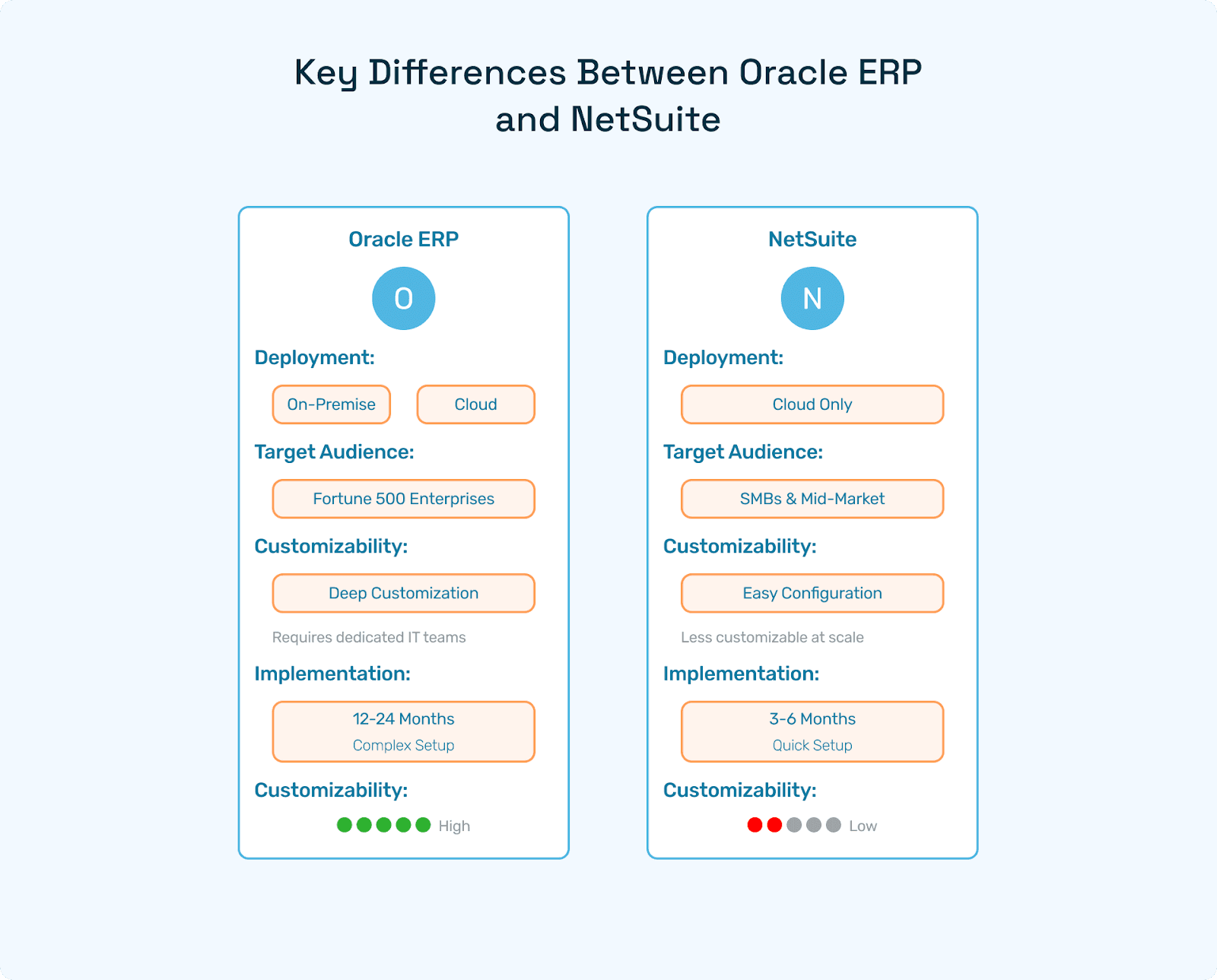
Deployment Model
Oracle ERP supports both on-premise and cloud deployments, while NetSuite is exclusively cloud-based. This distinction matters for organizations with strict IT policies or legacy infrastructure needs.
Target Audience
Oracle ERP is tailored for Fortune 500 enterprises, whereas NetSuite shines with high-growth SMBs and mid-markets.
Customizability & Complexity
Oracle ERP allows deep customization, often requiring dedicated IT teams. NetSuite offers easier configuration but is less customizable at scale.
Implementation Time
Oracle implementations may take 12–24 months, while NetSuite implementations are often completed in 3–6 months.
Feature-by-Feature Comparison
Feature | Oracle ERP | NetSuite ERP |
Financial Management | ✅ | ✅ |
Supply Chain & Manufacturing | ✅ (Advanced) | ✅ (Moderate) |
Human Capital Management | ✅ | ❌ (Requires integration) |
Multi-Entity Management | ✅ | ✅ |
Business Intelligence | ✅ (Embedded) | ✅ (SuiteAnalytics) |
CRM | ❌ (Separate Oracle module) | ✅ (Included) |
Industry Templates | Extensive | Moderate |
Global Tax Compliance | ✅ | ✅ |
Pricing Comparison: Oracle ERP Cloud vs NetSuite
NetSuite Pricing vs QuickBooks is often discussed, but when it comes to NetSuite vs Oracle, the cost structure shifts dramatically.
NetSuite Pricing
License: Starts around $999/month + $99/user/month.
Implementation: Typically between $20,000–$75,000.
Support & Maintenance: Tiered plans available.
Oracle ERP Cloud Pricing
License: Starts from $3,000–$6,000/month (varies by module).
Implementation: Starts at $100,000+, often reaching $500,000–$1M.
Customization & Integrations: Usually a separate cost line item.
Verdict: For fast-scaling mid-sized companies, NetSuite offers better ROI. For global enterprises with complex needs, Oracle ERP is the clear choice.
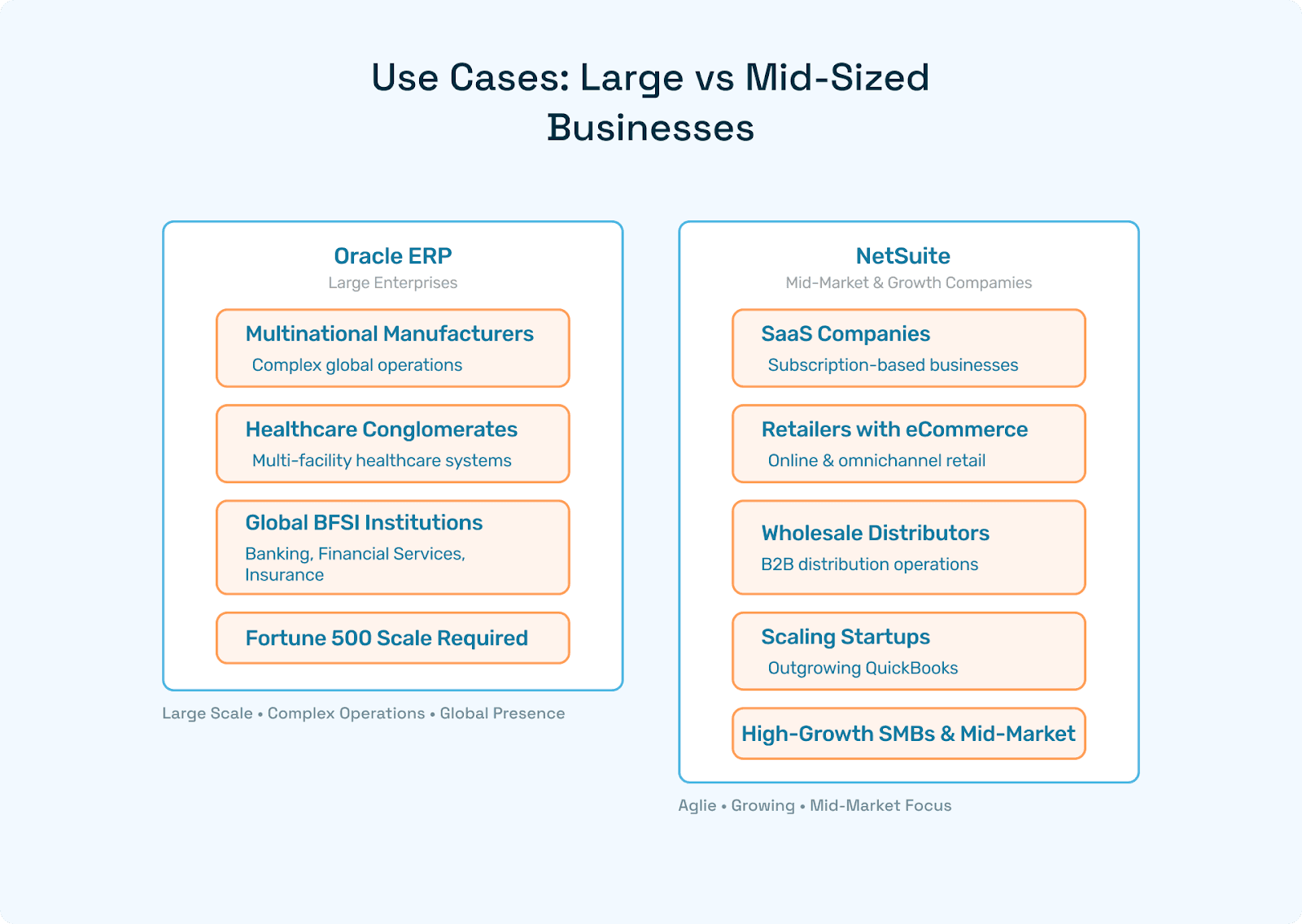
Use Cases: Large vs Mid-Sized Businesses
Oracle ERP is ideal for:
Multinational manufacturers
Healthcare conglomerates
Global BFSI institutions
NetSuite is ideal for:
SaaS companies
Retailers with eCommerce operations
Wholesale distributors
Startups scaling beyond QuickBooks
Pros and Cons of Oracle ERP
Pros
Deep functionality for Finance, SCM, and HCM
Global compliance capabilities
High scalability
Advanced analytics and machine learning
Cons
Long implementation times
Higher total cost of ownership
Requires larger IT support teams
Pros and Cons of NetSuite
Pros
Fast to deploy
Built-in CRM
Native cloud performance
Mid-market friendly pricing
Cons
Less scalable for very large enterprises
Limited HR capabilities
Less customizable for industry-specific needs
Why Hyperbots Is the Perfect AI Partner for Both
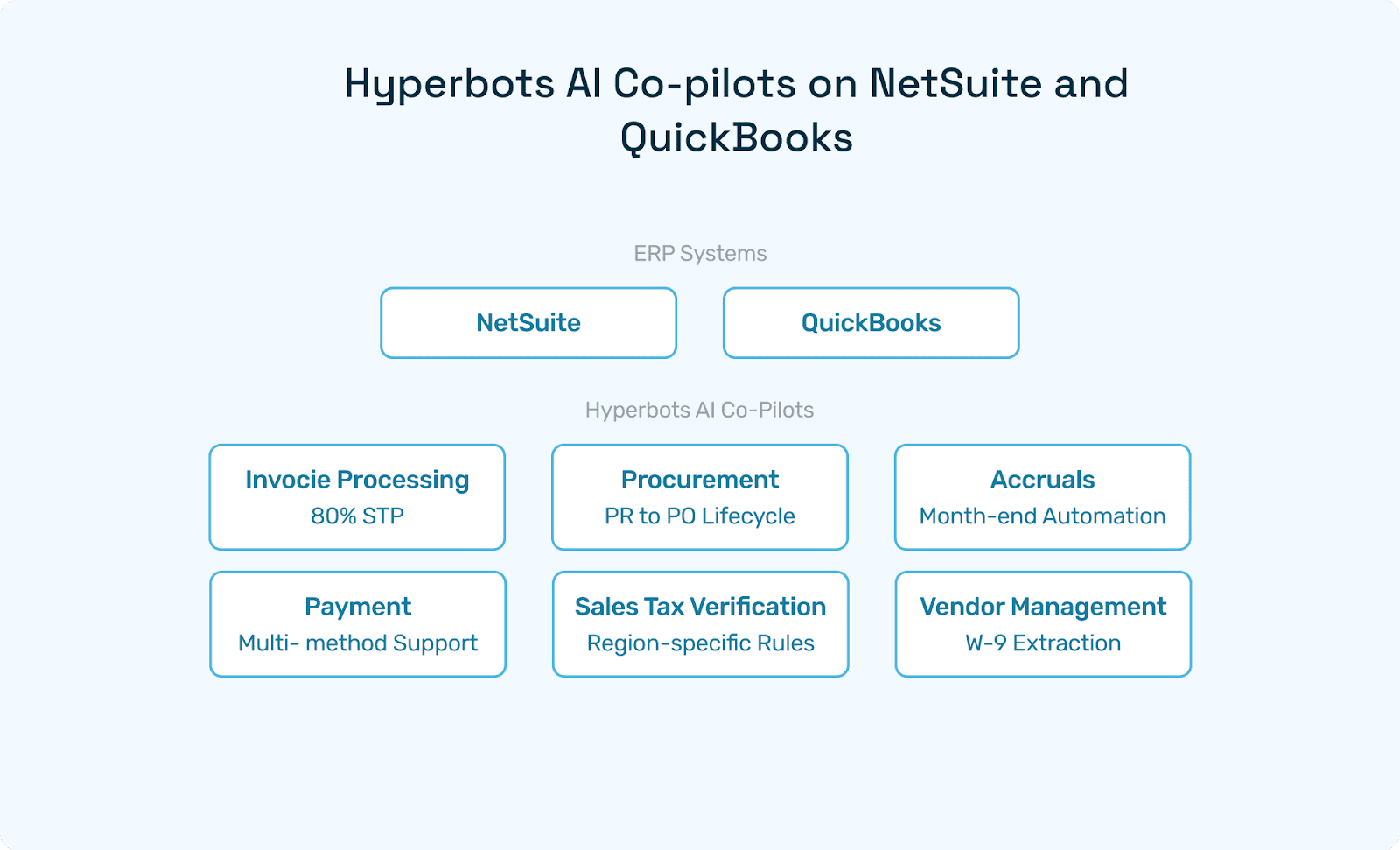
Hyperbots has built the most comprehensive AI Co-pilots for Oracle and NetSuite, addressing gaps in automation, accuracy, and control in finance operations.
These co-pilots are deployed across sectors like Manufacturing, Retail, Construction, and Healthcare, unlocking efficiency and compliance.
Hyperbots Co-Pilots: Transforming Finance on Oracle and NetSuite
Co-Pilot | Key Functionality |
80% STP, auto GL coding, multi-page invoice AI | |
Auto PR generation, PO workflows, vendor compliance | |
Accurate accrual suggestions, month-end closing support | |
Payment scheduling, fraud checks, method optimization | |
Jurisdiction-level validation, compliance monitoring | |
W-9 verification, duplicate detection, vendor portal |
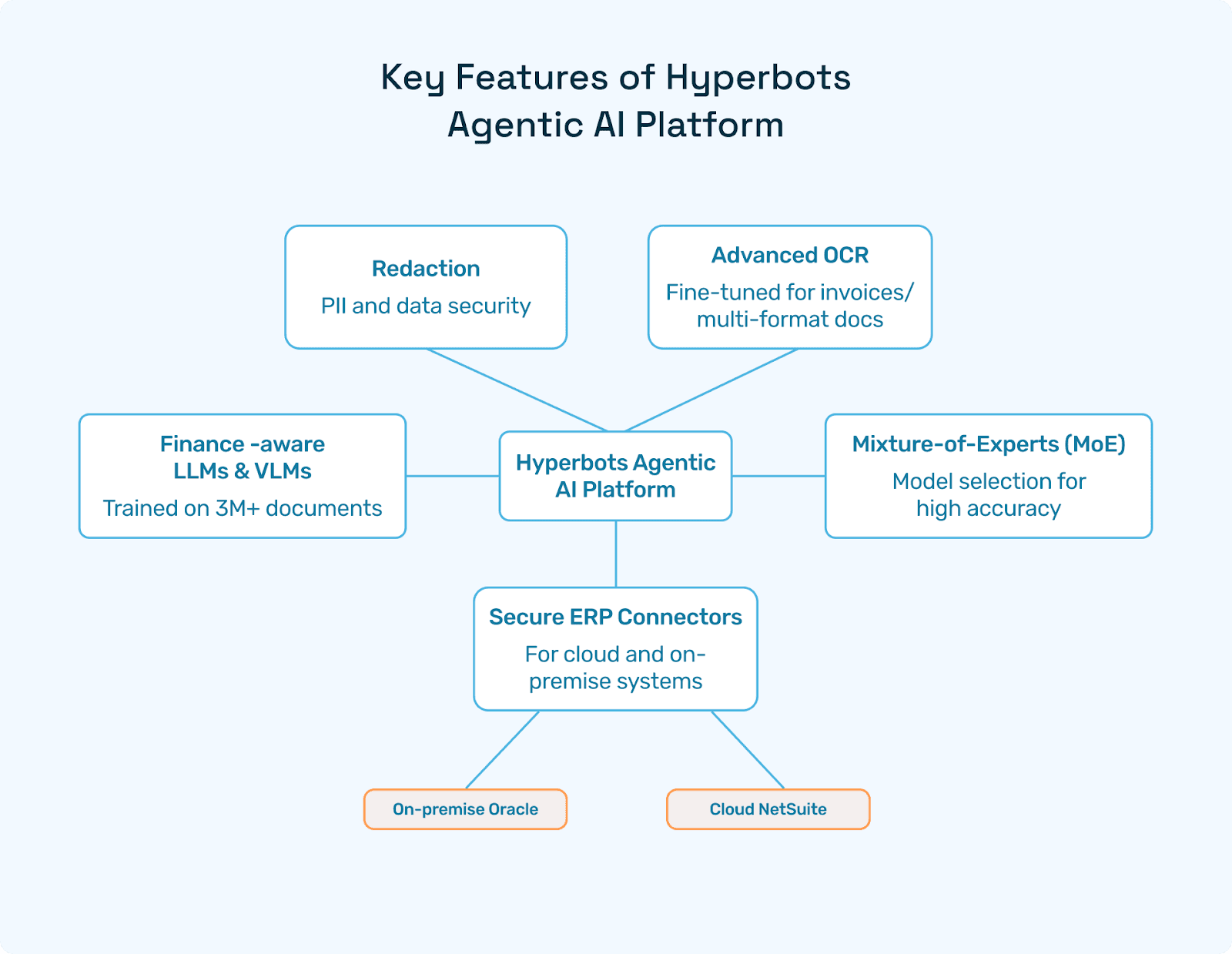
Hyperbots’ ERP Integrations include deep on-premise and cloud connectivity, ensuring data is read/written from Oracle and NetSuite in real-time.
These Agentic AI-powered co-pilots use:
Vision Language Models (VLMs)
Finance-trained LLMs
Mixture-of-Experts (MoE) approach
OCR with 99.8%+ accuracy
On-Premise vs Cloud Integrations: How Hyperbots Supports Both
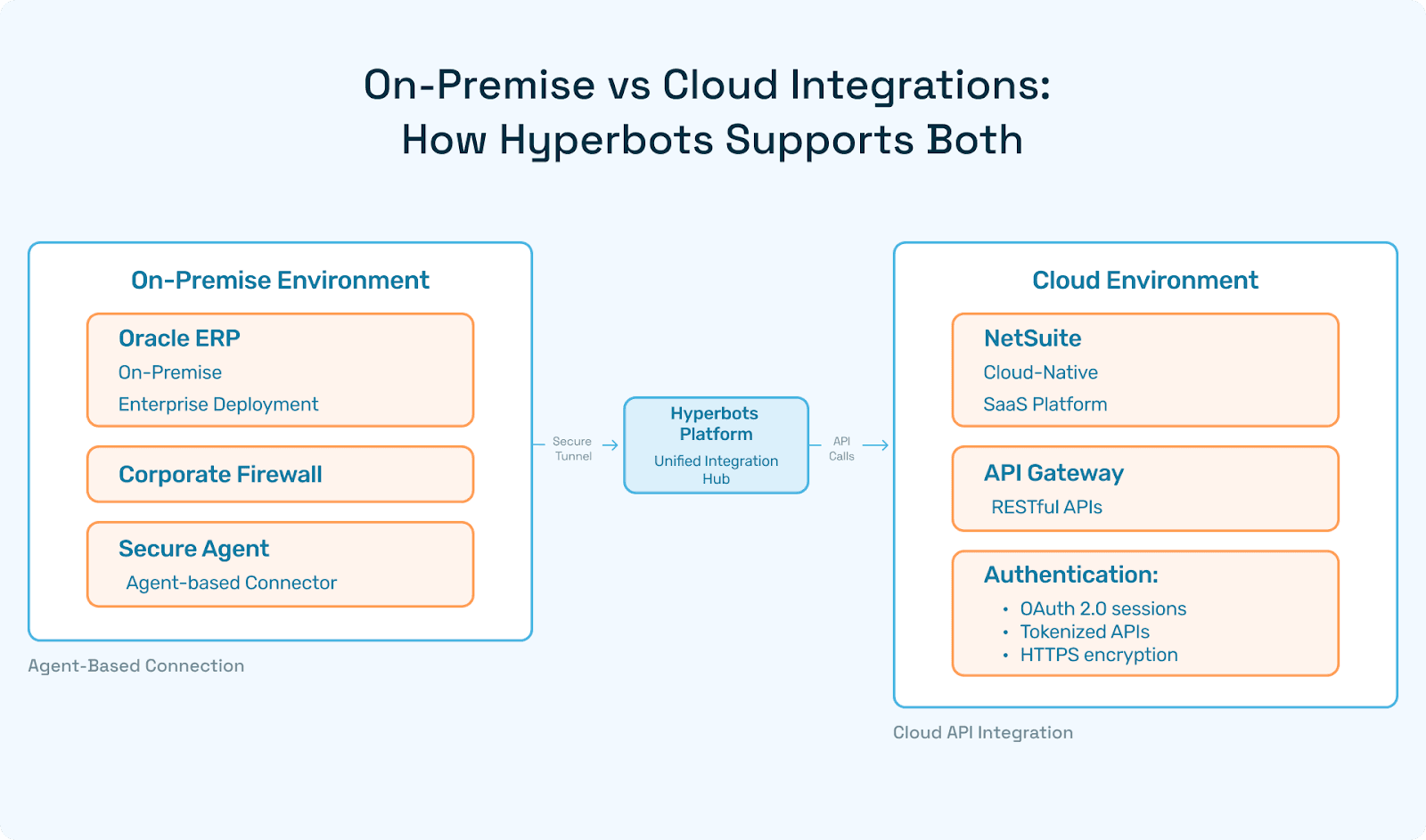
Unlike many competitors, Hyperbots' platform supports both on-premise Oracle deployments and cloud-native NetSuite setups.
On-premise connectivity is enabled via agent-based secure connectors
Cloud setups integrate via tokenized APIs and OAuth-secured sessions
Read more on our On-Premise ERP Integration.
Final Thoughts
Choosing between NetSuite vs Oracle ERP comes down to business complexity, scale, and growth trajectory. While Oracle suits larger, global businesses, NetSuite is better for fast-growing mid-size firms.
Regardless of the choice, Hyperbots AI Co-pilots ensure finance and accounting operations are streamlined, compliant, and automated with 99.8%+ accuracy.