Top ERP Consulting Firms: A Buyer's Guide to Choosing the Right Implementation Partner
A practical buyer’s guide to evaluating ERP implementation partners, post-go-live support, and finance automation strategy
Picking the wrong ERP consulting firm is expensive in ways that don't show up on the initial quote. A poorly scoped implementation can drag on for 18 months, blow past budget by 40–60%, and still leave finance teams stuck in spreadsheets because nobody thought through what happens after go-live.
The ERP consulting market has also changed. Buyers today aren't just evaluating technical credentials; they're asking whether a firm can deliver operational outcomes, not just a functional system. That means configuration skills matter, but so does post-implementation support, automation readiness, and the ability to reduce friction in day-to-day finance workflows after the ERP is live.
This guide covers the firms worth knowing, how they differ, and what a smart evaluation actually looks like.
What ERP Consulting Firms Actually Do
The core services are fairly standard across firms of all sizes:
ERP vendor selection and fit analysis
Workflow configuration and security setup
Data migration and system integration
Custom module development
Change management and end-user training
Post-go-live support and optimization
Where firms differ is in depth, specialization, and what they consider their job to be. Some firms treat go-live as the finish line. Others build implementation methodology around long-term adoption and measurable business outcomes. That distinction matters more than most buyers realize during vendor selection.
Enterprise ERP Consulting Firms
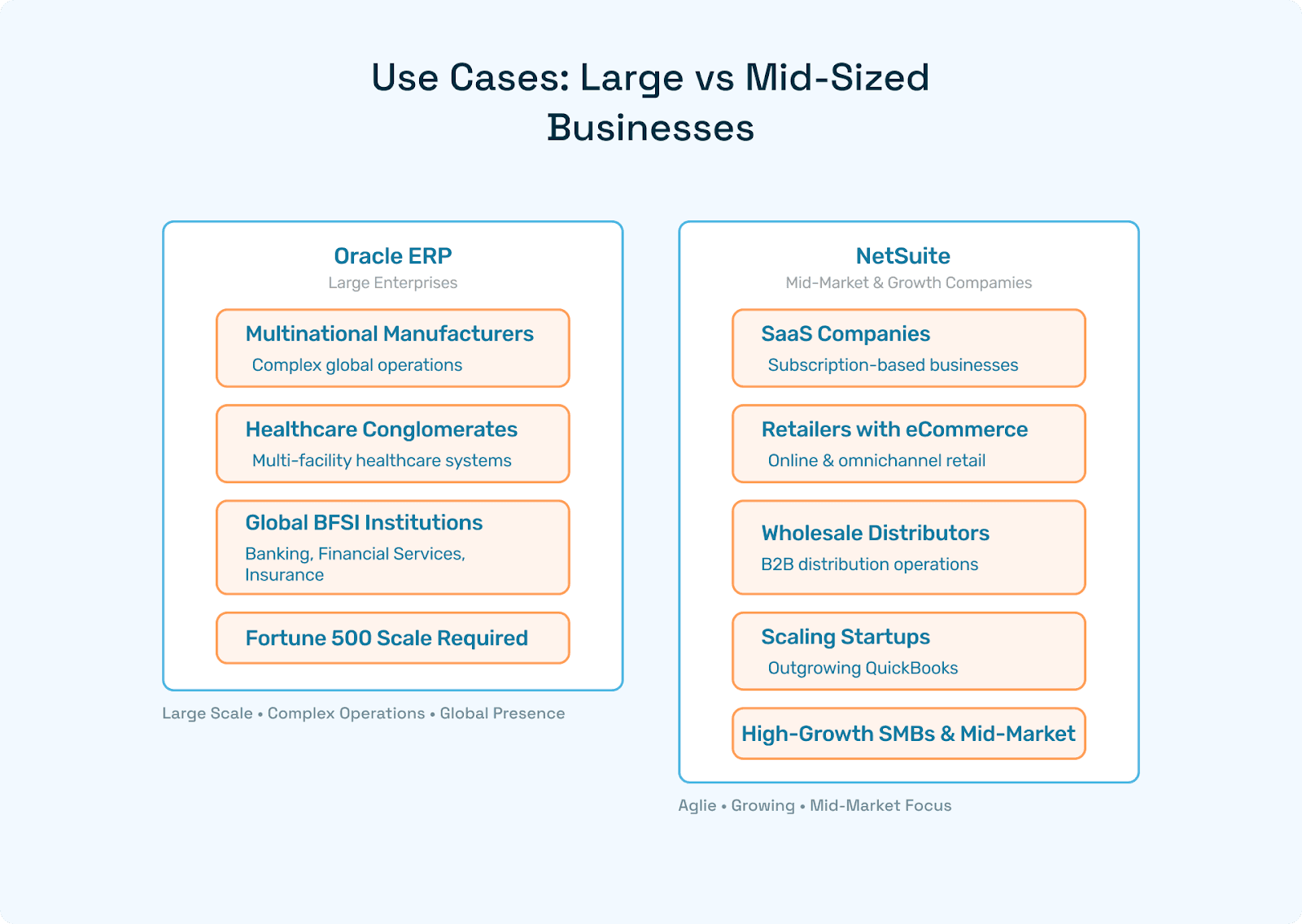
These firms handle large-scale, multi-region, multi-entity implementations. They typically serve organizations with revenues above $500M and work across Oracle ERP Cloud, SAP S/4HANA, and Microsoft Dynamics 365.
Deloitte
Deloitte is one of the most recognized ERP consulting firms globally, with deep practices across SAP, Oracle, and Workday. Their strength is complex, cross-functional transformations at enterprise scale, particularly in regulated industries like financial services, healthcare, and government. They bring structured program governance and a large bench of certified consultants, which matters for multi-year, high-stakes rollouts. Best suited for organizations that need rigorous change management alongside technical delivery.
Accenture
Accenture runs one of the largest SAP and Oracle practices in the world. Their differentiation is industry-specific accelerators: pre-configured templates and data models that can compress implementation timelines. They're particularly strong in manufacturing, consumer goods, and utilities. For organizations looking at a full finance or supply chain transformation, Accenture has the vertical depth and global delivery capability to support it. Cost structure reflects enterprise-tier engagement.
PwC
PwC's ERP practice sits within its broader finance transformation advisory, which gives it a natural orientation toward CFO-level outcomes rather than just system configuration. They work heavily in Oracle and SAP, with strong performance in financial close optimization, intercompany accounting, and consolidation. Particularly relevant for companies going through M&A, IPO readiness, or significant finance function restructuring alongside an ERP migration.
IBM Consulting
IBM brings a strong technology infrastructure angle to ERP consulting, which makes them a natural fit when an ERP implementation is part of a broader IT modernization or cloud migration. Their SAP practice is extensive, and they've built out capabilities in AI-assisted implementation tooling. Strong choice for organizations with complex legacy environments that need to be rationalized alongside the ERP rollout.
Capgemini
Capgemini has a large European footprint with strong North American presence, and covers most major ERP platforms including SAP, Oracle, and Microsoft Dynamics. They're known for cost-competitive delivery through their global delivery network. For mid-to-large enterprises that need enterprise-grade methodology at a more flexible commercial model, Capgemini is worth evaluating. Industry strength in manufacturing, retail, and telecom.
KPMG
KPMG's ERP practice is tightly integrated with its finance and risk advisory work, which positions them well for implementations where regulatory compliance, audit readiness, and internal controls are front and center. Strong SAP and Oracle presence. Particularly relevant for companies in financial services or those operating under complex compliance frameworks where the ERP needs to be configured with audit trail integrity from day one.
TCS, Infosys, Wipro, Cognizant
These firms operate at global scale with large certified implementation teams across SAP, Oracle, and Dynamics. Their commercial model is built around high-volume delivery, which translates to competitive pricing for organizations willing to work within defined project structures. Strongest when scope is clearly defined and the client has experienced internal project managers. Less suited for exploratory, strategy-heavy engagements where requirements are still being shaped.
Mid-Market ERP Consulting Firms
Mid-market firms handle organizations in roughly the $50M to $500M revenue range. They specialize in platforms suited to that tier, primarily NetSuite, Acumatica, and Microsoft Dynamics 365 Business Central, and typically offer faster timelines, more direct access to senior consultants, and pricing models that don't require a dedicated procurement team to negotiate.
Protelo
NetSuite specialist with a fixed-fee implementation model that removes the budget uncertainty common in time-and-materials engagements. Their support practice is strong, with managed services options that give clients ongoing optimization rather than a hard cutoff at go-live. Well suited for distribution, manufacturing, and professional services companies moving off legacy systems onto NetSuite for the first time.
Myers-Holum
Focused on SaaS businesses, life sciences, and subscription-model companies. Their NetSuite practice includes specific expertise in revenue recognition (ASC 606), deferred revenue, and subscription billing: areas where standard ERP configuration often falls short. A logical choice for software or services businesses that need the ERP to handle complex revenue workflows accurately from the start.
RSM
RSM brings an accounting firm background to ERP consulting, which means their implementations tend to be oriented toward financial reporting accuracy and audit readiness. They work across NetSuite, Sage, and Microsoft Dynamics, with a natural fit for companies that want their ERP partner to understand the finance function as well as the technology. Strong mid-market presence across professional services, real estate, and nonprofit sectors.
Cumula 3
Retail and distribution focus with rapid NetSuite deployment methodology. Their strength is in high-SKU, high-transaction environments where inventory management, warehouse operations, and vendor workflows need to be configured correctly from the start. Faster go-live timelines make them a practical option for companies that can't afford extended implementation cycles.
Cherry Bekaert
Finance transformation-focused practice with ERP accelerators that reduce configuration time for common mid-market use cases. Strong in technology, private equity-backed businesses, and government contracting. For companies that want an ERP implementation framed around finance function modernization rather than just system deployment, Cherry Bekaert's advisory orientation is a genuine differentiator.
LBMC Technology Solutions
Solid mid-market practice across NetSuite and Dynamics with a strong support model post-go-live. Particularly relevant for healthcare, manufacturing, and distribution businesses in the Southeast US. Their managed services offering gives clients ongoing access to functional expertise rather than leaving them to figure out optimization independently after implementation.
ERP Consulting Firm Comparison by Use Case
Firm | ERP Focus | Best For | Market Segment | Key Strength |
Deloitte | SAP, Oracle, Workday | Regulated industries, complex transformation | Enterprise | Program governance, change management |
Accenture | SAP, Oracle | Manufacturing, consumer goods, utilities | Enterprise | Industry accelerators, global delivery |
PwC | Oracle, SAP | Finance transformation, M&A, IPO readiness | Enterprise | CFO-level advisory, financial close |
IBM Consulting | SAP | IT modernization, legacy rationalization | Enterprise | Infrastructure integration, AI tooling |
Capgemini | SAP, Oracle, Dynamics | Manufacturing, retail, telecom | Large mid-market to enterprise | Cost-competitive global delivery |
KPMG | SAP, Oracle | Compliance-heavy industries, financial services | Enterprise | Audit readiness, internal controls |
Protelo | NetSuite | Distribution, manufacturing, professional services | Mid-market | Fixed-fee model, strong support practice |
Myers-Holum | NetSuite | SaaS, life sciences, subscription businesses | Mid-market | Revenue recognition, subscription billing |
RSM | NetSuite, Sage, Dynamics | Professional services, nonprofit, real estate | Mid-market | Accounting-oriented implementation |
Cherry Bekaert | Multi-platform | PE-backed businesses, government contracting | Mid-market | Finance transformation framing |
Cumula 3 | NetSuite | Retail, distribution | Mid-market | High-volume inventory, fast go-live |
How to Choose the Right ERP Consulting Firm
Most buyers compare firms too late in the process, after demos and proposals, when scope has already been partially shaped by the first firm they called. A better approach is to define evaluation criteria before any vendor conversations begin.
Industry expertise: Configuration for a SaaS company looks different from configuration for a manufacturer. Ask for references from companies similar to yours in size and business model, not just companies in the same broad industry.
Implementation methodology: Fixed-fee versus time-and-materials is an early signal. Fixed-fee structures force scope clarity upfront. T&M arrangements can be appropriate for complex engagements but require strong internal project management to avoid scope creep.
Post-go-live support: The first 90 days after go-live are when most implementations struggle. Understand exactly what support looks like during that period and whether there's a formal hypercare phase.
Integration capability: Modern ERP environments connect to CRM, billing systems, payment processors, tax engines, and various third-party platforms. Ask specifically about how the firm handles integration architecture and whether they've connected your ERP to the specific systems already in your stack.
Automation strategy: This is the question most buyers don't ask. Once the ERP is live, how does the firm approach process automation for finance workflows? Invoice processing, payment approvals, vendor management, and accruals all run on top of the ERP. If the firm can't articulate a clear answer, operational efficiency will depend entirely on manual processes for years after go-live.
Change management: ERP adoption fails more often from user resistance than from technical failure. Ask how the firm structures training, communication, and adoption measurement. Firms that treat change management as a project workstream rather than a soft add-on tend to produce better adoption outcomes.
Scalability: If the business is growing or planning acquisitions, the ERP needs to scale without requiring another full implementation. Ask how the firm's configuration approach accounts for future growth, including multi-entity, multi-currency, and multi-region requirements.
What Businesses Should Evaluate Beyond ERP Implementation
ERP implementation is the foundation, but it's not the finish line.
Finance teams at companies that have completed ERP implementations still routinely report problems with invoice processing backlogs, manual payment approvals, vendor onboarding delays, accrual calculation errors, and cash application lag. The ERP is configured correctly. The problem is that the workflows running above the ERP, the ones where finance staff actually spend their time, are still largely manual.
According to Ardent Partners, accounts payable automation adoption remains uneven across mid-market and enterprise segments, with a significant share of organizations still processing invoices through manual or semi-manual workflows even when a modern ERP is in place.
This is a structural gap in how ERP projects are scoped. Most implementations are designed to get the core system live. Operational automation, the kind that actually reduces AP headcount dependency, accelerates payment cycles, and eliminates manual accrual work, is treated as a phase two that sometimes never happens.
Modern ERP evaluations are starting to account for this. Buyers are now asking:
How well does this ERP support automation integrations for AP and AR workflows?
What does the vendor's ecosystem look like for AI-based finance automation?
How flexible is the ERP's API layer for connecting third-party automation tools?
Consulting firms that have a clear answer to these questions provide materially better long-term outcomes than those that stop at go-live.
Where Finance Automation Fits After ERP Implementation
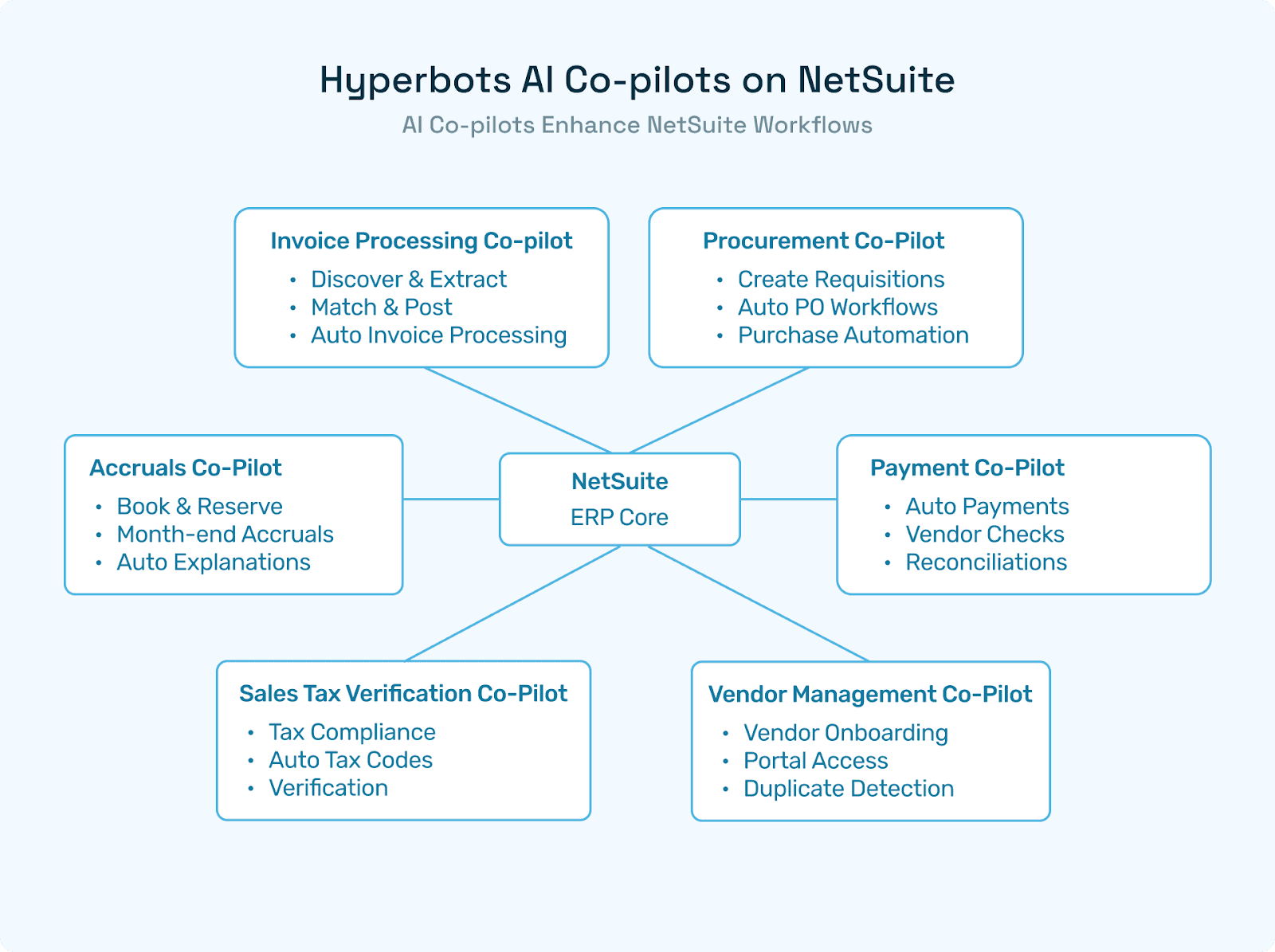
Once an ERP is live, the automation layer that produces the most measurable efficiency gains typically sits across these workflows: invoice capture and processing, three-way PO matching, payment approvals, vendor statement reconciliation, accruals calculation, cash application, and collections management.
These are the workflows where finance teams spend the most manual effort, and they're also the ones where AI-based automation produces the clearest ROI. Processing time drops, error rates fall, and the team shifts from data entry and exception chasing to actual financial analysis.
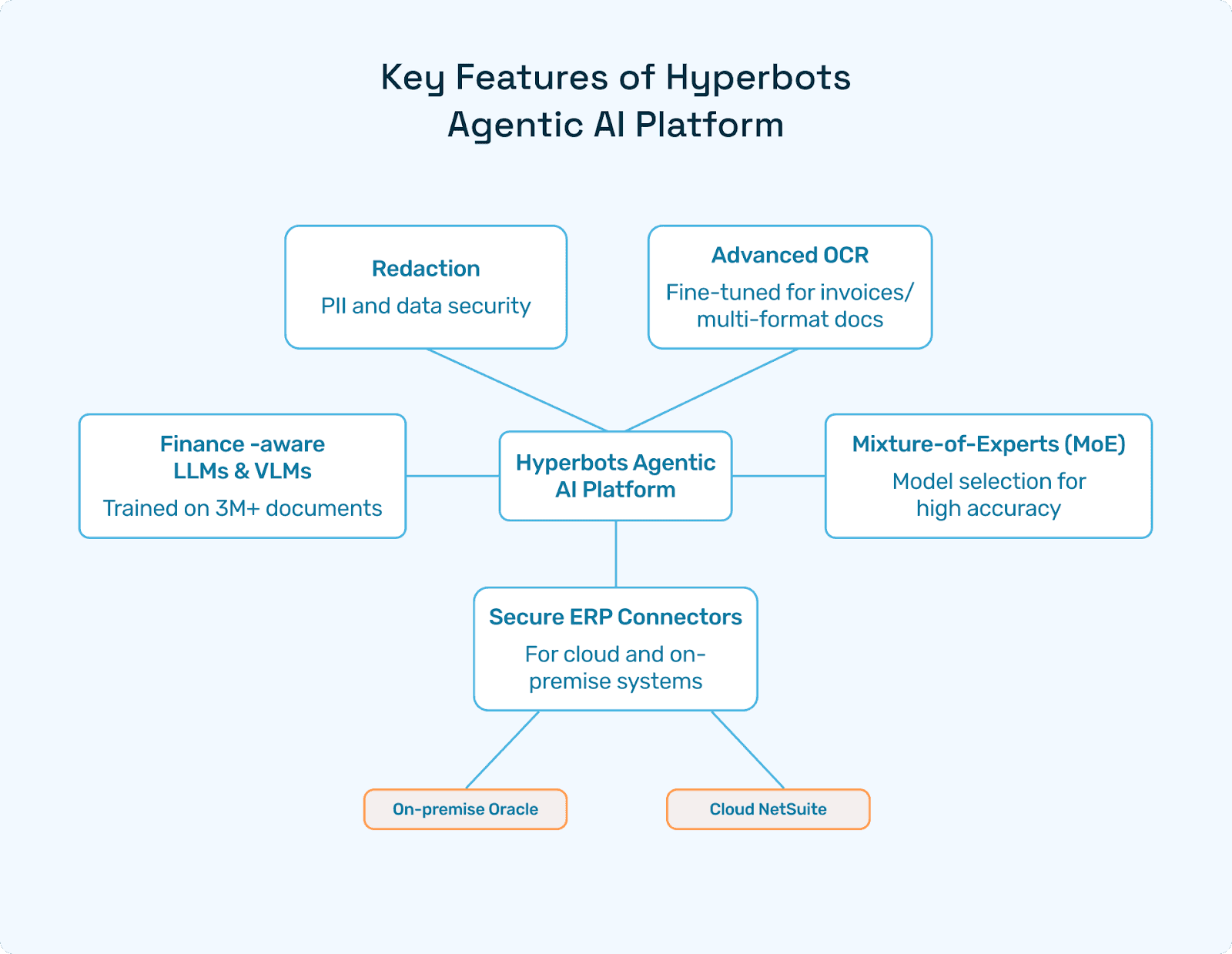
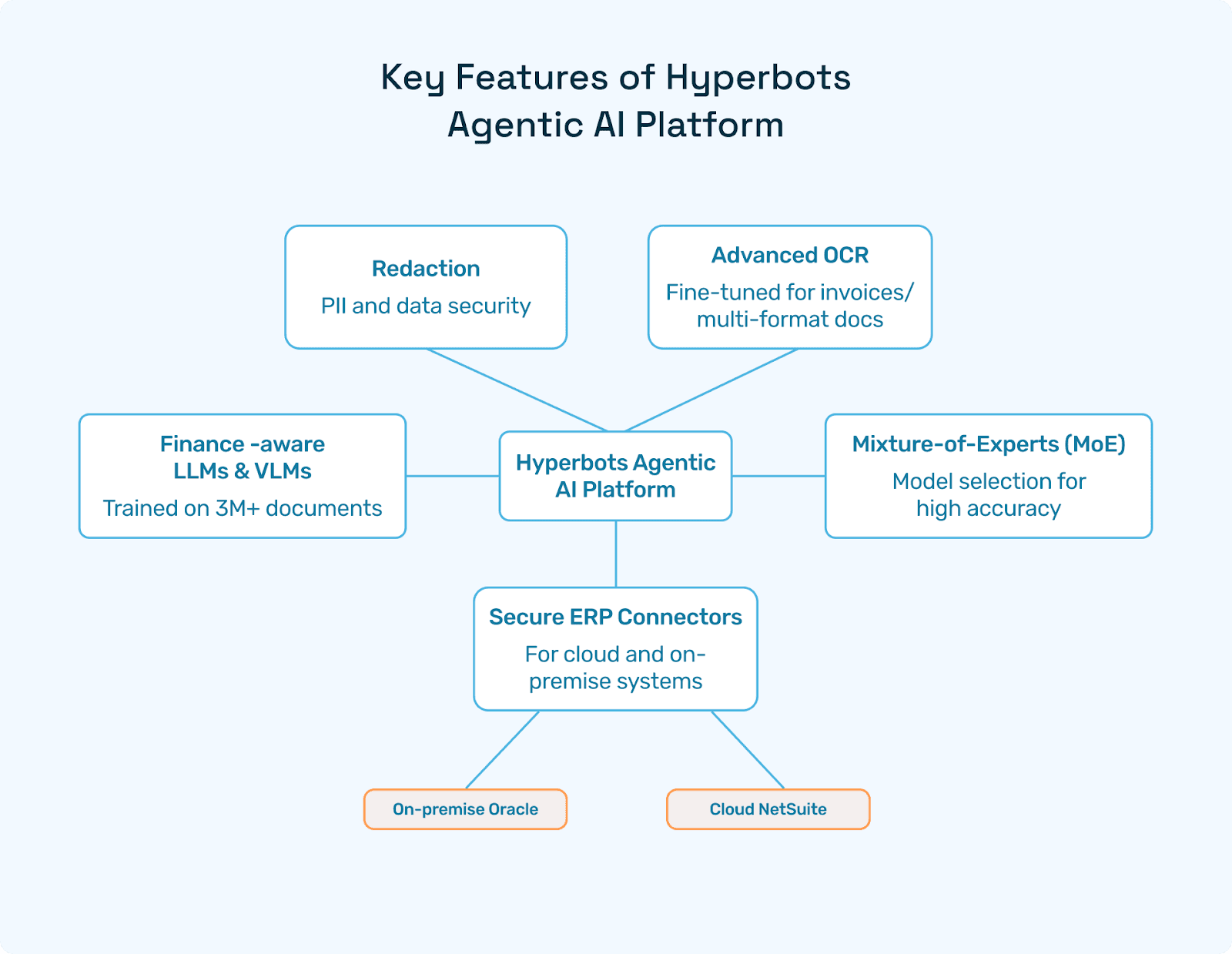
Hyperbots is built specifically for this layer. It connects to both cloud ERPs like NetSuite and Oracle Cloud and on-premise systems like Oracle EBS, automating the AP, AR, and accruals workflows that ERP configuration alone doesn't address. Finance teams typically see the most impact in invoice processing, vendor management, payment workflows, and cash application: areas where manual handling is both expensive and error-prone. For organizations working with an ERP consulting firm, it's worth evaluating Hyperbots as part of the broader implementation plan rather than as an afterthought. The firms that structure the ERP and automation layer together from the beginning consistently produce faster time-to-value than those that treat automation as a separate project.
Sector-Specific Automation Use Cases
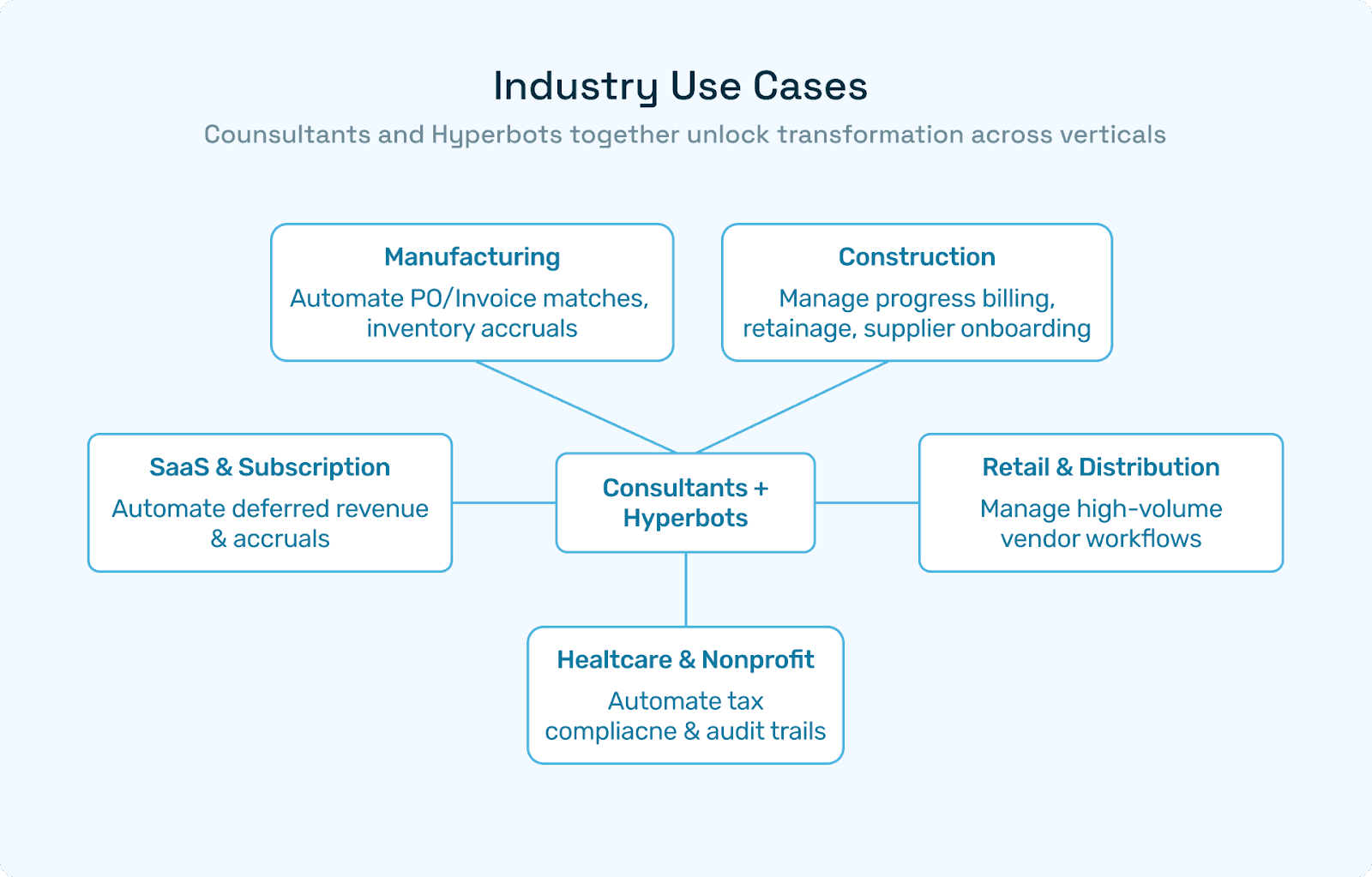
When consulting expertise is paired with Hyperbots, the resulting transformation addresses the unique operational friction points found across various industries:
Manufacturing: Streamlining three-way PO matching and automating inventory accrual logic.
Construction: Managing the complexities of progress billing, retainage tracking, and supplier onboarding.
SaaS & Subscription: Eliminating manual intervention in deferred revenue recognition and accrual workflows.
Retail & Distribution: Driving efficiency in high-volume vendor management and inventory workflows.
Healthcare & Nonprofit: Ensuring audit trail integrity and automating tax compliance requirements.
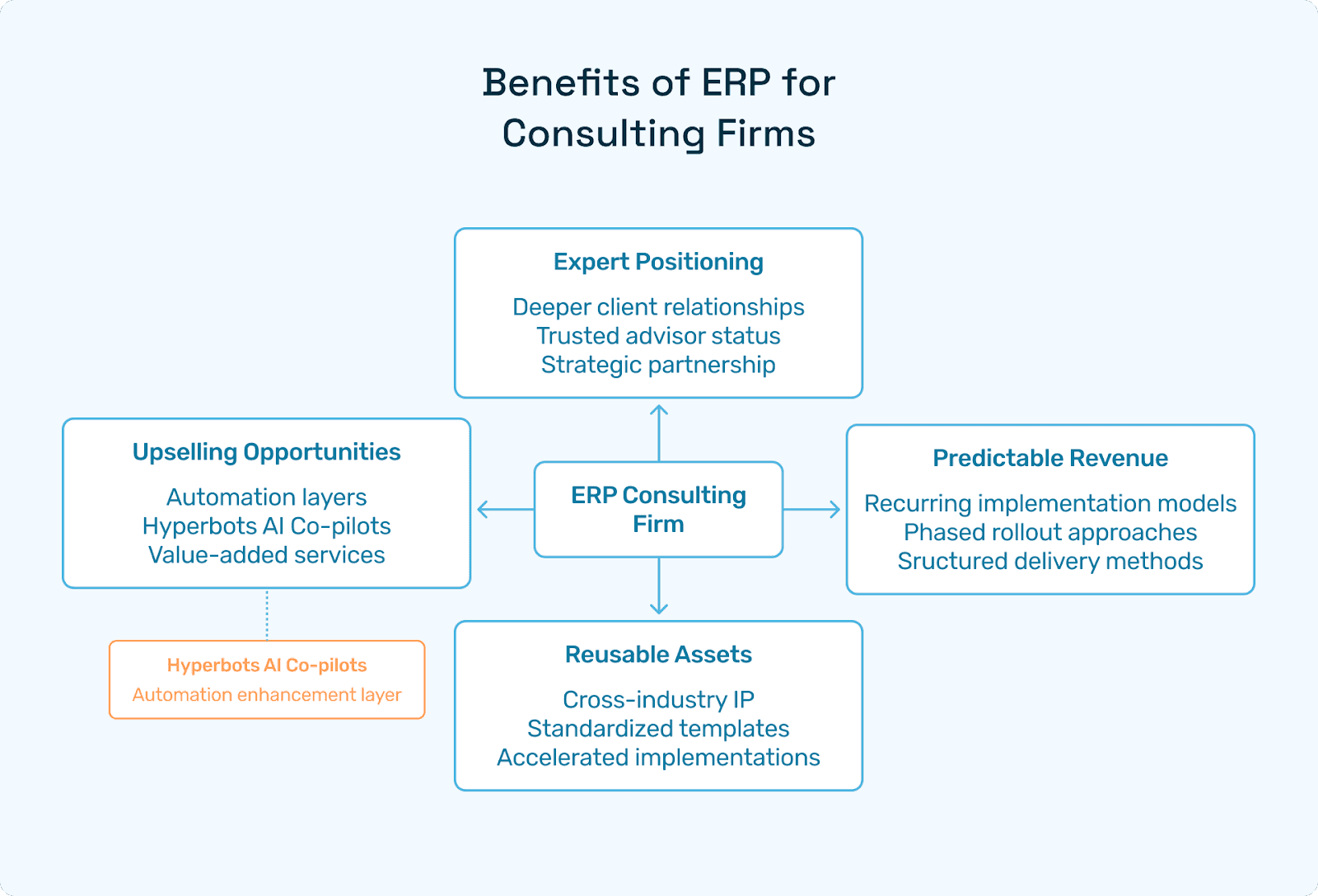
By identifying clients with these specific ERP for consulting firms needs, implementation partners can deploy a repeatable, high-impact automation playbook.
ERP Platforms Covered by Leading Consulting Firms
For reference, the major platforms that ERP consulting firms implement and support:
Oracle ERP Cloud / Oracle EBS: Dominant in enterprise, strong in manufacturing and financial services
SAP S/4HANA / SAP Business One: Deep supply chain and procurement functionality; largest global install base
NetSuite: Most common ERP platform for mid-market; strong in multi-entity and subscription businesses
Microsoft Dynamics 365: Strong SMB-to-mid-market presence; deep Microsoft stack integration
Acumatica: Cloud-native option gaining traction in construction, distribution, and manufacturing
Infor / Epicor: Industry-specific ERP platforms with strength in manufacturing, healthcare, and distribution
Final Thoughts
The ERP consulting market is large and the quality variance is real. A firm that's excellent at SAP for a Fortune 500 manufacturer may be the wrong fit for a $150M SaaS company moving onto NetSuite. Industry specialization, methodology, and post-go-live support matter as much as the brand on the proposal cover.
The firms listed in this guide represent a range of specializations across enterprise and mid-market segments. The right one depends on your ERP platform, industry, internal project resources, and what you need to achieve in the 12 months after go-live, not just at go-live itself.
Start the evaluation with clear criteria, ask for references that match your actual situation, and don't treat automation strategy as optional. The finance teams that get the most out of ERP investments are the ones whose organizations thought beyond the implementation before the contract was signed.