NetSuite Features: The Complete Guide for 2025
Transform NetSuite into an AI-powered, future-ready finance engine with Hyperbots as your intelligent partner.
Defining NetSuite
NetSuite is a cloud-based Enterprise Resource Planning (ERP) software suite developed by Oracle, designed to unify core business operations like finance, CRM, inventory, HR, and e-commerce into a single platform.
If you’re wondering how to define NetSuite, think of it as the central nervous system for growing companies, especially mid-market enterprises, looking to scale with automation and integrated decision-making.
What is NetSuite Used For?
The answer to “What is NetSuite used for?” depends on your role in the company. For CFOs, it centralizes finance and compliance. For COOs, it streamlines supply chain management, procurement, and inventory. For CMOs, it connects CRM with order fulfillment. For CEOs, it offers unified dashboards with real-time insights.
Most commonly, NetSuite is used for:
Financial Planning and Analysis (FP&A)
Order and billing management
Inventory and warehouse automation
CRM and customer lifecycle tracking
Employee management and payroll
E-commerce storefronts and fulfillment
Top NetSuite Features That Make It Stand Out
Unified Data Model
NetSuite ensures a single source of truth across all departments. Every module shares the same database, eliminating duplication.
Real-Time Dashboards
Customizable dashboards provide decision-makers with real-time financial KPIs, budget vs actuals, and operational data.
Global Capabilities
Supports multi-currency, multi-language, multi-entity, and tax compliance in 200+ countries.
Role-Based Access Control
Tailored access to each user depending on department, hierarchy, or project.
Scalability
From 10 to 10,000 users, NetSuite scales to match your business without the need to re-platform.
NetSuite Modules Overview
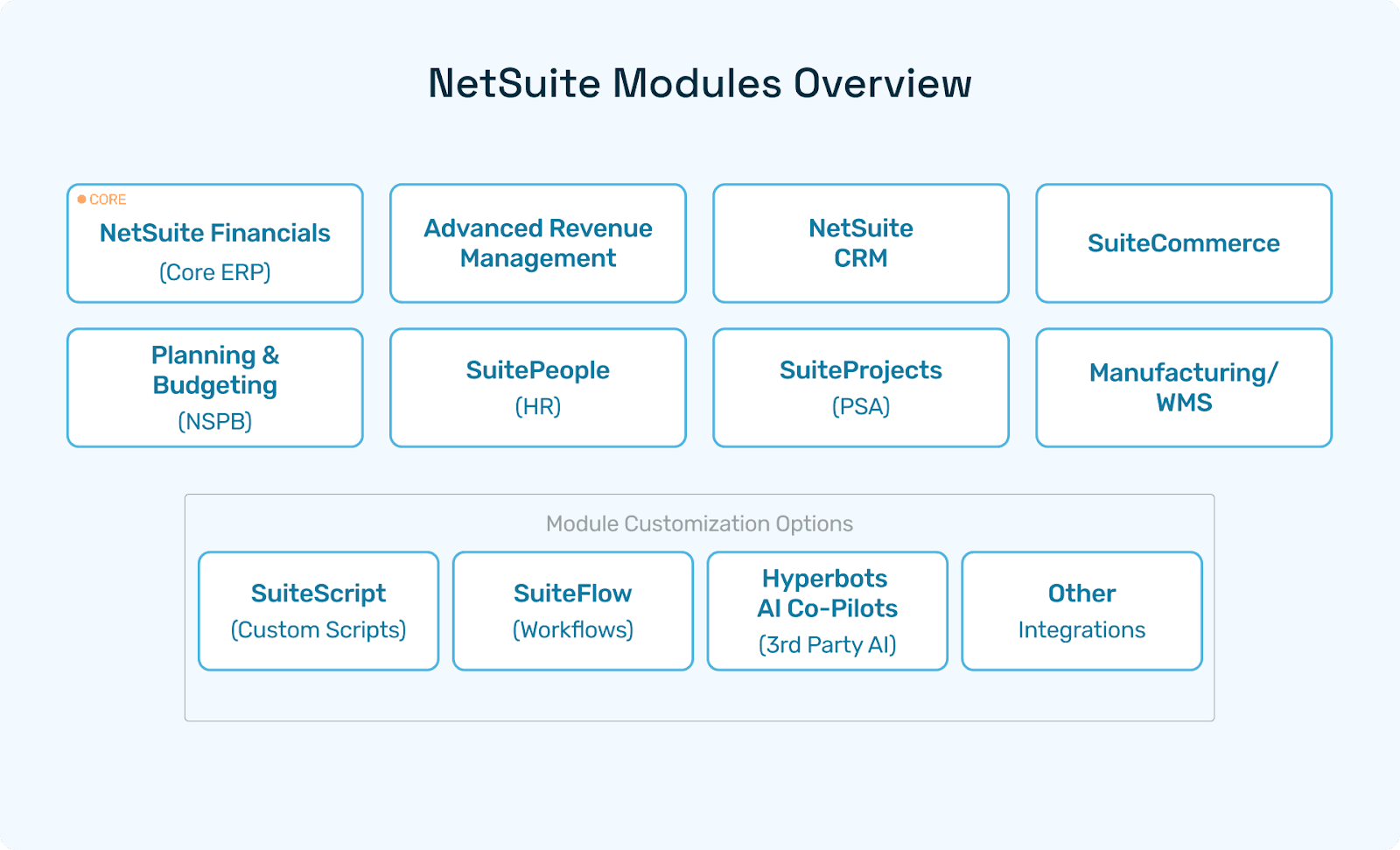
Each NetSuite customer configures their suite differently, choosing from a large set of modules:
NetSuite Financials (Core ERP)
Advanced Revenue Management
NetSuite CRM
NetSuite SuiteCommerce
NetSuite Planning and Budgeting (NSPB)
SuitePeople (HR)
SuiteProjects (PSA)
Manufacturing / WMS
Each module can be customized with scripts (SuiteScript), workflows (SuiteFlow), or third-party integrations like Hyperbots AI Co-pilots.
NetSuite Features by Function
Financial Management
General Ledger (GL) and sub-ledger consolidation
Multi-book accounting
Automated journal entries and reconciliations
Fixed assets and depreciation
Budgeting and forecasting
Inventory & Order Management
Multi-location inventory visibility
Real-time reorder points
Demand planning
Sales and purchase order automation
Warehouse and shipping integrations
CRM and Sales
Lead and opportunity tracking
Quotes, sales orders, and invoices in a single flow
Commission management
Customer support
HR and Payroll
Employee records and benefits tracking
Time-off management
Automated payroll runs
Performance reviews and promotions
Project Management
Time tracking and resource allocation
Task dependencies and project timelines
Billing milestones and project profitability
E-commerce
Unified product, inventory, and pricing
Shopping cart and checkout integration
Real-time updates from backend to storefront
NetSuite for Mid-market vs Large Enterprises
Mid-market enterprises adopt NetSuite for quick implementation, lower cost, and strong pre-built features.
Large enterprises prefer NetSuite for its ability to unify subsidiaries while enforcing compliance and controls.
Paired with Hyperbots AI Co-pilots, both segments experience intelligent automation, especially in finance and operations.
How Hyperbots AI Co-pilots Work on Top of NetSuite Features
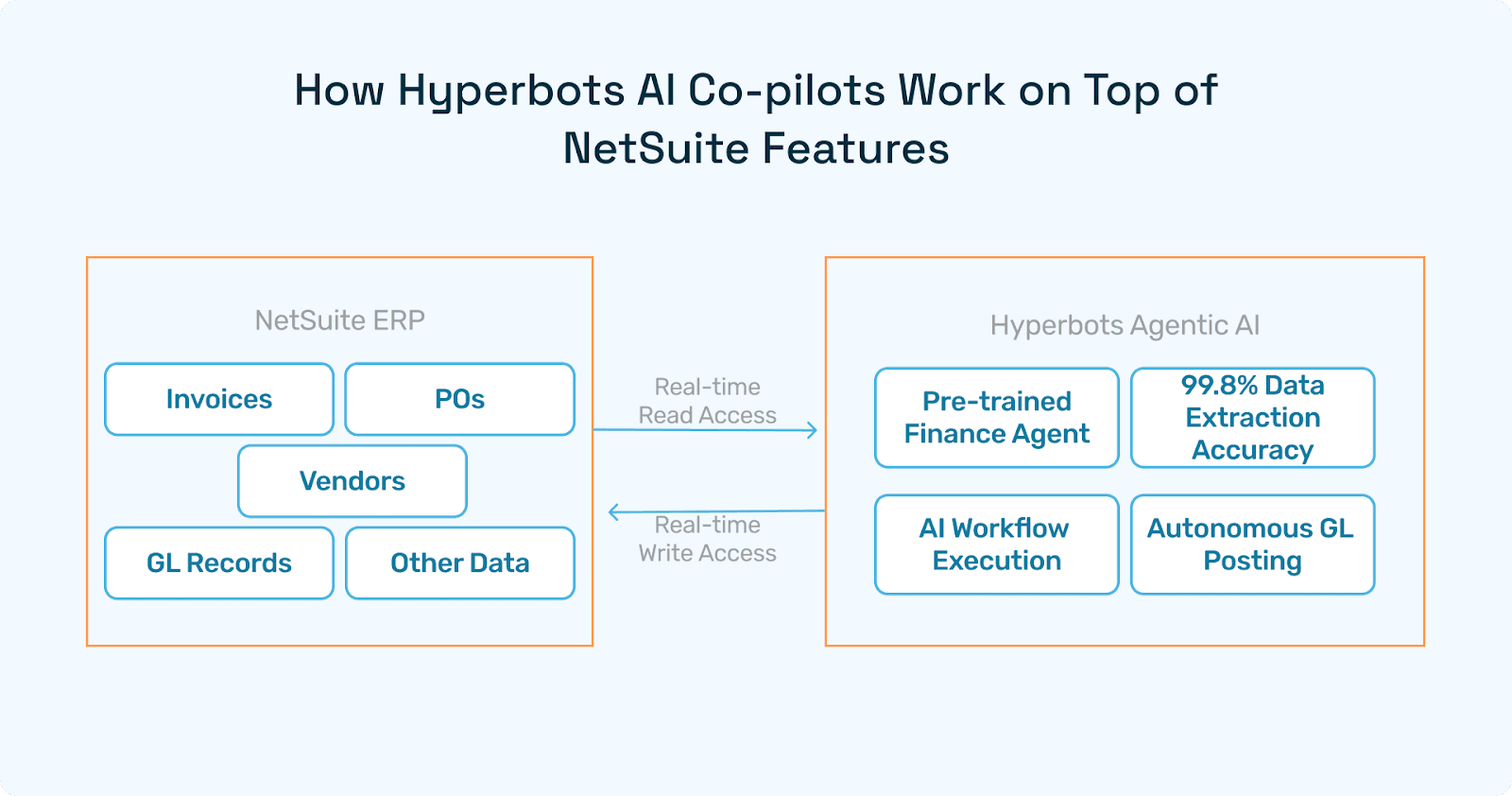
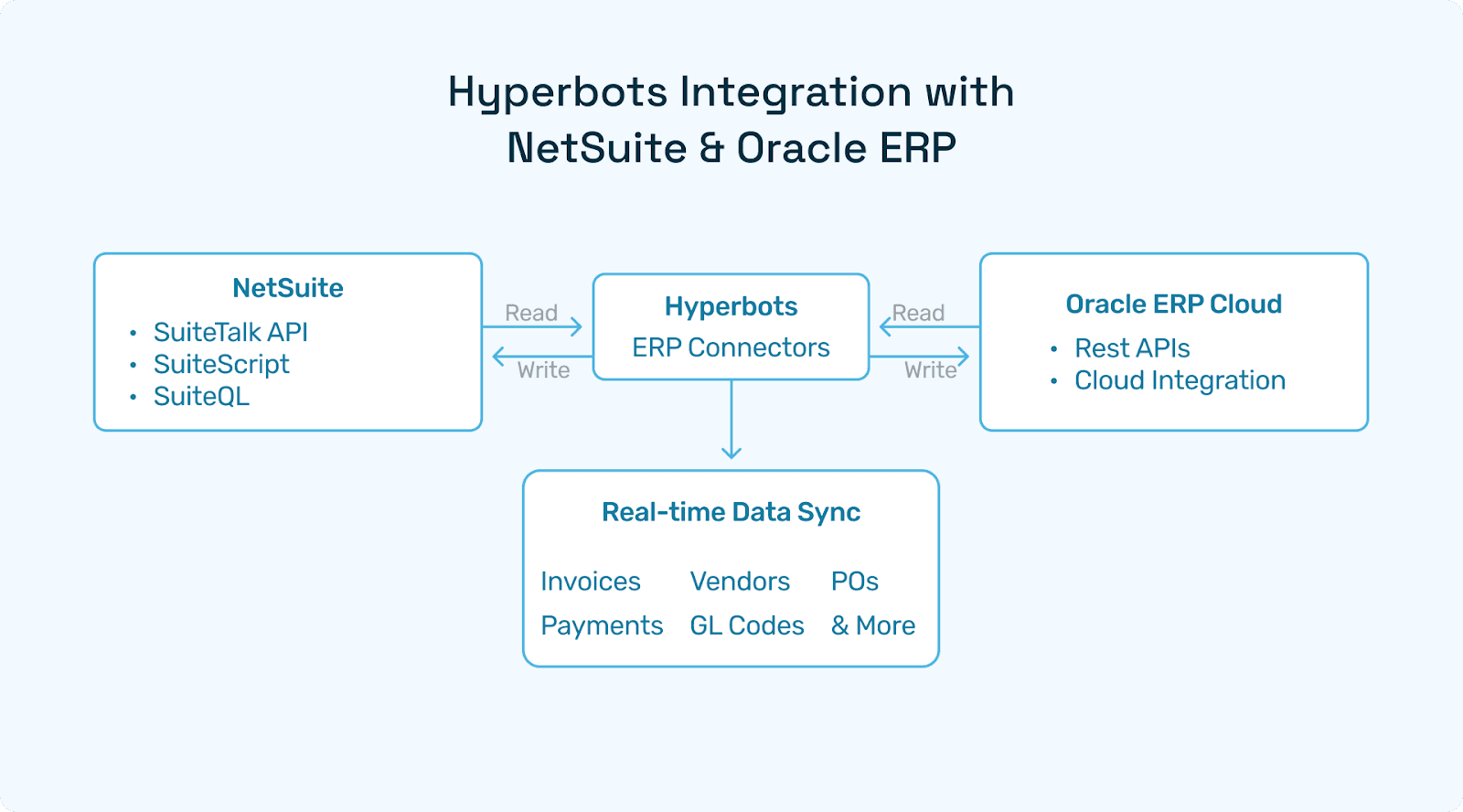
Hyperbots’ Agentic AI platform integrates natively with NetSuite, offering real-time read/write access to ERP data like invoices, POs, vendor records, and GLs.
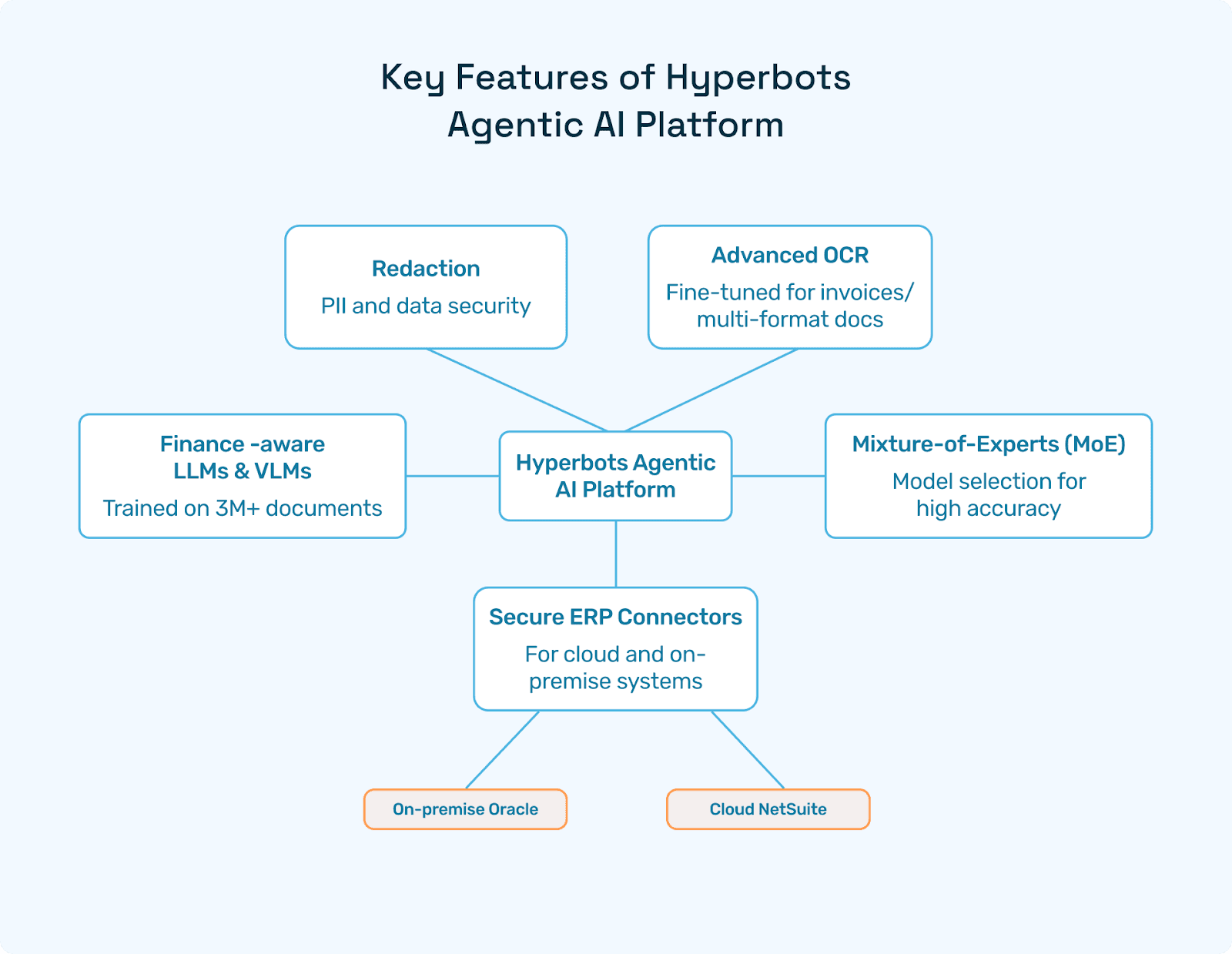
These AI co-pilots supercharge NetSuite’s capabilities by providing:
Pre-trained, finance-specific agents
High accuracy data extraction (99.8%)
AI-driven workflow execution
Autonomous GL posting and validations
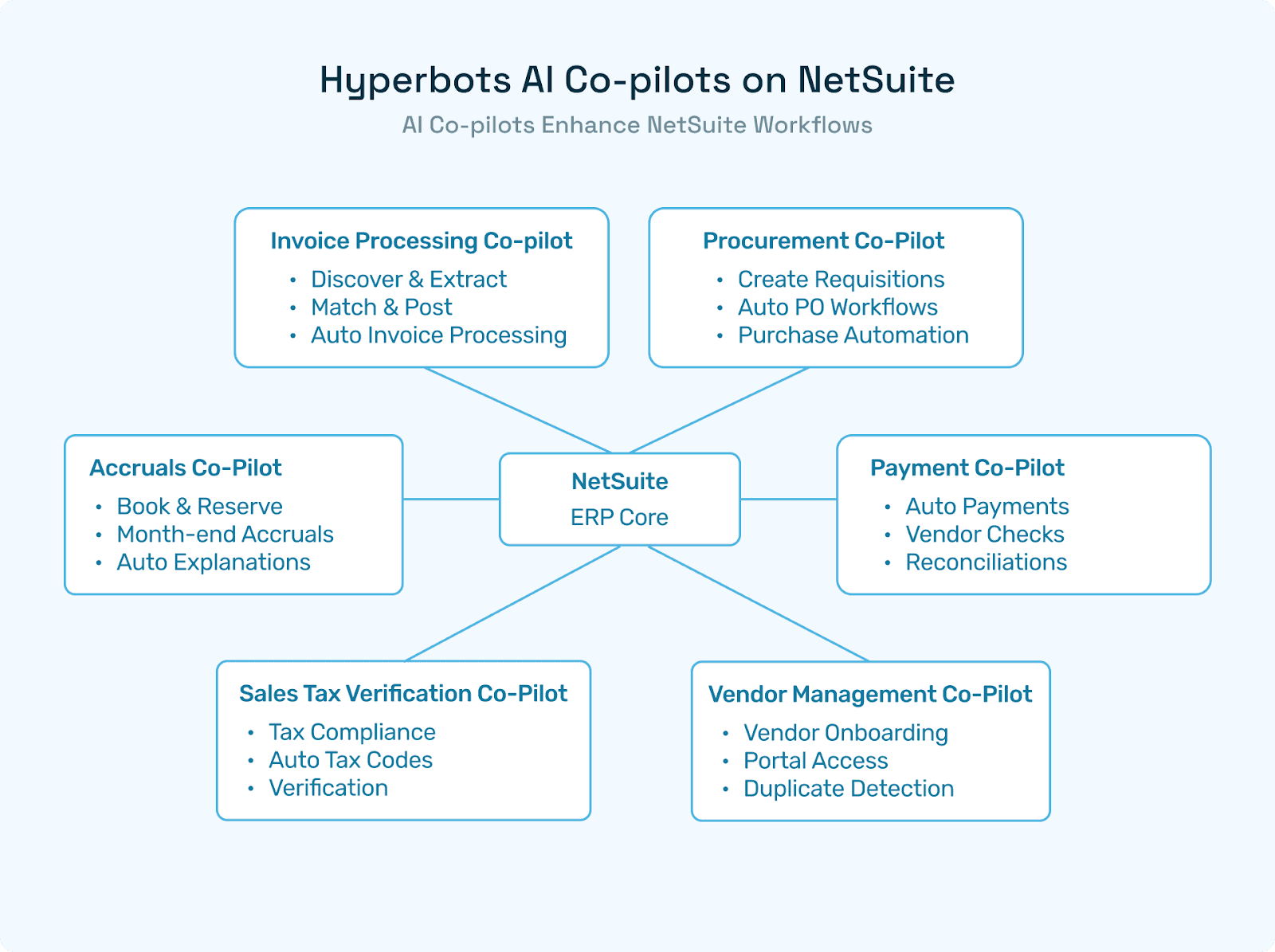
Hyperbots AI Co-pilots: Use Cases on NetSuite
Invoice Processing Co-Pilot
Automates discovery, extraction, matching, and posting of invoices in NetSuite
➡️ See: Invoice Processing Co-pilot
Procurement Co-Pilot
Creates purchase requisitions and automates PO workflows in NetSuite
➡️ See: Procurement Co-pilot
Accruals Co-Pilot
Books and reverse the month-end accruals with explanations
➡️ See: Accruals Co-pilot
Payments Co-Pilot
Automates payment workflow, vendor checks, and reconciliations
➡️ See: Payments Co-pilot
Sales Tax Verification Co-Pilot
Ensures tax compliance and auto-posts correct tax codes
➡️ See: Sales Tax Verification Co-pilot
Vendor Management Co-Pilot
Manages vendor onboarding, portal access, and duplicates detection
➡️ See: Vendor Management Co-pilot
Why Choose Hyperbots for NetSuite Users
Purpose-built for finance and ERP teams
Works out of the box with NetSuite
AI trained on 3M+ finance documents
Use of LLMs, VLMs, and MoE reasoning
No ERP modifications required
Trusted by mid-market and enterprise CFOs
Conclusion
If you’re evaluating NetSuite features, now you understand its full potential for transforming finance, inventory, CRM, HR, and more.
But the real power comes when you layer Hyperbots AI Co-pilots on top, turning a modern ERP into an autonomous finance command center.
Whether you’re scaling your mid-size business or optimizing a global enterprise, Hyperbots is the intelligent partner that turns NetSuite into a future-ready financial engine.