Bills Payable: The Complete 2025 Playbook for Controllers, Treasurers & AP Leaders
The Bills Payable Account supports better cash flow management, strengthens supplier relationships, and ensures top-tier compliance.
Bills Payable represent a company’s short-term promises to pay suppliers, but when they are mishandled, they drain cash and erode vendor trust.
Manual processes expose the Bills Payable account to duplicate payments, missed discounts, and compliance risk.
Modern AI, led by Hyperbots’ agentic co-pilots, captures invoices with 99.8% accuracy, validates terms, and schedules payments automatically.
Companies processing more than 20k payables a year cut AP costs by 83%, unlock early-pay savings, and close their books four days faster.
This guide covers definitions, accounting entries, risks, ROI benchmarks, and an implementation roadmap.
Table of Contents |
|---|
Bills Payable 101: Definitions & Context |
The Bills Payable Account in Double-Entry Accounting |
End-to-End Bills Payable Life-Cycle |
Top 7 Pain Points in Bills Payable |
AI & Automation: A New Hope |
Inside Hyperbots’ Bills Payable Co-Pilot |
11 Functional Capabilities You’ll Actually Use |
Architecture: Capture → Validate → Pay |
Compliance, Security & Audit-Readiness |
ROI Math & Benchmarks |
Implementation Roadmap |
Use-Case Deep Dives |
Wrap-Up |
Bills Payable 101: Definitions & Context
In plain English, Bills Payable are your company’s unpaid supplier invoices, which are short-term obligations typically due within 30–120 days. They sit on the balance sheet under current liabilities and flow through the cash-flow statement when settled.
Synonyms: Accounts payable, trade payables, AP vouchers.
Not to be confused with Bills Receivable (customer promissory notes).
A tight grip on the Bills Payable account boosts supplier confidence, captures early-payment discounts, and optimises working capital.
The Bills Payable Account in Double-Entry Accounting
Transaction | Debit | Credit |
|---|---|---|
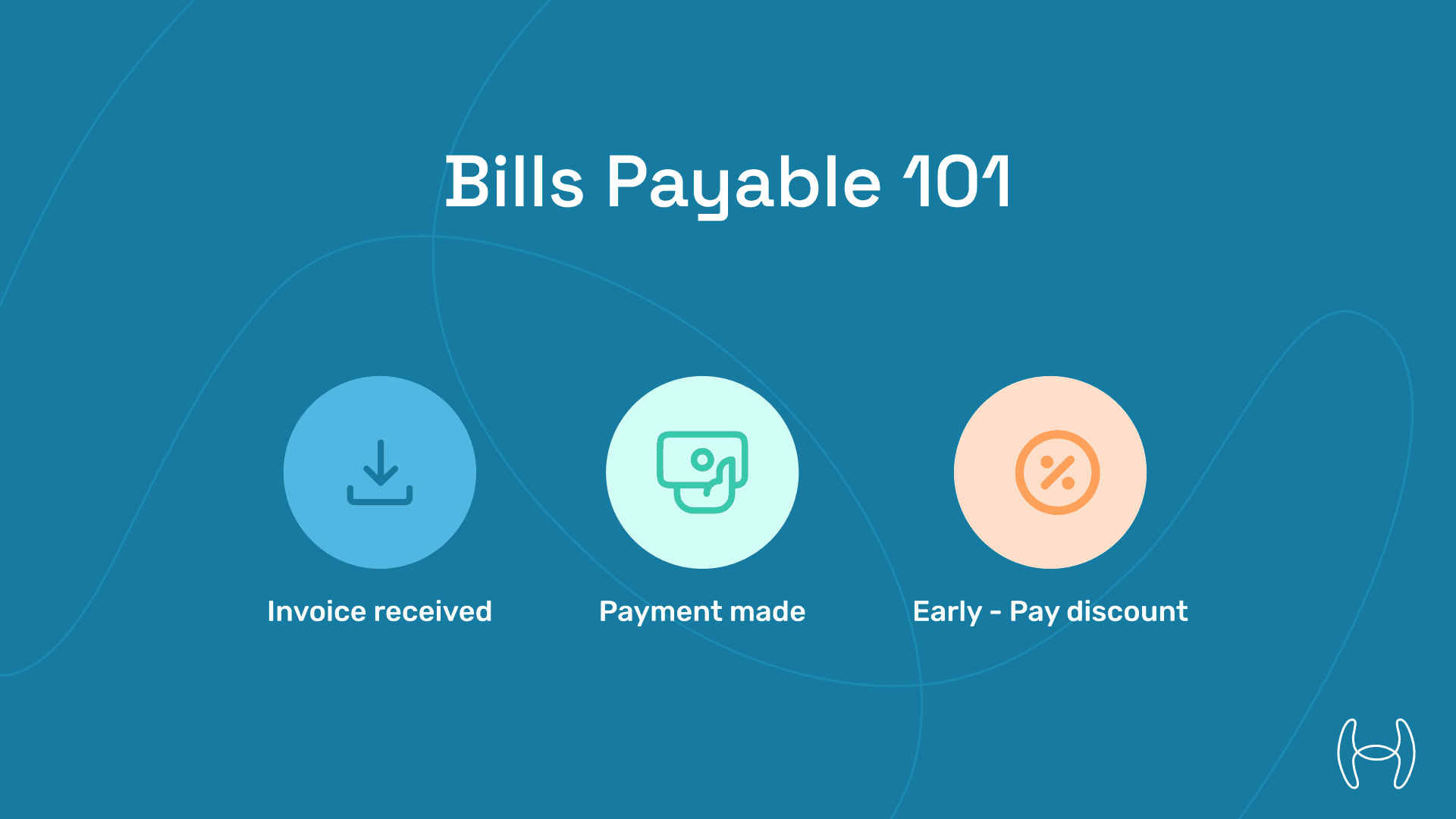
Invoice received | Expense / Asset | Bills Payable Account |
Payment made | Bills Payable Account | Cash / Bank |
Early-pay discount taken | Bills Payable | Expense (Discount) |
Key takeaways:
The Bills Payable account should clear to zero once payments post.
Aged-trial-balance aging buckets (0–30, 31–60, 61–90, >90) signal vendor health.
Duplicate entries distort both liabilities and expenses, but automation fixes that.
End-to-End Bills Payable Life-Cycle
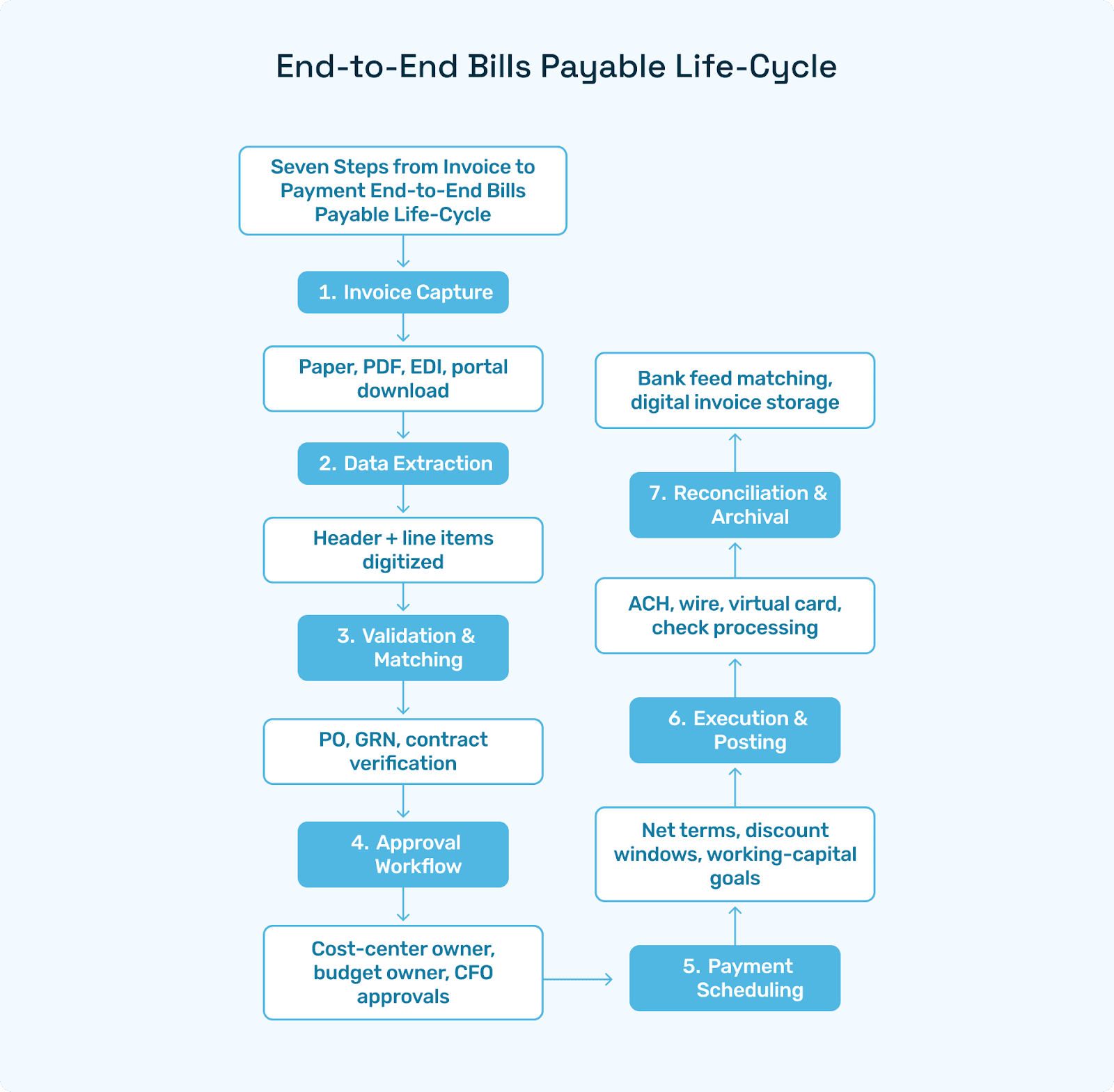
Invoice Capture — Paper, PDF, EDI, portal download.
Data Extraction — Header and line items digitised.
Validation & Matching — PO, GRN, contract.
Approval Workflow — Cost-center owner, budget owner, and CFO.
Payment Scheduling — Net terms, discount windows, working-capital goals.
Execution & Posting — ACH, wire, virtual card, check.
Reconciliation & Archival — Bank feed matching, digital invoice storage.
Top 7 Pain Points in Bills Payable
Data Entry Errors — Fat-fingered amounts, wrong vendor codes.
Duplicate Payments — Same invoice captured twice.
Missed Discounts — “2 / 10 Net 30” ignored.
Fraud & Phishing — Fake bank detail change requests.
Long Cycle Times — 12+ days approval locks up cash.
Compliance Gaps — Weak audit trail, SOX/PCI issues.
Siloed Systems — Email, shared drives, ERP not in sync.
AI & Automation: A New Hope for Bills Payable
Modern AI tackles these pain points by:
Reading unstructured invoices with Vision-Language Models (VLMs).
Detecting duplicates via fuzzy matching.
Parsing payment clauses at the paragraph level.
Auto-coding GL and cost centers.
Triggering payments only when a 3-way match passes.
Recording immutable blockchain audit logs.
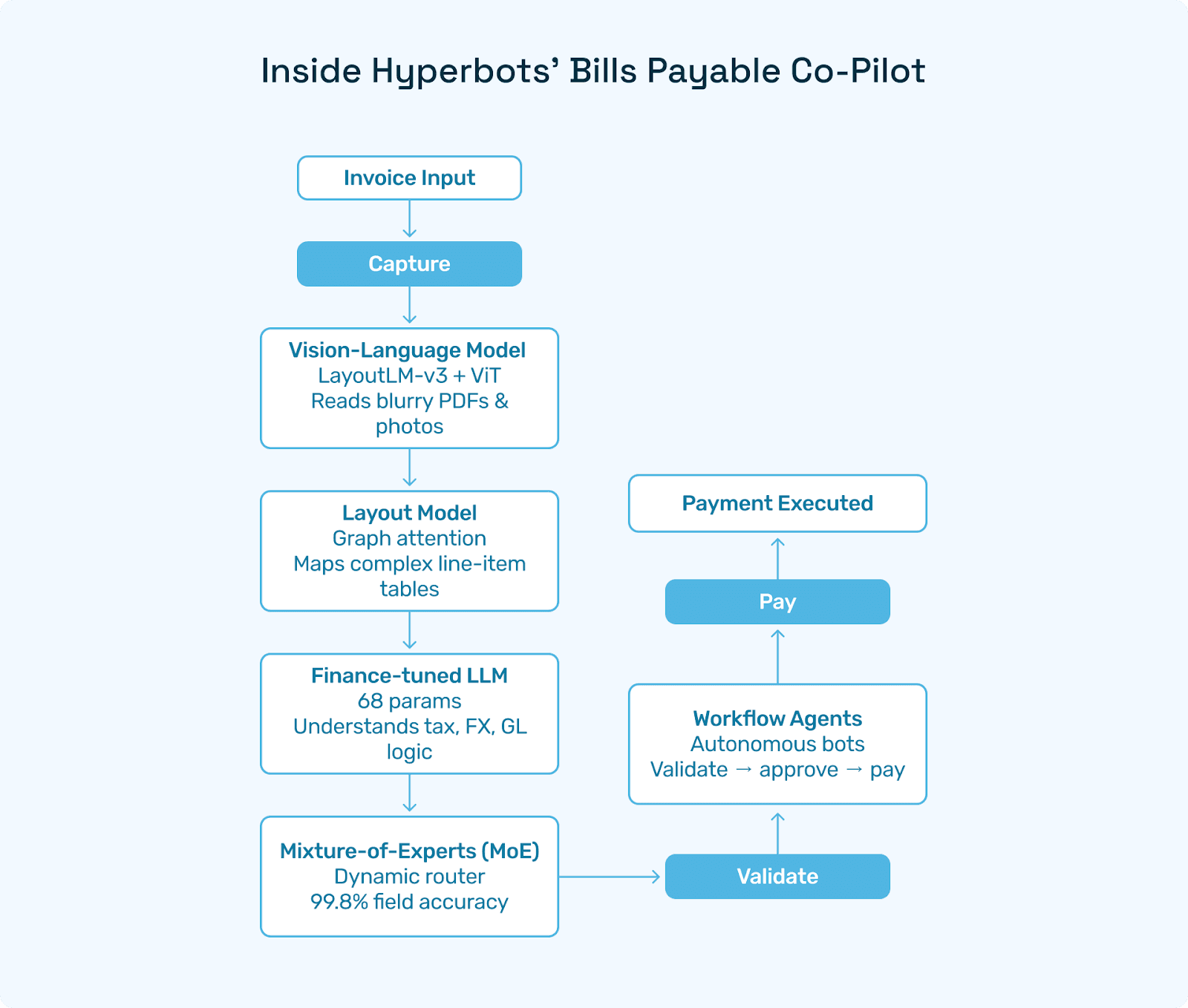
Inside Hyperbots Bills Payable Co-Pilot
Hyperbots extends its renowned invoice-processing engine into a full Bills Payable workflow:
Layer | Tech | Benefit |
|---|---|---|
Vision-Language Model (VLM) | LayoutLM-v3 + ViT | Reads blurry PDFs & photos |
Layout Model | Graph attention | Maps complex line-item tables |
Finance-tuned LLM | 6 B params | Understands tax, FX, and GL logic |
Mixture-of-Experts (MoE) | Dynamic router | 99.8% field accuracy |
Workflow Agents | Autonomous bots | Validate → Approve → Pay |
Level Payment Term Parsing
“1% per month after 60 days” or “2% / 10 Net 30” are captured, stored, and surfaced for cash-forecasting bots.
11 Functional Capabilities You’ll Actually Use
Email & Portal Ingestion — Zero lost invoices.
Intelligent Field Extraction — Header and limitless line items.
Dynamic GL & Cost-Center Coding — Learns from ERP.
2-, 3-, n-Way Matching — PO, GRN, contracts.
Tax & Payment-Term Validation — Penalties, discounts flagged.
Exception Workflow — Routes only true anomalies.
Real-Time ERP Integration — NetSuite, SAP S/4, Dynamics.
Continuous Learning Loop — Nightly micro-model retraining.
Agentic AI Orchestration — Specialised bots per task.
Multi-Currency & Multi-Language — Global operations readiness.
SOX-Ready Audit Log — Blockchain hash chain.
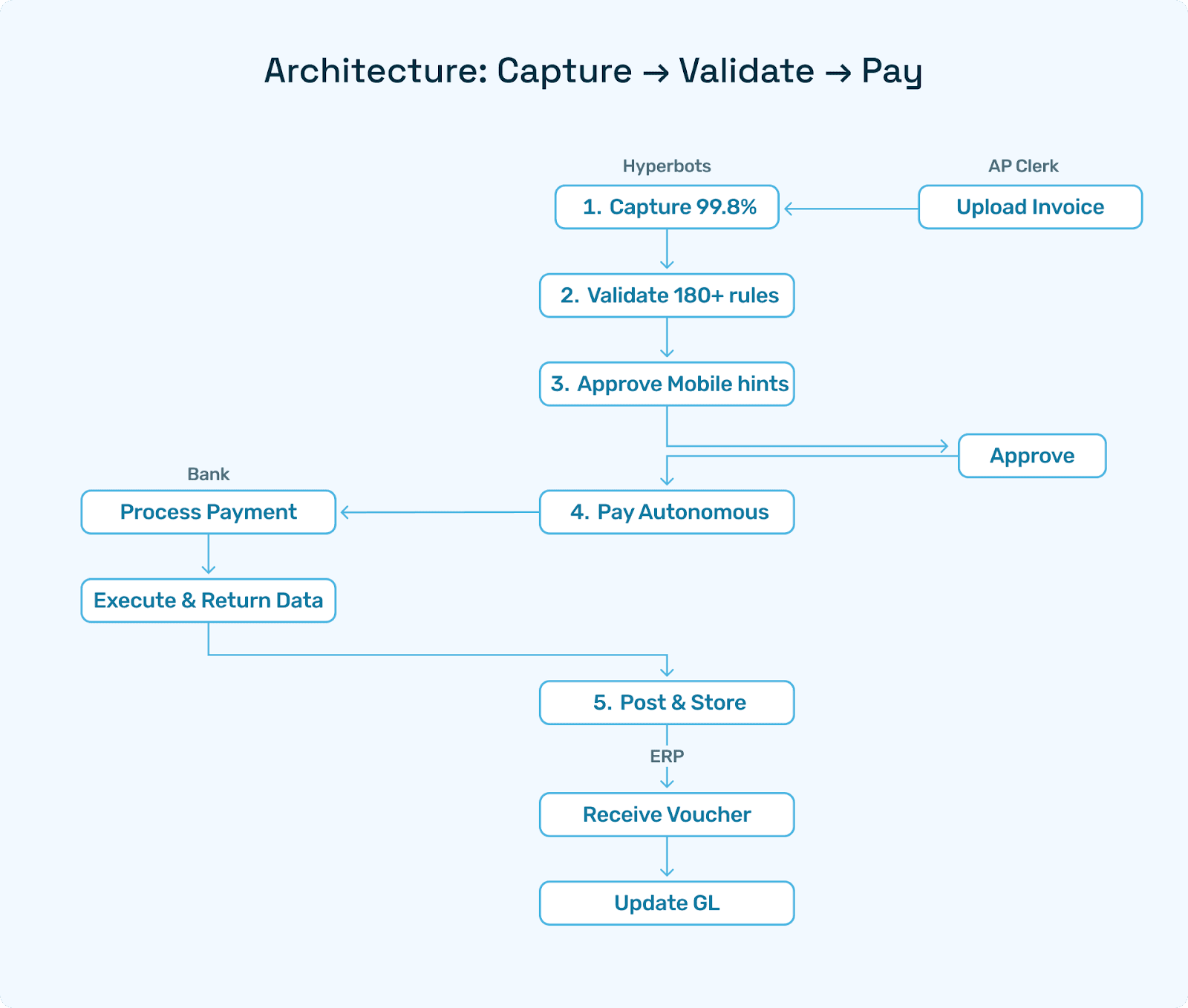
Architecture: Capture → Validate → Pay
Capture (99.8%) — VLM grabs every field, including PO lines, freight, and surcharges.
Validate (Real-Time) — 180+ rules: totals, tax, duplicate, vendor status.
Approve (Mobile) — Slack/Teams approvals with hints (“Approve, Discount ends in 2 days”).
Pay (Autonomous) — Auto-batch ACH/wire/check via bank APIs.
Post & Store — Voucher, journal entry and invoice image saved to digital vault.
Compliance, Security & Audit-Readiness
SOC 2 Type II + ISO 27001 certified hosting.
AES-256 at rest, TLS 1.3 in transit.
PII redaction for GDPR/CCPA.
WORM buckets/blockchain hashes for immutability.
Role-based access + SSO/SAML.
These controls protect the Bills Payable account from internal fraud and SOX deficiencies.
ROI Math & Benchmarks
KPI | Manual AP | Hyperbots Bills Payable | Impact |
|---|---|---|---|
Cost per invoice | $8.50 | <$2.40 | – 70% |
Approval cycle | 12 days | < 24 h | – 88% |
Early-pay discounts | 15% | 70% | +$600 k/yr |
Duplicate payment rate | 1.2% | 0.1% | – 1.1 pp |
Close-cycle days | 9 | 5 | – 4 days |
Mid-market firms (More than 20 k invoices/yr) see payback in less than 6 months.
Implementation Roadmap
Week | Phase | Deliverables |
|---|---|---|
1 | Discovery | Map data sources, KPIs, risk points |
2–3 | Pilot | 5,000 invoices; baseline accuracy |
4–5 | Integration | REST/SOAP plugins to ERP & banks |
6 | UAT & Training | 2-hour virtual workshop |
7 | Go-Live | HyperCare Slack; daily accuracy reports |
8+ | Scale | Add entities; optimise discount capture |
Change-management tip: Appoint a “cash champion” to showcase early wins from the Bills Payable project.
Use-Case Deep Dives
Manufacturing Early-Pay Blitz
Hyperbots flagged $2.3 M in potential discounts; finance captured 78% within the first quarter.
Construction Multi-Entity Setup
50 job sites, multi-currency. Hyperbots auto-coded cost centers; duplicate payments dropped 90%.
Pharma SOX Audit
Blockchain ledger met KPMG’s test; zero findings for the Bills Payable Account.
Wrap-Up
The Bills Payable Account isn’t just a liability line, it’s a lever for cash optimisation, supplier loyalty, and compliance excellence. Legacy OCR and spreadsheet workflows can’t keep pace. Hyperbots’ agentic AI delivers 99.8% capture accuracy, real-time validation, and autonomous payment orchestration, making it the gold standard for Bills Payable automation.
Ready to transform AP from a cost center to a strategic engine? Book a live demo and watch Hyperbots streamline capture, approval, and payment within weeks, not quarters.