NetSuite Alternatives: 2026 Buyer’s Guide to NetSuite Competition & AI Automation
Selecting a NetSuite alternative according to the industry demands requires checking vertical depth, AI readiness, and alignment with TCO.
NetSuite leads the mid-market ERP pack, yet fast-growing firms often need different price points, vertical depth, or deployment options.
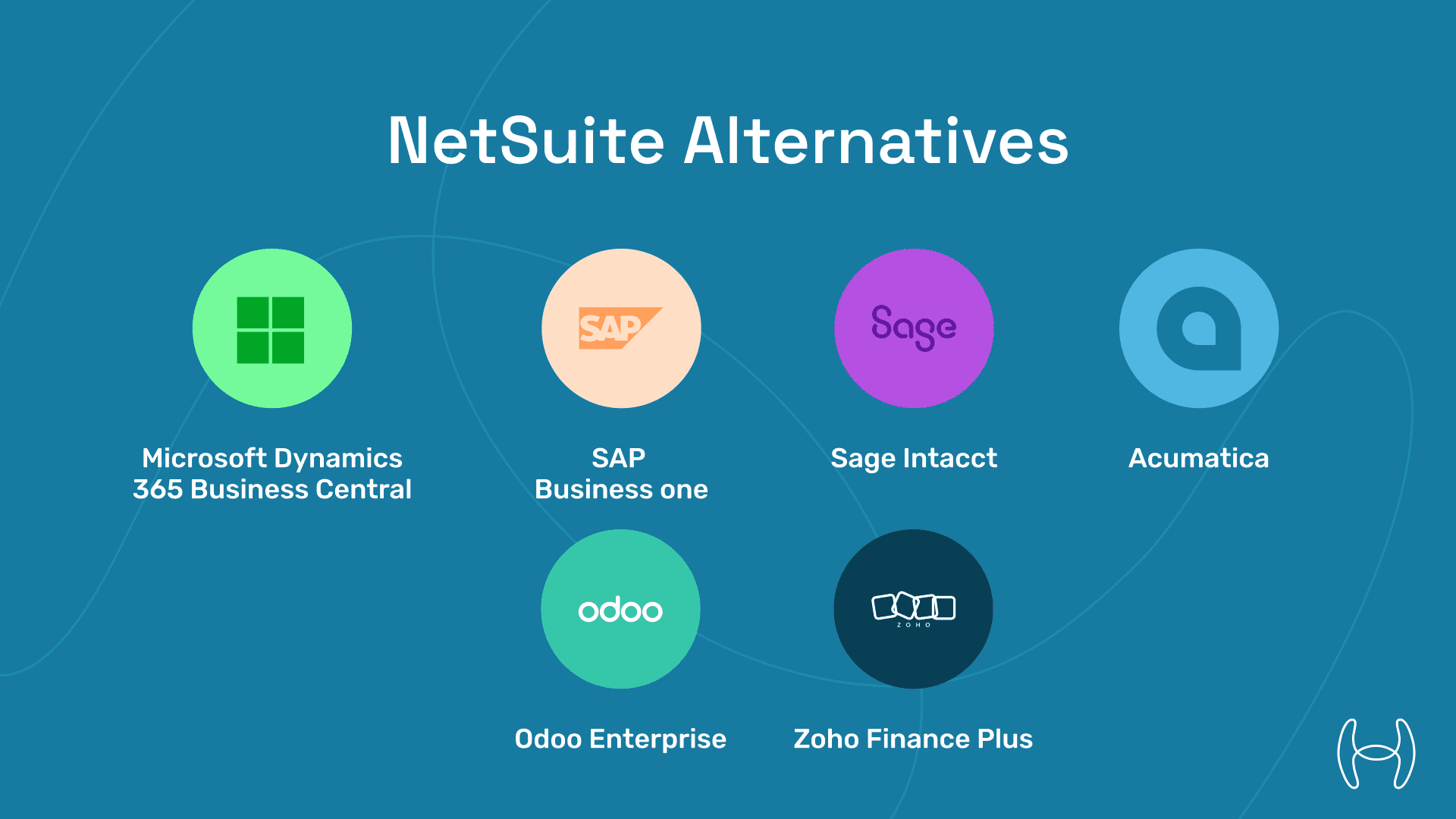
This guide compares seven NetSuite competitors, from Microsoft Dynamics 365 to Odoo, plus a special look at the best NetSuite alternative for small businesses. You will also find a real pricing comparison table, current market share data, and a breakdown of how AI-native ERPs are reshaping the competitive landscape heading into 2027.
Evaluation covers TCO, scalability, native modules, and ecosystem strength.
Regardless of the ERP you select, Hyperbots' six AI Co-pilots overlay finance workflows to deliver straight-through processing rates and data accuracy benchmarks that rival enterprise-grade automation stacks.
Use the decision matrix, migration checklist, and ROI math inside to choose confidently and future-proof with Hyperbots.
Why Look for NetSuite Alternatives?
Cost Sensitivity: NetSuite's user-based licensing and mandatory SuiteSuccess bundles stretch thin budgets. According to independent ERP research firm TechCloudPro, mid-market firms typically spend $72,000 to $180,000 per year in license fees alone, before implementation costs are added.
Vertical Complexity: Construction, Healthcare, and Manufacturing firms often need niche modules that NetSuite lacks out-of-the-box.
IT Strategy: Some CIOs prefer open-source stacks or regional hosting not offered by Oracle Cloud.
M&A Flexibility: Rapid roll-ups may demand multi-ERP coexistence before standardisation.
These drivers spark demand for software similar to NetSuite that can still scale, integrate, and automate.
Evaluation Criteria and Selection Framework
Dimension | What to Check | Notes |
Functional Fit | Core finance, distribution, and projects | Map to COA, supply chain, revenue ops |
Scalability | User count, multi-entity, multi-currency | Future M&A plans matter |
Total Cost of Ownership (TCO) | Licenses, implementation, support | 3-year horizon recommended |
Extensibility and APIs | REST, GraphQL, SDKs | Key for AI ERP software add-ons |
Ecosystem and ISVs | Marketplace depth | Tax, payroll, industry add-ons |
AI Readiness | Native ML vs. external overlay | Hyperbots Co-pilots work via API |
Implementation Risk | Partner quality, time-to-value | Ask for Suite-to-Live timelines |
Quick-Glance Matrix: NetSuite ERP Competitors
ERP | Ideal Company Size | Key Strength | AI Readiness | Pricing Tier | G2 Rating |
Microsoft Dynamics 365 Business Central | 100-1,000 FTE | Tight Office 365 tie-ins | Azure AI + Hyperbots | Mid | 4.0 |
SAP Business One / ByDesign | 100-500 FTE | Manufacturing depth | SAP BTP + Hyperbots | High | 4.2 |
Sage Intacct | 50-300 FTE | Non-profit and SaaS metrics | Intacct ML + Hyperbots | Mid | 4.3 |
Acumatica | 50-1,000 FTE | Unlimited users, modern UI | Open APIs + Hyperbots | Mid-Low | 4.5 |
Odoo Enterprise | 20-250 FTE | Open-source code, low cost | Python APIs + Hyperbots | Low | 4.1 |
Zoho Finance Plus | 10-150 FTE | SMB budget, quick setup | Zia AI + Hyperbots | Low | 4.3 |
QuickBooks Enterprise | Under 100 FTE | Familiar UI, US GAAP | API gateways + Hyperbots | Low | 4.3 |
Each player represents part of the NetSuite competition landscape. None match NetSuite's breadth alone, but combinations with the Hyperbots AI stack can close gaps.
Real Pricing Comparison: What Each ERP Actually Costs
Pricing is the most searched sub-topic in any ERP evaluation, yet most comparison guides avoid it. Here is what buyer data, partner-reported ranges, and independent research firms show as of 2026.
Important note: NetSuite and most mid-market ERPs do not publish official price lists. All figures below represent typical negotiated ranges drawn from G2 buyer reports, ERP Research, Softype, and TechCloudPro. Your actual quote will vary based on user count, modules, and contract length.
ERP | Base / Starting Fee | Per-User Cost | Typical Year-1 Total | Pricing Model |
NetSuite | $999/month base | $99-$199/user/month | $50,000-$200,000 | Per named user + modules |
Microsoft Dynamics 365 BC | $70/user/month | $70/user/month | $25,000-$100,000 | Per named user |
SAP Business One | $20,000-$50,000 year 1 | Included or per-user | $20,000-$100,000 | Perpetual or subscription |
Sage Intacct | Custom | Custom per entity + user | $50,000-$200,000 | Per user + per entity |
Acumatica | $15,000-$25,000/year (entry) | Unlimited users included | $75,000-$350,000 | Resource/consumption-based |
Odoo Enterprise | Free (Community) / $13-$31/user/month | $13-$31/user/month | $10,000-$60,000 | Per user (Enterprise tier) |
Zoho Finance Plus | Starts around $149/month | Bundled | $5,000-$30,000 | Suite-based |
QuickBooks Enterprise | Starts around $1,481/year | Included (1-40 users) | $2,000-$15,000 | Annual subscription |
What the table does not show: Implementation fees typically add 1x to 3x the annual license cost. NetSuite implementations for mid-market companies run $75,000 to $250,000 on top of licensing, per TechCloudPro's 2026 implementation cost guide. Acumatica's unlimited-user model is particularly competitive for companies with 15 or more users who need broad system access, since adding headcount does not trigger additional licensing costs the way NetSuite's named-user model does.
The Acumatica pricing exception: Unlike every other platform listed, Acumatica charges based on computing resources and transaction volume, not user count. A 50-person company and a 200-person company on the same resource tier pay the same price. For high-headcount, mid-volume operations, this model can produce meaningful 3-year TCO savings versus a comparable NetSuite deployment, according to case study data compiled by multientityaccounting.com.
ERP Market Share and Growth: Where NetSuite Actually Sits
Understanding the competitive landscape means looking at where each vendor stands in the broader ERP market, not just mid-market cloud comparisons.
According to 6sense market intelligence data for 2026:
Microsoft Dynamics holds approximately 24% of the ERP market
Workday holds approximately 12%
SAP ERP holds approximately 10.4%
NetSuite ERP holds approximately 5.2% of the ERP market overall
That 5.2% figure sounds modest, but it understates NetSuite's dominance in a specific segment: cloud-native ERP for companies with $5M to $500M in revenue. In that lane, NetSuite is the clear leader. Oracle reported that NetSuite crossed $1 billion in a single quarter for the first time in Q4 FY2025, with 18% year-over-year growth, an industry milestone that underscores demand for mid-market cloud ERP even as the broader tech sector faces headwinds, per Oracle's Q4 FY2025 earnings release.
The market itself is expanding fast. The global cloud ERP market was valued at approximately $65.9 billion in 2025 and is projected to reach over $207 billion by 2034, growing at a compound annual rate of around 7.2% through 2028, according to Fortune business insights. That means there is room for multiple platforms to grow simultaneously, which is why evaluating NetSuite competition is about fit and total cost rather than simply picking the market share leader.
Where the competition is intensifying: Industry analysis of ERP selection projects shows a clear pattern, most mid-market companies narrow their evaluation down to Microsoft Dynamics 365 and NetSuite as final contenders, while platforms like SAP S/4HANA, Oracle Fusion Cloud, and Workday appear more frequently in enterprise-tier decisions.
AI-Native ERP vs. Traditional ERP: A Split That Changes the Evaluation
The 2026 ERP market has divided into two meaningfully different camps, and understanding the difference matters before you shortlist vendors.
Traditional ERP competitors such as NetSuite, Dynamics 365, SAP Business One, Sage Intacct, and Acumatica share the same fundamental model: modular architecture, partner-led implementation, and AI features layered on top of existing platforms. Some do this better than others. NetSuite embedded over 100 AI agents through its NetSuite Next initiative launched at SuiteWorld 2025. Microsoft has embedded Copilot features across Dynamics 365 since late 2023. SAP is running AI through its Business Technology Platform. In every case, automation is a feature added to a platform built for a pre-AI world.
AI-native platforms take a different approach. Automation is not an add-on; it is the default operating mode. Implementation timelines are measured in weeks rather than months. Common examples in this emerging category include DualEntry, which covers the full financial stack and positions itself as a direct replacement for legacy mid-market ERPs.
The practical difference shows up in three places:
First, implementation time. Traditional ERPs average 3 to 12 months to go live, depending on complexity. AI-native platforms typically target 4 to 8 weeks for a finance-focused deployment.
Second, automation depth. Traditional platforms use AI to assist existing workflows. AI-native platforms redesign the workflow around automation first, with human review as the exception rather than the rule.
Third, total cost trajectory. Traditional ERPs tend to scale costs with headcount and module additions. AI-native platforms often use flat or consumption-based models that are more predictable at scale.
Where Hyperbots fits this picture: Hyperbots operates as an AI overlay that works across both categories. Rather than requiring a platform switch, Hyperbots plugs in via REST API or file drop on top of your existing ERP, whether that is NetSuite, Dynamics, Sage Intacct, or Acumatica, and delivers finance automation outcomes including invoice capture, accrual booking, payment timing, and vendor onboarding. The benefit is that you get AI-native automation benchmarks without replacing your core ERP, and without the implementation risk of switching to a platform with a shorter track record.
According to Gartner, AI is rapidly becoming a standard capability in enterprise applications, with up to 40% expected to include task-specific AI agents by 2026. As this shift accelerates, the question for ERP buyers is no longer whether AI is present, but how deeply it is integrated and whether it meaningfully reduces manual finance work at scale.
The SAP ECC Deadline: A Migration Trigger Worth Knowing About
If your organisation is currently running SAP ECC, or evaluating a company that is, the end-of-2027 deadline for mainstream SAP ECC support is a significant buying trigger.
SAP has confirmed that mainstream maintenance for SAP ECC 6.0 (EHP 6 through 8) ends on December 31, 2027, with no extensions planned. Extended maintenance is available through 2030 but carries an additional cost premium of approximately 9% above standard maintenance fees, with no new functionality delivered, as reported by Rimini Street.
As of late 2024, Gartner and CIO research estimated that only around 39% of SAP ECC customers had licensed SAP S/4HANA, meaning more than 60% of the SAP installed base still faced a migration decision. Migrations of any meaningful complexity typically take 18 to 36 months, per SAVIC Technologies' migration data, which means companies that have not started evaluating their path by mid-2026 are already in a compressed timeline.
This creates a real window for NetSuite and cloud-native competitors. For mid-market companies currently on SAP ECC that do not need the full complexity of S/4HANA, NetSuite, Acumatica, and Dynamics 365 Business Central all represent viable, faster migration paths at lower total cost of ownership.
Deep Dives into Seven Oracle NetSuite Competitors
Microsoft Dynamics 365 Business Central
Pros: Seamless Excel export, Power BI, and manufacturing add-ons.
Cons: Limited native project management; per-tenant upgrades require planning.
AI Edge: Azure Cognitive Services pairs with Hyperbots for ERP AI in invoice capture, tax, and vendor onboarding. Microsoft has also embedded Copilot AI features across Dynamics 365 since 2023, with Copilot Studio releasing further customisation tools in April 2026.
Pricing: Starts at $70/user/month, making it one of the most accessible mid-market ERP entry points on a per-user basis. Total first-year costs including implementation typically range from $25,000 to $100,000 for small to mid-sized deployments.
G2 Rating: 4.0 out of 5
SAP Business One / ByDesign
Pros: Strong MRP, QC, batch tracking, which is great for Manufacturing.
Cons: Higher license cost; complex UI.
AI Edge: SAP BTP ML services and Hyperbots Co-pilots bring Artificial Intelligence in ERP without custom ABAP.
Pricing: Year-one costs typically range from $20,000 to $100,000 depending on deployment type (perpetual vs. subscription) and user count, per ERP Research's SAP Business One overview. SAP Business One is best evaluated with a partner quote given significant variability by region and customisation scope.
G2 Rating: 4.2 out of 5
Sage Intacct
Pros: Best-in-class multi-entity GL, Salesforce integration.
Cons: Light warehouse functions; pricing accumulates quickly per entity.
AI Edge: Intacct Smart-Events trigger Hyperbots Accruals Co-pilot for faster financial closes.
Pricing: Custom pricing based on users and entities. Typical project costs run $50,000 to $200,000, per ERP Research's Sage Intacct alternatives guide. Sage Intacct's per-entity charge structure makes it progressively more expensive as a business acquires subsidiaries, which is worth modelling across a 3-year horizon before signing.
G2 Rating: 4.3 out of 5
Best fit: Service-centric businesses, SaaS companies, and non-profits where finance is the primary ERP driver and operational modules are not needed.
Acumatica
Pros: Usage-based pricing, Construction and Distribution editions.
Cons: Fewer prebuilt dashboards than NetSuite.
AI Edge: Open REST APIs let Hyperbots' Invoice and Payment Co-pilots reach high straight-through processing rates in weeks.
Pricing: Resource-based, not per-user. Entry-tier pricing starts around $15,000 to $25,000 per year for low transaction volumes. Mid-tier ranges from $25,000 to $45,000 per year, per multientityaccounting.com's Acumatica pricing guide. Unlimited named users are included at every tier, which makes Acumatica particularly cost-effective for growing teams. Gartner Peer Insights rates it among the highest-rated cloud ERP platforms for mid-market buyers.
G2 Rating: 4.5 out of 5
Odoo Enterprise
Pros: Open-source flexibility, low TCO, a popular NetSuite alternative for small businesses in EMEA.
Cons: Requires partner customisation; accounting depth is lighter than dedicated financial ERPs.
AI Edge: Python hooks call Hyperbots VLMs for high-accuracy document processing.
Pricing: Odoo Community is free and self-hosted. Odoo Enterprise runs $13 to $31 per user per month depending on region and module selection, making it one of the most affordable fully-supported ERP options available. ERP Research describes it as the most credible fully-supported option in the budget ERP tier. Total first-year costs including implementation range from $10,000 to $60,000.
G2 Rating: 4.1 out of 5
Zoho Finance Plus
Pros: Fast setup, CRM tie-ins, global tax packs, solid software similar to NetSuite at startup scale.
Cons: Limited advanced inventory; no native MRP.
AI Edge: Zoho's Zia and Hyperbots Co-pilots automate AP end-to-end.
Pricing: Suite-based pricing starts around $149/month. Total annual cost including implementation and onboarding typically runs $5,000 to $30,000 for SMB deployments, which is a significant step down from mid-market ERP costs.
G2 Rating: 4.3 out of 5
QuickBooks Enterprise + Apps
Pros: Ubiquitous, skill-based, simple reporting.
Cons: Weak multi-currency, no built-in warehouse management.
AI Edge: Hyperbots' NetSuite-grade Co-pilots connect via QuickBooks API Hub to deliver enterprise-class straight-through processing.
Pricing: Annual subscription starts around $1,481/year and supports 1 to 40 users. Total annual cost including any add-on apps typically stays between $2,000 and $15,000, making it by far the lowest-cost option in this list and the right fit only for sub-$20M revenue businesses with straightforward US GAAP needs.
G2 Rating: 4.2 out of 5
NetSuite Alternative for Small Business
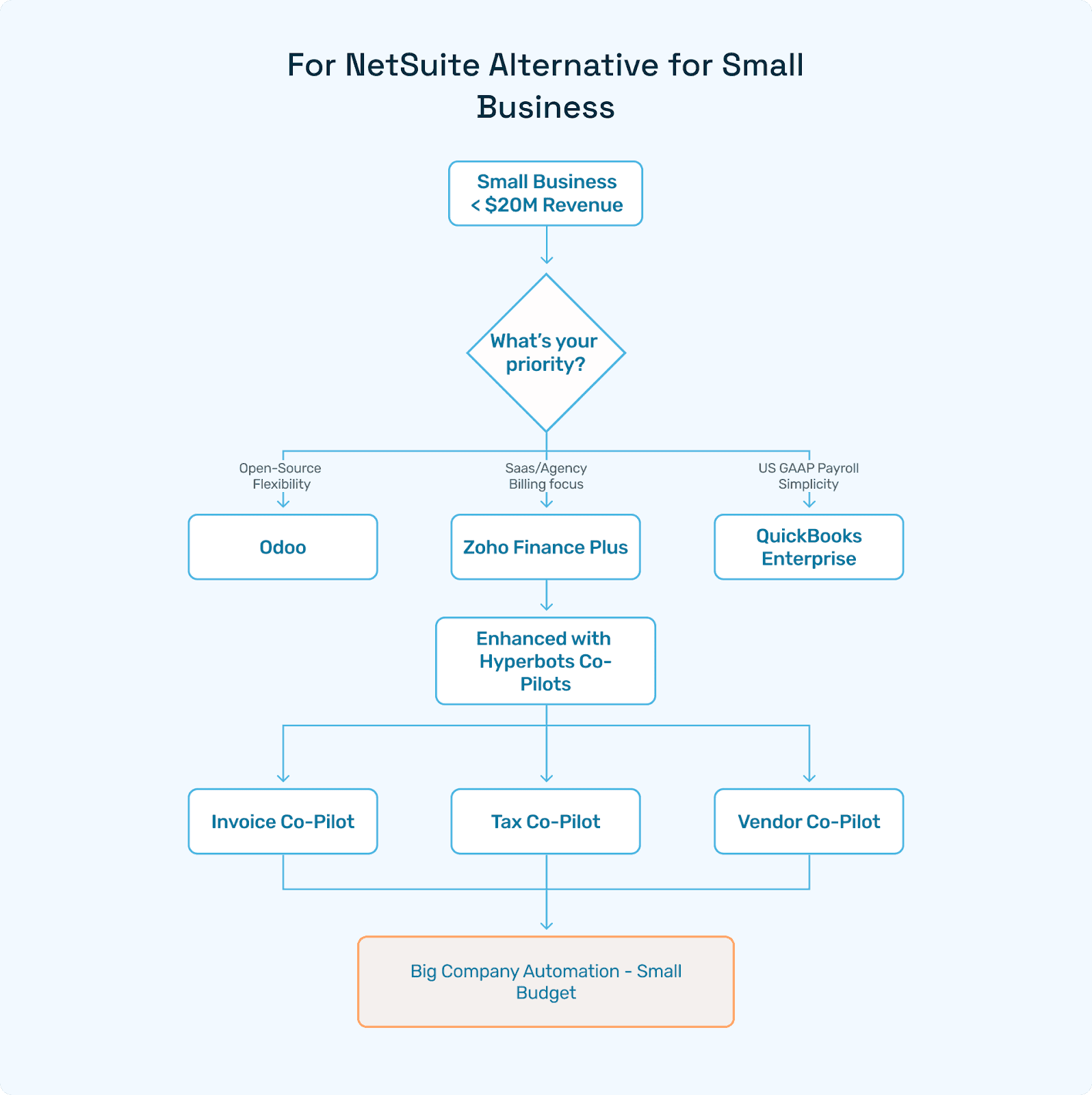
For firms with less than $20M in revenue:
Odoo for open-source believers who have technical resources to manage customisation.
Zoho Finance Plus for SaaS or agency billing where CRM integration matters.
QuickBooks Enterprise if US GAAP simplicity and payroll are the primary requirements.
All three pair smoothly with Hyperbots Invoice, Tax, and Vendor Co-pilots, bringing big-company automation to small budgets.
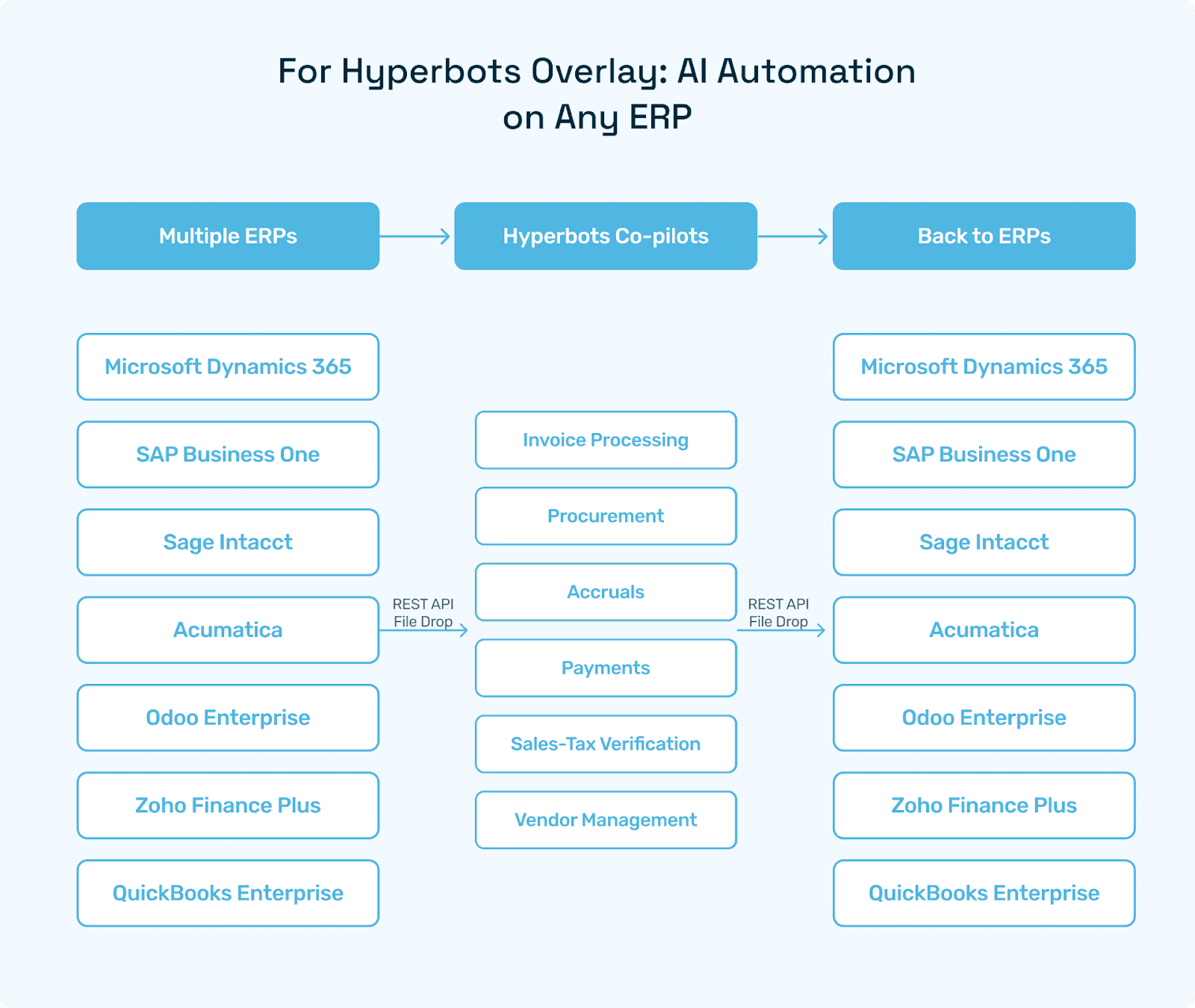
Hyperbots Overlay: AI Automation on Any ERP
Regardless of which NetSuite competitors you choose, Hyperbots plugs in via REST or file drop:
Co-pilot | Pain Point Solved | ERP Objects Touched |
Invoice Processing | High capture rate, high STP | Vendor Bills, Payables |
Procurement | AI requisition to PO | Requisitions, POs |
Accruals | Auto book and reverse | Journals, Schedules |
Payments | Discount timing, ACH/wire | Payment Batch, Bank |
Sales-Tax Verification | Jurisdiction look-ups | Tax Code, Vendor Bill |
Vendor Management | Onboard W-9 and portal | Vendor Record, PO Feed |
By decoupling AI from the core ERP, Hyperbots future-proofs your finance stack regardless of which Oracle NetSuite competitor wins your RFP.
Migration Checklist and Timeline
Phase | Week | Tasks |
Discovery | 1 | Define requirements, map Hyperbots' dependencies |
Vendor Shortlist | 2-3 | Score NetSuite alternatives via matrix |
Proof of Concept | 4-6 | Pilot top 2 ERPs and Hyperbots Invoice Co-pilot |
Selection and Contract | 7-8 | Negotiate pricing, lock migration date |
Implementation | 9-20 | Data conversion and ERP switching, Hyperbots API implementation(4 weeks to implement) |
UAT and Training | 21-22 | Hyperbots in-app tours, ERP role-mapping and sandbox testing |
Go-Live | 23 | HyperCare, Monitoring |
Optimise | 24+ | Add Accruals, Vendor portals, AI payments |
Conclusion
Choosing among NetSuite alternatives is less about "best logo" and more about aligning TCO, vertical depth, and AI readiness. Microsoft, SAP, Sage, Acumatica, Odoo, Zoho, and QuickBooks each outshine NetSuite in specific niches, making them worthy NetSuite ERP competitors.
The cloud ERP market is heading toward $207 billion by 2034. The SAP ECC deadline in 2027 is pushing tens of thousands of companies into a forced migration decision. And AI-native finance automation is moving from differentiator to table stakes. All of that means the window to choose thoughtfully and migrate carefully is shorter than it looks.
Whichever path you pick, Hyperbots AI Co-pilots ensure your finance team reaches high straight-through processing rates, faster financial closes, and audit-ready accuracy, within weeks, not quarters.
Ready to test Hyperbots on your shortlist of software similar to NetSuite? Book a live demo and see NetSuite or its rivals elevated to an AI-driven future.