Coupa Accruals vs Hyperbots: Which Stack Closes Your Books Faster?
How integration architecture is quietly extending your month-end close, and what a leaner accrual stack looks like.
Month-end close is one of the most time-pressured processes in finance. Many organizations rely on Coupa accruals to manage spend visibility and invoice data, but the real question is whether Coupa actually enables fast, real-time accrual posting to the general ledger.
The short answer: usually not without middleware.
This post covers how Coupa handles accruals, where it introduces delays, and how invoice-driven automation tools like Hyperbots are helping finance teams close faster and with fewer last-minute corrections.
What Accruals Actually Are (And Why Getting Them Wrong Costs You Time)
An accrual is an accounting entry that records an expense or revenue in the period it occurs, regardless of when cash moves. It sounds simple. In practice, it's one of the messiest parts of close.
The problem is timing. An invoice arrives on the 3rd. The service was delivered on the 28th. That gap between when something happened and when the paperwork catches up is where accruals live. Finance teams have to estimate, post, reverse, and reconcile these entries at close, and any lag in the data pipeline means estimates instead of actuals, which means adjustments, which means a longer close.
For most mid-market and enterprise finance teams, the accrual process looks like this: spend data sits in a procurement or AP platform, gets pushed through middleware or a scheduled integration job, and eventually lands in the ERP as a journal entry. Every hop in that chain adds latency. And latency at month-end means surprises.
That's the core tension this post addresses.
Quick snapshot: What “Coupa Accruals” Actually Offers
Coupa markets itself as a full spend-management platform with procurement, invoicing, expense, and AP automation and positions those features as helpful for month-end activities.
Coupa’s AP automation messaging claims it reduces invoice costs and improves visibility, which on the surface sounds like a natural foundation for accruals.
But in practice:
Many Coupa implementations rely on integration playbooks and outbound transaction feeds to push receipts, invoices, and accrual-related objects into an ERP (or into middleware) where the GL entries are finally generated.
Coupa’s integration playbook explicitly describes using Receipts to create accruals and using Invoice objects to create reversals and notes that customers typically must own and develop middleware processes to convert those transactions into GL accrual adjustments.
In short: Coupa is strong as the source of truth for spend data, but not always a one-click “post accruals to general ledger” solution without integration work.
Put bluntly: Coupa can deliver the data that accruals need but it commonly requires external orchestration (ERP, middleware, or third-party tools) to convert that data into live accrual journal entries. That architecture works but it’s not inherently “live accruals out of the box.”
Where Coupa helps the close and where it can slow things down
What helps
Centralized invoice and PO receipt records make it easier to find the transactions that should drive accruals.
Coupa’s AP automation is explicitly designed to reduce manual handling and increase visibility into spend. That visibility is a foundational piece of faster close workflows.
What hurts
Because GL accrual posting frequently depends on downstream conversions (middleware/ERP/journal automation), there’s often a window where Coupa holds “unposted” transaction data until the integration job runs.
If that integration is nightly, weekly, or manual, you get a reporting lag between invoice receipt and financial statement recognition.
That delay is one of the practical sources of Coupa month-end close delay for teams expecting instant GL impact.
Many organizations bolt on third-party close tools or build custom ETL processes to translate Coupa transactions into accrual journals which accelerates the close, but also adds project and operational overhead.
The need for these add-ons is evidence that Coupa’s out-of-the-box accrual posting is usually part of a larger solution architecture.
If your objective is “faster close with fewer moving parts,” relying on a platform that needs heavy integration to post accruals can be a drag unless those integrations are mature, near-real-time, and fault-tolerant.
The Hyperbots promise: live, invoice-driven accrual automation (what that actually means)
Hyperbots pitches a different tradeoff: rather than being a spend system that can feed accruals to other software, Hyperbots focuses on capturing invoice-level events and converting them into near-real-time accrual journal entries, minimizing the gap between when an expense is incurred and when it hits the GL.
Key value propositions from Hyperbots (and that matter for month-end):
Invoice-driven accruals: Every invoice or receipt event that should create an accrual is translated into a journal entry automatically reducing manual estimates and late adjustments.
Near-real-time posting: Instead of waiting for nightly batches, the bookkeeping is updated quickly (depending on the ERP integration cadence), which tightens reporting windows and reduces the “unknowns” during reconciliation.
Less reliance on bespoke middleware: By offering more of the accrual logic to the invoice capture layer, Hyperbots reduces custom ETL work and speeds up time to value.
It’s valuable to note that any vendor that posts journals to a customer’s ERP still needs tight testing and mapping. No tool is magic. But reducing the number of transformation hops between invoice capture and GL posting measurably shortens the month-end critical path.
Coupa VS Hyperbots: Accrual Stack Comparison
Feature / Capability | Coupa (Typical Stack) | Hyperbots (Live-Accrual Stack) |
Primary Role | Spend-management, invoicing, PO/receipt tracking, AP automation. Good for centralized cost control and spend visibility. | Dedicated invoice capture + accrual automation tool that links invoices/receipts directly to GL entries. |
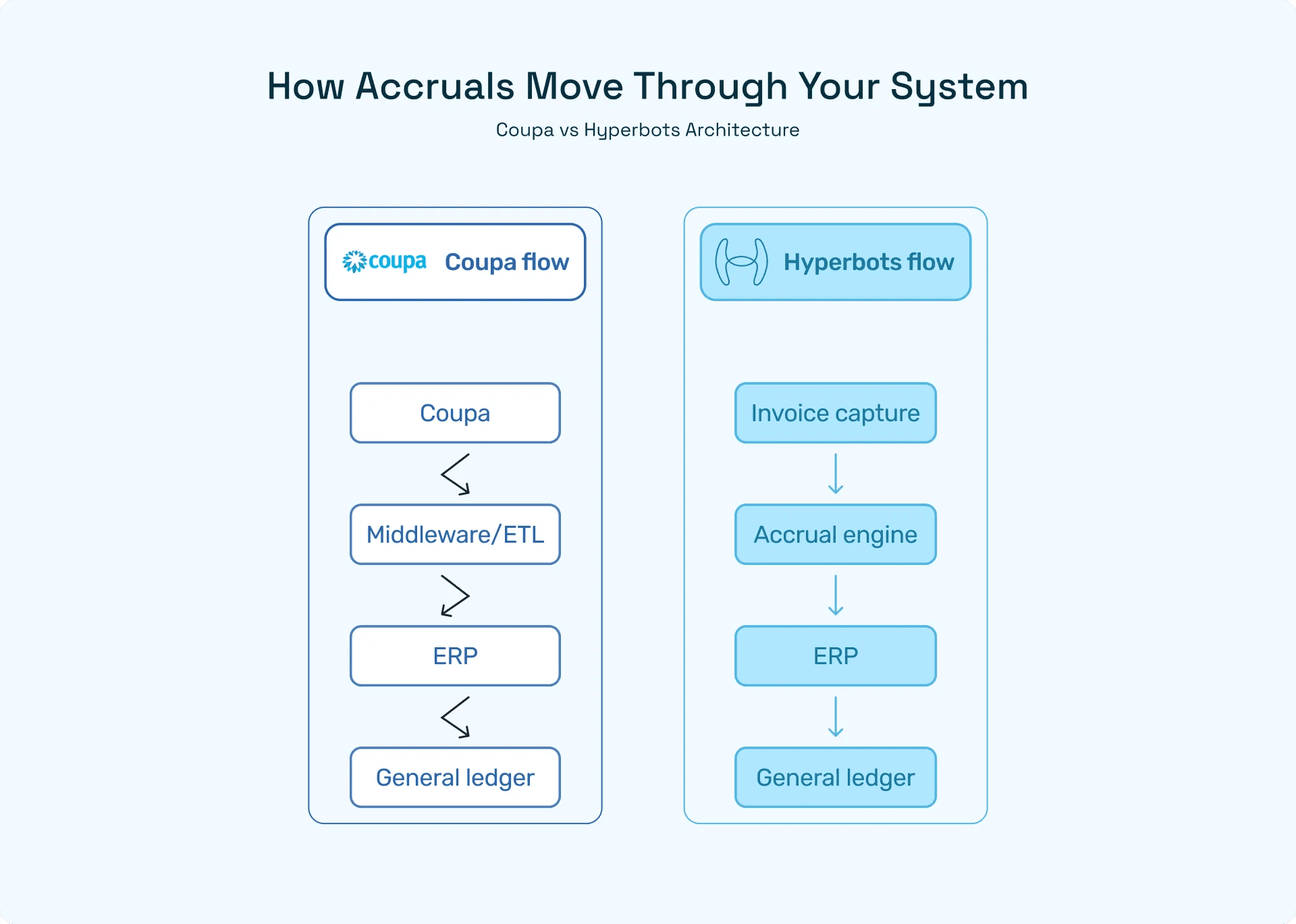
Accrual Post Workflow | Coupa → middleware/ETL or integration playbook → ERP → GL. Requires custom conversion or third-party add-ons. | Invoice capture → accrual engine → native ERP connector → direct GL posting (journals) with minimal hops. |
Time from Invoice Capture to GL Posting | Variable — depends on integration schedule; could be hours, nightly batches, or even days. Leads to potential reporting lag. | Typically fast — near-real-time or within a few hours (depending on ERP API cadence). Much more predictable close timing. |
Accrual Discovery & Accuracy | Relies on receipts/invoices being processed, plus manual or downstream routines for non-PO items or late invoices. Often reactive. | Proactive accrual detection: goods received but not invoiced (GRNs), pending invoices at cut-off, recurring non-PO accruals forecasted — all built into the accrual engine. |
GL Coding / Account Mapping | Needs custom mapping logic in middleware/ETL; prone to mapping errors, exceptions, or manual rework. | Built-in, adaptive GL recommender — learns from historical journal data + user corrections; reduces coding errors and manual touchpoints. |
Reversals / Cut-off Handling | Usually managed via scheduled jobs or manual reversal scripts; may be delayed, especially for late invoices. | Configurable policy-based posting and automatic reversals (month-start, real-time, 4-4-5 calendars, etc.) — keeps GL aligned automatically. |
Maintenance & Operational Overhead | High: requires maintaining middleware / ETL scripts, monitoring integrations, mapping logic, error handling. | Lower: pre-built no-code/low-code “Co-Pilot” connectors and accrual logic reduce custom work and maintenance burden. |
Auditability, Audit Trails & SOX Compliance | Spend data exists in Coupa; journal creation often occurs via external systems — traceability relies on custom logs / middleware. Audit trails may be fragmented. | Full end-to-end traceability: from invoice/receipt capture → accrual logic → posted GL entries; every step stamped with metadata and approvals for clean audit logs. |
Post-Close Adjustments & Journal Corrections | More frequent: due to mapping errors, late invoice posting, missed accruals, or manual overrides. | Fewer adjustments: accruals are accurate and timely, GL coding more reliable, and reversals aligned — reducing post-close corrections. |
Month-End Close Cycle Duration & Predictability | Less predictable: delays due to integration windows, manual adjustments, and batch jobs can push close out. | More predictable and shorter: real-time accruals and streamlined posting reduce surprises, enabling faster closes with fewer late-night corrections. |
Typical real-world outcomes: Comparing close speed
Here’s a playbook-style comparison of what teams often experience:
Coupa-centric stack (Coupa → middleware/ETL → ERP → GL)
Visibility into spend: strong.
Time from invoice capture to GL accrual posted: variable (hours → days → batch windows) depending on integrations. If integration is not real-time, the delay becomes Coupa financial reporting lag, particularly for late-month invoices.
Implementation effort: medium to high (integration playbooks, mapping, testing).
Hyperbots-style stack (Invoice capture + accrual logic → direct ERP journal posting)
1) Invoice discovery & enrichment (source-of-truth capture)
Hyperbots first finds all invoice signals (email, portals, drives, EDI/cXML feeds) and filters noise so only valid invoices enter the accrual pipeline. It augments missing fields and links invoices to PO/GRN data automatically meaning the platform knows what was received and what is outstanding before accrual logic runs. This front-loading is crucial to accurate accrual discovery.
2) Accrual discovery engine (services received / pending invoices / non-PO)
Hyperbots runs specialized routines to detect:
Goods received but not invoiced (GRNs and receipts),
Pending invoices at cut-off, and
Recurring non-PO accruals (utilities, subscriptions) via time-series forecasting and historical patterns.
That means the platform proactively builds an accrual list at cut-off, not after the fact — so accruals are discovered, quantified, and ready to post.
3) Dynamic GL coding & intelligent mappings
Instead of sending raw spend data downstream and letting middleware guess account mappings, Hyperbots uses GL-recommendation that learns from historical journal data and human corrections. It suggests (and can auto-apply) the correct account strings, cost centers, and dimensions while reducing coding exceptions and rework during the close.
4) Policy-aware posting & configurable reversals
Accruals can be posted according to your accounting rules (month-start reversals, real-time reversal on invoice arrival, 4-4-5 calendars, etc.). That eliminates manual reversal tasks and keeps the GL in sync with actual invoice lifecycle events. Hyperbots also embeds exception handling (period closed flag, invalid GL), so posts either succeed or are triaged immediately.
5) Native ERP connectors & read-back validation
Hyperbots ships with pre-built, tested connectors that write validated journal entries directly into ERPs and perform read-back validation to confirm successful double-entry posting. The result: accruals move from “detected” to “posted with provenance” in a single validated flow.
6) Audit trails, notifications & observability
Every decision from AI recommendation, human override to posting, is stamped with metadata, approvals and notifications. That makes SOX evidence and audit walkthroughs far simpler (and less nail-biting) than stitched-together middleware logs.
Why this beats the typical Coupa + middleware model (architectural advantages)
Fewer transformation hops = less latency
Coupa is excellent as a spend and PO/invoice management platform, but most customers rely on ERP integration playbooks, APIs or middleware to convert Coupa receipts/invoices into GL accrual journals.
That multi-system choreography (Coupa → middleware/ETL → ERP → GL) introduces batch timing, mapping drift, and troubleshooting overhead.
Hyperbots collapses much of that work into the invoice/accrual layer and posts directly via connectors, shortening time-to-GL and reducing “Coupa financial reporting lag.”
Accrual discovery happens earlier (and smarter)
Coupa can surface receipts and invoices (and its playbooks show receipt→ERP flows), but pending invoice checks, predictive non-PO accruals, and time-series forecasts are typically left to downstream reconciliations or added tools.
Hyperbots runs accrual discovery and forecasting at capture time, producing a ready-to-post accrual list at cut-off, not a list that needs reconciliation after nightly batches. That reduces post-close churn.
GL coding accuracy and feedback loop
When GL coding lives across multiple systems, mistakes happen more often and take longer to reconcile.
Coupa’s integration playbooks require teams to manage dynamic accounting mappings (e.g., for SAP) which often increases integration complexity.
Hyperbots’ GL recommender learns from corrections and produces adaptive mappings, lowering exceptions and manual coding edits which directly shortens close cycles.
Reversals and cut-off behavior are configurable and real-time
Many Coupa setups rely on scheduled jobs to reverse accruals or post journals; if those jobs run nightly, late invoices can create reporting lag or manual adjustments.
Hyperbots supports real-time or month-start reversals automatically, keeping the GL aligned with invoice events and minimizing manual reversal scripts.
Lower ongoing maintenance for close-critical logic
With Coupa, organizations often build custom ETL or use integration platforms (Workato, custom APIs) to handle the accounting mappings and posting logic. That means more moving parts to maintain.
Hyperbots advertises ready-to-deploy Co-Pilots with built-in connectors and no-code configuration, shrinking operational maintenance for accruals logic. Less orchestration = fewer breakpoints during month-end.
Bottom line
Hyperbots’ accrual stack is purpose-built to detect, quantify, code, post, and reverse accruals with minimal middleware choreography, a design that shortens month-end critical paths and reduces post-close noise.
Coupa is a powerful spend management source of truth and exposes the necessary data, but most Coupa implementations still rely on middleware/ETL and integration playbooks to translate that data into GL activity, which adds latency and maintenance. If your priority is invoice-driven, near-real-time accruals and a tighter close, the architectural advantages of an agentic, ERP-connected solution like Hyperbots are clear.
The business impact is straightforward: faster accruals = fewer adjustments, fewer post-close journals, and a tighter, more predictable month-end.
Fewer Hops, Faster Close: The Smarter Accrual Path
If your finance team is tired of month-end surprises, depends on late manual accruals, or sees regular Coupa month-end close delays, it’s time to inspect the integration architecture, not just the spend system. Coupa brings excellent spend visibility and AP automation to the table (great), but historically it’s been part of a multi-piece architecture for GL accruals which introduces variability unless properly designed.
Hyperbots (and other live-accrual approaches) aren’t magic but by collapsing the hops between invoice capture and GL posting, they reduce lag, shorten the close, and help finance teams avoid the ritual of “adjust, reclassify, apologize.” If you want the books to more closely match the business at close, minimizing transformation hops and moving to invoice-driven accruals is the pragmatic play.
FAQs (Frequently Asked Questions)
1. How does Coupa handle accruals during month-end close?
Coupa surfaces invoice and receipt data, but accrual posting typically depends on ERP integrations, middleware, or scheduled batch jobs.
2. Why do some finance teams experience Coupa month-end close delays?
Delays often come from integration latency, batch-based journal posting, and manual accrual adjustments outside Coupa.
3. What are invoice-driven accruals and why do they matter?
Invoice-driven accruals post expenses to the GL as invoices or receipts arrive, reducing lag, estimates, and post-close corrections.
4. How does Hyperbots automate accruals differently from Coupa?
Hyperbots converts invoice and receipt events directly into near-real-time ERP journal entries with built-in GL coding and reversals.
5. Which approach delivers a faster and more predictable month-end close?
Live, invoice-driven accrual automation with fewer integration hops—like Hyperbots—typically enables faster, cleaner, and more predictable closes.