Coupa ROI vs Hyperbots ROI: Why 99.8% Invoice Accuracy Generates 3× More Payback
Coupa ROI vs Hyperbots ROI: Invoice Accuracy Pays Back
When the finance team says “we’re automating AP,” they usually mean one of two things: (A) we bought a spend-management suite and told IT to make it sing with the ERP, or (B) we deployed a purpose-built invoice engine that posts clean journals to the GL the moment an invoice lands. Both sound good. Both promise ROI. One of them tends to deliver it sooner, with fewer headaches.
Because the fastest way to ROI isn’t buying more dashboards… it’s stopping invoices from becoming five-touch monster tickets.
When accuracy jumps from “ugh, why is this wrong again?” to ~99.8% correct, everything else falls into place: fewer exceptions → fewer late-night spreadsheet rescue missions → no surprise invoices haunting the close → better early-pay discounts → and auditors who don’t glare at you like you hid something. Put simply, 3× more payback happens not through magic but by removing the chaos that eats ROI alive.
Because when the numbers flow straight through instead of fighting you…That's when automation finally feels like automation.
The baseline: How vendors talk about Coupa ROI (the bright slide deck version)
Coupa positions itself as an AI-native total-spend management platform that delivers meaningful source-to-pay ROI. Coupa references Forrester/TEI studies and customer success stories suggesting large multi-year returns; the company also publishes materials about “optimizing TCO” and offers deep integration playbooks to link Coupa to ERP systems.
In short: Coupa is a comprehensive spend platform that can drive big strategic value (savings, fraud prevention, community intelligence) when implemented as intended.
Coupa’s confirms that receipts, invoices and accrual objects are typically sent downstream to ERPs or middleware for posting, and that customers commonly use APIs, flat files, or integration providers to perform that work.
In other words: Coupa is a strong source of truth for spend but many GL fidelity actions occur in downstream systems you also have to build and run.
Forrester TEI / Coupa TEI claim substantial multiyear ROI on source-to-pay consolidation.
Coupa’s AP automation promises to reduce invoice cost and increase visibility.
All true, in a polished slide deck. But the real question for month-end, accruals, and AP cost-economics is less “does Coupa reduce spend leakage overall?” and more “how fast and reliably does money-moving data turn into GL postings and accurate financials?” That’s where architectural detail and TCO assumptions matter.
“Where did that budget go?” Coupa ROI challenges and Coupa TCO problems
When you go beyond the slides, three recurring themes pop up and they directly impact realized ROI:
a) Integration & orchestration overhead (the middleware tax)
Coupa is designed to integrate with ERPs via API, CSV or third-party integration platforms.
That flexibility is powerful, but it also means the GL posting and accrual logic often sits outside Coupa, implemented in middleware, custom ETL, or the ERP itself.
Those integration projects take time, money, and ongoing maintenance and they add failure modes that increase month-end friction.
Coupa’s own integration playbooks acknowledge the need for integration and provide patterns for it.
Impact on ROI: implementation costs (consulting, custom code), extended timelines (longer payback windows), and operational staff to monitor/patch integrations.
b) TCO grows with scope & customization (Add a feature → Add a Bill)
Several observers and vendor comparisons note a common pattern: as you expand scope (global rollouts, SAP complexity, custom approval flows, supplier onboarding), TCO rises.
Coupa itself has content on “optimizing TCO,” which implicitly accepts that total cost depends heavily on integration and operational decisions.
Third-party comparisons sometimes call out Coupa’s TCO as increasing with added customizations and partner dependencies.
Impact on ROI: higher ongoing fees, more expensive upgrades/customizations, and the risk of partner-driven professional services consumption that eats into projected savings.
c) Reporting and accrual lag: How is this STILL NOT in the GL?
Because Coupa often hands off to a downstream job that converts receipts/invoices into GL accruals or reversals, the time between invoice capture and GL recognition can vary (near-real-time → nightly batch → manual).
When those conversion jobs are not near-real-time, you get reporting lag and month-end headaches (late invoices that require post-close adjustments).
Impact on ROI: the finance organization pays in FTE overtime, deferred adjustments, and audit friction, costs that often get ignored in “headline ROI” models that center on procurement savings.
Hyperbots vs. Coupa: ROI & Accuracy Comparison
Criteria | Coupa | Hyperbots | Why It Matters |
Primary Value Proposition | Broad spend-management platform | High-accuracy invoice + accrual automation | Spend visibility vs. financial precision |
Invoice Data Accuracy | Lower / variable (dependent on integrations + manual touchpoints) | ~99.8% accuracy | Fewer exceptions → exponential ROI gains |
Straight-Through Processing (STP) | Commonly requires manual fixes + downstream enrichment | 80%+ STP on average | Less labor, faster throughput |
Exception Handling Required | High; exceptions escalate at month-end | Low; Intelligent capture prevents most exceptions | Exceptions are the biggest recurring AP cost |
Accrual Posting to ERP | Middleware or IT-managed integrations | Direct ERP journal posting with read-back validation | Eliminates latency + failure points |
Reporting & Close Speed | Often batch-dependent → Coupa financial reporting lag | Near-real-time → shorter, predictable close | Faster financial clarity = better decisions |
Hidden TCO Costs | Integration, iPaaS, consulting creep, custom workflows | Lower; prebuilt connectors and co-pilots | Less budget leakage post-implementation |
Audit Trail Completeness | Fragmented across tools | Unified; end-to-end traceability | Cuts audit hours and risk remediation costs |
Payback Window | Longer; integration drives delays | Faster ROI due to exception elimination | Finance leadership cares about time-to-benefit |
The economics that actually move the needle: accuracy, exceptions, and time
ROI in AP usually comes from a few levers:
reduced cost per invoice (automation),
fewer exceptions (accuracy),
faster cash management (early pay discounts, optimized payment terms), and
lower operational risk (fewer duplicate payments, audit findings).
Industry benchmarks show wide ranges for cost per invoice: manual processing commonly ranges from roughly $12–$40 per invoice depending on complexity and non-PO vs PO invoices, while automated, end-to-end processes can fall into the $1–$5 range per invoice for high performers.
But a crucial, often overlooked number is the exception rate, the fraction of invoices that require manual intervention. Exceptions are expensive.
They tie up skilled staff, require vendor follow-ups, cause late payments or missed discounts, and produce audit trail headaches.
Accuracy, measured using straight-through processing (STP) rate or extraction accuracy, is the multiplier on all AP economics.
Higher accuracy → far fewer exceptions → exponentially better ROI.
Where Coupa ROI models can under-count costs (the “hidden costs”)
Common places Coupa ROI decks (and many procurement ROI models) under-count:
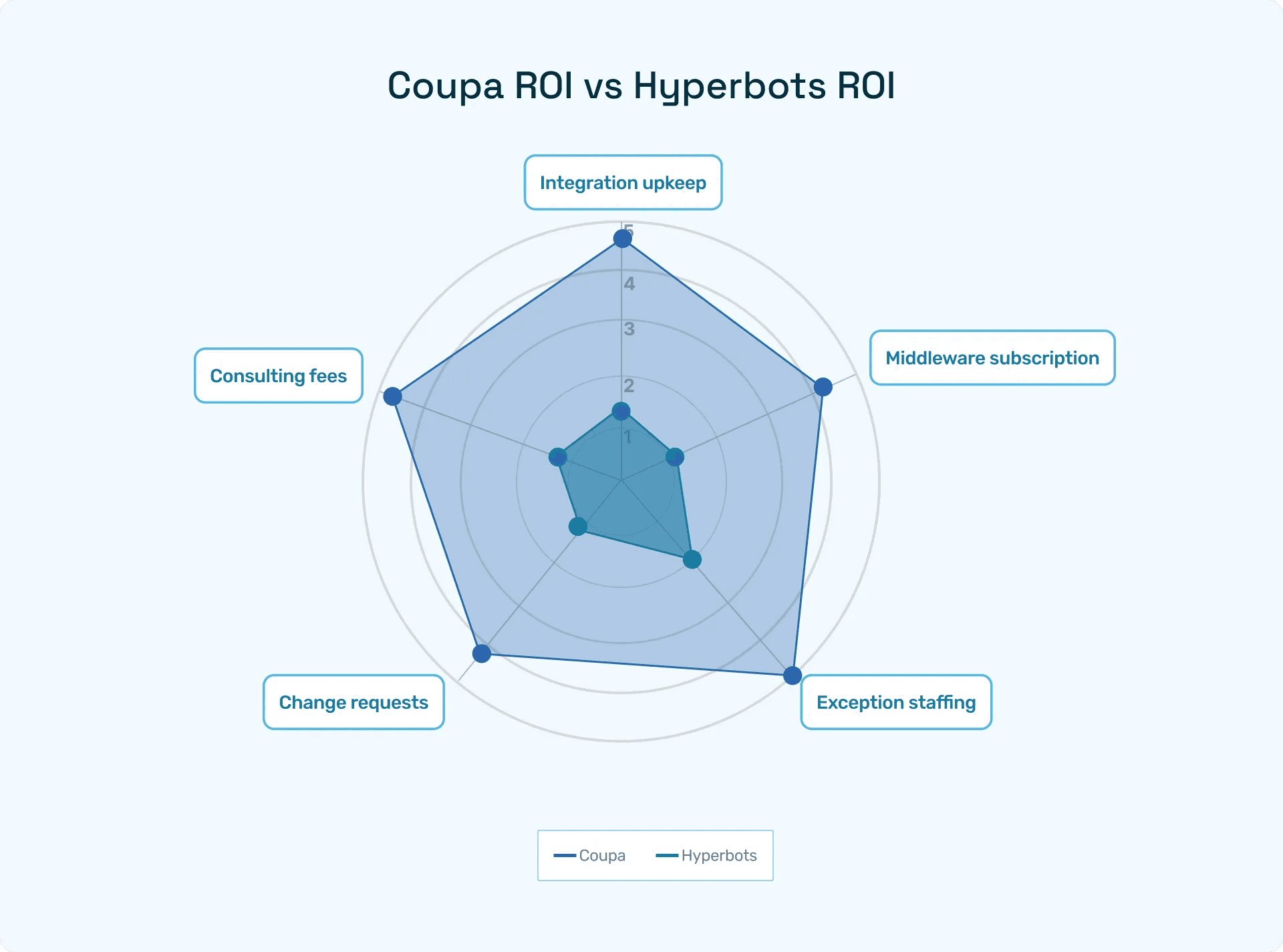
Professional services & consulting for integration and roll-out (global rollouts, tax/regulatory mapping). Coupa’s integration playbooks help, but most large orgs still budget significant partner time.
Middleware platform licenses / iPaaS and the operational team to run them (Workato, Boomi, Mulesoft, custom ETL). Those license fees and run-costs add up.
Exception handling headcount: many firms under-staff and then add contingent headcount or overtime around month-end. Exceptions are the recurring cost that compounds. Industry benchmarks place a wide range on per-invoice exception costs, which is why accuracy matters.
Customizations and change requests: every twist in approval routing, every unique supplier, and every ERP idiosyncrasy is extra time and cost. Coupa’s Compass playbooks reduce risk but don’t eliminate customization expense.
Call them Coupa hidden costs, Coupa TCO problems, or simply the middleware tax. They’re real, they matter, and they delay payback.
Why a high-accuracy, invoice-driven approach materially changes that calculus
A Hyperbots-style stack (invoice discovery → intelligent enrichment → accrual engine → native ERP connectors → validated GL posting) attacks the largest cost center, exceptions and the integration overhead directly:
Fewer hops, fewer owners: fewer systems to monitor means fewer breakpoints. Hyperbots has built-in connectors, read-back validation, and an accruals co-pilot that posts and validates entries (so you’re not stitching middleware logs to prove an audit trail).
Higher STP and extraction accuracy: Hyperbots achieves a high extraction and STP, with large gains in straight-through processing (More than 80% STP figures for many customers). Higher STP = exception reductions.
Policy-aware postings & reversals: automatic reversal logic, configurable cut-offs, and read-back validation minimize manual reversal scripts and late adjustments. That’s a direct exception-and-workload reducer.
End-to-end auditability: the system stamps metadata, approvals and provides read-back confirmation. Auditability reduces costly audit queries and the downstream time auditors spend chasing provenance.
These mechanisms deliver the exception reductions and TCO simplifications so your team can realize true automation instead of just throwing money and not seeing it’s worth.
Objections & reality checks (because nothing is free or magical)
Let’s be honest and fair: there are times when Coupa + proper integrations is the pragmatic choice:
If your team is prepared to invest in integration maturity with good iPaaS, strong testing, and experienced middleware engineers, you can drive down the Coupa stack’s exception rates and shorten its payback window.
Coupa Compass and integration playbooks are useful references for those teams.
But if your primary goal is to accelerate month-end close, eliminate accrual lag, and minimize the human exception tax in AP/AR/Accruals then architecture matters.
You want the fewest hops between invoice discovery and GL posting, and you want the fewest exceptions. That’s where Hyperbots accuracy-driven ROI wins.
Practical checklist: How to evaluate the ROI claims and validate your own multiples
When a vendor throws a shiny ROI slide at you, ask these questions and run the numbers using your own data:
What’s your current exception rate? (the single most important metric)
What’s the true cost to resolve one exception? (include FTE load, escalation, and ERP fixes)
What integration architecture do they require? (middleware + iPaaS + consultants = ongoing cost)
What is the vendor’s published STP / extraction accuracy and can they show audited runs on your documents? (ask for raw metrics on your file types)
How much of the accrual logic is native vs downstream? (if your accruals live in middleware, add that cost)
What’s the onboarding & change control process for GL mappings and reversals? (how much of your finance team’s time will be required to maintain mappings?)
Ask for a pilot on a representative sample of invoices (ideally including the actual complex invoices that create exceptions). Measure STP and exception cost delta on your baseline, not a vendor demo.
Final thought: The real ROI is the one you can sustain
“Coupa ROI” is real and in many cases impressive particularly around procurement consolidation, supplier management, and spend visibility. But the headline ROI number often hides two things:
the recurring TCO of integration and maintenance
the drag that exceptions impose on your finance function.
When you model AP economics properly, accuracy (exception reduction) turns out to be the single most leveraged variable. Increasing invoice accuracy from a few-percent exception rate down to near zero doesn’t produce only linear savings, it collapses the ongoing, human labor-dominated tail of AP costs. That’s why an invoice pipeline that reliably hits ~99.8% accuracy can produce 3× the net payback compared to a more traditional Coupa + middleware approach under realistic assumptions.
If you’re evaluating investments, don’t just ask “what’s the platform discount potential?” Ask “how many exceptions will I still have on month end, and what will they cost me next year?” Accuracy answers that question; architecture delivers it.
Frequently Asked Questions (FAQs)
Q1: Why doesn’t Coupa automatically deliver high ROI in AP automation?
Coupa can deliver strong procurement-driven savings but AP ROI hinges on invoice accuracy, exception reduction, and how quickly data posts to the GL.
Since Coupa often relies on middleware or ERP-side logic to finalize GL postings, exception costs, integration overhead, and reporting lag can dilute the expected return.
Q2. What are the biggest hidden costs behind “Coupa ROI”?
The usual suspects:
Integration design + long-term maintenance
Middleware (iPaaS) subscriptions
Exception handling staff + overtime (especially at close)
Customizations and change requests
Consulting hours that never seem to end
These costs aren’t always front-and-center in the slide deck… but they show up fast in the invoice trail.
Q3. How does invoice accuracy actually affect ROI?
Accuracy is the multiplier on AP economics.
Higher accuracy → fewer exceptions → less labor, fewer delays, fewer audit issues → accelerated payback.
When error rates drop below 0.2% (≈99.8% accuracy), exception handling nearly disappears. That’s what unlocks up to 3× more ROI versus systems with lingering manual touchpoints.
Q4. Does Hyperbots replace Coupa?
Hyperbots CAN replace Coupa but it’s also common for companies to:
keep Coupa to control spend and procurement workflows
use Hyperbots to automate invoice accuracy, accruals, and posting.
Q5. Can Coupa achieve similar ROI if integrated well?
Yes; with:
✔ advanced iPaaS
✔ strong middleware engineering
✔ optimized ERP mapping
✔ continuous monitoring
✔ low exception environment
But… that’s a lot of “ifs” and it requires ongoing investment. A high-accuracy, direct-to-ERP posting model simply reduces the number of things you must get right for ROI to show up.