Coupa Implementation vs Hyperbots Deployment: 9-12 Months vs a Few Weeks
Coupa Implementation vs Hyperbots Deployment: Timeline Compared
If you’ve ever stared at a Gantt chart during a procurement system rollout and felt a tiny piece of your soul pack its bags…welcome to the club. Implementing a new procure-to-pay solution should feel like progress and yet all too often, it becomes a marathon of delayed integrations, invoice backlog panic, and vendor-onboarding fatigue. Finance leaders don’t just need software, they need automation that actually launches within the same fiscal year.
That’s where the frustration begins. Many procure-to-pay SaaS deployments promise digital transformation, but instead deliver:
Slow time-to-value while everyone waits for integrations to behave
Complex configuration cycles that drain implementation budgets fast
Supplier onboarding delays that keep AP teams stuck in manual mode
Change-management challenges where end users cling to old processes
Project fatigue that sets in long before the first automation goes live
Every month a platform isn’t live, finance misses out on the automation benefits they bought in the first place, faster invoice processing, fewer errors, more control, and actual cost savings instead of PowerPoint promises. The business wants outcomes; IT wants stability; finance wants ROI; and executives want everything yesterday.
And that’s really the heart of the discussion: do you choose a heavyweight solution that might take a year to fully deploy, or a modern automation platform designed to deliver value in weeks?
Common Reasons Enterprise Coupa Projects Stretch to 9-12 Months
Many organizations find that implementing Coupa isn’t a quick “turnkey” job, especially at scale. Real user conversations in procurement forums and verified reviews point to extended timelines, often approaching or exceeding a year, for reasons that go beyond simple configuration.
• Complex Scope and Change Management
Deployments often involve aligning procurement, AP, finance, and IT teams. As one practitioner noted, “Coupa implementation takes forever… especially for large companies” where tool flexibility combined with organizational complexity makes rollout slower than expected.
• Configuration and Integration Friction
While Coupa integrates with major ERPs like SAP and Oracle, users report ongoing integration challenges even months after go-live, particularly around supplier and finance connectivity, indicating that integrations can extend well into implementation and stabilization phases.
• Workflow and Adoption Complexity
Several reviewers noted that going beyond basic procurement into layered approvals and cross-functional workflows can be “cumbersome” and time-intensive to set up correctly, especially in enterprise environments with multiple entities and approval chains.
Industry deployment guides also estimate that end-to-end timelines for comprehensive procure-to-pay solutions can range from a few months to over a year for large, multi-ERP, multi-region enterprises, depending on scope, integrations, and internal readiness.
The “few weeks” promise: what it actually means for Hyperbots
“Few weeks” isn’t magic, it’s design philosophy. Hyperbots aims to reduce the heavy lifting that inflates project timelines by focusing on:
Pre-built connectors and lightweight integration patterns so ERP handshakes happen quickly.
AI-first invoice/data extraction to avoid long periods of template creation and manual mapping.
Minimal, sane configuration defaults so teams can run standard procure-to-pay flows without bespoke builds.
Rapid supplier onboarding tools (self-service portals, bulk upload flows) to shrink the time vendors spend in purgatory.
Put simply: Hyperbots trades deep, custom configuration for practical readiness. That means teams can start processing invoices, approvals and exceptions fast then expand features iteratively. If you prefer to eat the cake and then decide whether to ice it, this is the approach. (Yes, we meant cake.)
1) Project Length
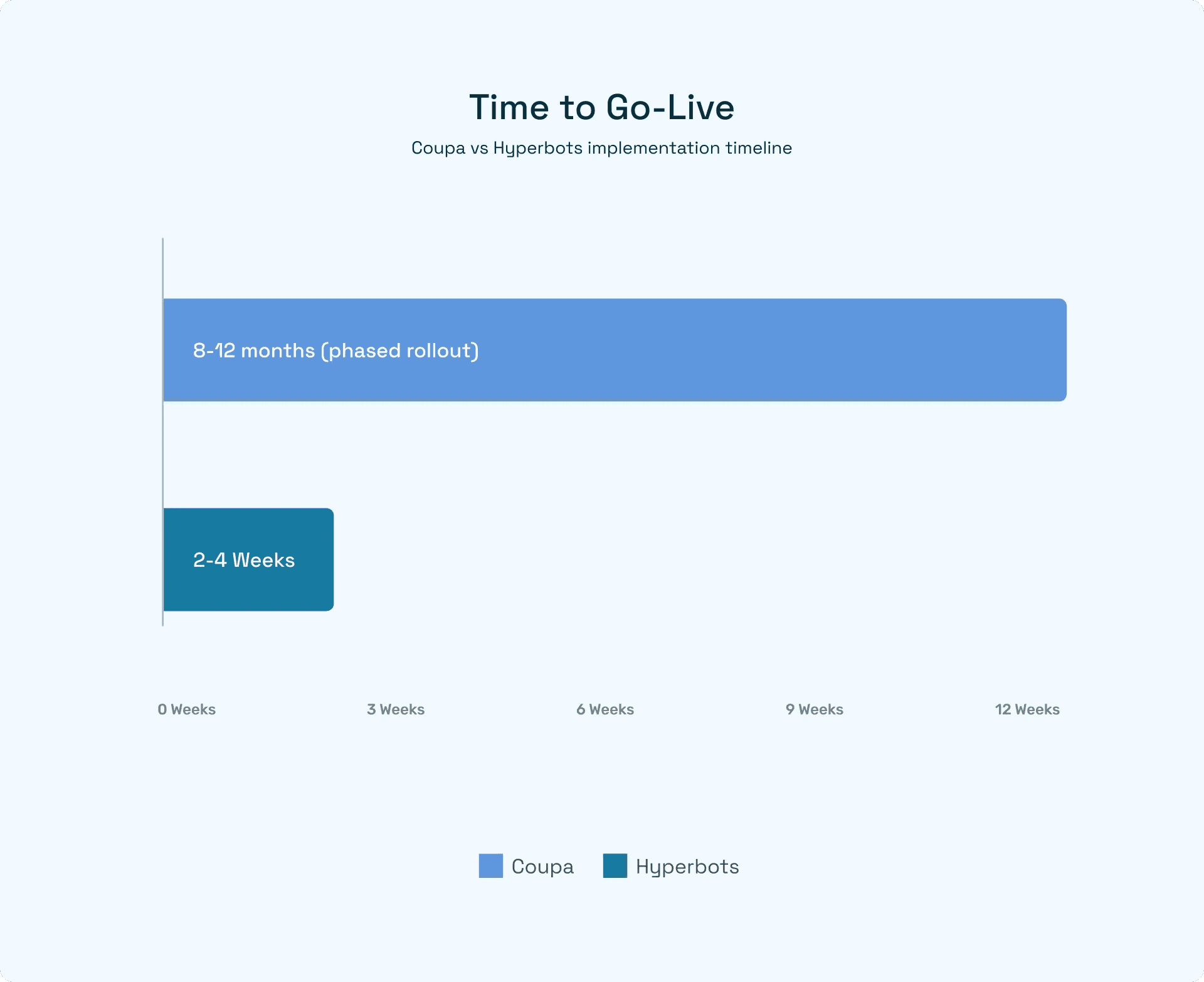
Coupa: Enterprise rollouts commonly extend 8–12 months due to broad scope: procurement, supplier onboarding, approvals, contracts, and finance integrations rolling out in phases across teams and regions.
Hyperbots: Typically reaches a production-ready deployment in weeks, with incremental capabilities added post-go-live, so value starts early rather than waiting for a “big bang.”
2) Integration Complexity
Coupa: Integrations often span multiple ERPs, tax engines, CLM, and middleware layers. While APIs exist, mapping and orchestration across systems and stakeholders adds time and coordination overhead.
Hyperbots: Also integrates deeply with ERPs, but with a narrower functional blast radius (invoice → ERP → GL). Pre-built, bidirectional connectors and focused data models reduce integration sprawl without reducing rigor.
3) Testing & UAT
Coupa: Requires formal SIT and UAT cycles due to enterprise scope and cross-system dependencies.
Hyperbots: Also runs full SIT and UAT, same rigor, fewer moving parts. Because fewer workflows are in scope at go-live, test cycles are typically more contained and faster to stabilize.
4) Change Management
Coupa: Broad rollouts require structured training programs and coordinated adoption across procurement, finance, and suppliers.
Hyperbots: Faster time-to-value helps adoption feel incremental. Teams see working automation early, which reduces resistance and accelerates buy-in.
Both platforms demand enterprise-grade testing. The difference isn’t rigor, it’s scope control. Coupa modernizes everything at once. Hyperbots modernizes what impacts close, accuracy, and compliance first.
Real-world trade-offs (aka: pros and cons without the fudge)
Why choose Coupa?
Enterprise-grade feature set covering SRM, sourcing, contracts and advanced analytics.
Proven global deployments across large enterprises and heavy spend profiles.
Extensive documentation, community and implementation partners.
Why choose Hyperbots (when speed matters)
Rapid deployment: get value earlier and reduce project risk from long timelines.
Lower initial implementation cost (less custom integration work up front).
Better for organizations that want incremental improvement and fast ROI rather than a big-bang platform swap.
Closing thoughts
Think of software projects like moving houses. Coupa is a full, custom renovation with an architect, scaffolding and weekly stakeholder meetings, it’s beautiful when it’s done, but it takes planning and a lot of time. Hyperbots is moving you into a perfectly livable, furnished apartment first; you can hang art later. Both are fine choices but if your company wants to stop paying invoices by carrier pigeon and actually show savings this quarter, the apartment approach tends to win hearts (and CFOs).
Frequently Asked Questions ( FAQs)
Q1: How long does a typical Coupa procure-to-pay implementation take?
For large or multi-entity organizations, Coupa implementations commonly take 9–12 months. Timelines vary based on scope, number of integrations, approval complexity, supplier onboarding requirements, and internal change management readiness.
Q2: Why do procure-to-pay implementations often take longer than planned?
Delays usually stem from integration complexity, workflow configuration, supplier onboarding, and cross-team coordination. When procurement, finance, IT, and vendors are all involved, even small changes can cascade into longer timelines.
Q3: What does “deployment in a few weeks” actually mean for Hyperbots?
It means reaching a production-ready state quickly—processing real invoices, approvals, and exceptions—using pre-built integrations, AI-based data extraction, and minimal configuration. Additional capabilities can be added incrementally after go-live.
Q4: Is a faster deployment less secure or less rigorous?
No. Both platforms follow enterprise-grade practices like SIT, UAT, audit controls, and compliance checks. The difference lies in scope at launch, not testing rigor—Hyperbots reduces initial complexity to stabilize faster.
Q5: How should finance leaders choose between Coupa and Hyperbots?
It depends on priorities. Organizations seeking a broad, all-at-once procurement transformation may prefer Coupa. Teams focused on speed, faster ROI, and incremental automation often choose Hyperbots to start delivering value within the same fiscal year.