Coupa Procurement Automation vs Hyperbots: PR-to-PO Speed, Guided Buying & Approvals Compared
Coupa vs Hyperbots: Procurement Automation Compared
Procurement is supposed to accelerate business, not turn into an obstacle course of forms, approvals, and mystery delays that make teams wonder if ordering a laptop requires UN security clearance. Finance leaders need tighter spend control, but they also need to avoid becoming the department of “no” (or worse: “please submit that again in the correct format”).
Coupa has long been the polished, enterprise procurement suite due to its broad capabilities, deep controls, and a reputation for handling complexity but that level of sophistication can also introduce slower PR-to-PO cycles, rigid approval chains, and guided-buying experiences that sometimes frustrate users.
Hyperbots takes a speed-first approach. It prioritizes fast PR-to-PO automation, intuitive guided buying, and approvals that adapt to the way the business works in the real world. Less setup, more momentum. Less governance theatre, more operational flow.
And this is where procurement success is won or lost: how quickly good decisions turn into approved purchases, with compliance built in, not bolted on.
PR-to-PO: Why speed matters
PR-to-PO Speed: Where Procurement Lives or Dies
Turning a purchase request into a purchase order should feel like a quick green light, not a traffic jam. When this flow slows down, the whole procurement chain slows with it.
Coupa’s strength:
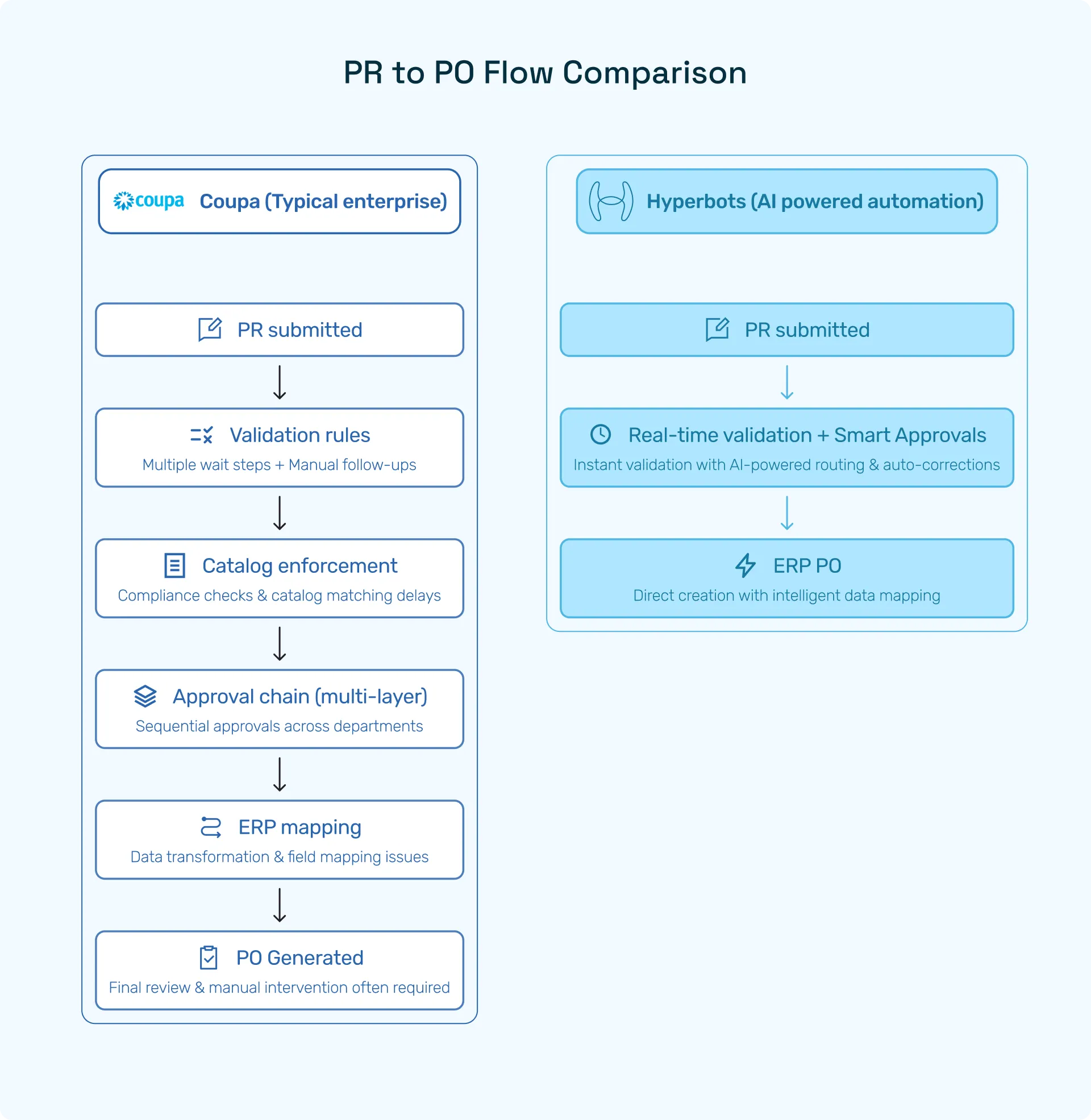
Coupa gives companies a full, controlled PR-to-PO process.
It has strong intake tools, catalog controls, and policy enforcement designed to keep spending clean and compliant.
Their documentation emphasizes speeding approvals and managing all types of spend with one system.
Where delays creep in:
In the real world, the setup required to make Coupa run smoothly can stretch timelines, integrations, data mapping, approval rules, user training…the list is long.
All necessary for governance, but they can turn a simple laptop request into a mini-project.
And when the PR-to-PO path takes too long?
People start chasing approvals over email or, worse, buying outside the system altogether.
Hyperbots’ advantage
Hyperbots is built to cut waiting from the process. Smart intake, pre-built ERP connections, and real-time validation help requests become POs quickly without teams having to babysit each step.
What that means for the business
More approved orders, fewer side quests, and almost no “Who’s holding up this PO?” detective work.
Guided buying: beautiful, but is it useful?
Guided buying is one of Coupa’s marquee capabilities designed to steer users to preferred catalogs, enforce policies at the point of request, and reduce maverick spend. Coupa markets an “intuitive, user friendly guided buying experience” in its product literature and user help resources.
The good:
When configured well, guided buying reduces rogue purchases and increases compliance because employees see recommended suppliers, negotiated contracts and policy warnings inside the catalog.
For organizations with mature supplier programs and disciplined catalogs, that’s a game changer.
The friction: Several verified user reviews and buyer guides point out tradeoffs:
Learning curve & complexity: Users sometimes find Coupa’s UI and the combination of features overwhelming, especially during early adoption. Review sites flag occasional usability pain and a learning curve for new users.
Supplier portal usability: Some suppliers report the Coupa Supplier Portal can be tricky, which delays supplier adoption and the clean handoff from PO to invoice. That, in turn, undermines the ideal guided-buying → PO → invoice experience.
Where Hyperbots differentiates: Guided buying is effective when the catalog and supplier network are tight and standardized. But when the business’ primary pain is AP exceptions and messy invoices, a system that focuses on post-PO automation (accurate invoice capture, intelligent matching, context-aware validation) delivers more tangible day-one ROI.
Hyperbots is designed to complement or replace parts of the P2P stack that most commonly generate rework so even if guided buying funnels requisitions correctly, the downstream automation still needs to be robust.
Approval workflows: bottlenecks, approvals and the tyranny of exceptions
Approval workflows are where policy meets people. Automating approvals is more than wiring org charts into tech, it requires handling out-of-office routing, thresholds, multi-entity rules, and the messy real-world exceptions that always appear.
Coupa’s approval capabilities:
Coupa supports dynamic approval workflows and multi-level automated invoice validation, and many customers praise its governance controls when fully configured.
The platform has built-in workflow engines and approval orchestration intended to scale across geographic entities and policies.
Practical pain points in approvals:
Workflow complexity: Enterprise approval logic can get complex quickly (multi-company GL routing, delegated authority, exceptions).
Good design requires careful configuration and rigorous testing; otherwise approvals bottleneck or misroute.
Implementation guides advise detailed SIT/UAT to capture such scenarios.
Human factors: Even with the best workflows, approver availability and unclear exception context create delays.
If approvers lack the information to act (e.g., missing invoice lines, ambiguous descriptions), they will decline or deflect decisions, increasing cycle time.
Hyperbots’ Approach to Approvals
Hyperbots approaches approvals by reducing how often they are needed, rather than trying to optimize every approval path.
By focusing on high-accuracy extraction, upfront validation, and policy checks before invoices enter workflows, fewer invoices reach approvers in an incomplete or ambiguous state.
Clean invoices can move forward with minimal intervention, while only true exceptions require review.
When approvals do occur, approvers see invoices that are already validated and structured, reducing hesitation, rework, and decision delays.
The result isn’t fewer controls, it’s fewer unnecessary approval bottlenecks, leading to more predictable cycle times and smoother closes.
Implementation reality: customization, integrations, and the hidden timeline
Everyone loves product demos until the integration spreadsheet shows up.
Coupa’s implementation model:
Coupa offers tailored implementation programs and professional services; the platform can scale from SMBs to global enterprises.
But real implementations usually require mapping to ERPs, testing edge cases for POs (revisions, multi-line & split accounting), and supplier onboarding processes.
Coupa’s documentation includes integration playbooks and scenarios that require careful technical execution.
What reviewers say: Many customers praise Coupa’s capabilities but also note a steeper learning curve and occasional need for consultant support for complex configurations particularly around multi-entity setups and bespoke workflows.
Hyperbots’ implementation model: Hyperbots emphasizes prebuilt, bidirectional ERP connectors, faster model validation for extraction, and staged rollouts focused on the highest-value automation (invoices, matching, approvals) so finance sees measurable ROI earlier.
This reduces the immediate need for heavy bespoke engineering work and shortens the “time before work reduces” window.
When to pick Coupa and when to choose a focused automation partner like Hyperbots
Pick Coupa if:
You need a broad source-to-pay suite across sourcing, contracts, supplier management and procurement; and
Your procurement objectives prioritize strategic sourcing, supplier collaboration, and centralized supplier networks (the mall, not the scalpel). Coupa’s breadth is valuable when procurement breadth is a top priority.
Pick Hyperbots if:
Your immediate pain is AP exceptions, lengthy PR→PO→invoice cycles, or long month-end closings that require manual reconciliation; and
You want faster time to measurable automation (fewer exceptions, higher STP) with lighter upfront configuration.
Both approaches are valid, the trick is aligning the vendor to the problem you most urgently need to solve.
Category | Coupa Procurement Automation | Hyperbots Procurement Automation |
Primary Focus | End-to-end source-to-pay suite with extensive procurement governance and supplier controls | Speed-first PR→PO→Invoice automation with high accuracy and low manual intervention |
PR→PO Speed | Can be slow due to setup, complex workflow routing, ERP mapping, and user onboarding | Fast validation + real-time checks + prebuilt ERP connectors → PO flows move quickly |
Guided Buying | Strong feature for established catalog programs; reduces rogue spend when configured well | Focused more on downstream automation and reducing rework which complements guided buying |
User Experience | Broad functionality can introduce a learning curve and more clicks | Lightweight, intuitive, fewer steps to complete a request |
Supplier Adoption | Supplier portal usability varies; can slow onboarding and PO→invoice flow | Simpler onboarding via automation-first PO and invoice flows |
Integration Effort | Heavier ERP and data mapping work; requires SIT/UAT cycles to stabilize | Prebuilt connectors and progressive rollout lower integration time and risk |
Implementation Timeline | Longer (4-6 months); configuration, training and mapping required for value to appear | Faster (2-4 weeks); automation value delivered earlier with minimal engineering |
Ideal Buyer Profile | Large enterprises needing broad procurement suite: sourcing, catalogs, supplier collaboration | Businesses focused on reducing AP exceptions, increasing STP, accelerating spend execution |
Business Outcome | Robust governance across all spend categories | Measurable operational gains: shorter cycle times, higher automation, fewer manual follow-ups |
Full Procurement Mall vs. Fast Automation Lane: Why Coupa Isn’t Always the Best Fit
Coupa is a powerhouse for organizations that need a full procurement mall. It’s feature-rich, trusted, and deeply engineered for breadth.
But breadth sometimes means more knobs to turn, more testing to run, and more training for users who just wanted to requisition a laptop without reading a manual. Reviews consistently praise Coupa’s strength while pointing out complexity and the learning curve, not fatal flaws, but real operational costs to plan for.
Hyperbots isn’t trying to be the mall. It is trying to be the thing you use to fix the sewer when the invoices clog it. If your business needs fewer exceptions, faster PR→PO→invoice flow, and approvals that don’t require an investigator’s report, the focused automation route is worth testing.
FAQs
1. Does Coupa procurement automation handle complex approval logic?
Yes, Coupa supports multi-level approval rules and dynamic workflows, but complex real-world scenarios require careful configuration, testing and change management.
2. Are PR-to-PO delays common with Coupa?
Delays can occur during implementation and when integrations or supplier onboarding aren’t fully mature. Rigorous SIT/UAT and clear integration playbooks reduce but don’t always eliminate these delays.
3. Can guided buying reduce maverick spend?
Yes, guided buying in Coupa is designed to steer users to preferred suppliers and contracts, improving compliance. But success depends on good catalog hygiene, supplier adoption, and user training.
4. Will Hyperbots replace my procurement suite?
Depends. Hyperbots is optimized for fast, accurate AP automation and approval orchestration. For organizations that need end-to-end source-to-pay strategic sourcing, Coupa (or a comparable suite) may still be appropriate. In many cases, Hyperbots is deployed alongside procurement suites to sharpen invoice-to-ERP automation.
5. What’s the fastest way to prove value in a POC?
Bring real, messy requisitions and invoices. Measure time and manual touches for PR→PO and invoice posting. Validate approval rerouting behavior and ERP sync scenarios realistic data is the only thing that separates demos from production reality.