eCommerce ERP Software: End-to-End Playbook for Online Retail & ERP Webshops
Streamline eCommerce growth with ERP software and AI automation for finance, tax compliance, and vendor management.
Executive Summary
The explosion of multichannel sales, same-day shipping, and global tax regulations has made siloed shopping-cart data a liability. Modern ecommerce ERP software unifies storefronts, inventory, fulfillment, and finance—turning scattered touchpoints into one profit engine. This in-depth guide (≈6,000 words) unpacks enterprise resource planning in e-commerce, compares leading ERP webshop platforms, and reveals how Hyperbots AI Co-pilots automate invoices, POs, tax, and vendor onboarding for DTC brands, Amazon sellers, and B2B marketplaces alike.
1. Market Shift: Why eCommerce Needs ERP Now
Omnichannel explosion—Amazon, Shopify, TikTok Shop, and B2B portals.
Same-day delivery—Requires real-time ATP (Available-to-Promise).
Cross-border taxes—complex nexus and VAT rules.
Razor-thin margins—Demand automated landed-cost tracking and AI-led cost control.
Only a modern business management platform that marries storefront and back office can keep pace.
2. What is eCommerce ERP Software?
An e-commerce ERP software suite is a cloud platform that synchronizes:
Webshop orders (Shopify, Magento, WooCommerce)
Inventory & warehouse operations
Procurement & vendor management
Financials (GL, AP/AR, tax)
Customer service (RMA, subscription billing).
In essence, it’s enterprise resource planning in e-commerce—tailored for fast-moving digital merchants.
3. Core Modules of an ERP Webshop
Module | eCommerce Need | Cloud Advantage |
Order & OMS | Multi-channel sync, fraud checks | Real-time status |
Inventory & WMS | Bin, lot, serial, FIFO | Mobile scanning |
Purchasing & Dropship | Auto-PO, vendor EDI | Supplier portals |
Financials | Multi-currency, chargebacks | Seamless payment recon |
Returns & RMA | Reverse logistics | Automated workflows |
BI & Analytics | Margin, LTV, CAC | Embedded dashboards |
4. Key Challenges in Enterprise Resource Planning in E-Commerce
Manual order-to-cash slows shipment.
Spreadsheet inventory causes overselling.
Tax complexity across states/countries.
High return rates demand a streamlined RMA.
5. Must-Have Features of Cloud eCommerce ERP
Native storefront connectors (Shopify, Amazon, eBay).
Real-time stock availability across 3PLs.
Automated landed-cost & duty calculations.
Built-in subscription & usage billing.
Open APIs for AI agents like Hyperbots.
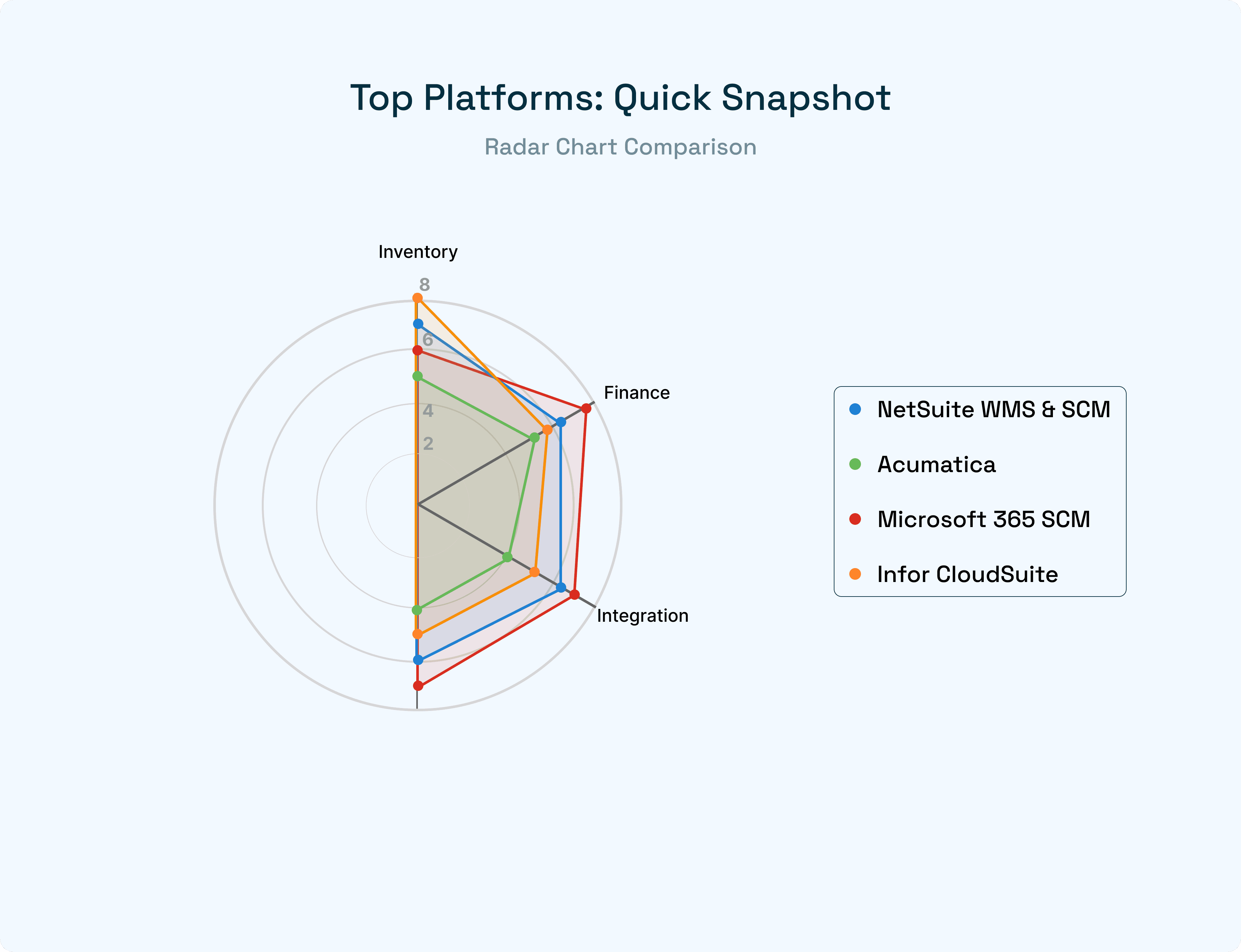
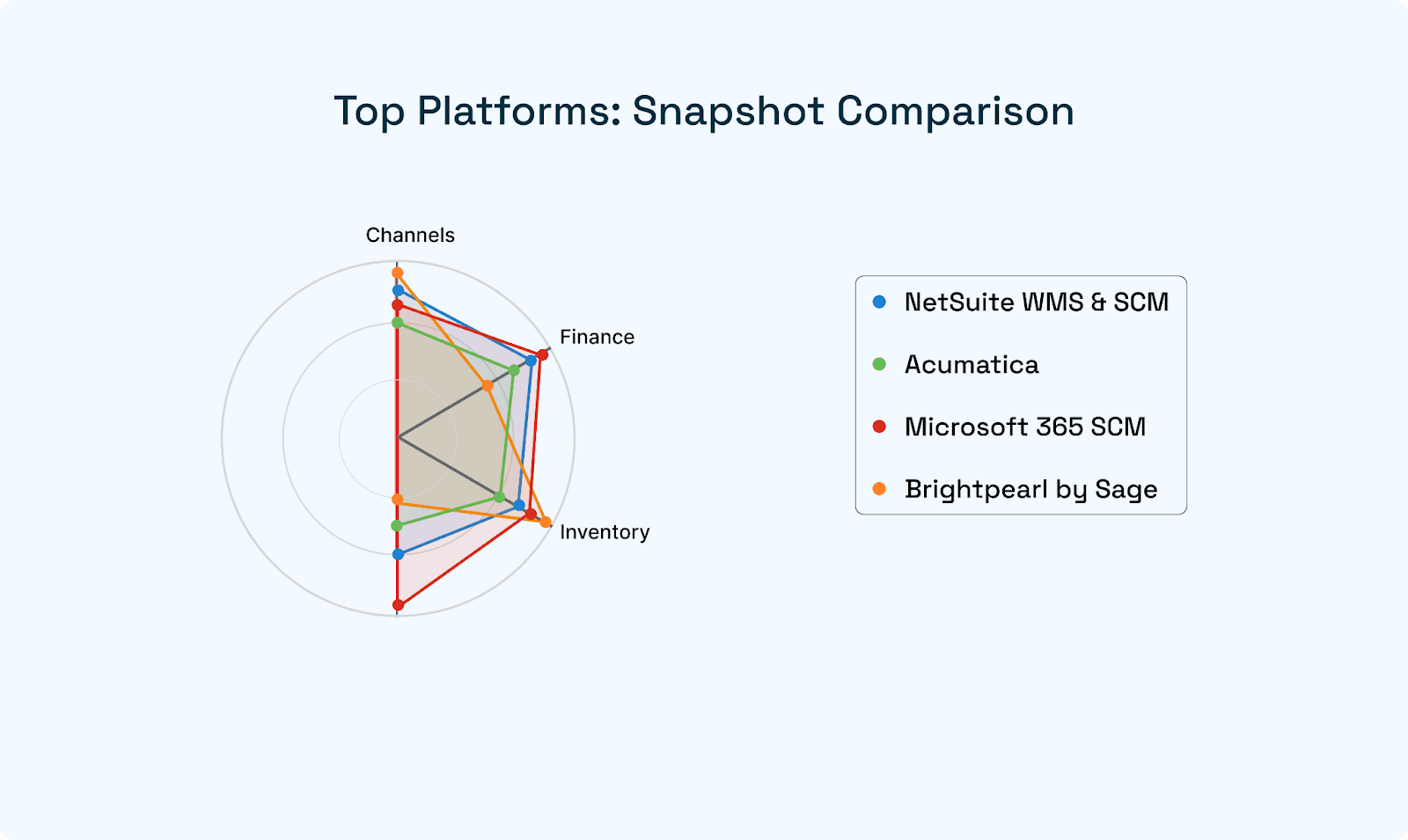
6. Top Platforms: Snapshot Comparison
Platform | Best For | Strengths | Watch-outs |
NetSuite SuiteCommerce + WMS | Mid-market | Unified finance + web | Setup cost |
Acumatica Retail-Commerce | SMB–mid | Unlimited users | Partner dev needed |
Microsoft Dynamics 365 Commerce & BC | Upper-mid | Native MS stack | Licensing maze |
Brightpearl by Sage | Pure retail | Retail workflows | Limited manufacturing |
7. NetSuite + Hyperbots: AI Automation Stack for Online Retail
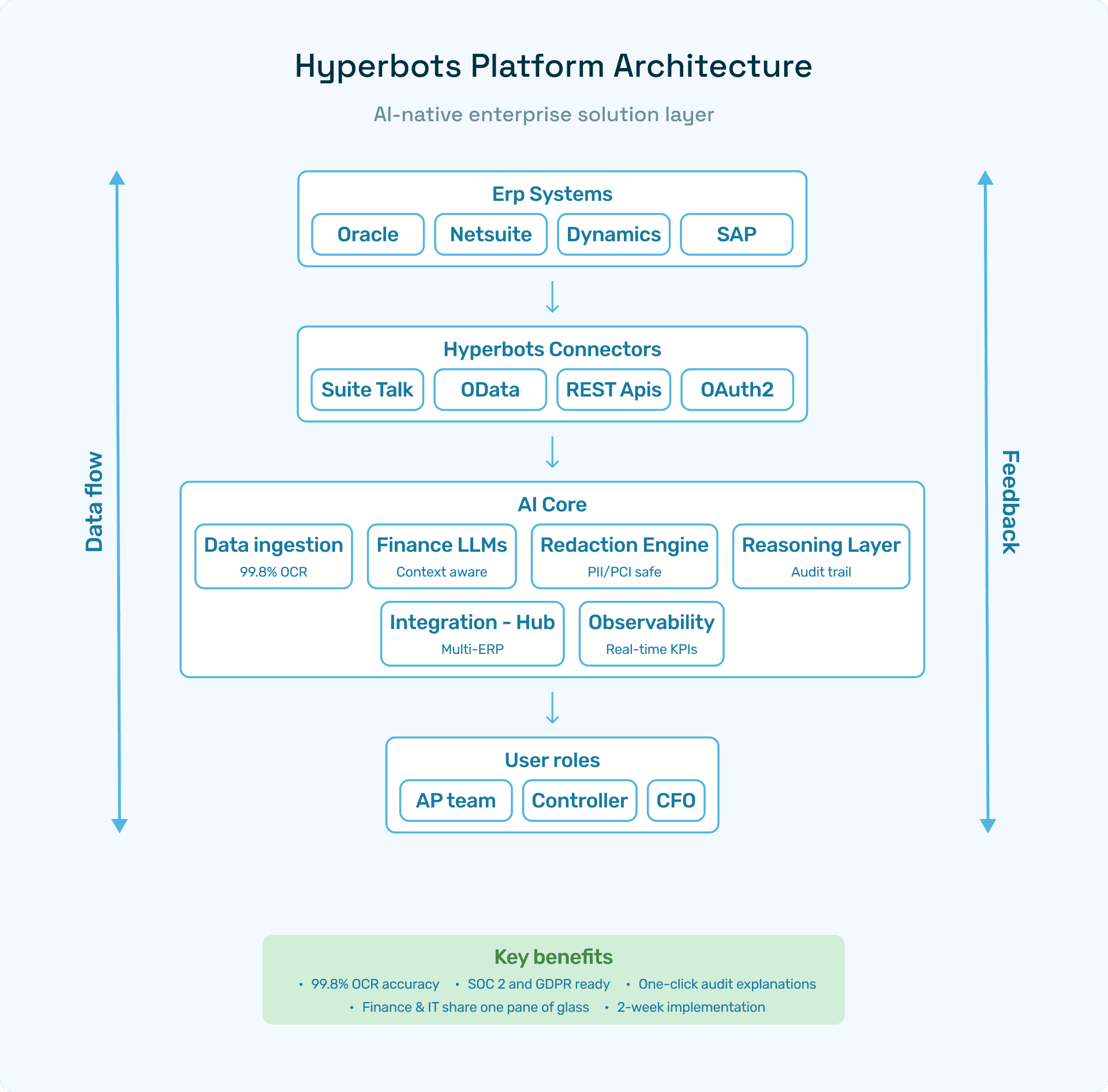
NetSuite already supports cloud-based distribution software and DTC storefronts. Hyperbots levels it up:
Hyperbots Co-pilot | eCommerce Pain Solved |
Auto-indexes supplier invoices, 3-way match with PO & ASN | |
AI PO suggestions based on velocity & seasonality | |
Auto books freight, duty, and subscription revenue accruals | |
Pays vendors on optimal terms, prevents fraud | |
Validates US state nexus & EU VAT IOSS | |
Self-service onboarding, W-8/W-9 checks |
Result: 75 % faster AP cycle, 30 % lower working-capital lock-up, 99.8 % data accuracy.
8. Hyperbots Platform Capabilities for eCommerce Finance
OCR + Vision-Language Models—Recognize packing slips, invoices, screenshots.
Finance-trained LLMs—Classify gift-card breakage, returns reserves.
Mixture-of-Experts—Specialist models for SKU mapping, tax lines, and discount tiers.
Reasoning engine—Explains GL posting logic for auditors.
Redaction—PII removal for PCI compliance.
9. Implementation Roadmap & Pitfalls to Avoid
Channel sync audit—Identify SKU mismatches.
Data hygiene—Normalize UOM, HS codes, and tax zones.
Phased rollout—OMS → Inventory → Finance → Hyperbots.
Avoid half-integrations—use native connectors or iPaaS.
Train ops & finance jointly—ensure end-to-end visibility.
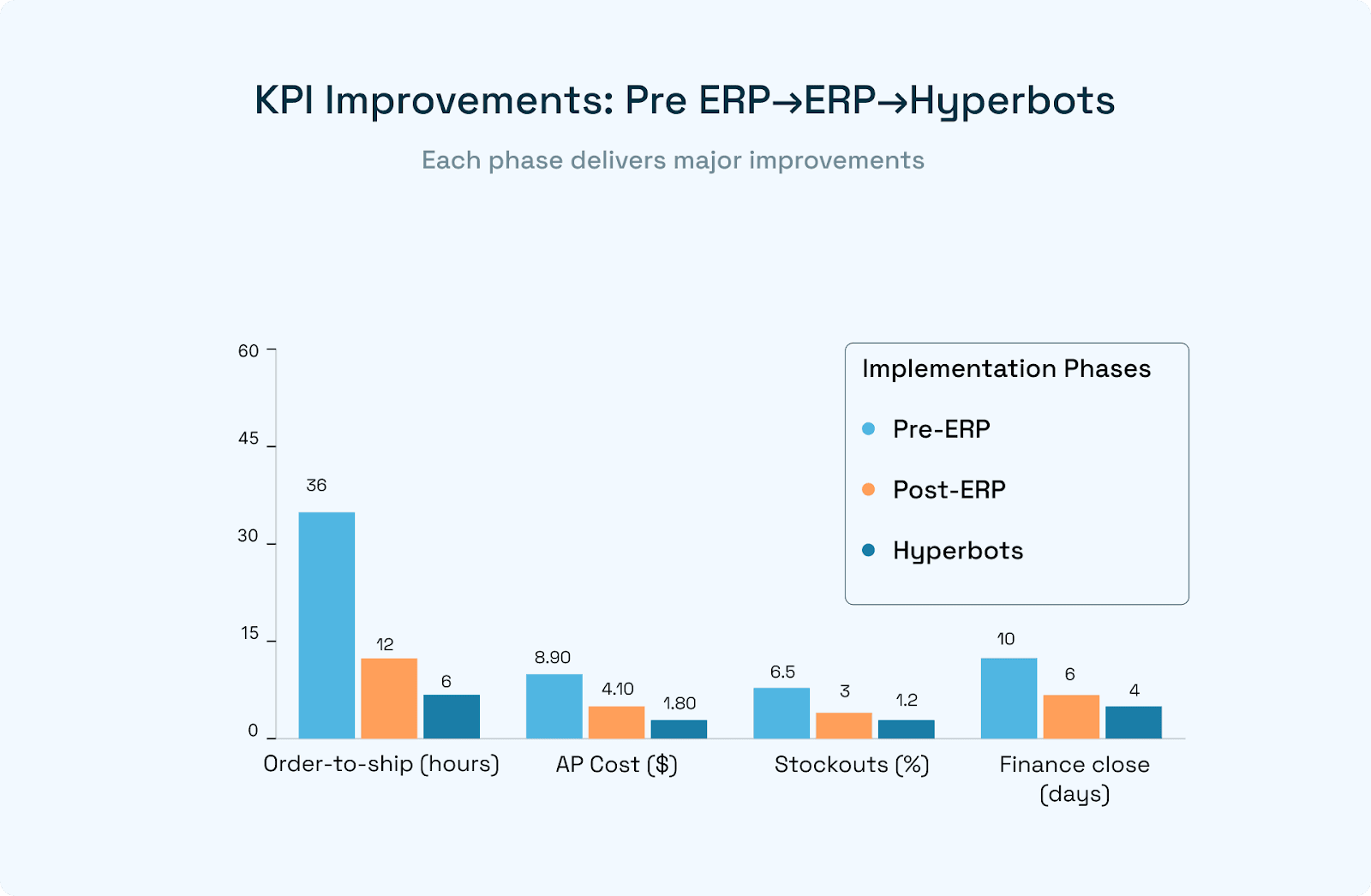
10. Metrics & ROI Benchmarks After ERP + Hyperbots
KPI | Pre-ERP | Post-ERP | Post-Hyperbots |
Order-to-ship (hrs) | 36 | 12 | 6 |
AP cost/invoice | $8.90 | $4.10 | $1.80 |
Stockouts (%) | 6.5 | 3.0 | 1.2 |
Finance close (days) | 10 | 6 | 4 |
11. FAQs
Q1. What is e-commerce ERP software?
A cloud ERP tailored for webshops—combining orders, inventory, fulfillment, and finance.
Q2. Can Hyperbots work with Shopify Plus and QuickBooks?
Yes - connects via APIs; NetSuite and Dynamics deliver deeper synergy.
Q3. How fast is payback?
Most brands recoup Hyperbots' fees within 9–12 months via labor savings and margin gains.
Q4. Does Hyperbots cover EU VAT OSS & IOSS?
Sales Tax Co-pilot maps EU VAT rates and eCommerce import schemes automatically.
12. Conclusion & Next Steps
Scaling a brand from 5 to 500 orders per day demands more than a shopping-cart plug-in; it requires a robust e-commerce ERP software backbone. Merge that with Hyperbots’ AI Co-pilots and you unlock touch-less finance, error-free tax, and vendor harmony—giving your team bandwidth to drive growth, not data entry. Ready to elevate your ERP webshop? Book a Hyperbots demo and unleash AI-powered online retail today.