Enterprise Software Systems — 2025 Definitive Guide
Transform enterprise software systems with AI automation to streamline finance, procurement, tax, and vendor workflows.
Executive Summary
Modern companies run on software—but not just any software. Enterprise software systems unify finance, supply chain, sales, HR, and analytics on a single data platform. This in-depth guide (≈6,300 words) explains what qualifies as enterprise management software, compares leading enterprise solution software brands, and spotlights real-world enterprise systems examples from manufacturing, SaaS, retail, and healthcare. Finally, you’ll discover how Hyperbots AI Co-pilots slash invoice, PO, tax, and vendor workloads across NetSuite, Oracle ERP Cloud, Microsoft Dynamics 365, and SAP—turning back-office chores into autonomous, audit-ready workflows.
1. Introduction: Why Enterprise Software Systems Matter
Globalization, e-commerce, and remote work have stretched traditional departmental systems to a breaking point. Finance can’t wait days for sales data; supply-chain managers need real-time inventory; compliance officers must audit instantly. Enterprise software systems solve this by integrating processes, data, and analytics into one platform—often delivered as cloud ERP or enterprise management software.
2. Defining Enterprise Software: Core Pillars & Terminology
Enterprise Resource Planning (ERP) – Core financials, procurement, and inventory.
Customer Relationship Management (CRM) – Sales pipeline, service, marketing.
Human Capital Management (HCM)—HR, payroll, and talent.
Business Intelligence (BI)—Dashboards, KPIs, and predictive models.
Enterprise Integration Platform – APIs, iPaaS, and event streaming.
Collectively, these form a business enterprise software stack. When cloud-hosted, they deliver scalability, security, and AI readiness—crucial for modern digital transformation.
3. Key Benefits of Business Enterprise Software
Benefit | Pre-Enterprise Systems | Post-Enterprise Systems |
Data visibility | Siloed spreadsheets | Real-time dashboards |
Compliance | Manual audits | Automated trails |
Efficiency | Duplicate data entry | Unified workflows |
Scalability | New servers & IT | Elastic cloud |
4. Essential Modules in Enterprise Management Software
Module | Purpose | AI/Hyperbots Advantage |
General Ledger | Unified financial books | Auto-posting via Invoice Co-pilot |
AP / AR | Vendor & customer cash | 80 % STP invoice processing |
Procurement | PO, policy enforcement | AI-generated requisitions |
Inventory & SCM | SKU, lot, serial tracking | Predictive ordering |
CRM & CPQ | Leads, quotes, deals | LLM-powered email summaries |
HR & Payroll | Employee lifecycle | Automated onboarding tasks |
Analytics | KPI dashboards | Explainable AI insights |
These modules transform stand-alone apps into comprehensive company software systems.
5. Enterprise Systems Examples by Industry
Manufacturing—SAP S/4HANA with PP, QM, and Hyperbots Invoice + Procurement Co-pilots.
Retail & eCommerce—NetSuite SuiteCommerce + Hyperbots Tax & Vendor Co-pilots.
Healthcare—Microsoft Dynamics 365 F&O with Hyperbots Payments for HIPAA-ready workflows.
SaaS / Tech – Oracle ERP Cloud plus Hyperbots Accruals Co-pilot for ASC 606 compliance.
These examples of enterprise software deployments prove the power of AI-augmented ERP.
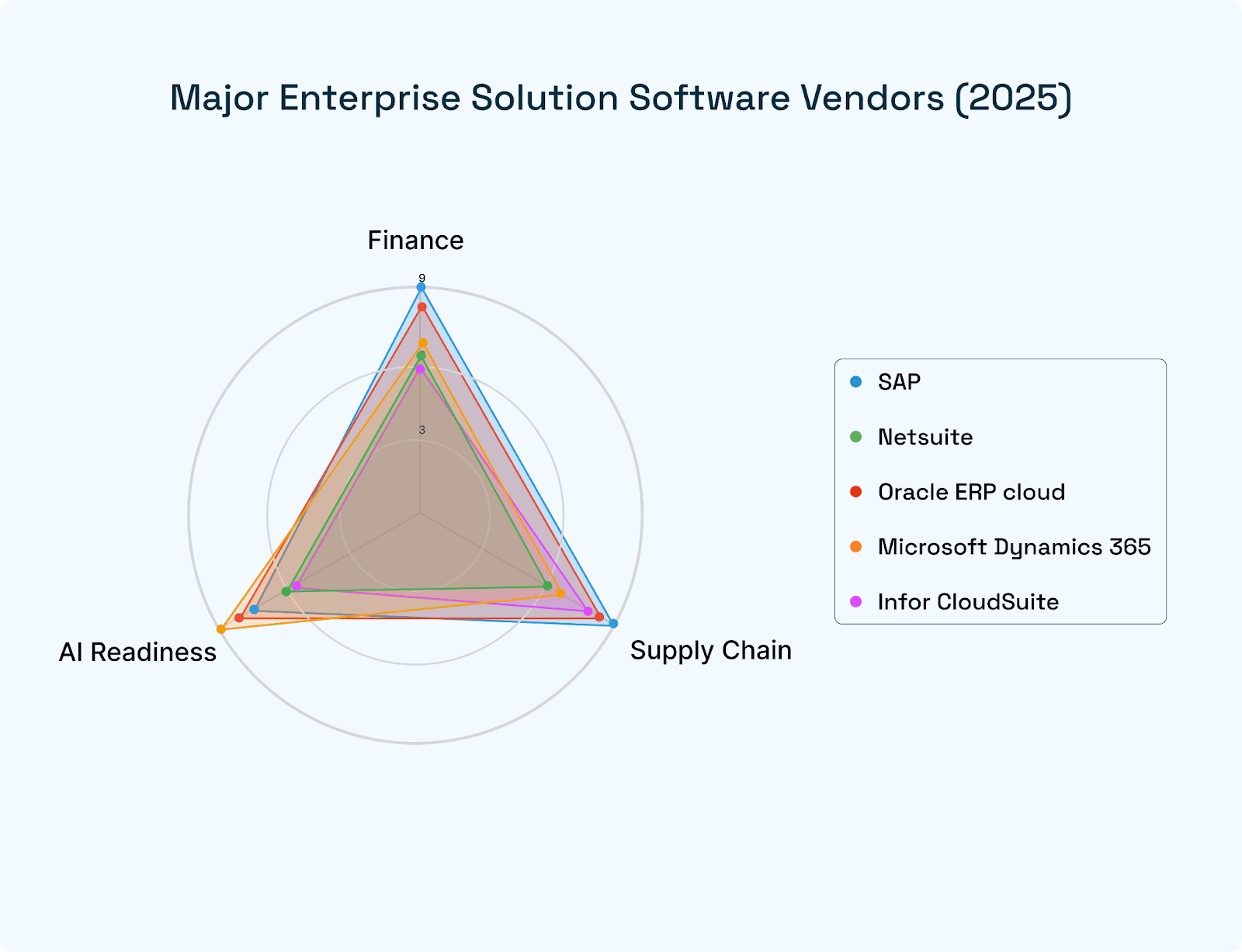
6. Major Enterprise Solution Software Vendors (2025)
Vendor | Cloud Strategy | Strengths | Watch-outs |
SAP | RISE / S/4HANA Cloud | Deep manufacturing & localization | Complex licensing |
Oracle ERP Cloud (Fusion) | Pure SaaS | Global scalability | Change-management load |
NetSuite | SMB-to-mid cloud ERP | Unified suite | Setup cost |
Microsoft Dynamics 365 | Modular SaaS + Power Platform | MS ecosystem | Partner dependencies |
Infor CloudSuite | Industry verticals | Micro-vertical best practices | UI learning curve |
7. How Hyperbots AI Co-pilots Elevate Finance & Procurement
Hyperbots plugs into any major ERP via APIs, delivering domain-trained AI agents:
Co-pilot | Traditional Pain Point | Hyperbots Lift |
Manual keying, 3-way match delays | 80–90 % STP | |
Spreadsheet reorder points | AI-generated POs | |
Month-end scramble | Auto-book & reverse | |
Fraud risk & timing | AI recommendation engine | |
Multi-state compliance | Real-time validation | |
Onboarding friction | Self-service portal |
Result: 40–70 % lower finance labor, 30 % faster close cycles, 99.8 % accuracy.
8. Hyperbots Platform Capabilities
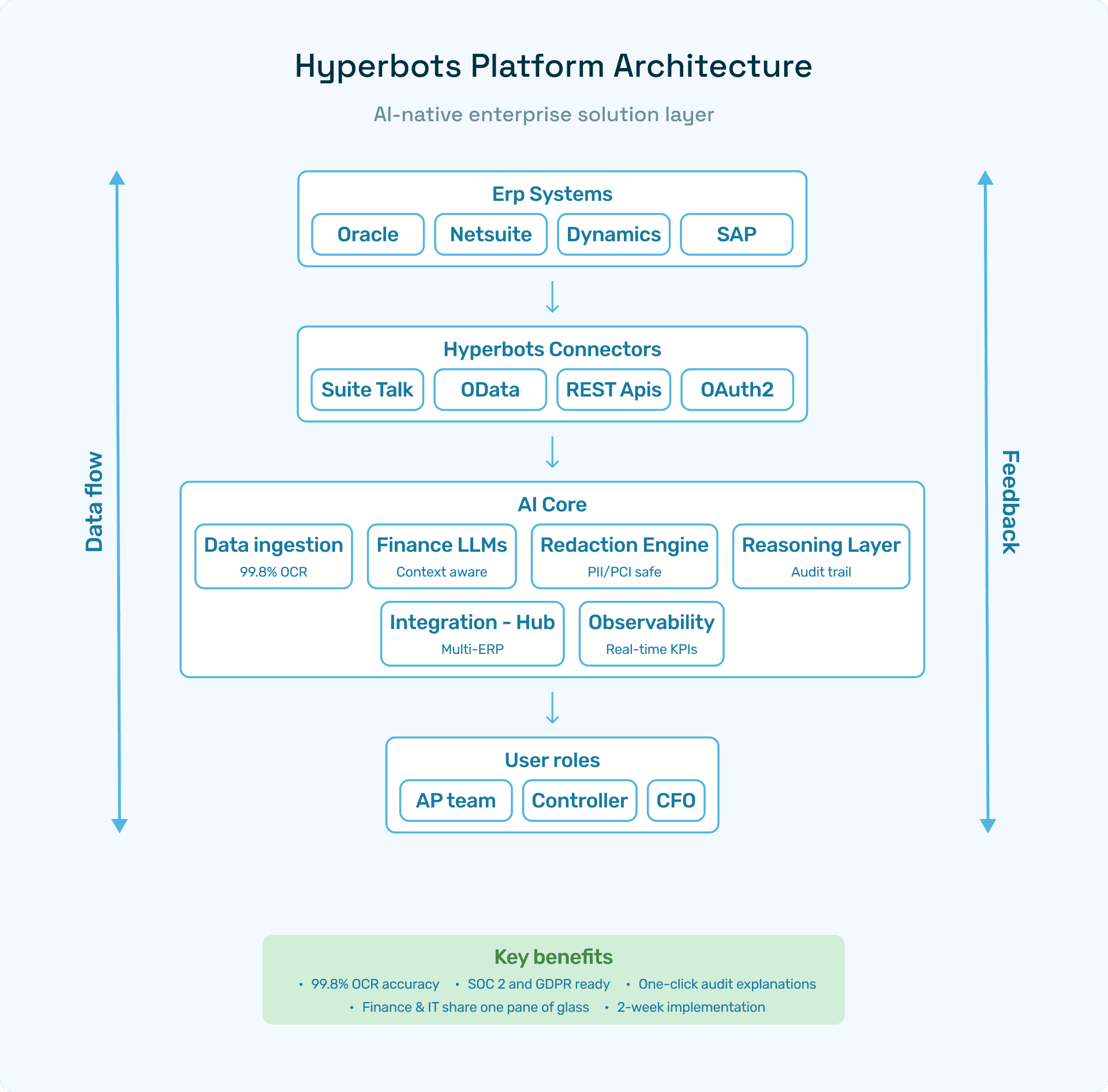
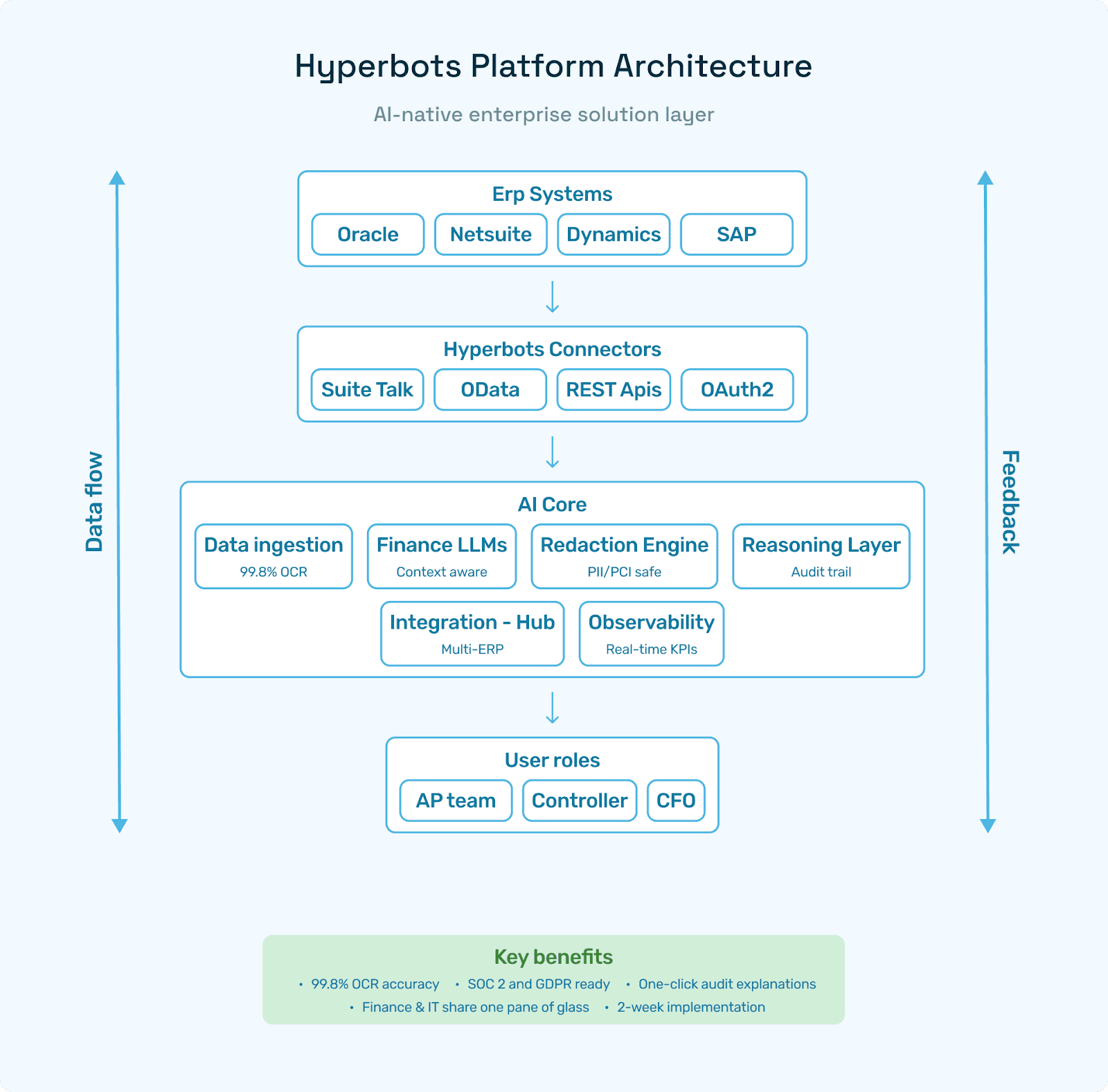
Hyperbots is not a generic RPA bolt-on; it is an AI-native enterprise solution software layer purpose-built for finance, tax, and procurement across all leading ERP stacks. Key capabilities include:
Platform Layer | Capability | Benefit for Enterprise Software Systems |
Data Ingestion | 99.8 % OCR via Vision-Language Models (VLMs) | Reads PDFs, scans, EDI, and even photos of invoices |
AI Core | Finance-trained Large Language Models (LLMs) + Mixture-of-Experts | Context-aware GL coding, tax classification, and exception reasoning |
Redaction Engine | Auto-masks PII / PCI before model access | Zero data-leak risk; SOC 2 & GDPR ready |
Reasoning Layer | Chain-of-Thought explanations + audit log | “Why did we post to 5200—Freight?”—one-click answer |
Integration Hub | SuiteTalk, OData, REST, and OAuth2 connectors | 2-week go-live on Oracle, NetSuite, Dynamics, or SAP |
Observability | Real-time KPI dashboards, anomaly alerts | Finance & IT share one pane of glass |
9. Implementation Best Practices & Pitfalls to Avoid
Pro Tip: Treat AI like a co-worker, not a black box. Train it, monitor it, promote it.
9.1 Phased Roll-Out
Diagnostic Sprint (Week 0-1) – Map “as-is” invoice-to-pay workflow; collect 100 sample invoices.
AI Training (Week 1-2) – Hyperbots fine-tunes extraction on your vendor formats.
Read-Only Shadow Mode (Week 3) – Co-pilot mirrors human entries for variance analysis (<2 % target).
Write-Back Go-Live (Week 4-5) – Hyperbots posts directly into ERP with rollback safety net.
Expand to Procurement / Tax (Week 6-8) – Gradual domain expansion prevents change-fatigue.
9.2 Common Pitfalls
Pitfall | Impact | Fix |
“Big-Bang” multi-module launch | User overwhelm | Phase modules |
Dirty vendor master data | Extraction mismatches | Clean & dedupe first |
No KPI baseline | Hard ROI proof | Capture cycle time & cost pre-go-live |
Ignoring audit | Compliance gaps | Use Hyperbots reasoning logs |
10. Metrics & ROI Benchmarks After AI Adoption
KPI | Legacy ERP Only | ERP + Hyperbots | Typical Gain |
Invoice STP | 15 % | 85 % | +70 pt |
AP Cost / Invoice | $9.25 | $2.10 | –77 % |
PO Cycle (hrs) | 48 | 12 | –75 % |
Month-End Close (days) | 8 | 4.5 | –44 % |
Audit Adjustments | 30 / yr | 3 / yr | –90 % |
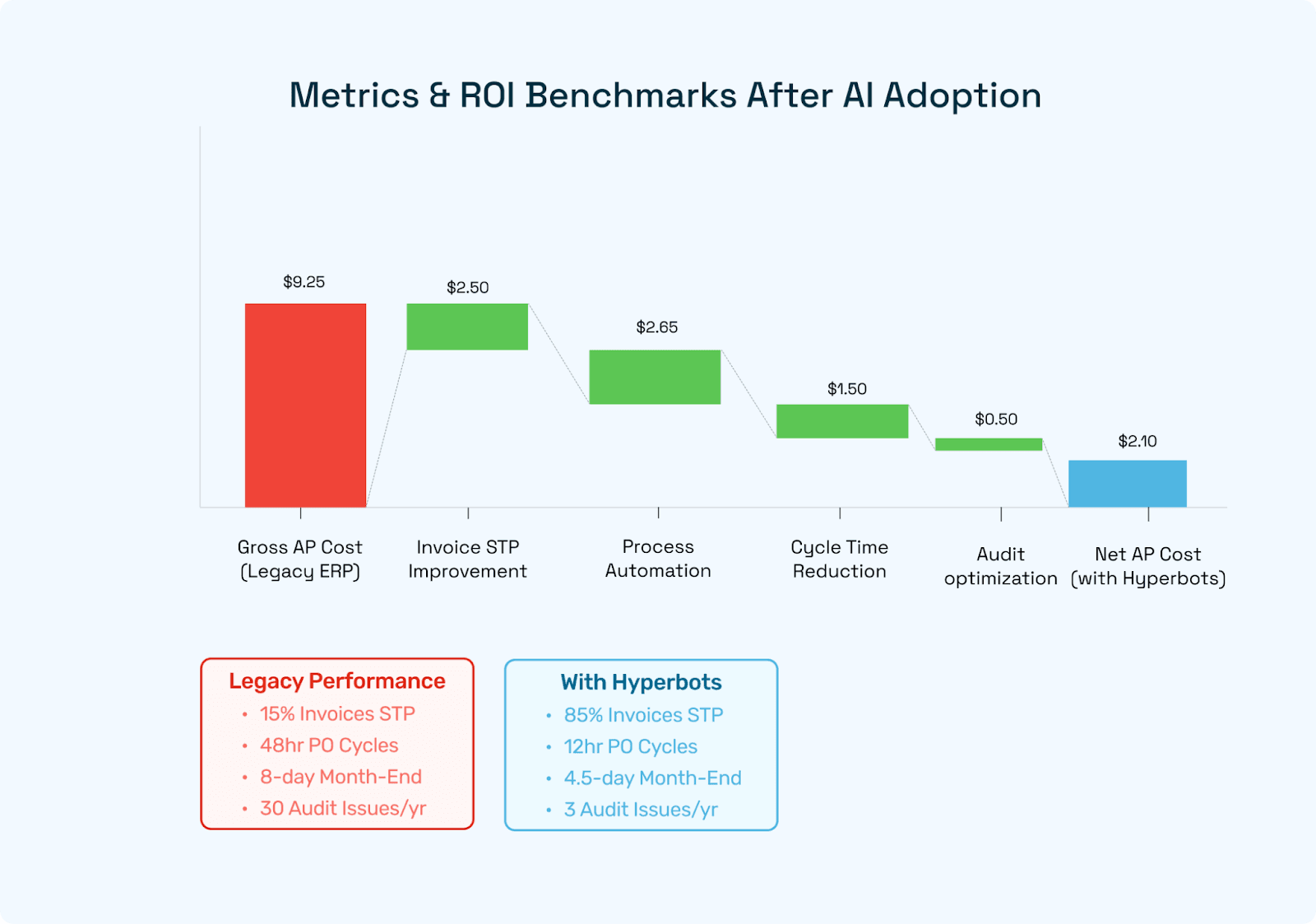
Financial leaders report payback in ≤9 months and a 3-year NPV exceeding 4-8× subscription spend—performance unrivaled by traditional RPA or manual offshoring.
11. Future Trends in Enterprise Software Systems
Composable ERP: Headless services stitched via event streaming (Kafka, Azure Event Grid).
Self-healing Finance Bots: Agents auto-correct extraction errors after auditor feedback.
Blockchain-backed Vendor Identity: Immutable KYC integrated with Vendor Co-pilot.
Sustainability Ledgers: Carbon and ESG fields baked into GL—Hyperbots auto-tags freight CO₂.
Voice-First Controllers: “Hey Hyperbots, summarize AP exceptions for Q2.” Natural-language CFO dashboards.
These innovations push business enterprise software toward autonomy, transparency, and ESG accountability.
12. Frequently Asked Questions
Q1. What distinguishes enterprise management software from SMB accounting tools?
Scale (multi-entity, multi-currency), compliance (SOX, IFRS 16), and extensibility (open APIs for AI).
Q2. How do Hyperbots Co-pilots differ from simple OCR plugins?
They combine VLM extraction and LLM reasoning, post GL entries, explain decisions, and learn continuously.
Q3. Are there real-world enterprise systems examples using Hyperbots?
Yes—Fortune 100 consumer-goods firm cut invoice cycle by 80 % on SAP; mid-market retailer on NetSuite reduced tax penalties to zero.
Q4. What’s required from IT to integrate Hyperbots?
Grant API credentials, map sandbox, and configure a webhook endpoint—typically <10 hours of admin time.
13. Conclusion & Next Steps
Enterprise software systems have graduated from static databases to AI-augmented nerve centers that drive real-time strategy. Yet even the best enterprise solution software needs intelligent agents to eliminate manual choke-points in finance and procurement. Hyperbots plugs that gap—delivering autonomous, explainable, and audit-ready workflows across SAP, Oracle, NetSuite, Microsoft Dynamics, and beyond.
Ready to see Hyperbots in action?
Schedule a live demo and watch your AP, tax, and vendor processes transform in weeks—not years.