ERP for Professional Services—Complete 2025 Guide
Boost professional services with ERP and AI automation to streamline billing, compliance, invoicing, and vendor management.
Executive Summary
Project-centric organizations—consultancies, marketing agencies, IT integrators, law and accounting firms—live and die by utilization rates, billable milestones, and razor-thin project margins. Manual spreadsheets and disconnected apps fall apart when you juggle 20 active clients, 60 resources, and multi-currency billing. Modern ERP for professional services unifies project accounting, resource management, time & expense (T&E), billing, revenue recognition, and analytics on one cloud platform.
This 4,000-plus-word guide compares the best ERP for professional services, maps core modules, dives into leading vendors (NetSuite SRP, Microsoft Dynamics Project Ops, Deltek, Unit4, Sage Intacct), and shows how Hyperbots Invoice Processing Co-pilot and its five sister agents turn labor-heavy finance cycles into autonomous, audit-ready workflows. By the end, you’ll have an actionable blueprint to evaluate, implement, and scale the right professional services ERP software for your firm.
1. Why Professional Services Need Purpose-Built ERP
Time is inventory. Every unbilled hour erodes margin. Traditional manufacturing ERPs focus on BOMs and warehouses; service firms need real-time insight into resource calendars, WIP (work-in-progress), fixed-fee vs. T&M billing, and ASC 606 revenue allocation. A dedicated professional services ERP system offers:
Project-centric GL—each engagement as its own P&L.
Resource scheduling & utilization dashboards.
Automated time & expense capture via mobile apps.
Multi-entity, multi-currency billing to match global client footprints.
Without these, firms drown in spreadsheets, miss revenue, and misquote projects.
2. Core Modules in a Professional Services ERP System
Module | Why It Matters to Services | Hyperbots Lift |
Project Accounting | Tracks budget vs. actual, WIP, margin | Accruals Co-pilot automates revenue deferrals |
Resource Management | Allocates staff by skill & availability | AI forecasts utilization trends |
Time & Expense (T&E) | Mobile capture, approvals, policy | Hyperbots validates receipts vs. policy |
Billing & Invoicing | Milestone, progress, retainer, T&M | Invoice Co-pilot creates clean client invoices |
Revenue Recognition | ASC 606/IFRS 15 compliance | Auto-schedule rev-rec entries |
Procurement & AP | Sub-contractor POs, vendor bills | PO + Invoice Co-pilots sync approvals |
Analytics & BI | Utilization, backlog, cash burn | Real-time dashboards, AI anomaly alerts |
Together, these deliver the ERP solutions for professional services that replace siloed PSA tools.
3. Benefits & KPIs: From Billable Utilization to Cash Flow
Implementing enterprise-grade professional services ERP software yields a measurable impact:
KPI | Pre-ERP | Post-ERP | Post-ERP + Hyperbots |
Billable utilization | 68 % | 74 % | 78 % |
Invoice cycle (days) | 15 | 7 | 2 |
DSO (days) | 54 | 38 | 30 |
Month-end close | 9 days | 6 days | 4 days |
Audit adjustments | 25/yr | 8/yr | 2/yr |
Hyperbots’ AI Co-pilots (Invoice, Accruals, Payments, Procurement, Tax, Vendor) accelerate every finance touchpoint, proving why it’s the best ERP for professional services when layered on top.
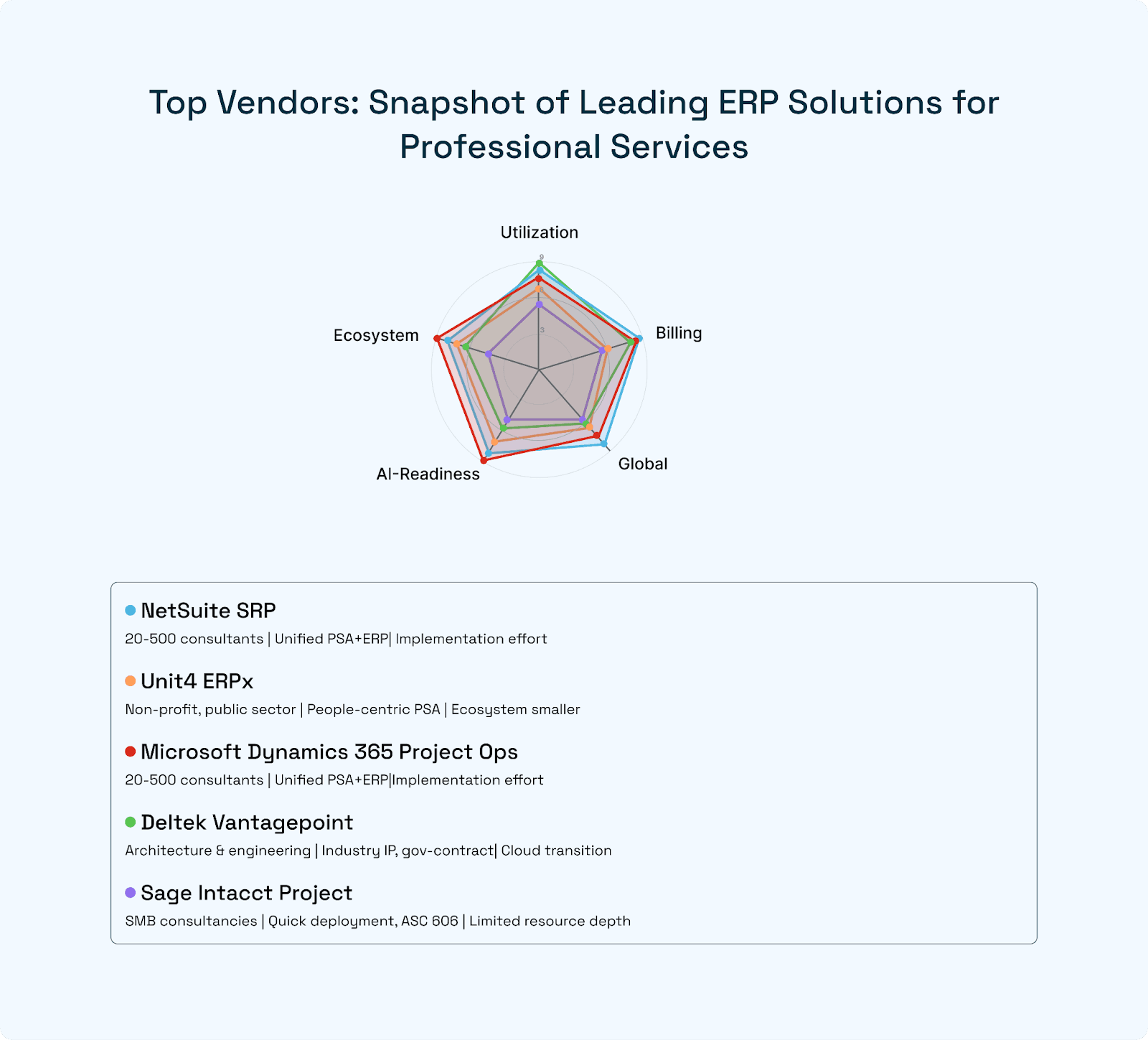
4. Top Vendors: Snapshot of Leading ERP Solutions for Professional Services
Vendor | Ideal Firm Size | Strengths | Watch-outs |
NetSuite SRP | 20 – 500 consultants | Unified PSA + ERP, global scope | Implementation effort |
Microsoft Dynamics 365 Project Ops | 50 – 2,000 | MS ecosystem, Power BI | Partner dependency |
Deltek Vantagepoint | Architecture & engineering | Industry IP, gov-contract modules | Cloud transition |
Unit4 ERPx | Non-profit, public sector | People-centric PSA | Ecosystem smaller |
Sage Intacct Project | SMB consultancies | Quick deployment, ASC 606 | Limited resource mgmt depth |
5. Deep Dive: NetSuite SRP + Hyperbots AI Automation Stack
NetSuite SRP (Services Resource Planning) natively integrates CRM, project accounting, resource scheduling, T&E, and finance. Yet clients still cite manual AP, slow vendor onboarding, and month-end accrual crunches. Hyperbots resolves these pain points:
Invoice Processing Co-pilot: Auto-reads subcontractor bills, 3-way matches, posts to project WBS.
Procurement Co-pilot: Generates POs when resource cost thresholds trigger.
Accruals Co-pilot: Calculates unbilled revenue, books & reverses automatically.
Payments Co-pilot: Suggests early-pay discounts vs. cash-flow.
Sales Tax Co-pilot: Validates jurisdiction for multi-state professional services.
Vendor Management Co-pilot: One-click subcontractor onboarding, W-9 checks, portal.
Result: 70 % faster invoice-to-cash, 30 % higher project margin visibility—why many analysts now call NetSuite + Hyperbots the best ERP for the professional services industry.
6. Hyperbots Platform Capabilities for Service Finance
Capability | Tech | Service-Firm Benefit |
OCR + VLM | 99.8 % extraction on PDFs, scans, receipts | Zero manual AP entry |
Finance-trained LLM | Contextual GL & project coding | No mis-bucketed costs |
Mixture-of-Experts | Specialized models per doc type | High confidence postings |
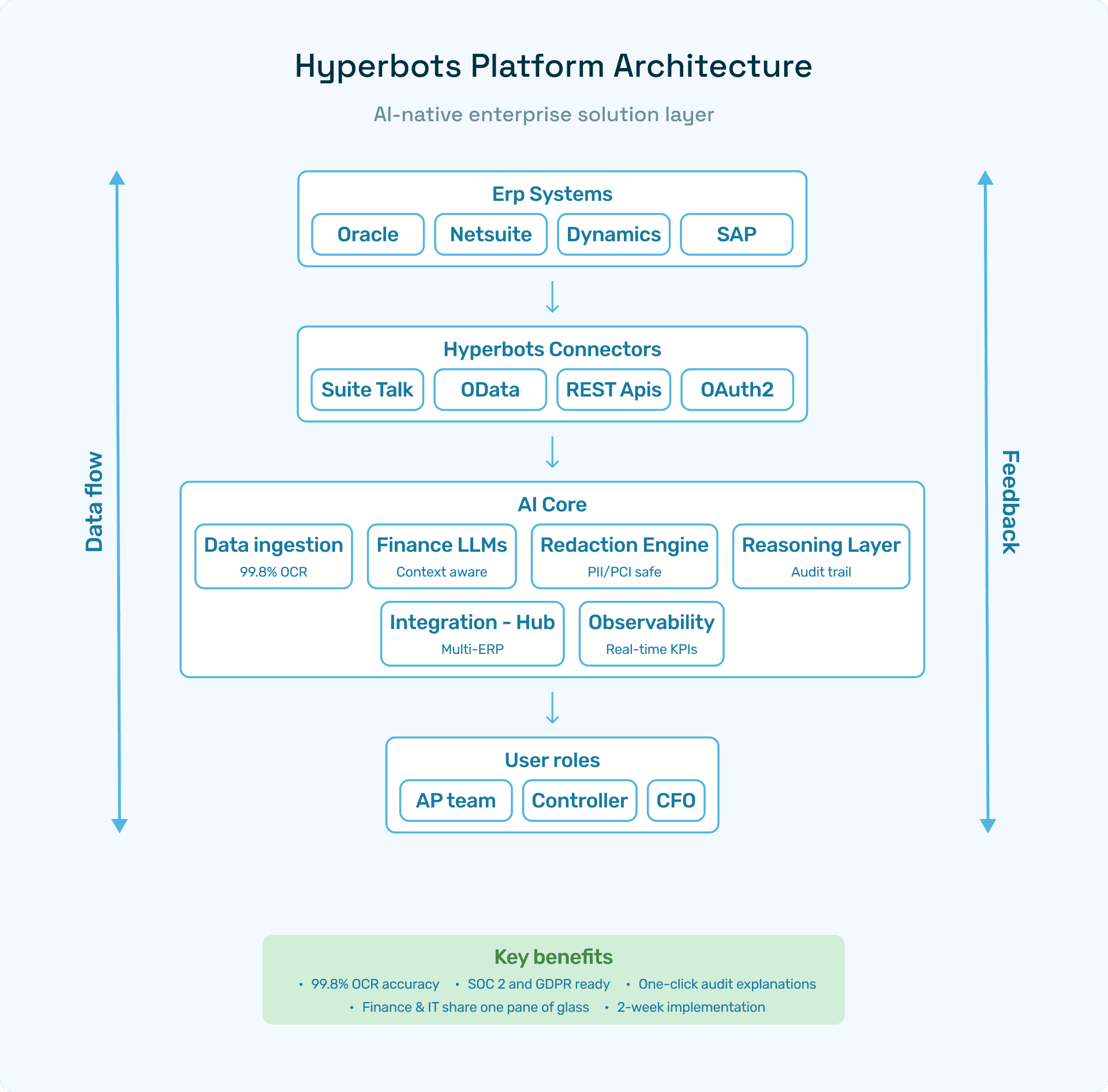
Redaction | Auto-mask PII & client data | SOC 2 / GDPR ready |
Reasoning | Chain-of-thought audit log | Instant auditor answers |
Integration Hub | SuiteTalk, OData, OAuth2 | 2-4 week deployment |
These complement any professional services ERP software stack.
7. Implementation Roadmap & Best Practices
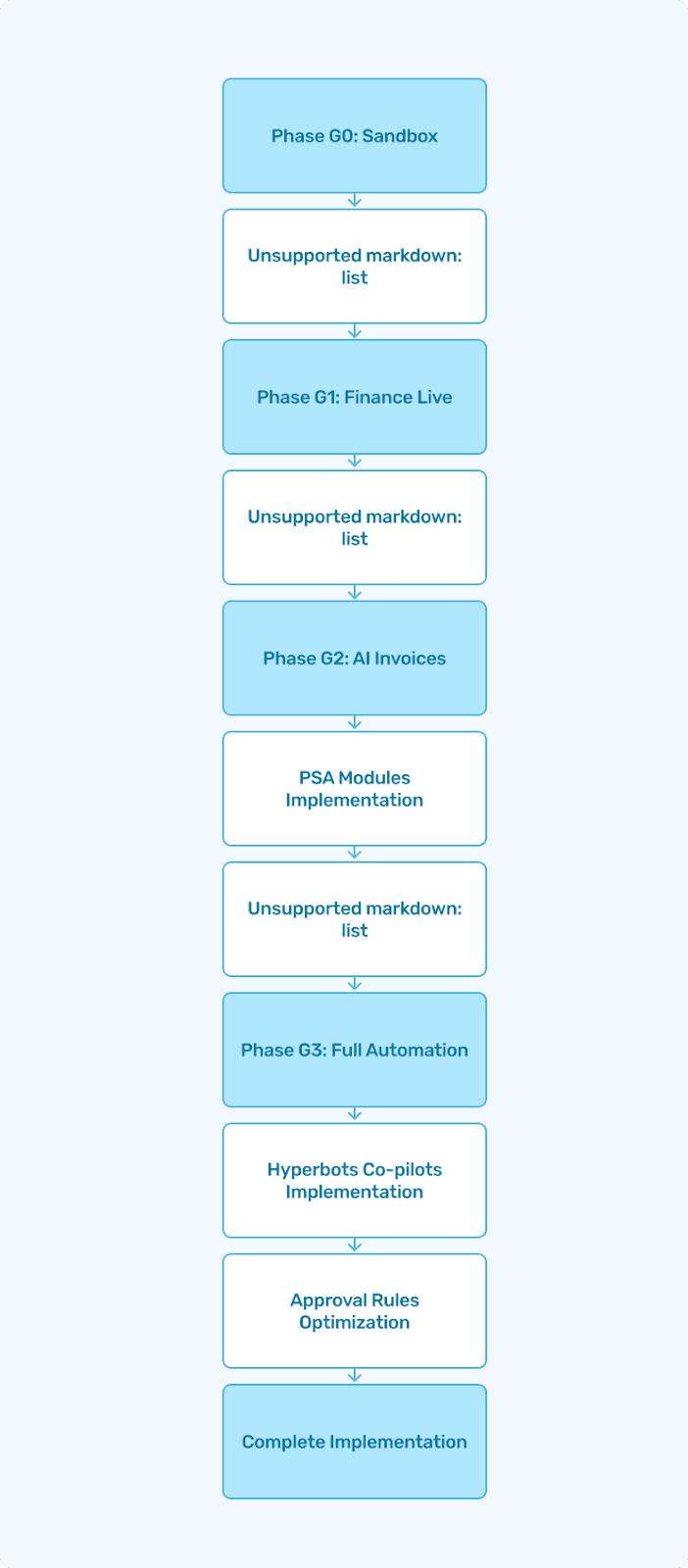
Diagnostic – Map quote-to-cash and procure-to-pay touchpoints; gather 200 invoices & timesheets.
Data Hygiene – Clean project codes, client master, tax zones.
Phased Go-Live – Financial core → PSA modules → Hyperbots Co-pilots.
Change Management – Power-user training; set KPI scorecards (utilization, DSO).
Hyper-care – 30-day sprint reviews to tune extraction models and approval rules.
8. Future Trends in ERP for the Professional Services Industry
AI Staffing Optimizers—LLMs suggest resource mixes vs. margin targets.
Usage-based Billing Engines—Metered professional services (e.g., API-support hours).
ESG & DEI Reporting—ERP dashboards track consultant travel emissions & diversity metrics.
Voice UI for PMs—“Hey ERP, log 3 hours to Project X.”
Composable Microservices—Replace monolith modules with best-of-breed edges, still under one data fabric.
Hyperbots align with these trends by delivering autonomous, explainable finance agents today.
9. FAQs
Q1. What makes an ERP ‘best’ for professional services?
Native project accounting, resource scheduling, flexible billing, and open APIs for AI.
Q2. Does professional services ERP software replace PSA tools?
Yes—modern ERPs embed PSA features and offer stronger finance integration.
Q3. How quickly can Hyperbots deploy?
SMB firms: 3–4 weeks; mid-market: 6–8 weeks, including training.
Q4. What’s typical ROI?
4–8× subscription cost within 12 months via labor savings and faster cash collection.
10. Conclusion & Next Steps
Winning in the project economy means maximizing billable hours, billing faster, and nailing compliance—without drowning teams in admin. Purpose-built ERP for professional services does the heavy lift; Hyperbots AI Co-pilots finish the job by eliminating manual invoice capture, PO creation, accrual posting, and vendor onboarding. If you’re ready to transform finance for your consulting, agency, or IT services firm, book a Hyperbots demo and witness autonomous project accounting in action.