One License, Infinite Users, Massive ROI: Welcome to Unlimited Access with Hyperbots
Hyperbots' unlimited access licensing model can reduce costs, boost agility, and transform AP operations with no seat limits or delays.
Jace:
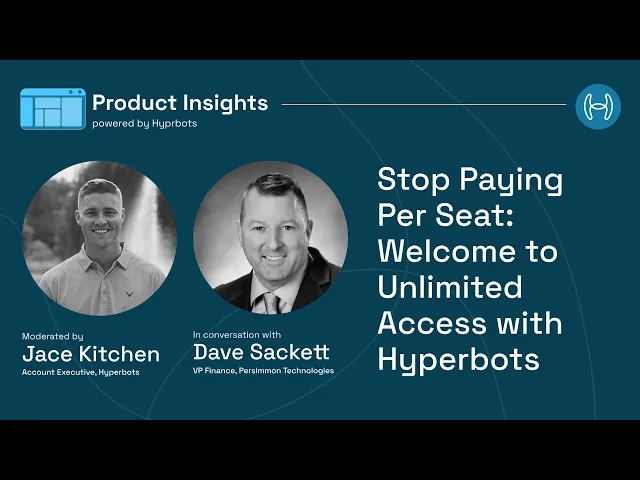
There we go. Perfect. Hi! Thanks, Dave, for joining us today. A quick introduction of myself: my name is Jace, and I’m an Account Executive here at Hyperbots. I’ve spent about six years in the Software-as-a-Service (SaaS) space, focused on finance and accounting automation.
Today, we have Dave Sackett with us, a finance leader with deep expertise in AI, ERP systems, and operational finance. He currently serves as the VP of Finance at Persimmon Technologies and has held senior roles at multiple other corporations as well. So, thanks for joining us, Dave.
Dave Sackett:
Thanks, Jace, for the intro.
Moving Beyond Traditional Per-Seat Pricing
Jace:
Today’s topic is “Hyperbots' unlimited access licensing model”. First question for you, Dave, is:
Most Software-as-a-Service (SaaS) finance tools still price per seat. What does Hyperbots mean by “access to unlimited users”?
Dave:
It means we pay for the application, not on a per-user basis. Anyone in our company can log in and use Hyperbots without any additional charge.
Jace:
Awesome. Where did you initially feel the pain of seat-based pricing before using Hyperbots?
Dave:
Usually, even in our ERP system, we’re charged by the number of users, regardless of whether or not they’re actually using the system. So we end up paying for a service we’re not really utilizing fully, from a licensing point of view. With Hyperbots, we only pay for what the bot does. It’s a pay-as-you-go model. It doesn’t matter if I have one user or a hundred; the cost remains the same.
Simplifying Approvals and Reducing Delays in AP Workflows
Jace:
And how are roles and permissions assigned if access is so open?
Dave:
We use approval chains, with varying levels of permissions, from limited approval to power users. Previously, invoices had to wait for someone with a license to review them. That step is now eliminated. Hyperbots operate in real time, which means invoices move faster through the system without delays.
Jace:
Does this access extend to external stakeholders, like vendors?
Dave:
Yes, that's possible. We're not using it just yet, but we’re looking forward to enabling vendors to see what’s going on. Having another set of eyes helps resolve issues, like payment delays or invoice discrepancies, more quickly.
Flexible Onboarding Designed for Speed and Scalability
Jace:
You have over 300 users. How did you handle the onboarding process for them?
Dave:
Actually, only a small portion of those employees use Hyperbots directly. My finance team worked closely with Hyperbots during onboarding. We held weekly meetings to go over action items, testing, and user acceptance. We also brought in our IT director to assist with API connections to our ERP system on the backend.
Jace:
Can you import users from Excel if HR integration isn’t ready?
Dave:
Absolutely. You can drag and drop a CSV file with names, emails, and roles. Let’s say you acquire a new subsidiary and need to onboard users quickly; it’s designed for that.
Jace:
Pretty seamless process. And what happens when an employee leaves the organization?
Dave:
They’re flagged as terminated, and Hyperbots revokes access automatically. So there are no orphan accounts. It’s a real-time win for maintaining database security.
Automating Invoice Processing Across Time Zones
Jace:
Your team operates globally. How does 24/7 access improve operations?
Dave:
While we’re sleeping, the bot is working. We receive invoices from around the world. They get sent to a central inbox, which Hyperbots monitors. Even if we’re offline, Hyperbots processes those invoices without delay.
Jace:
When we spoke previously, you described the model as “democratized participation.” Could you elaborate?
Dave:
Sure. When every stakeholder can participate, disputes get resolved faster. For example, a plant foreman can comment on a price variance directly in the invoice thread, instead of sending an email to a licensed controller. Stakeholders can track the invoice’s status and see who’s responsible for the next step, creating a clear audit trail.
Comparing ROI and Flexibility with Other Solutions
Jace:
From your experience, how does this compare with competitors you’ve evaluated?
Dave:
I’ve gone through an implementation with another company before. There were a lot of upfront fees and fixed maintenance costs. Hyperbots’ model is usage-based; if the bot does little, we pay less; if it does a lot, we pay more, but still less than hiring someone to do the same work. The ROI is definitely in our favor.
Improving Vendor Experience & Scaling Operations
Jace:
What impact, if any, has this had on your vendor relationships?
Dave:
Vendors now get paid faster. There are fewer issues, and fewer invoices have to be submitted manually. Once an invoice hits the inbox, if all the data is correct, it gets processed automatically. We also benefit from automation in tracking W-9s and checkpoint validations, which saves everyone time.
Jace:
What if your user base doubles after an acquisition?
Dave:
That’s part of our growth plan. We’re not planning to increase headcount in finance. Instead, the bot will simply do more work. It’s more efficient and cost-effective than hiring. As we scale and volume increases, the bot continues to learn and improve, processing everything more quickly.
Balancing Open Access with Enterprise-Grade Security
Jace:
Does open access raise any security concerns?
Dave:
Not at all. Roles are granular, data is encrypted, and we use SSO with Azure AD and enforced MFA. “Unlimited” doesn’t mean “ungoverned.” We manage bot permissions just like we would an employee’s.
Jace:
Any unexpected wins from having unlimited seats?
Dave:
Absolutely. Instead of paying for a user who just needs view-only access, we can now give access to anyone, like the head of purchasing, an IT manager, or even our CEO. That flexibility, without extra cost, is a big win.
Calculating ROI Through Productivity & Cost Avoidance
Jace:
Final question: What’s the overall impact on your bottom line?
Dave:
Before Hyperbots, I had two people in Accounts Payable (AP) and was considering hiring another as we grew. With Hyperbots, we avoided that hire. It’s now doing the equivalent work of a full AP clerk and 80% of the work of our AP manager. That’s how we’re calculating ROI. Budget-wise, it’s been a big positive.
Jace:
Awesome. Love to hear that. Thanks again for your time, Dave. We look forward to chatting with you again soon.
Dave:
Thanks, Jace.