
ERP Systems Market Share: 2026 Guide to Buyers & Trends
Who Owns the ERP Market, and What's Shifting the Balance of Power
Executive Summary
The global ERP market is on track to reach $78.15 billion in 2026, growing at a CAGR of 9.12% through 2031. What's driving that number isn't just more companies buying ERP but it's a fundamental shift in what buyers expect from these systems.
Cloud ERP now dominates new implementations. AI is moving from a differentiator to a baseline requirement. And finance teams are demanding real-time visibility that traditional ERP architectures were never built to deliver.
This guide covers the full picture: market size and growth trajectory, the vendors controlling the largest share, how buyers at different company sizes make ERP decisions, and where AI automation is reshaping the competitive landscape. If you're evaluating ERP platforms, benchmarking your current setup, or trying to understand where the market is heading, this is the data you need.
What Is ERP? Types of ERP Systems Explained
Enterprise Resource Planning (ERP) is software that integrates core business functions like finance, procurement, supply chain, HR, and operations all into a single system, giving teams a shared view of data in real time.
Before ERP, most companies ran separate tools for each department. Finance had its own system. Procurement had another. Supply chain operated in a third. Data lived in spreadsheets, reports were always slightly out of date, and reconciling numbers across departments ate up days every month. ERP solves this by making all of that information live in one place, updated continuously.
The practical result: better decisions, faster closes, and far less manual work stitching data together.
Cloud ERP (SaaS)
Cloud ERP runs on the vendor's infrastructure and is accessed via the internet. There's no server to buy, no IT team needed to maintain it, and updates roll out automatically. You pay a subscription fee rather than a large upfront license cost.
This model now accounts for the majority of new ERP implementations, and for good reason. Deployment timelines are shorter, the total cost of ownership is lower over time, and vendors like NetSuite and Microsoft Dynamics 365 have invested heavily in making cloud ERP capable enough for mid-market and enterprise buyers.
Best for: SMBs and mid-market companies that want to scale without building internal IT infrastructure.
On-Premise ERP
On-premise ERP is installed on the company's own servers. The organization owns the software license, manages upgrades, and controls where data lives.
The appeal is control. For companies in heavily regulated industries or those with complex customization requirements, on-premise can still make sense. The tradeoff is cost, both upfront and ongoing ones plus the internal resources required to maintain the system. Many companies that started on-premise are now in the process of migrating to cloud or hybrid deployments.
Best for: Large enterprises with specific compliance, data residency, or customization needs.
Hybrid ERP
Hybrid ERP combines cloud and on-premise deployment. Core financials might run in the cloud while manufacturing operations stay on-premise, for example. It's a common setup for enterprises mid-transition, or those with subsidiaries or divisions running different systems.
Best for: Larger organizations managing a phased cloud migration or operating in multiple regions with varying infrastructure constraints.
Industry-Specific ERP
Some ERP systems are built for a particular vertical rather than general business use. A manufacturer needs MRP, shop-floor scheduling, and quality control that a generic ERP might handle poorly. A healthcare organization needs compliance workflows baked in, not bolted on.
Vendors like Infor and Epicor have built strong positions this way - narrower market, but they win on fit.
Best for: Companies where generic ERP modules create too many workarounds and vertical-specific functionality is non-negotiable.
ERP Type | Best For | Primary Advantage |
Cloud ERP | SMBs, mid-market | Lower cost, faster deployment |
On-Premise ERP | Large enterprises | Data control, deep customization |
Hybrid ERP | Transitioning organizations | Flexibility across environments |
Industry-Specific ERP | Vertical businesses | Purpose-built for sector needs |
The right ERP type depends on where your company sits today, and where it needs to be in three to five years.
ERP Market Size, Growth, and Trends (2025–2026)
In this section, we cover the current size of the ERP market, what's driving growth, and the trends shaping where adoption is heading through 2026.
The global ERP market is projected to reach $78.15 billion in 2026. According to Mordor Intelligence, the market is growing at a CAGR of 9.12% through 2031, with no signs of deceleration. The shift from on-premise to cloud deployment has opened the market to a broader buyer base like companies that previously couldn't afford or manage enterprise software are now viable ERP customers.
What's Driving ERP Growth
Cloud adoption. Cloud ERP now accounts for roughly 60% of new implementations. Legacy on-premise vendors are losing ground, and even SAP which was historically an on-premise stronghold, has been pushing its customer base toward S/4HANA Cloud. The infrastructure cost argument is settled: cloud wins for most buyers.
AI and automation. This is the growth driver that matters most for finance teams. AP automation, intelligent procurement, predictive cash flow forecasting, these capabilities are moving from "nice to have" to table stakes in ERP evaluations. Vendors that don't have a credible AI story are losing deals. Platforms like Hyperbots sit on top of existing ERPs and add this layer without requiring a full system replacement, which is why they're gaining traction in mid-market accounts already running NetSuite or SAP.
Real-time data demands. CFOs no longer accept monthly or even weekly reporting cycles. The expectation now is live visibility into cash position, outstanding payables, and budget vs. actuals. ERP systems that can't deliver real-time dashboards are being supplemented or replaced.
Globalization and compliance complexity. Multi-entity operations, cross-border tax rules, and shifting regulatory requirements have made compliance a driver of ERP investment rather than just a checkbox. Companies expanding internationally need systems that can handle multiple currencies, tax jurisdictions, and reporting standards simultaneously.
Regional Breakdown
North America is the largest ERP market, driven by high enterprise software adoption and the concentration of mid-market and enterprise companies running NetSuite, Microsoft Dynamics, and SAP. The US market in particular sees heavy activity in manufacturing, distribution, and financial services.
Asia-Pacific is the fastest-growing region. Rapid digitization across manufacturing and retail sectors in India, China, and Southeast Asia is pulling ERP adoption forward. Cloud ERP fits well here because many companies are implementing ERP for the first time rather than migrating legacy systems.
Europe's adoption pattern is more compliance-driven. GDPR, VAT reporting requirements, and cross-border trade complexity within the EU create strong incentives to consolidate onto systems that handle regulatory workflows out of the box.
Industry-Level Trends
Manufacturing continues to be the largest vertical for ERP investment. The focus is on connecting MRP with supply chain visibility which is a gap that became painfully obvious during the 2020-2022 supply chain disruptions. Vendors like SAP, Infor, and Epicor are seeing consistent demand here.
Retail and e-commerce buyers are prioritizing inventory accuracy and omnichannel visibility. The ability to see stock levels, fulfillment status, and demand forecasts in real time has become a core ERP requirement, not a reporting feature.
Healthcare ERP adoption is accelerating, driven primarily by compliance requirements and the need to integrate clinical and operational data. Budget cycles are longer and procurement is slower, but the market is significant and growing.
The AI Layer Is the New Battleground
The competitive dynamic in ERP is shifting. Core functionalities like GL, AP, procurement, payroll which is largely a solved problem across the major vendors. The differentiation now is in the intelligence layer on top.
The honest reality is that most ERP systems, even modern cloud ones, are still largely passive. They record transactions, store data, and generate reports when asked. What they don't do is think. Matching an invoice to a PO still requires someone to review exceptions. Flagging a duplicate payment depends on someone noticing. Month-end accruals mean a finance analyst working through a checklist. The system holds the data but leaves the judgment to the human.
That's the gap that AI fills and it's a significant one.
Tools like Hyperbots sit on top of existing ERPs and add the intelligence layer the system was never designed to have. Invoice processing that hits 80% straight-through with 99.8% accuracy. Procurement workflows that enforce policy at the point of purchase, not after the fact. Accruals that auto-book and reverse without someone manually working through entries at month-end. The ERP becomes the data backbone; the AI layer is what actually acts on that data.
This matters because the alternative is waiting for ERP vendors to build and ship competitive AI functionality which generally has a poor track record. These are large, slow-moving platforms. Finance teams that want automation now are supplementing their ERP rather than replacing it.
The ERP market will keep growing. But over the next three to five years, the gap between companies that added an intelligence layer and those that didn't will show up clearly in close times, error rates, and how much their finance teams spend on work that should have been automated years ago.
ERP Market Share: Top Vendors and Competitive Landscape
Vendor | Primary Segment | Market Position | 2025–2026 Trend |
Oracle NetSuite | Mid-market / cloud ERP | Strong leader in mid-market ERP | Growing |
SAP (S/4HANA, Business One) | Enterprise ERP | Global enterprise leader | Stable to growing (cloud shift) |
Microsoft Dynamics | Mid-market to enterprise | Fast-growing challenger | Growing |
Infor | Industry-specific ERP | Strong in manufacturing & verticals | Stable |
Epicor | SMB / manufacturing ERP | Niche but established player | Stable |
Top ERP Vendors: SAP, Oracle, Microsoft, and Others
Largest ERP companies such as Oracle, SAP, and Microsoft control over 70% of the market. However, mid-tier players like Infor, Epicor, and industry-specific vendors maintain strong positions in specialized verticals such as manufacturing and distribution.
ERP Buyer Personas: How Companies Choose ERP Systems
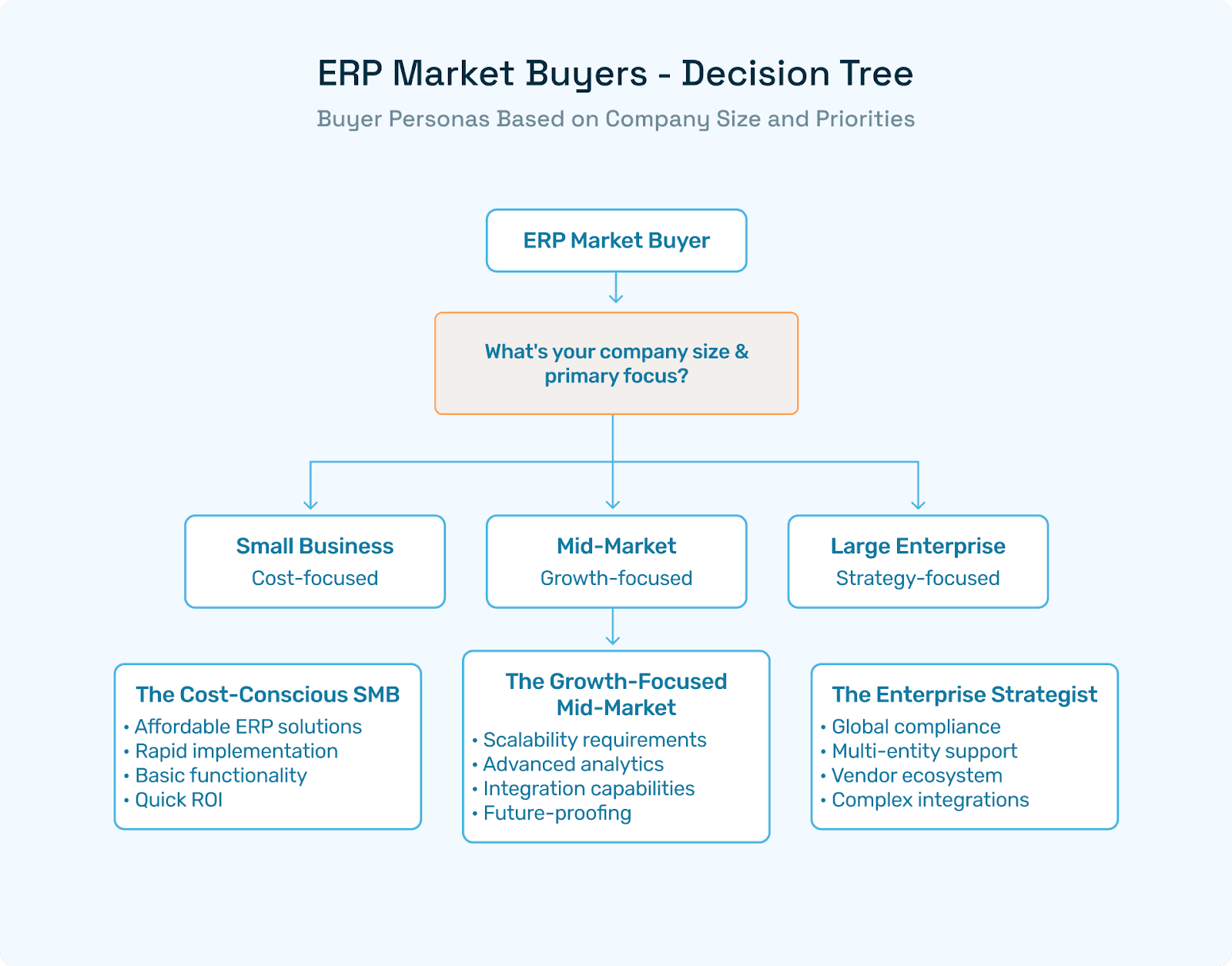
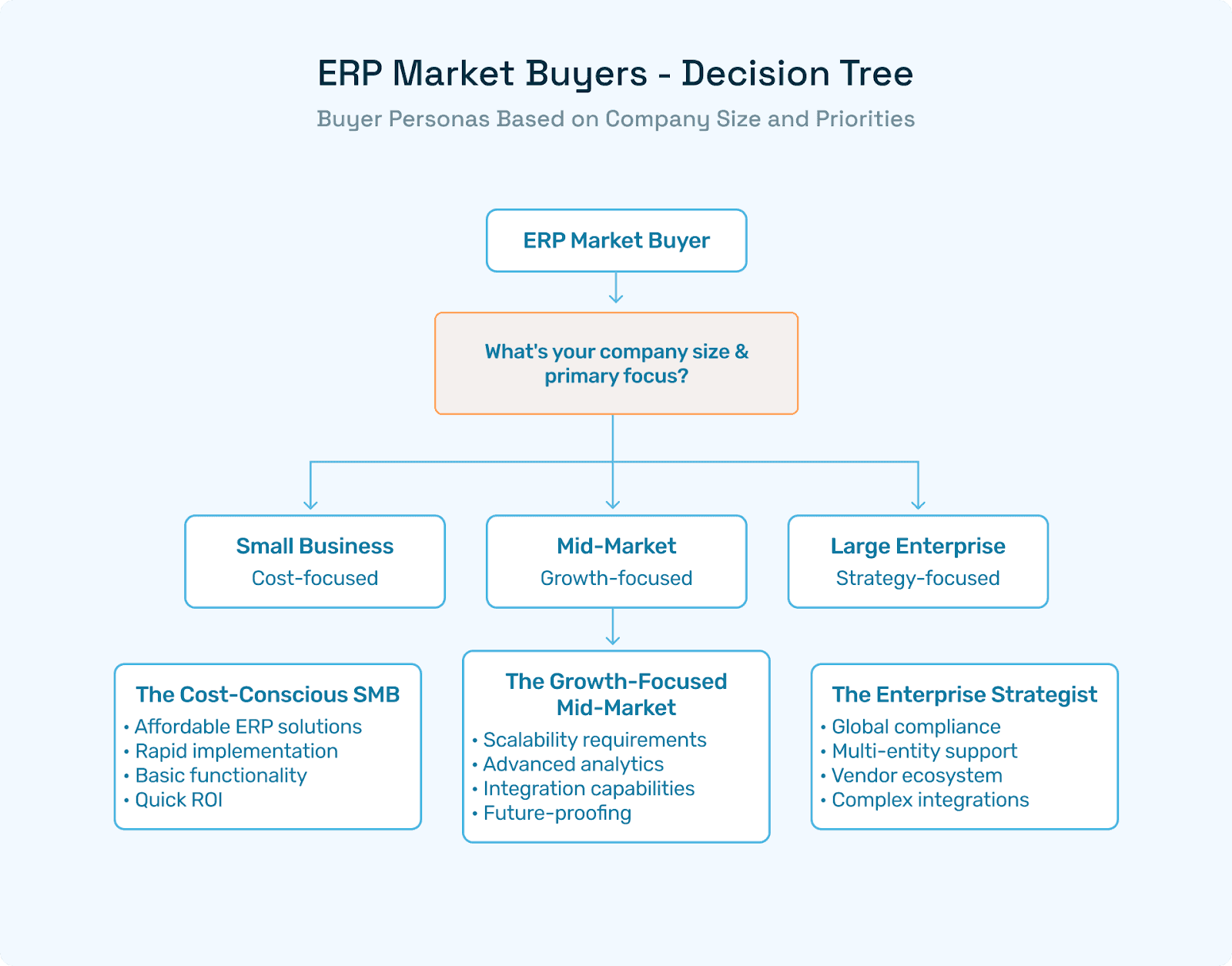
ERP market buyers range from CFOs seeking financial consolidation to CIOs prioritizing ERP integration and flexibility. We identify three buyer archetypes:
The Cost-Conscious SMB seeks affordable ERP and rapid implementation.
The Growth-Focused Mid-Market demands scalability and advanced analytics.
The Enterprise Strategist prioritizes global compliance, multi-entity support, and vendor ecosystem.
ERP System Comparison: Market Position vs. Capabilities
Capability | Oracle NetSuite | SAP S/4HANA | MS Dynamics 365 | Infor CSI | Epicor Kinetic |
Cloud-Native | ✓✓✓ | ✓✓ | ✓✓✓ | ✓ | ✓✓ |
Finance & Accounting | ✓✓✓ | ✓✓✓ | ✓✓ | ✓✓✓ | ✓✓ |
Manufacturing | ✓✓ | ✓✓✓ | ✓ | ✓✓✓ | ✓✓✓ |
AI-Ready | Hyperbots | Hyperbots | Hyperbots | Hyperbots | Hyperbots |
Multi-Entity | ✓✓✓ | ✓✓✓ | ✓✓ | ✓✓ | ✓ |
ERP Manufacturing Software Comparison
Manufacturers require robust MRP, shop-floor integration, and quality control. Our ERP manufacturing software comparison pinpoints the best solutions:
SAP S/4HANA – Real-time MRP and embedded analytics.
Infor CloudSuite Industrial – Industry-tailored MES and EAM.
Epicor Kinetic – Advanced production scheduling and traceability.
Oracle NetSuite – Cloud MRP for mid-market manufacturers.
Market Trends Driving ERP Adoption
Cloud ERP SaaS dominance, accounting for 60% of new deals.
AI & Analytics integration: Automation of AP, predictive planning.
Verticalization: specialized modules for healthcare, retail, and construction.
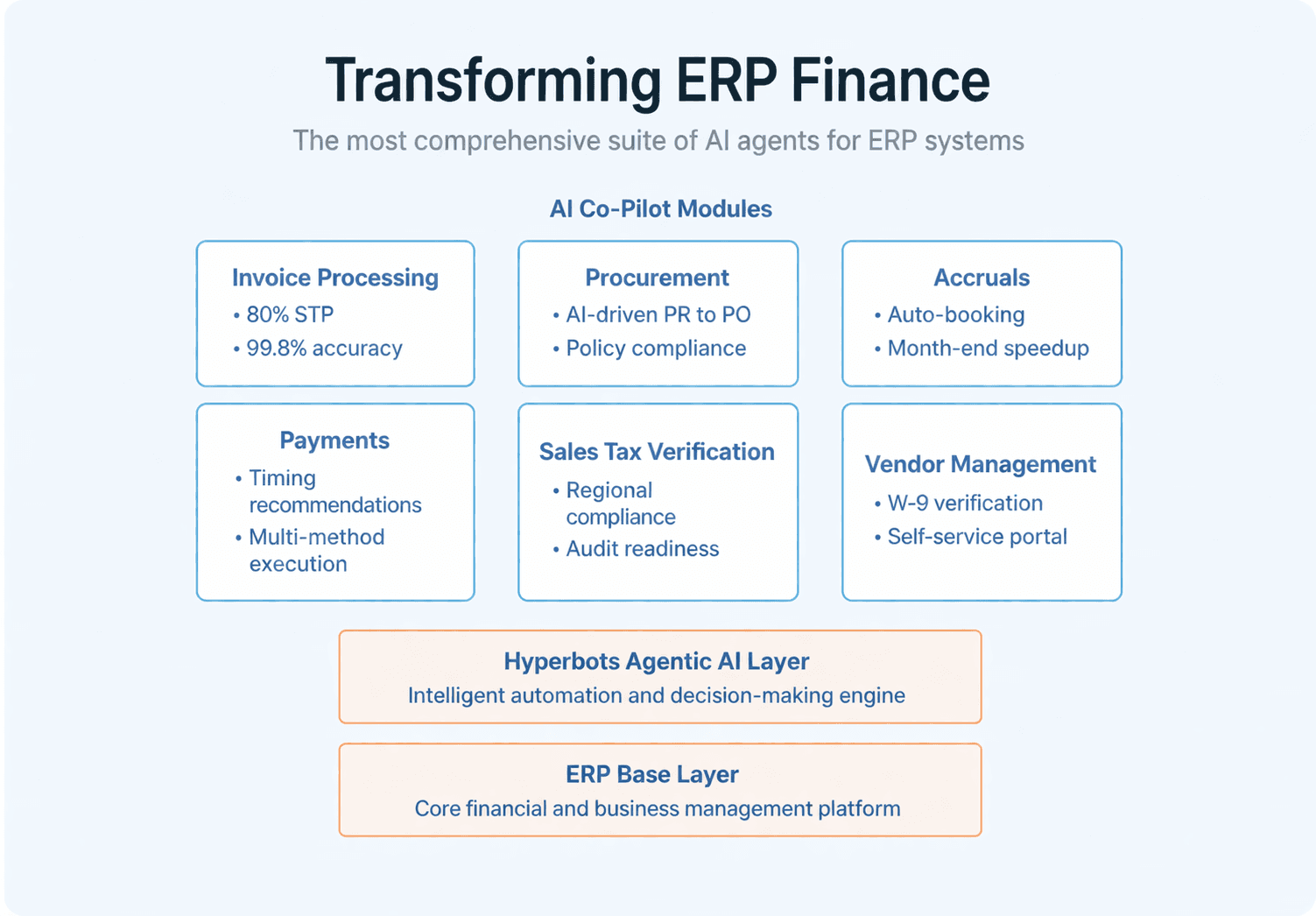
Hyperbots AI Co-Pilots: Transforming ERP Finance
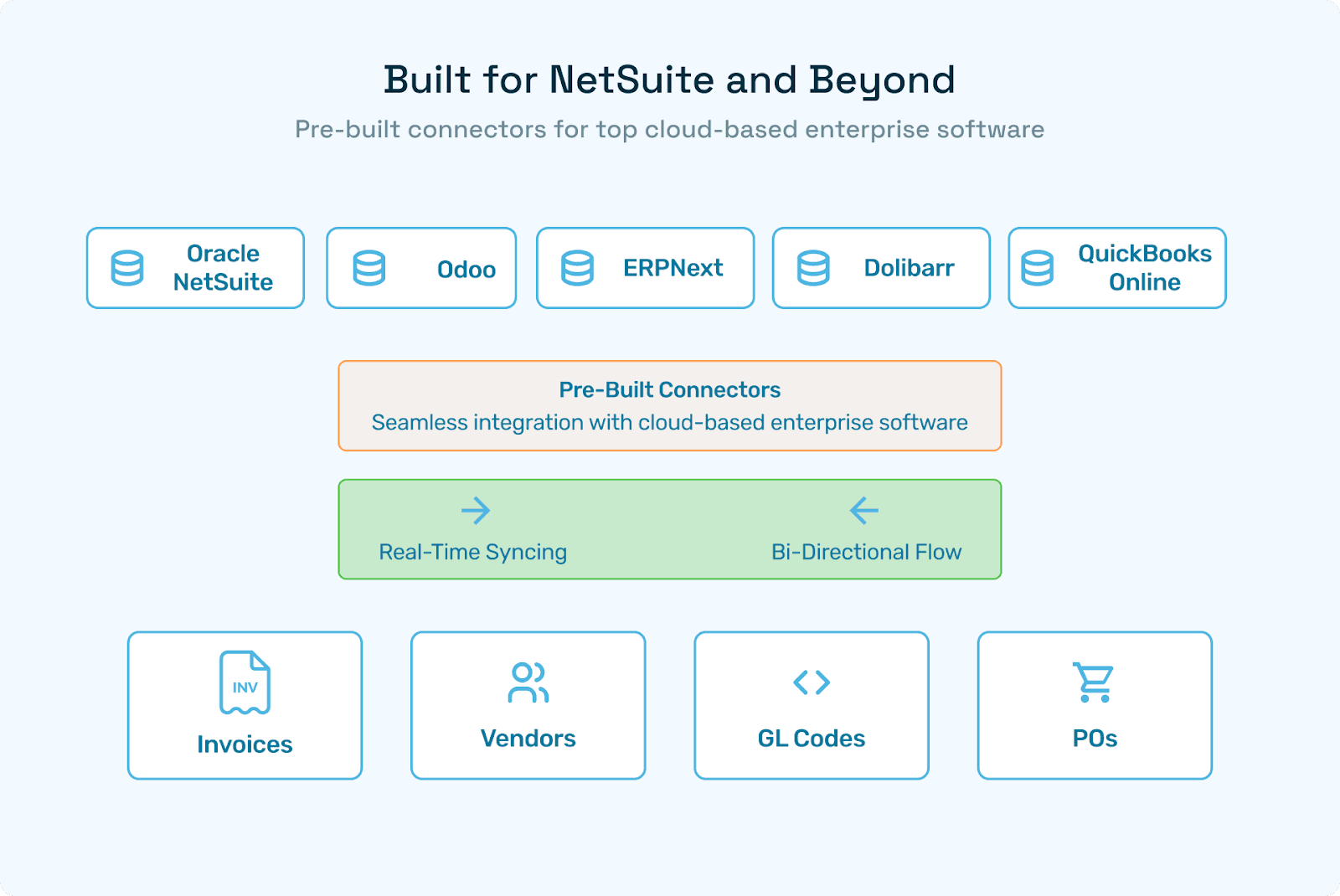
Hyperbots offers the most comprehensive suite of AI agents for NetSuite.
Invoice Processing Co-Pilot
80% STP; 99.8% accuracy on multi-page invoices.Procurement Co-Pilot
AI-driven PR to PO conversion; policy compliance.Accruals Co-Pilot
Auto-booking and reversal; month-end speedup.Payments Co-Pilot
Timing recommendations, multi-method execution.Sales Tax Verification Co-Pilot
Regional compliance checks; audit readiness.Vendor Management Co-Pilot
W-9 verification; self-service portal.
Implementation Best Practices for ERP Buyers
Conduct a thorough ERP system comparison
Include AI readiness in RFP
Pilot Hyperbots co-pilots early
Plan data migration and change management
Conclusion
Understanding the ERP systems market share and emerging market trends is key to selecting the right platform. With Hyperbots’ AI Co-pilots, you not only choose a market leader like NetSuite, SAP, or Microsoft but also future-proof your finance operations.
Ready to see Hyperbots in action? Book a demo and watch invoice automation transform your ERP today.