From Intake to PO: Automated Processing of Purchase Orders
Turn requisitions into purchase orders faster with AI-powered automation and precision.
Executive Summary
Manual purchase order workflows are notorious for delays, errors, and compliance risks. Despite digitization, many organizations still rely on spreadsheets, inboxes, and rule-based systems that can’t scale with modern procurement demands. Automated purchase order processing redefines how finance and procurement leaders manage intake, validation, approvals, and ERP integration — turning weeks-long cycles into hours.
This blog explores:
What automated purchase order processing means in today’s enterprise context
How intake orchestration improves compliance and efficiency
Common pitfalls of manual and semi-automated workflows
ROI benchmarks including cycle time reductions
How Hyperbots AI Co-pilots lead the market in transforming procurement and finance workflows
By adopting Hyperbots’ AI-powered platform, organizations achieve up to 80% cost reduction, improve supplier trust, and empower CFOs with real-time spend visibility.
Introduction: Why Automated Processing of Purchase Orders Matters
For decades, organizations have treated purchase orders (POs) as administrative tasks - forms to be filled, approved, and pushed into ERP systems. Yet, this process consumes significant time and creates financial blind spots.
Inbox bottlenecks: Approvals lost in endless email chains
Data errors: Manual entry leads to mismatches and rework
Compliance gaps: Lack of structured audit trails increases regulatory risks
Scaling limits: Finance teams cannot keep up as transaction volumes rise
According to a recent Deloitte Global CPO Survey, digital leaders in procurement achieve significantly better performance across cost, risk, and supplier collaboration compared to peers who remain stuck in manual workflows.
This is where automated purchase order processing steps in — not just digitizing forms but orchestrating intake, validation, and approvals with AI precision.
What Is Automated Purchase Order Processing?
Automated purchase order processing is the use of intelligent software to:
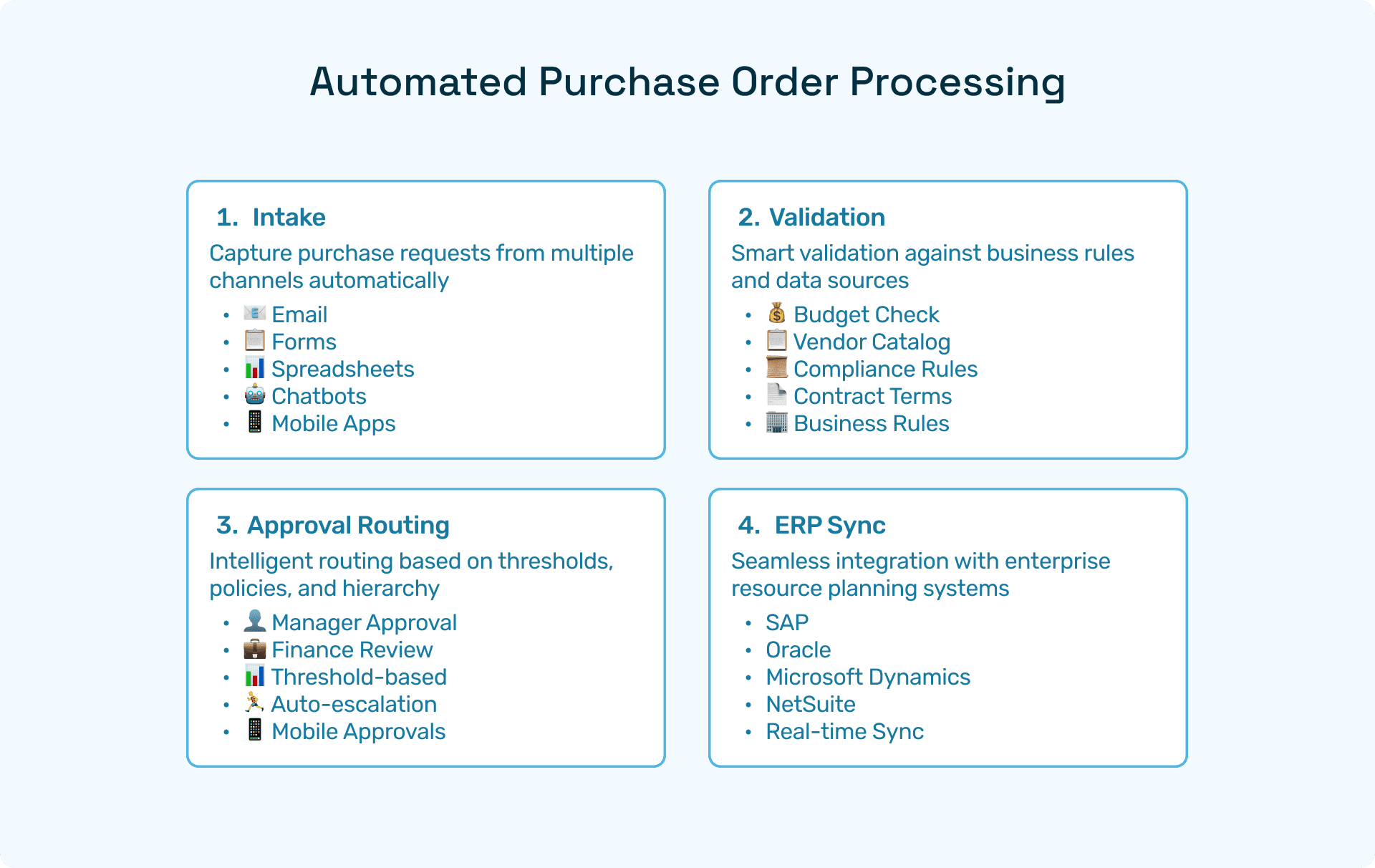
Capture purchase requests from intake channels (email, forms, spreadsheets, chatbots)
Validate requests against budgets, vendor catalogs, and compliance rules
Route POs automatically to approvers based on thresholds and policies
Sync approved POs directly with ERP systems like SAP, Oracle, Microsoft Dynamics, or NetSuite
Unlike traditional “system-based” workflows, automation turns purchase orders into living processes - enabling real-time visibility, faster cycle times, and improved compliance.
👉 Example: A team uploads a vendor requisition file into the system. The automation validates line items against contracts, applies business rules, routes to the correct manager for approval, and instantly syncs the final PO with SAP.
The Role of Intake Orchestration in Purchase Orders
One of the biggest pain points in procurement is intake orchestration — the front door where purchase requests enter. Without automation, intake becomes fragmented across:
Email threads
Shared Excel files
Unstructured messages in Teams or Slack
This creates delays, duplication, and confusion.
Automated intake orchestration consolidates these channels and standardizes how requests are handled. For example:
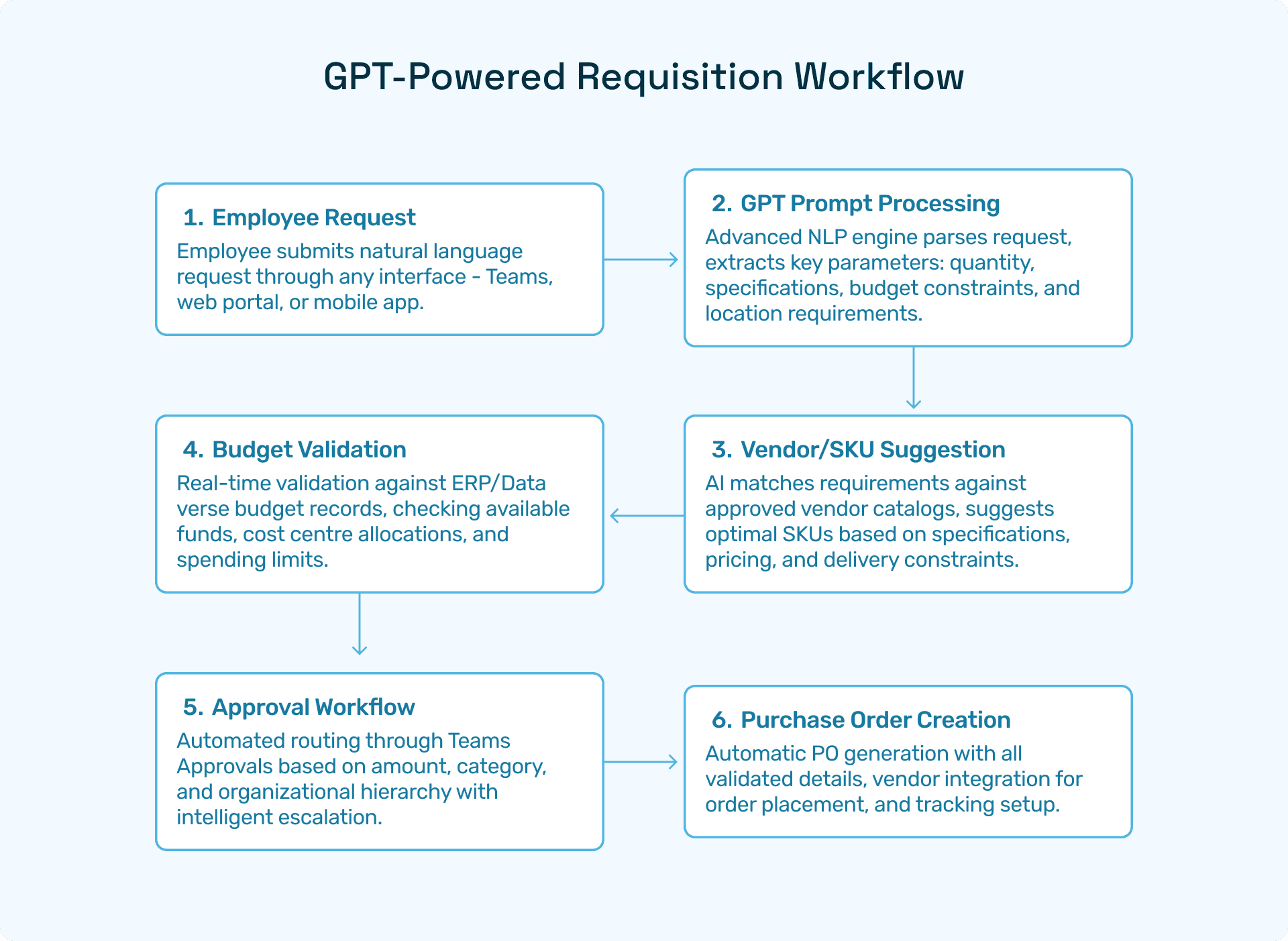
An employee submits a request in Microsoft Teams → automation parses details and creates a structured requisition.
A CSV file is uploaded via email → automation validates and transforms it into a PO.
This ensures every request is logged, validated, and tracked with an audit trail.
Key Challenges of Manual PO Processing
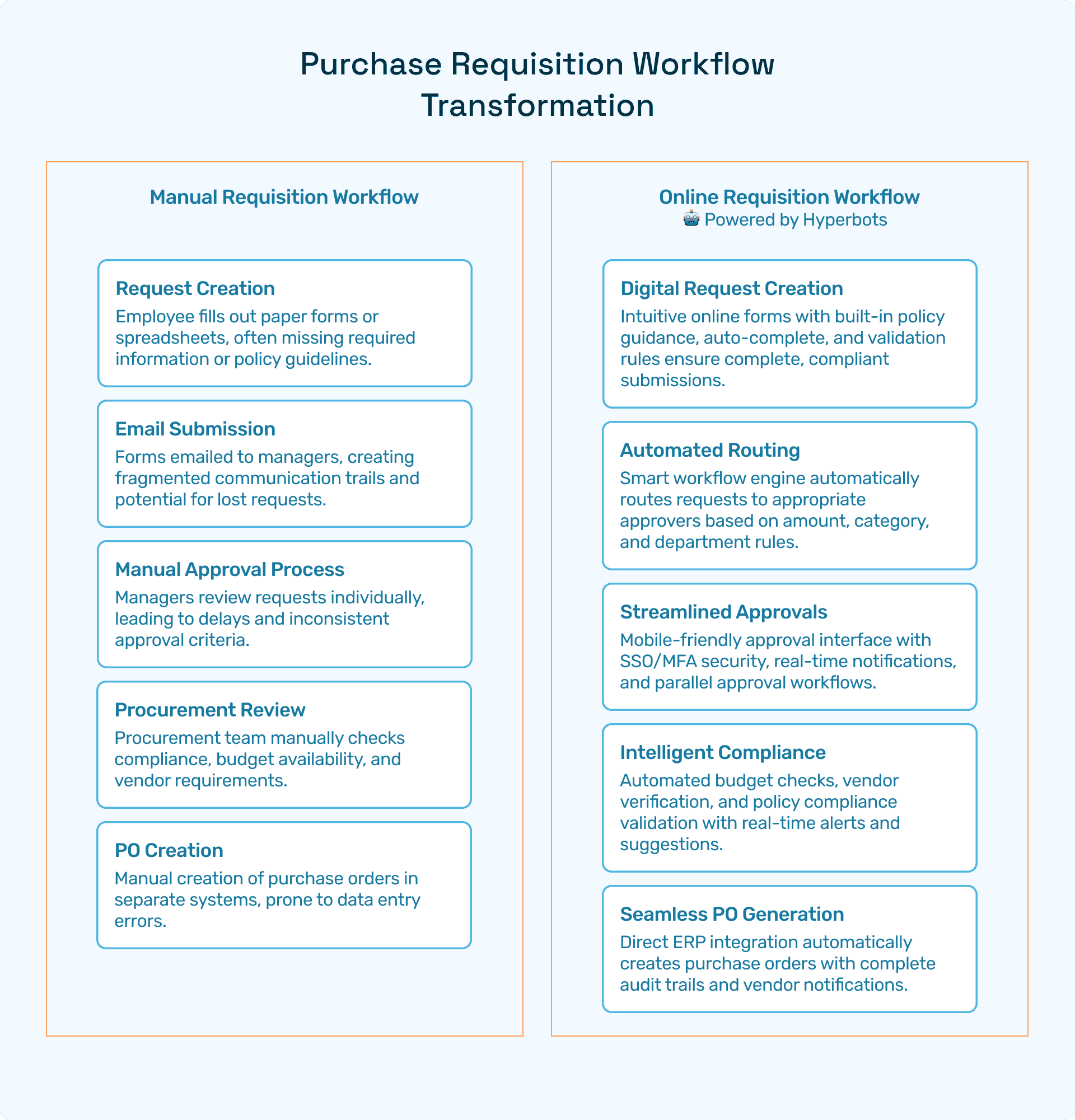
While manual PO workflows feel “familiar,” they mask hidden costs:
Approval bottlenecks: Approvals can sit idle for days in inboxes.
Error-prone data: Re-keying increases duplicate and mismatched POs.
Lack of compliance: No structured trail for auditors.
Scaling risks: Mid-market firms quickly outgrow manual systems.
A Gartner report notes that top supply chain leaders leverage AI-driven procurement automation at twice the rate of laggards.
Benefits of Automated Purchase Order Processing
1. Faster Cycle Times
Cuts approval cycles from weeks to hours
Auto-approves low-value, policy-aligned purchases
2. Reduced Costs
Up to 80% cost savings through elimination of manual rework
Lowers transaction overhead per PO
3. Stronger Compliance
Automated validation against budgets and policies
Digital audit trails with timestamped approvals
4. Real-Time ERP Sync
Eliminates delays between approval and execution
Integrates seamlessly with SAP, Oracle, Dynamics, and NetSuite
5. Enhanced Visibility
Dashboards for spend, vendor activity, and approval metrics
Proactive insights for CFOs and Controllers
Why Hyperbots Leads in Automated Purchase Order Processing
While many vendors digitize purchase orders, Hyperbots sets the standard for true automation with its AI Co-pilots.
Procurement Copilot
Shrinks cycle times from request to PO
Delivers ERP-synced approvals instantly
Auto-validates policies with contextual AI
Provides real-time spend dashboards
Supporting AI Co-pilots
Invoice Processing Copilot → Automates invoice validation and 3-way matching
Vendor Management Copilot → Streamlines onboarding and compliance
Accruals Copilot → Provides real-time expense visibility
Payments Copilot → Ensures secure, policy-compliant disbursements
Hyperbots Platform Capabilities
Handles unstructured data (PDFs, emails, scanned invoices)
Deep ERP integrations (SAP, Oracle, Dynamics, NetSuite)
AI-driven decision intelligence (anomaly detection, predictive analytics)
Human-in-the-loop controls for CFO oversight
Differentiator: Unlike rule-based systems, Hyperbots uses agentic AI to adapt dynamically, delivering both speed and compliance.
ROI from Hyperbots-Led PO Automation
Organizations implementing Hyperbots achieve:
Stronger vendor relationships
Higher employee satisfaction
Data-driven decision-making with predictive insights
Templates & Examples of Automated Processing of Purchase Orders
Example 1: CSV-to-PO Automation
Upload CSV file → validate fields → auto-route → sync with ERP
Example 2: Email-to-PO Conversion
Employee emails “Need 30 monitors” → automation parses, validates, routes → PO created
Example 3: Intake via Teams
Teams request submitted → auto-approval for under $1,000 → ERP sync
FAQs
Q1. What is automated purchase order processing?
A: It’s the automation of intake, validation, routing, and ERP syncing of POs.
Q2. How does intake orchestration improve efficiency?
A: It standardizes fragmented intake sources like email, Teams, and Excel into structured workflows.
Q3. How does Hyperbots differ from competitors?
A: Unlike rule-based vendors, Hyperbots leverages AI Co-pilots with ERP-deep integration and predictive intelligence.
Q4. Which industries benefit most?
A: Manufacturing, logistics, retail, and healthcare - all with high PO volume and compliance needs.