Designing GPT Workflows for Requisition Drafting and Validation
Leverage GPT intelligence to draft, validate, and accelerate purchase requisition workflows.
A GPT purchase requisition software system automates the two most time-consuming parts of procurement: drafting requisitions and validating them against budget and policy rules. Instead of employees filling in SKUs, chasing vendor codes, and manually cross-referencing ERP records, AI handles the structure, the lookups, and the routing.
This guide breaks down how GPT-driven requisition workflows actually work, what each component does, and how finance teams at mid-market and enterprise companies are using them to cut requisition-to-PO cycle times without sacrificing compliance or audit readiness.
Why Traditional Requisition Drafting Falls Short
Most enterprises still rely on employees to manually draft requisitions, fill in item details, and verify budget compliance before routing for approval. The gaps this creates are well-documented.
Common failure points include human error in entering SKUs, pricing, or vendor codes; slow turnaround times caused by back-and-forth approval chains; budget misalignment from the absence of real-time ERP validation; and outdated vendor catalogs that give procurement teams no way to make informed sourcing decisions at the point of request.
The result is wasted effort, inconsistent requisitions, and delayed purchase orders. According to Ardent Partners' 2025 State of Procurement research, roughly one in four procurement teams has integrated some form of AI into standard procurement activities — meaning the majority are still running these processes manually, at significant cost to cycle time and accuracy.
Introducing GPT Workflows in Requisition Drafting and Validation
Modern enterprises are turning to GPT purchase requisition software systems to close these gaps.
These AI-driven workflows apply natural language processing (NLP) to transform simple user inputs into structured, validated requisitions. For example:
An employee types: "Need 50 ergonomic chairs for NYC office under $300 each."
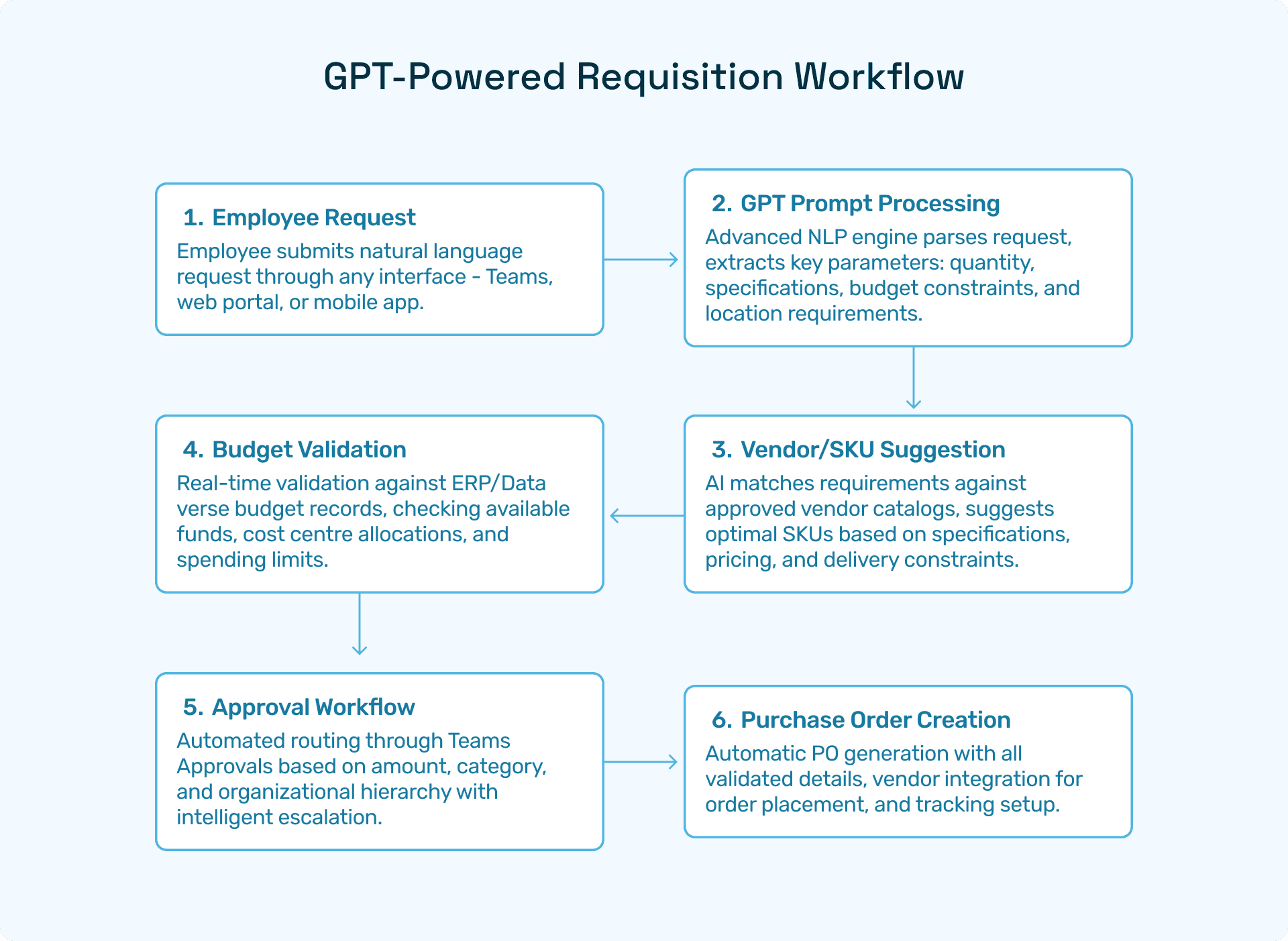
The system automatically suggests vendors and SKUs that meet the specification, populates line items with correct details, validates the total against the relevant cost center budget in the ERP, and routes the requisition for approval through Teams or a configured approval channel.
The employee never touches a form. The procurement team receives a clean, policy-compliant request.
Key Components of a GPT-Driven Requisition Workflow
1. AI Prompt Templates for Drafting
Prebuilt AI prompt templates let employees enter requests in natural language without needing to know catalog codes, vendor IDs, or budget line structures.
Templates standardize input while giving the underlying model enough context to capture intent accurately. Examples of inputs the system handles:
"Order 20 laptops with 16GB RAM, $1,000 budget limit per unit."
"Reorder last month's office supplies with a 5% quantity increase."
"Source three quotes for industrial shelving, Q3 delivery required."
When inputs are ambiguous or incomplete, the system flags the gap and prompts for clarification rather than guessing — which is where many simpler automation tools fail.
2. Vendor and SKU Suggestions
AI agents analyze historical purchase data, approved vendor catalogs, contract terms, and lead times to surface ranked vendor recommendations at the point of requisition. This is not a simple catalog search. The ranking logic factors in preferred supplier status, pricing history, delivery performance, and any active contract obligations.
The practical result: instead of a requester picking a familiar vendor from habit, the system surfaces the option that best fits the organization's current sourcing strategy. This directly reduces maverick spending and improves purchase order compliance without requiring the requester to know procurement policy in detail.
3. Automated Budget Validation
This is the section that matters most to CFOs and Controllers, and it is also where manual processes fail most visibly.
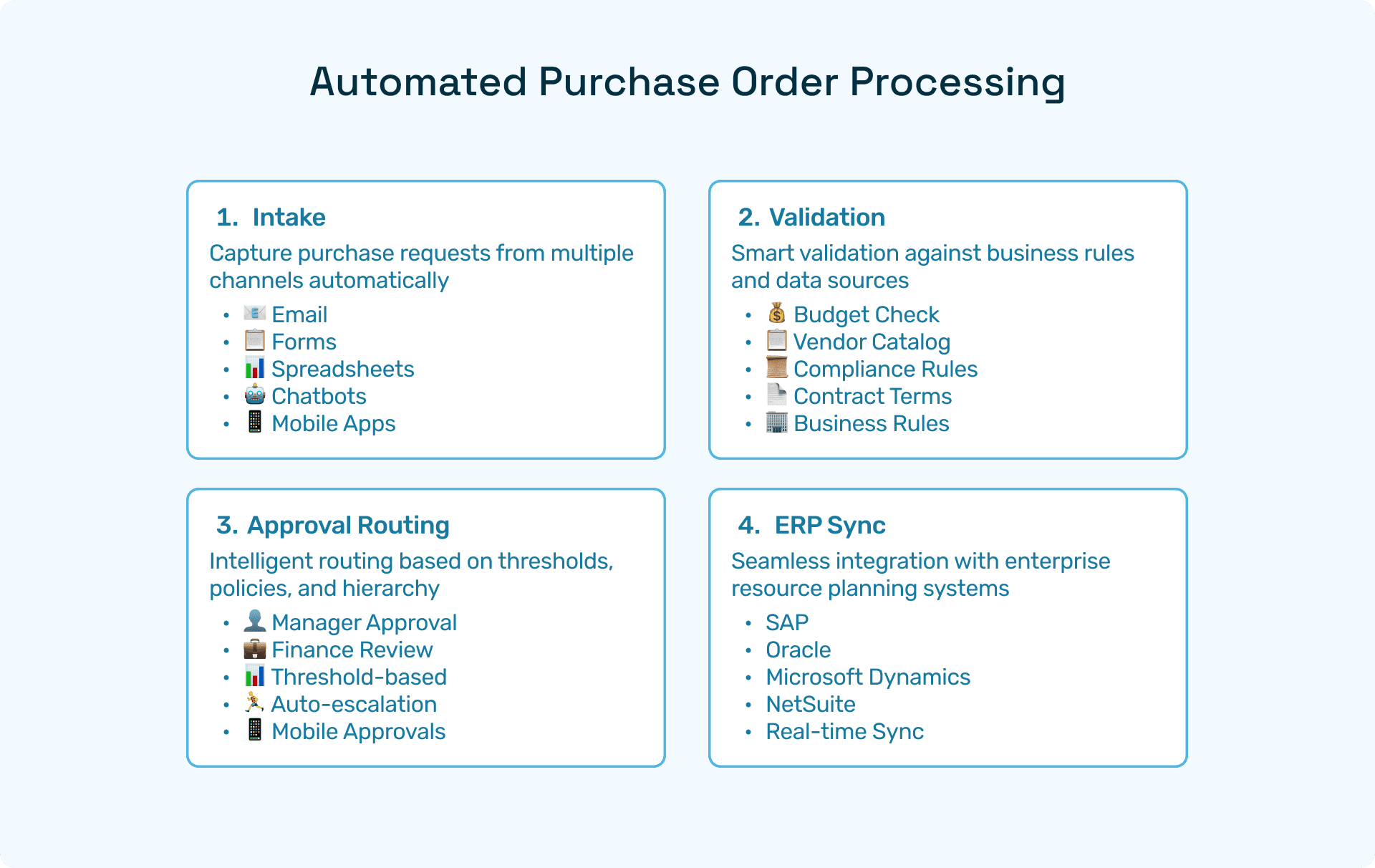
GPT workflows connect directly with ERP and finance systems to cross-check each requisition against the relevant departmental budget before the approval chain begins. The data flow works roughly as follows:
The system reads the cost center, GL code, and budget period from the ERP in real time.
It calculates available budget against open commitments, approved POs not yet invoiced, and actuals.
If the requisition fits within tolerance, it moves to approval routing automatically.
If it exceeds the threshold, it is flagged and can trigger a different approval path — for example, direct CFO review above a defined spend level.
This creates a complete, timestamped audit trail on every requisition. For organizations with SOX compliance requirements or internal audit obligations, this audit trail is not optional — it is a control requirement. A system that generates it automatically removes the manual work of reconstructing approval evidence after the fact.
Real-time budget validation also means Controllers see encumbrance data as commitments are created, not after POs are issued. This matters for month-end accuracy and for preventing overspend against closed periods. For a deeper look at how committed spend is tracked, see how encumbrance accounting works in automated environments.
4. Adaptive Approval Routing
Requisitions are routed based on configurable rules: dollar thresholds, department, category, vendor tier, or any combination. The system learns escalation patterns over time and adjusts routing suggestions accordingly.
This reduces bottlenecks in two specific ways. First, straightforward low-value requisitions that currently sit in a shared inbox waiting for review are approved instantly without human intervention. Second, high-value or policy-sensitive requisitions reach the right approver faster, with context already assembled — no back-and-forth requesting the original justification or budget details.
How Hyperbots Enhances GPT Requisition Workflows
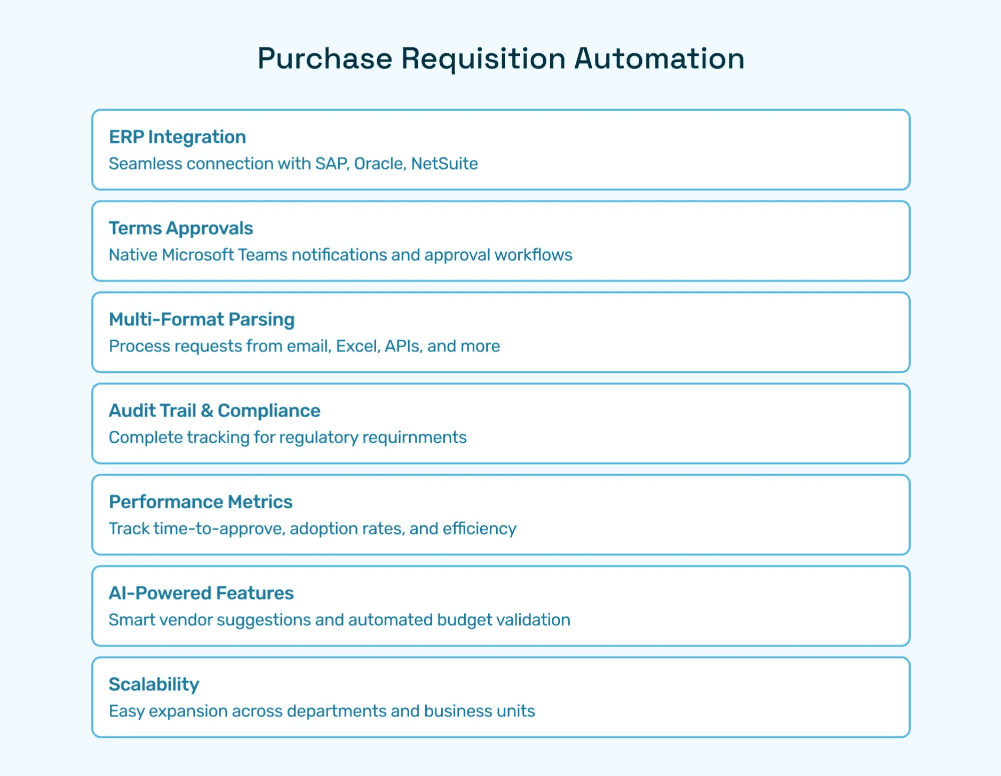
Hyperbots' Procurement Co-Pilot applies this architecture across the full requisition lifecycle. Key capabilities include:
Intake orchestration: Captures unstructured requests via email, chat, or procurement portals and converts them into structured requisitions, so the process works regardless of how the original request was submitted.
ERP-synced approvals: Fully integrated with SAP S/4HANA, Oracle NetSuite, Microsoft Dynamics, and other enterprise ERP environments. Approvals write back to the ERP, so committed spend is visible in real time.
Real-time compliance: Every requisition is validated against spend policies and procurement rules before it reaches the approval queue, not after.
End-to-end automation: From intake through automated purchase order creation, manual touchpoints are removed from the standard path.
ROI of GPT-Driven Requisition Drafting and Validation
CFOs and Procurement Heads need to see what this translates to in practice.
Deloitte's 2025 Global Chief Procurement Officer Survey, which covered more than 250 CPOs across 40 countries, found that procurement organizations classified as "Digital Masters" — those pairing advanced technology with skilled talent — achieve an average 3.2x return on GenAI investments, compared to approximately 1.5x for organizations that have not made comparable investments. Digital Masters are allocating up to 24% of their procurement budgets to technology, nearly double what the same cohort reported in 2023.
The efficiency gains show up at the operational level too. Hyperbots customers report up to 80% reduction in manual effort for requisition drafting and validation, driven primarily by the elimination of manual form completion, email-based approvals, and retrospective budget checking.
Additional ROI levers include fewer errors in SKUs, vendor details, and budget allocations; faster cycle times from intake to PO issuance; and improved vendor relationships from more consistent, timely purchase orders.
Differentiating Hyperbots in the Market
Unlike general-purpose procurement software, Hyperbots' AI Co-Pilots are built specifically for finance-led automation at mid-market and enterprise scale.
Adaptive reasoning means the system goes beyond rule-based routing to make context-sensitive decisions — flagging an unusual vendor for a policy-sensitive category, for example, even if the dollar value does not trigger a threshold alert.
Deep integrations cover ERP systems, collaboration tools, and data platforms, so the system works within existing infrastructure rather than requiring a separate data environment.
The broader AI Co-Pilots portfolio covers AP invoice processing, vendor management, and three-way match automation, creating an end-to-end procure-to-pay automation layer across the full P2P cycle.
Suggested Use Cases for GPT Requisition Workflows
Requisition drafting: Employees enter plain-language requests; the system structures them into compliant, ERP-ready requisitions.
Policy validation: Each requisition is checked against active spend policies, category rules, and preferred supplier lists before it reaches an approver.
Vendor optimization: The system surfaces preferred vendors based on existing contracts, pricing history, and delivery performance rather than leaving the choice to the requester.
Budget control: Auto-validation against departmental budgets prevents overspend before it happens rather than catching it at month-end reconciliation.
Rapid approvals: Requests route instantly to the right approver with full context attached, reducing the average time from submission to approval decision.
Practical Implementation Roadmap
Phase 1: Process Assessment
Identify requisition-heavy workflows — IT hardware, office supplies, MRO, professional services — and document current cycle times and error rates. This baseline matters: without it, there is no clear way to measure what the system actually changes.
Typical findings at this stage include average requisition cycle times of 5 to 10 business days, error rates of 15 to 25% requiring rework, and significant manual effort concentrated in a small number of high-frequency categories.
Phase 2: Workflow Design
Deploy AI prompt templates calibrated to the organization's category structure. Configure ERP connectors to pull budget, vendor, and catalog data in real time. Define approval thresholds, escalation rules, and policy flags that the system will enforce automatically.
Phase 3: Pilot Rollout
Start with one or two departments — typically IT or facilities, where requisition volume is high and categories are relatively standardized. Measure cycle time reductions, error rates, and approval turnaround over 60 to 90 days before expanding.
Phase 4: Full-Scale Deployment
Extend to enterprise-wide requisition handling and layer in additional automation for AP invoice approval workflows and vendor management. At this stage, the system is handling the full purchase cycle from intake to payment, with manual intervention reserved for exceptions only.
Hyperbots Platform Impact on Purchase Order Automation
Hyperbots connects requisition automation to the broader P2P cycle. Procurement Co-Pilot shrinks the time from request to approved PO. Invoice processing ensures faster, error-free reconciliation against those POs. Vendor management keeps supplier data current and performance visible.
The output for finance leadership is real-time spend visibility across the full cycle, with dashboards that give Controllers and CFOs an accurate picture of committed spend, open POs, and liabilities at any point in the month — not just at close.
According to the Deloitte 2025 CPO Survey, organizations that combine procurement technology investment with talent development significantly outperform peers on cost savings targets, with 96% of Digital Masters meeting or exceeding their cost savings plans compared to the broader survey population.
FAQs
Q1. What is a GPT purchase requisition software system? An AI-powered system that uses large language models to draft, validate, and route purchase requisitions from plain-language employee inputs, reducing manual effort and accelerating the requisition-to-PO cycle.
Q2. How is budget validation handled in Hyperbots workflows? Every requisition is cross-checked against ERP cost center budgets in real time, before it reaches the approval queue. If a requisition exceeds the available budget or a configured threshold, it is flagged automatically and routed for the appropriate level of review.
Q3. Can Hyperbots integrate with my ERP system? Yes. Hyperbots supports SAP S/4HANA, Oracle, Dynamics, NetSuite, and custom ERP environments via APIs and prebuilt connectors.
Q4. What are the limitations of GPT-driven requisition systems? Like any AI system, performance depends on data quality. If vendor catalogs, budget data, or ERP master data are incomplete or outdated, the system's recommendations will reflect those gaps. Implementation typically includes a data quality assessment for this reason.
Q5. What ROI can finance leaders realistically expect? Based on Hyperbots customer data, organizations typically see up to 80% reduction in manual effort for drafting and validation. The Deloitte 2025 CPO Survey puts the broader picture in context: procurement Digital Masters achieve 3.2x returns on GenAI investment compared to 1.5x for the broader population.
Reimagining Procurement with GPT and Hyperbots
Procurement teams that have deployed GPT-driven requisition systems are not just moving faster — they are producing cleaner data, better audit trails, and more accurate committed spend figures at month-end. Those are outcomes that matter to finance leadership beyond the procurement function.
For CFOs, Controllers, and Procurement Heads evaluating where AI delivers real process change rather than incremental efficiency, requisition automation is one of the clearest entry points. The inputs are structured enough to automate well, the errors are measurable, and the cycle time improvement is visible within the first pilot quarter.
👉 Explore Hyperbots' Procurement Co-Pilot