Gen AI Purchase Order Tracking System: How Generative AI Is Redefining PO Visibility
How Generative AI Is Redefining PO Visibility Across the Full Procurement Lifecycle
A gen AI purchase order tracking system does something traditional procurement tools have never been able to do: it gives finance and procurement teams a continuous, intelligent view of every purchase order, from requisition to closure that too in real time, without manual effort.
For most enterprises, PO tracking today means checking ERP dashboards, chasing approvers over email, and manually reconciling statuses across disconnected systems. It is slow, error-prone, and reactive. By the time a bottleneck surfaces, the damage is often already done due delayed deliveries, missed budget windows, strained vendor relationships.
Generative AI changes the equation entirely. Unlike rule-based automation, a Gen AI system can interpret unstructured data, reason across multiple data sources, generate natural language status summaries, and proactively flag risks before they escalate. This guide breaks down exactly what a Gen AI PO tracking system is, how it works across the full purchase order lifecycle, and why it represents a step change and not just an upgrade in procurement intelligence.
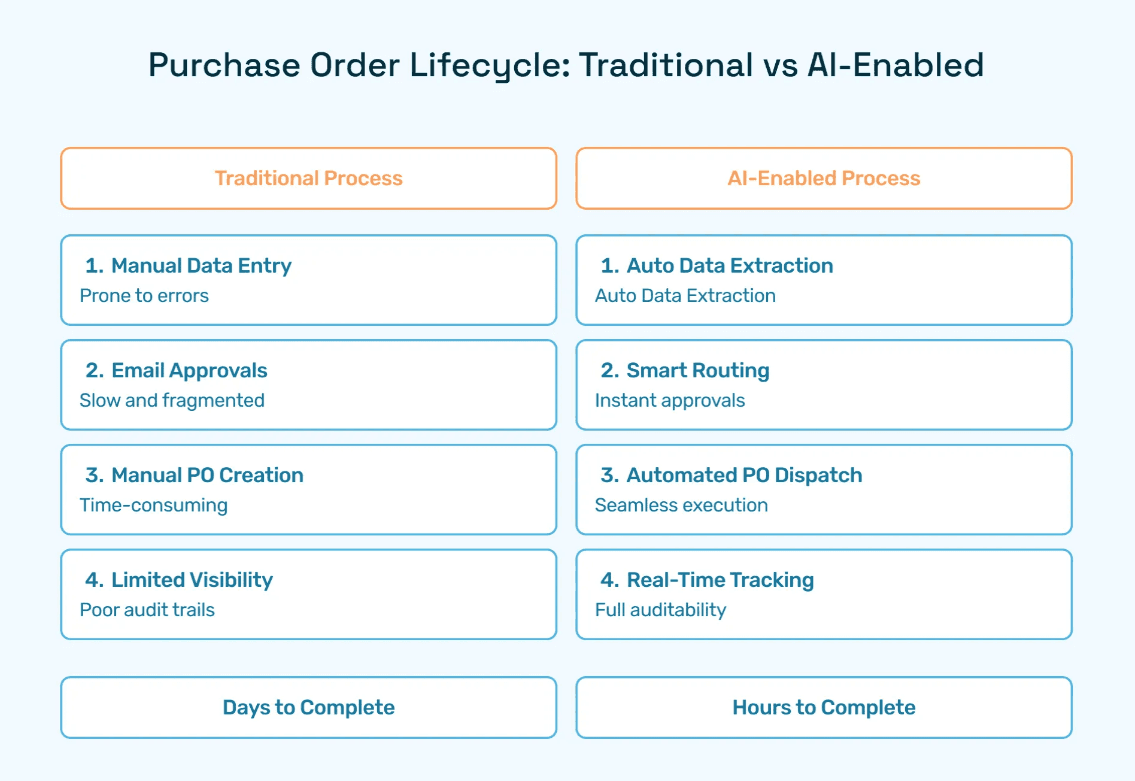
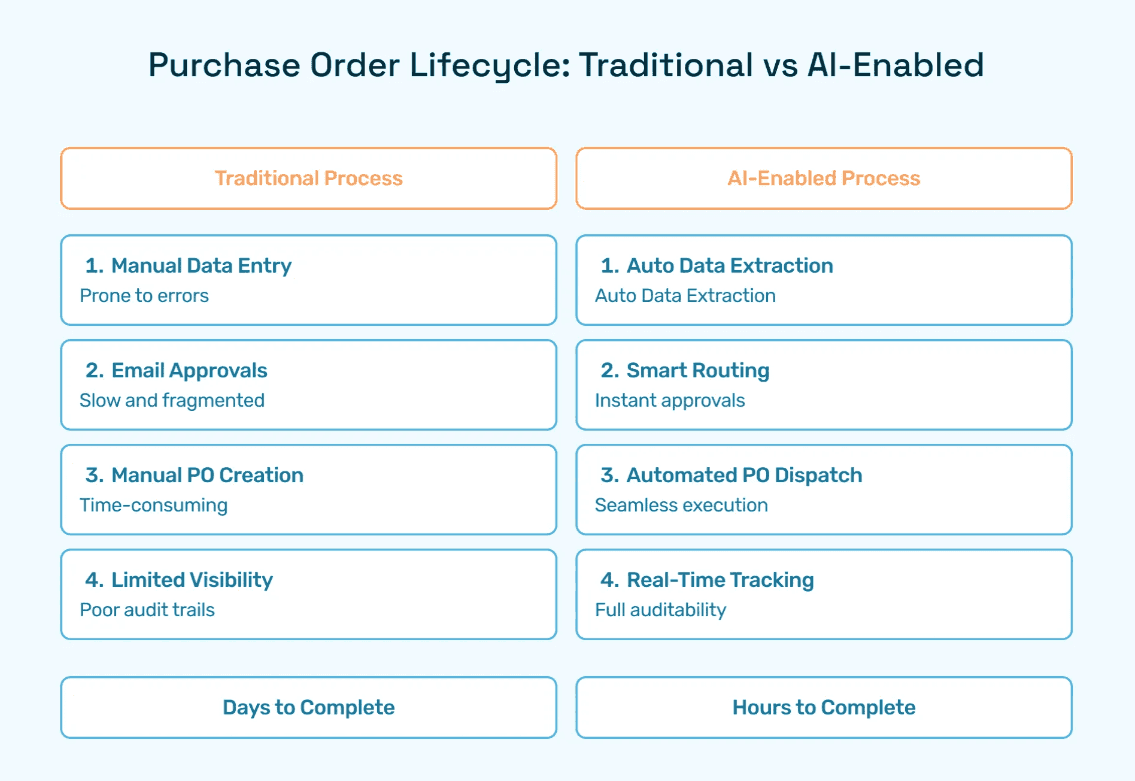
The Problem with Traditional Purchase Order Tracking
Before understanding how Gen AI transforms PO tracking, it is worth being precise about what is broken in the traditional approach. The challenges are not just inconvenient rather they are strategically costly.
No real-time status visibility: PO status lives in ERP fields that are only updated when a human logs in and manually changes them. Between events, the actual state of a purchase order is unknown.
Approval bottlenecks go undetected: When a PO stalls in someone's inbox for days, there is no automatic escalation. The procurement team only finds out when a supplier calls asking where their order is.
Fragmented, siloed systems: ERP data, vendor emails, shipping confirmations, and payment records sit in separate platforms. Getting a complete picture of any single PO requires manual reconciliation across all of them.
Manual GL-coding errors: General ledger codes are assigned by humans under time pressure. Miscoding is common, often discovered only during audit or month-end close.
Compliance gaps and weak audit trails: Without automated logging, proving who approved what and when which required manually piecing together email threads and spreadsheet histories.
No predictive intelligence: Traditional systems report what has happened. They cannot forecast what is about to happen such as a delivery delay, an imminent budget breach, a vendor reliability issue developing in the background.Generative AI agents for requisition intake and approvals represent the shift toward truly predictive procurement.
Collectively, these issues do not just slow teams down rather they systematically prevent procurement from operating as a strategic function. Finance leaders end up managing exceptions rather than driving decisions.
What Is a Gen AI Purchase Order Tracking System?
Definition: A gen AI purchase order tracking system is an AI-powered procurement platform that uses Generative AI and machine learning to monitor, interpret, and report on the status of purchase orders across every stage of the procurement lifecycle automatically and in real time. Unlike legacy tools, it does not just display data: it reasons over it.
The critical distinction from older automation approaches is the reasoning layer. A rule-based system can flag a PO that has been in "pending approval" for more than 48 hours but only if someone programmed that specific rule. A Gen AI system understands context. It can read an email from a vendor, recognise that a delivery date has shifted, update the PO status accordingly, alert the relevant stakeholder, and suggest a corrective action, all without a rule having been written for that exact scenario.
How It Differs from Rule-Based Automation
Traditional RPA and workflow automation tools follow scripts. Gen AI systems are different in three fundamental ways:
They understand unstructured data: Emails, PDFs, scanned documents, and verbal inputs can all be ingested and interpreted, not just structured database fields.
They reason under ambiguity: When a vendor confirmation message is worded unusually or a delivery note contains a partial match, a Gen AI system handles it intelligently rather than failing silently.
They improve over time: Machine learning models continuously learn from outcomes, improving GL-coding accuracy, anomaly detection, and vendor risk scoring with every cycle.
Core Capabilities of an Intelligent PO Tracking System
Natural language PO status queries
Autonomous status updates from multiple data sources
Predictive delay and budget overrun alerts
End-to-end lifecycle visibility (creation to closure)
Automated audit trail generation
Intelligent three-way matching
Anomaly and duplicate PO detection
ERP-native integration without middleware
How a Gen AI Purchase Order Tracking System Works
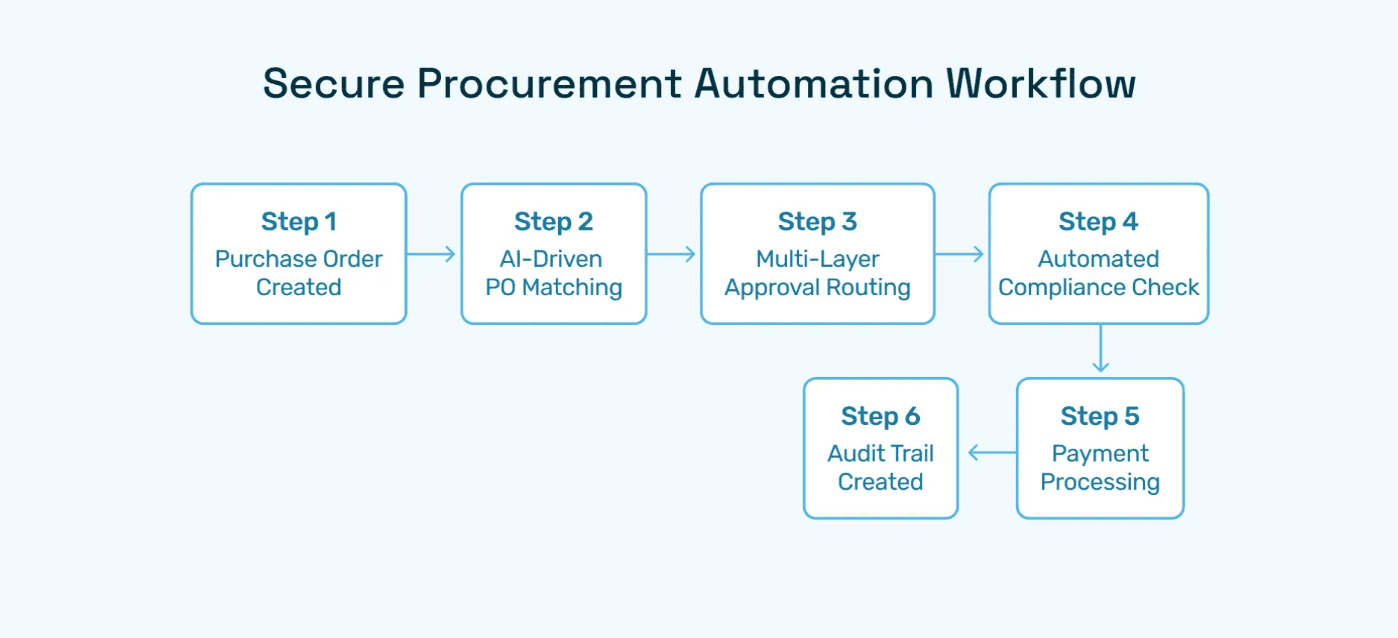
The real value of AI PO tracking becomes clear when you map it against the actual purchase order lifecycle. At every stage, Gen AI is not passively recording status but it is actively interpreting data, predicting outcomes, and recommending actions.
Stage 1: Purchase Requisition Creation
AI role: data extraction + anomaly detection
Gen AI extracts and autofills requisition data from unstructured sources like emails, PDF contracts, prior purchase history, or natural language inputs. It validates field completeness and flags anomalies such as duplicate vendor requests or out-of-policy spend before a PO is even raised, eliminating errors at the source.
Stage 2: Budget Validation and GL Coding
AI role: GL-code recommendation + budget control
The system cross-references requisition data against approved budgets and cost centre policies, recommending the correct GL codes based on historical patterns and organisational rules. Budget exceptions are flagged instantly rather than discovered during month-end close which gives controllers real-time spend intelligence.
Stage 3: Approval Workflow Tracking
AI role: SLA monitoring + automated escalation
Gen AI monitors where each PO sits in the approval chain in real time. If an approver has not acted within a defined SLA, the system sends automated escalations, reroutes approvals based on delegation rules, and logs all actions with timestamps. Approval bottlenecks become visible and addressable before they delay procurement.
Stage 4: PO Dispatch and Vendor Acknowledgment
AI role: auto-dispatch + acknowledgment monitoring
Once approved, purchase orders are automatically generated and dispatched to vendors. The system tracks vendor acknowledgment, monitoring inbound confirmations via email or EDI and flags cases where no acknowledgment has been received within an expected window, preventing silent order failures.
Stage 5: Delivery and Goods Receipt Tracking
AI role: live delivery correlation + discrepancy detection
Gen AI correlates PO data with inbound shipment notifications, goods receipt records, and vendor communications to maintain a live delivery status. It can detect partial deliveries, discrepancies between ordered and received quantities, and emerging delays, proactively alerting operations and finance teams before the impact reaches downstream processes.
Stage 6: Invoice Matching and PO Closure
AI role: three-way matching + automated closure
The system performs intelligent three-way matching, PO versus goods receipt versus invoice resolving minor discrepancies autonomously and escalating true exceptions. Once all conditions are satisfied, the PO is closed, accruals are updated, and the audit trail is finalised. The entire lifecycle is tracked in a single, tamper-proof record.
Key insight: In a Gen AI PO tracking system, the system is not waiting to be queried rather it is continuously processing signals across every stage and surfacing the information that requires human attention before it becomes a problem.
Traditional PO Tracking vs. Gen AI PO Tracking
Capability | Traditional PO Tracking | Gen AI PO Tracking |
Status updates | Manual, periodic | Automatic, real-time |
Data sources | Structured ERP data only | ERP + emails + PDFs + vendor portals |
Anomaly detection | Rule-based, reactive | Predictive, proactive |
Natural language queries | Not supported | Fully supported |
Approval tracking | Email-based, opaque | Automated, timestamped, escalation-aware |
Delivery visibility | Manual reconciliation | Live correlation with shipment data |
GL coding accuracy | Human-dependent | AI-recommended, continuously improving |
Audit trail | Incomplete, manually compiled | Automatic, tamper-proof, always current |
Risk identification | After the fact | Before escalation occurs |
Learning over time | None | Continuous model improvement |
User interaction | Dashboard navigation only | Natural language interface |
ERP integration depth | Siloed ERP modules | Native cross-system intelligence |
Use Cases of Gen AI in Purchase Order Tracking
1. Real-Time Spend Visibility for CFOs
A CFO needs to understand committed spend versus actual spend at any point in the month. With a Gen AI PO tracking system, they can query the platform in plain language - "Show me open POs over $50K pending delivery this quarter" and receive an instant, accurate summary without waiting for a finance analyst to pull a report. Decisions that previously waited days now take seconds.
2. Preventing Approval Bottlenecks in Large Enterprises
A global manufacturing firm routes POs through regional managers before reaching central procurement. When a key approver is travelling, POs stall for days. The Gen AI system detects the SLA breach within hours, automatically applies the pre-approved delegation rule, reroutes the PO, and notifies both parties - reducing approval cycle times from days to hours without any manual intervention.
3. Detecting Duplicate or Fraudulent POs Before Dispatch
During a system migration, a procurement team inadvertently raises duplicate POs for the same vendor. Gen AI cross-references the new POs against historical patterns, flags the duplicates before dispatch, and prevents double-payment, saving tens of thousands of dollars and avoiding a vendor relationship headache that would have taken weeks to untangle.
4. Vendor Performance Monitoring Tied to PO History
A procurement leader wants to evaluate whether a key supplier consistently delivers on time before contract renewal. The intelligent PO tracking system automatically correlates PO dispatch dates, promised delivery windows, and actual goods receipt records to generate a vendor reliability score, informing sourcing decisions without any manual data compilation or analyst time.
5. Proactive Budget Overrun Alerts
During a high-spend quarter, multiple departments raise POs that collectively approach the approved budget ceiling. The Gen AI system tracks cumulative committed spend in real time, projects the overrun trajectory based on pending requisitions, and alerts the controller before the threshold is breached, not after. The team adjusts purchasing priorities with enough lead time to stay on budget.
Key Features to Look for in a Gen AI PO Tracking System
Native ERP Integration (SAP, Oracle, Ariba)
Any Gen AI PO tracking system that requires complex middleware or custom API development to connect to your ERP is introducing a fragility that will create ongoing maintenance costs and data sync issues. Look for platforms with pre-built, native connectors to major ERP systems. The integration should be bidirectional, the AI needs to both read from and write back to your system of record.
Natural Language Interface
One of the most practical advantages of a true Gen AI system is the ability for non-technical users like controllers, category managers, CFOs to query procurement data in plain language. If your team needs to know the SQL syntax or navigate complex filter hierarchies to get answers, the AI layer is not doing its job.
Predictive Risk Intelligence
AI PO tracking should surface risks before they become incidents. This means the system needs to be doing continuous analysis of patterns across your PO history and not just monitoring defined thresholds. Delivery delays, vendor reliability trends, and budget trajectory are all signals that a mature system should be interpreting and acting on autonomously.
Configurable Workflow and Escalation Rules
Every enterprise has its own approval hierarchies, delegation frameworks, and compliance requirements. A Gen AI PO tracking system should adapt to your organisation's structure and not force you to adapt to the software's assumptions. Configurable workflows with template customisation and dynamic escalation paths are non-negotiable at enterprise scale.
Audit-Ready Compliance Trail
Every action in the PO lifecycle - who approved it, when, what data was present at the time should be logged automatically in a tamper-proof, exportable format. This is not just a compliance checkbox; it is the foundation that makes every other audit and reconciliation process dramatically faster.
How Hyperbots' Procurement Co-pilot Powers Gen AI PO Tracking
Hyperbots is built around an AI-native architecture that embeds intelligence across the entire procure-to-pay lifecycle, not just at discrete automation touchpoints. Its Procurement Co-pilot is designed specifically to address the visibility, tracking, and compliance gaps that traditional systems leave unresolved.
Automated field extraction and PR autofill: captures data from emails, PDFs, and scanned documents to eliminate manual entry and accelerate requisition creation
Real-time approval and status tracking: monitors every PO through the approval chain with automated SLA enforcement and escalation routing
Anomaly detection and duplicate prevention: identifies errors, inconsistencies, and potential duplicates before they impact operations or budgets
Budget controls and GL coding recommendations: ensures compliance with financial policies while improving general ledger accuracy through continuous learning
Automated PO creation and dispatch: generates and sends purchase orders automatically upon approval, eliminating manual handoff delays
End-to-end auditability: maintains a complete, traceable record across the entire PO lifecycle for compliance, audits, and internal controls
The platform integrates natively with SAP, Oracle, Ariba, and other enterprise ERP systems, and operates as an agentic system while detecting anomalies, suggesting corrections, and optimising workflows without constant human instruction.
Measurable ROI: What Enterprises Are Achieving
The value of a Gen AI purchase order tracking system is not theoretical. Enterprises deploying intelligent PO tracking are reporting measurable improvements across cost, speed, and compliance metrics.
80% reduction in operational procurement costs
Near-zero manual data entry errors in GL coding
Approval cycles reduced from days to hours
100% PO lifecycle audit coverage, fully automated
Beyond these headline numbers, the strategic shift matters equally. When procurement teams are no longer spending their time chasing approvals, fixing coding errors, and manually reconciling statuses, they are free to focus on what actually moves the business forward like vendor negotiations, category strategy, cash flow optimisation, and predictive demand planning.
Start your free trial or request a demo to see how Hyperbots can transform your PO tracking.
FAQs on Gen AI Purchase Order Tracking Systems
Q: What is a gen AI purchase order tracking system?
A gen AI purchase order tracking system is an AI-powered platform that uses Generative AI and machine learning to automatically monitor, interpret, and update the status of purchase orders across the full procurement lifecycle - from requisition creation through payment and closure in real time, without manual input. Unlike rule-based tools, it can read unstructured data, reason over ambiguous inputs, and proactively surface risks before they escalate.
Q: How does Gen AI PO tracking differ from traditional automation?
Traditional automation follows predefined rules and only handles scenarios it was explicitly programmed for. A Gen AI PO tracking system learns from patterns, interprets unstructured data (emails, PDFs, vendor communications), and adapts to new situations without requiring a new rule to be written. It shifts procurement from reactive exception-handling to proactive intelligence.
Q: Which stages of the PO lifecycle can Gen AI track?
A fully capable Gen AI PO tracking system covers all six stages: purchase requisition creation, budget validation and GL coding, approval workflow tracking, PO dispatch and vendor acknowledgment, delivery and goods receipt tracking, and invoice matching and PO closure. At each stage, the AI is not just recording status but it is also analysing data, predicting risks, and recommending actions.
Q: Can a Gen AI PO tracking system integrate with SAP, Oracle, or Ariba?
Yes. Enterprise-grade Gen AI PO tracking platforms like Hyperbots are built with native, bidirectional integrations with major ERP and procurement systems including SAP, Oracle, and Ariba. This eliminates the need for custom middleware and ensures that AI-generated insights and status updates flow directly into the systems your team already works in.
Q: How does Gen AI handle unstructured PO data like vendor emails or PDFs?
Gen AI uses natural language processing (NLP) to read and interpret unstructured inputs like vendor confirmation emails, scanned delivery notes, PDF contracts, and more. It extracts relevant data fields, cross-references them against existing PO records, and updates system statuses automatically. This eliminates a significant source of manual processing that traditional tools cannot handle at all.
Q: What ROI can enterprises expect from AI PO tracking?
Enterprises deploying intelligent PO tracking systems typically report up to 80% reduction in operational procurement costs, approval cycle times reduced from days to hours, near-elimination of GL coding errors, and full automated audit trail coverage. The strategic benefit from freeing procurement teams for higher-value work, compounds these gains over time.
Q: Is a Gen AI PO tracking system secure and audit-compliant?
Yes, when built to enterprise standards. Every action across the PO lifecycle should be logged in a tamper-proof, timestamped audit trail that meets regulatory and internal compliance requirements. This automated audit coverage is typically far more complete and reliable than manually maintained records, reducing both audit preparation time and compliance risk.
Q: How long does it take to implement a Gen AI PO tracking system?
Implementation timelines vary by organisation size, ERP complexity, and the scope of automation required. Platforms with pre-built ERP connectors and configurable workflow templates significantly reduce deployment time compared to custom-built solutions. Most enterprise deployments reach initial production in a matter of weeks rather than months.