Minimizing Fraud Risk with Purchase Order Automation: The Ultimate Guide for CFOs
Executive Summary
In today’s digital-first finance environment, fraud prevention in purchase orders has evolved from a compliance checkbox into a strategic necessity for CFOs, procurement leaders, and vendor management teams. Traditional manual approval methods—often reliant on email trails, spreadsheets, or outdated ERP workflows—leave organizations exposed to fraudulent activity, compliance lapses, and costly inefficiencies. These gaps not only increase financial risk but also erode trust across the supply chain.
AI-powered, secure procurement automation offers a fundamentally different approach. By continuously monitoring transactions, it detects anomalies, duplicate orders, and hidden risks in real time. Instead of depending on post-fact audits, finance teams gain proactive fraud detection, ensuring compliance while shrinking operational costs. This also streamlines audit readiness, as every transaction is tracked with transparency and accountability.
Why Fraud Prevention in Purchase Orders is Critical
Fraud in procurement costs companies billions of dollars every year, draining profits, damaging vendor relationships, and eroding stakeholder trust. Much of this stems from gaps in manual purchase order (PO) processes that rely heavily on spreadsheets, emails, and fragmented ERP workflows. In such environments, duplicate payments, unauthorized vendors, and compliance failures often slip through unnoticed—until the damage is already done.
The urgency for advanced fraud prevention has never been higher. Finance and procurement leaders today must deal with rising cyber threats, fake invoices, insider fraud, and evolving regulatory requirements. Traditional systems, built for transactional efficiency rather than fraud detection, are no longer enough. When approvals are routed casually through email and oversight depends on after-the-fact audits, organizations expose themselves to unacceptable levels of risk.
Common Procurement Fraud Risks
Some of the most frequent vulnerabilities include:
Duplicate or inflated invoices – Vendors submitting multiple invoices for the same goods or services.
Unauthorized vendors – Payments made to unapproved or fraudulent suppliers.
Fake approvals – Email-based workflows that can be spoofed or manipulated.
Non-compliance – POs that bypass company policy or budgetary limits.
Data tampering – Manual edits to PO or vendor records without proper audit trails.
Each of these risks not only impacts cash flow but also threatens data integrity and supplier trust—two pillars of long-term financial health.
Why Traditional Controls Fall Short
Legacy ERP systems and manual audits were designed to verify transactions, not to actively prevent fraud. Key challenges include:
Delayed detection: Fraud often surfaces weeks or months later during reconciliations.
High dependency on people: Manual checks are inconsistent and error-prone.
Email vulnerabilities: Approvals routed through inboxes can be intercepted or spoofed.
Lack of visibility: Siloed systems prevent real-time monitoring across procurement, finance, and vendor management.
The Case for Digital Fraud Prevention
Modern finance teams are turning to AI-powered procurement automation to close these gaps. Intelligent systems can:
Detects anomalies in real time by flagging duplicate invoices, mismatched vendor data, or policy violations.
Automate compliance checks before approvals are granted.
Strengthen audit readiness with transparent logs and immutable records.
Safeguard vendor relationships by ensuring accurate and timely payments.
The message is clear: fraud prevention in purchase orders is no longer optional—it’s mission-critical. Companies that embrace digital, AI-driven controls not only protect themselves from fraud but also unlock faster cycle times, lower costs, and stronger governance.
What Is Purchase Order Automation?
At its core, purchase order automation transforms the traditionally manual and error-prone steps of procurement into a streamlined, digital workflow. Instead of relying on paper forms, spreadsheets, or endless email threads, automation allows finance and procurement teams to handle every stage of the purchase order (PO) lifecycle with greater speed, accuracy, and control.
From requisition to PO issuance, automation takes care of repetitive, rules-driven tasks while ensuring compliance and visibility at every stage. This shift is not just about saving time—it’s about eliminating risk, enhancing supplier trust, and giving leaders real-time insight into organizational spending.
How Purchase Order Automation Works
Automated systems digitize and orchestrate the entire PO process, including:
Data capture & validation – Pulling requisition details from multiple sources (ERP, email, catalog) and validating fields automatically.
Policy enforcement – Ensuring requisitions comply with budgets, approval hierarchies, and company rules before advancing.
Approval routing – Sending requests to the right stakeholders, often via integrations with platforms like Microsoft Teams or Slack.
PO issuance – Generating and dispatching accurate purchase orders to approved vendors.
Vendor communication – Tracking vendor confirmations, expected delivery, and exceptions in real time.
Why Do Modern Businesses Need PO Automation?
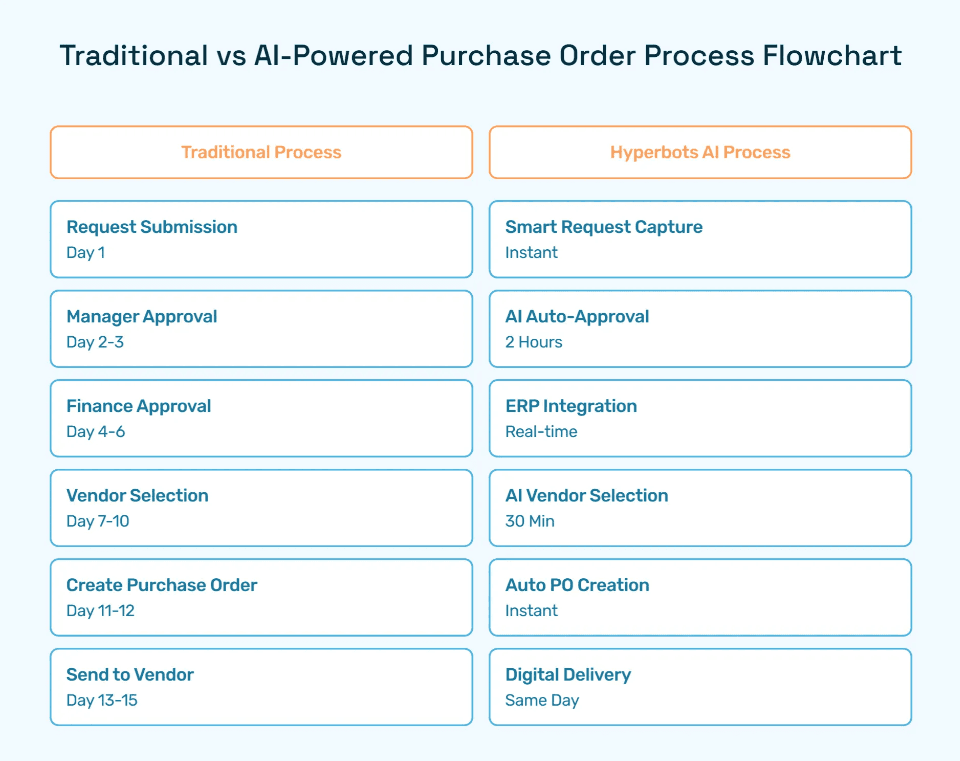
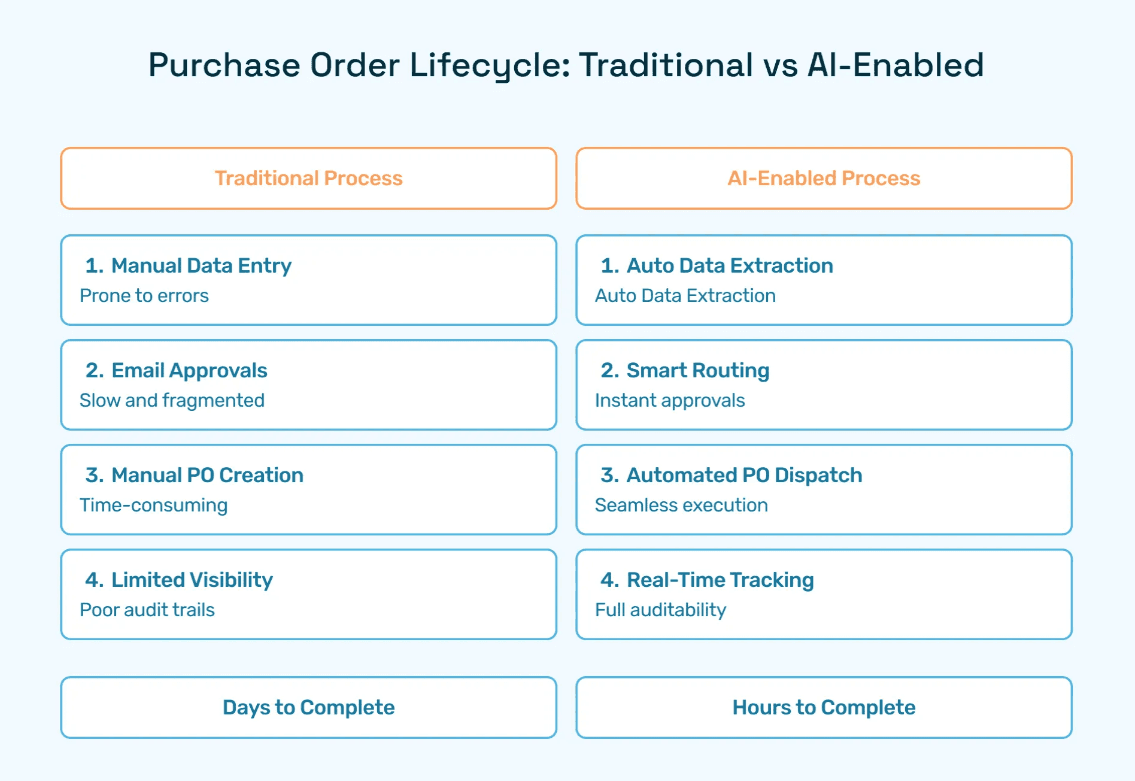
Manual purchase order (PO) processes create more problems than they solve. Reliance on emails, spreadsheets, and paper trails slows procurement down and exposes organizations to unnecessary risks. Finance and procurement leaders are under constant pressure to improve efficiency, cut costs, and enforce compliance—but manual workflows stand in the way.
Key Challenges of Manual PO Processes
Delays and bottlenecks
Approvals often get stuck in inboxes or misplaced in paperwork, creating procurement delays. These bottlenecks frustrate vendors, disrupt supply chains, and hurt operational agility.Human errors
Manual entry of PO data leads to common mistakes—typos, duplicate requests, or missing compliance checks. Small errors can quickly snowball into payment disputes and unnecessary costs.Limited visibility
Finance leaders lack a clear, real-time view of spending across departments. Without transparency, it becomes difficult to enforce budgets, prevent overspending, or spot irregularities.Fraud and compliance gaps
Manual processes make it easier for unauthorized purchases or policy violations to slip through. Fraudulent vendors, duplicate orders, or bypassed approvals often go undetected until audits reveal the damage.
Why Automation Is the Answer
Purchase order automation addresses these challenges head-on. By digitizing and orchestrating the entire PO lifecycle—from requisition to approval to vendor communication—automation eliminates bottlenecks, reduces errors, and strengthens compliance.
With AI-powered platforms like Hyperbots, organizations gain:
Systematic validation of every PO before issuance.
Automated, multi-layered approvals aligned with company policies.
Real-time anomaly detection to flag risks instantly.
Transparent audit trails for better governance and reporting.
Ultimately, PO automation isn’t just about speed—it’s about embedding trust, control, and transparency into procurement. Modern businesses that embrace automation unlock greater agility, resilience, and long-term cost savings.
How Manual Purchase Orders Invite Fraud
Purchase orders are meant to safeguard organizations by standardizing procurement, enforcing approvals, and ensuring accountability. However, when managed manually such as through emails, spreadsheets, or paper these same processes can turn into weak links. Manual PO systems not only slow down procurement but also create blind spots where fraud, errors, and compliance failures thrive.
Why Manual PO Systems Are Vulnerable
Unlike automated solutions that validate every step, manual processes rely heavily on human intervention. This dependence on people and disconnected systems opens the door to fraud and oversight. Below are the most common issues organizations face:
Duplicate orders and payments
Without cross-system visibility, finance teams often process the same PO multiple times. Vendors may receive duplicate payments, or staff may unintentionally (or deliberately) resubmit the same order. These errors drain budgets and create reconciliation headaches.Falsified or unauthorized vendors
Vendor records are usually verified manually, which makes it easy for fake suppliers or unapproved vendors to slip into the system. Fraudsters exploit this gap to divert payments or charge inflated prices for low-quality goods.Approvals bypassed or rubber-stamped
Overloaded managers may approve POs without proper scrutiny, or worse, bypass approvals altogether. In a manual setup, it’s difficult to enforce multi-layered checks, leaving the organization vulnerable to unauthorized purchases.Lack of real-time anomaly detection
Manual systems rarely provide instant alerts when something looks off—such as unusually high amounts, frequent orders to the same vendor, or suspicious timing. Without these controls, fraud often goes unnoticed until audits uncover it.Gaps in documentation and audit trails
Paper files, scattered spreadsheets, and email approvals are hard to track. Missing documents or inconsistent records make audits painful and increase the risk of failing regulatory checks.
The Hidden Costs of Fraud in Manual POs
When businesses think about procurement fraud, the first impact that comes to mind is financial loss. While that’s certainly significant, the damage runs far deeper. Fraud undermines trust, disrupts operations, and exposes organizations to compliance and reputational risks that can take years to repair.
Direct financial loss
Duplicate payments, inflated invoices, or fraudulent vendor transactions are the most visible outcomes of weak procurement controls. These errors can add up to millions annually, draining working capital and disrupting budget planning. For many organizations, the losses aren’t just monetary—they represent missed opportunities for reinvestment and growth.Audit failures
Auditors rely on clear, consistent documentation to validate financial integrity. Manual processes and fragmented records make it difficult to prove compliance during financial reviews. Missing paperwork or inconsistent approval trails often result in failed audits, penalties, and costly remediation efforts.Regulatory risks
Industries such as finance, healthcare, and manufacturing operate under strict regulatory frameworks. Procurement irregularities—whether accidental or intentional—can trigger investigations, fines, or legal consequences. Non-compliance damages credibility with regulators and erodes stakeholder trust.Damaged supplier relationships
Vendors expect timely payments and consistent communication. Fraud-related disputes, such as duplicate payments or delayed approvals, can create tension with suppliers. Over time, these issues weaken partnerships, limit negotiation leverage, and disrupt supply chain reliability.
Ultimately, procurement fraud is an operational and reputational one. Organizations that fail to close these gaps risk losing the confidence of auditors, regulators, suppliers, and even internal teams.
Why Businesses Need to Act: The Case for AI-Powered Purchase Order Automation
Fraud tactics are becoming increasingly sophisticated. Traditional, manual purchase order systems simply cannot keep up with these challenges. Relying on manual processes exposes organizations to a range of risks, including financial loss, operational inefficiencies, and compliance issues. Here’s why businesses need to act now:
Key Vulnerabilities of Manual Purchase Order Systems:
Inconsistent Vendor Validation: Without automation, there’s no reliable way to verify vendor credentials, increasing the risk of duplicate or fraudulent vendors.
Policy Gaps: Manual systems cannot systematically enforce procurement policies, making it easier for errors or intentional violations to slip through.
Lack of Transparency: Tracking approvals manually often leads to incomplete records, making it difficult to know who approved what, when, and why.
Slow Response to Anomalies: Detecting unusual or suspicious transactions often happens too late, delaying corrective action and increasing potential losses.
Modern organizations cannot afford to ignore these vulnerabilities. To stay competitive and secure, many CFOs, finance leaders, and procurement heads are turning to AI-powered purchase order automation.
Benefits of AI-Driven Automation:
Fraud Detection Built-In: Automated systems continuously monitor transactions, flagging suspicious activities in real time.
Policy Compliance: AI enforces procurement rules consistently across the organization, reducing human error.
Audit-Ready Transparency: Every approval and action is logged digitally, making audits faster and more reliable.
Operational Efficiency: Automating routine tasks frees up finance and procurement teams to focus on strategic initiatives, improving overall productivity.
In a world where every transaction matters, relying on manual purchase orders is no longer an option. Automation is the key to secure, efficient, and transparent procurement operations.
Secure Procurement Automation: Core Components & Workflow
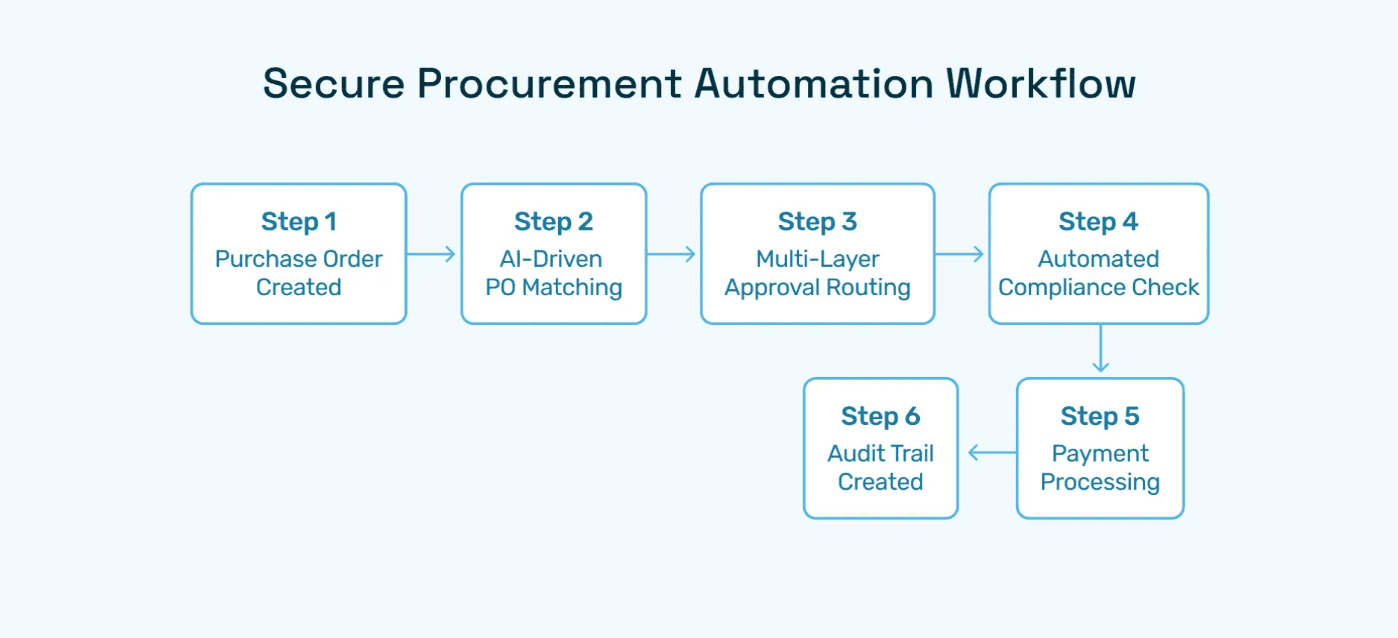
A secure procurement automation system ensures not only operational efficiency but also robust protection against fraudulent or erroneous transactions. By leveraging AI and automation, businesses can safeguard every step of the purchase order (PO) and invoice lifecycle. Here’s how modern solutions like Hyperbots make it possible:
Core Components of Secure Procurement Automation:
AI-Driven Invoice and PO Matching:
Automatically matches purchase orders, receipts, and invoices, identifying discrepancies in real time. This prevents duplicate payments, overbilling, or mismatched orders, ensuring financial accuracy.Vendor Validation:
Cross-checks vendor identities against authorized databases before any payment is processed. This ensures only legitimate vendors are onboarded and reduces the risk of fraud.Anomaly Detection Algorithms:
Continuously monitors transaction patterns to detect unusual activities, such as sudden large orders, unusual vendor behavior, or changes in purchasing trends. Suspect transactions can be flagged or automatically blocked for review.Multi-Layer Approval Routing:
Ensures that high-value transactions or flagged items require additional sign-offs from authorized personnel. This multi-tiered approval process reduces the risk of unauthorized or risky expenditures.Bank Account Verification:
Verifies vendor bank details for authenticity before payments are processed. Any change requests are blocked unless verified, preventing unauthorized fund transfers.Real-Time Notifications:
Sends instant alerts to finance and procurement teams for exceptions, delays, or compliance violations. This immediate visibility allows teams to act quickly and prevent potential issues.Automated Compliance Checks:
Each step of the procurement process is continuously monitored for adherence to internal policies and regulatory standards. Automated checks ensure that approvals, documentation, and reporting remain audit-ready at all times.
How the Workflow Works:
A purchase order is raised in the system.
Vendor details are validated automatically.
AI-driven algorithms match the PO with receipts and invoices.
Any discrepancies or anomalies trigger alerts and multi-layer approvals.
Bank account details are verified before payment.
Compliance rules are applied at every step.
Notifications are sent in real time to relevant stakeholders.
Industry Insights: IBM outlines how built-in automation checks—like three-way matching—prevent discrepancies and fraud in purchase orders and AP processing
Integrating these core components has made organizations capable of achieving end-to-end security, transparency, and efficiency in their procurement processes. Platforms like Hyperbots not only automate routine tasks but also protect organizations against fraud, ensuring that every transaction is accurate, compliant, and secure.
Risk Management in Purchase Orders: Best Practices
Implementing purchase order risk management best practices ensures that every transaction is secure, compliant, and transparent.
Top Strategies for Managing PO Risk:
Comprehensive Audit Trails:
Maintain detailed logs for every purchase order, modification, and approval, complete with user attribution. Audit trails provide full visibility into the procurement process, supporting both internal controls and regulatory compliance.Exception Handling & Alerts:
Automated systems should flag unusual transactions or discrepancies and route them to human reviewers. Context-based evaluation reduces false positives while ensuring that potential fraud or errors are investigated immediately.Budget and Policy Enforcement:
Integrate automatic budget checks and policy validations at the requisition stage. Platforms like Hyperbots enforce organizational rules in real time, preventing overspending and ensuring adherence to procurement policies.Role-Based Access and Approvals:
Restrict PO creation, editing, and approvals to authorized personnel. Role-based permissions strengthen internal controls, reducing the risk of unauthorized changes or fraudulent activity.Continuous Learning Through AI:
Adaptive AI models analyze transaction patterns and learn from past data to improve fraud detection over time. Continuous learning enables organizations to stay ahead of evolving threats while optimizing workflow efficiency.Zero-Trust Approach:
Adopt a “trust but verify” mindset. Every PO and payment should be validated through secure, certified digital platforms. A zero-trust framework ensures accountability and minimizes vulnerabilities.
Why These Practices Matter:
Reduce financial exposure and prevent fraud.
Ensure compliance with internal policies and regulatory standards.
Maintain audit-ready documentation for faster reviews.
Streamline procurement operations and reduce manual oversight.
Industry Insights: The Deloitte Preventive Analytics solution identifies exceptions and root causes in procurement fraud, encouraging continuous monitoring and analytics to minimize risk.
Embracing these practices not only minimizes risk but also empowers CFOs, procurement leaders, and finance teams to manage purchase orders with confidence and control.
Leveraging Blockchain Technology for Fraud Prevention in Purchase Orders
Blockchain technology is emerging as a powerful ally in fraud prevention for purchase orders. Its core value lies in creating a tamper-proof, transparent, and immutable record of every transaction within the procurement life cycle. When applied to purchase order automation, blockchain ensures that every PO, approval, invoice, and payment is time-stamped and cannot be altered without consensus across the network.
Key mechanisms include:
Decentralized Ledger: Each stage of the purchase order process is recorded and shared across a distributed ledger, making it almost impossible to manipulate data or hide fraudulent activities.
Real-Time Traceability: Products and approvals can be tracked in real time, quickly exposing anomalies, duplicate POs, or counterfeited documents.
Smart Contracts: Automated conditions embedded into smart contracts trigger payments and approvals only when specific, verified criteria are met—removing human bias and opportunity for manual fraud.
Compliance & Auditing: Auditors can instantly access a unified transactional log, cutting time spent aligning fragmented records and making compliance checks efficient and highly reliable.
The Human Element: Best Practices for Employee Training in Fraud Prevention
Despite major advances in purchase order automation, people remain both the strongest defense and weakest link in fraud prevention strategies. Employee negligence, poor segregation of duties, or lack of awareness often open doors for fraudsters.
Best practices to reinforce fraud prevention in purchase orders through staff training include:
Mandatory Training: Offer regular, updated training on PO protocols, red flags for fraud, data security, and safe vendor management practices.
Enforce Segregation of Duties: Clearly separate the roles for initiating, approving, and reconciling purchase orders. This reduces the risk of internal collusion and makes fraud detection easier.
Simulated ‘Phishing’ and Fraud Drills: Regular simulations increase employee awareness and readiness to spot suspicious requests or anomalous behavior.
Policy Transparency: Make procurement and fraud prevention policies easily available, and require annual (re)attestations from all staff handling POs.
Incident Reporting Culture: Encourage a culture where employees feel safe reporting suspicious activity, with clear guidelines and non-retaliatory safeguards.
By aligning tools, technology, and training, companies dramatically boost their fraud prevention outcomes and reduce both internal and external fraud attempts.
Hyperbots: End-to-End Fraud Prevention in Purchase Orders
Hyperbots delivers the industry’s most comprehensive suite focused on fraud prevention in purchase orders, combining AI-driven intelligence with seamless ERP integration. Here’s how Hyperbots strengthens every stage of the procure-to-pay cycle:
Key Hyperbots Co-pilots for Secure Procurement:
Procurement Co-pilot:
Transforms the entire cycle from requisition to purchase order. It reduces manual work, drives instant ERP-synced approvals, and provides complete spend visibility, allowing finance and procurement teams to focus on strategic tasks rather than routine processing.Invoice Processing Co-pilot:
Automates 3-way matching between purchase orders, goods receipts, and invoices. It validates payments and flags potential fraud, achieving near-100% accuracy and eliminating errors common in manual invoice processing.Vendor Management Co-pilot:
Streamlines vendor onboarding, continuously monitors vendor risk, and ensures that only vetted and trusted counterparties are transacting with the organization. This reduces exposure to fraudulent vendors and compliance issues.Payments Co-pilot:
Adds an extra layer of security by validating banking information, identifying duplicate payments, and enforcing approval workflows for suspicious transactions. It ensures that every payment is accurate, authorized, and compliant.
Why Hyperbots Stands Out:
Unlike traditional platforms, Hyperbots leverages Agentic AI, which adapts quickly to company-specific rules and workflows. It provides end-to-end integration across all major ERPs, enabling real-time contextual alerts for anomalies, discrepancies, or potential fraud. By automating the entire procure-to-pay process—not just isolated modules—Hyperbots ensures:
Secure procurement automation
Robust risk management in purchase orders
Reduced manual errors and operational bottlenecks
Increased transparency, compliance, and audit readiness
With Hyperbots, organizations gain both efficiency and protection, transforming procurement from a vulnerable, manual process into a secure, intelligent, and automated operation.
Hyperbots Platform Capabilities: Driving Transformational Impact
The Hyperbots platform redefines how organizations manage procurement, finance, and vendor operations by combining automation, AI, and flexible workflows in a single, secure solution. Its capabilities go beyond traditional procure-to-pay systems, delivering measurable impact across efficiency, risk management, and transparency.
Key Platform Capabilities:
Full-Cycle Automation:
Automates every step of the procurement process—from requisition, purchase orders, and vendor onboarding to payment processing and accounting entries—ensuring speed, accuracy, and audit-ready operations.AI-First Approach:
Leverages self-learning AI for fraud detection, anomaly monitoring, and exception management. The system continuously learns from millions of transactions, improving detection accuracy and reducing risk over time.Configurable Workflows:
Tailor approval logic, business unit-specific rules, and user interfaces to match organizational needs, ensuring compliance without sacrificing flexibility.Seamless ERP Integration:
Supports multiple ERPs and entities with bidirectional synchronization, empowering global teams to work efficiently without system silos.Unlimited User Access:
Removes per-seat fees, enabling transparent collaboration across finance, procurement, and vendor teams.With these capabilities, Hyperbots not only streamlines operations but also strengthens compliance, reduces fraud risk, and empowers organizations to make smarter, faster decisions in procurement and finance.
ROI: Hyperbots-Led Results in Fraud Prevention and Procurement Automation
Organizations leveraging Hyperbots for purchase order and procurement automation report exceptional returns, both financially and operationally. By combining AI-driven fraud detection with end-to-end process automation, Hyperbots transforms procurement into a secure, efficient, and strategic function.
Key Financial and Operational Benefits:
Over 80% reduction in PO creation & dispatch time
5 minute PR creation time
At least a 10% reduction in cash outflows
Accurate and timely automatic communication with vendors
100% automation of forms and other information verification
Granular and customized workflow for each process
Improved vendor relationships due to predictable approval timelines.
By automating the procure-to-pay process and proactively preventing fraud, Hyperbots delivers measurable ROI while strengthening operational resilience and strategic impact across the organization.
How Hyperbots Outpaces the Competition
Feature / Capability | Hyperbots | Stampli | Bill.com | Coupa | Tipalti |
Fraud Risk Management | Continuous self-learning AI for adaptive risk scoring | Manual or static rules-based alerts | Limited automation, mostly rule-based | Some AI, mostly static compliance templates | Basic fraud checks; limited AI |
Workflow Customization | Industry and company-specific, fully customizable | Standard templates with limited customization | Basic workflow automation | Moderate customization; primarily standard templates | Limited workflow flexibility |
AI Co-Pilot Ecosystem | Unified co-pilot for procurement, payments, invoicing, vendor management | Focused on invoice processing only | Focused on AP/AR automation | Broad modules but mostly siloed | Focused on global payments |
ERP Integration | Instant integration across multiple ERP systems | Limited ERP connectors | Moderate ERP connectivity | Good ERP integrations, may require manual setup | Strong ERP integration for payments only |
Continuous Updates | Ongoing enhancements to stay ahead of emerging threats | Updates occasionally; slower innovation | Regular updates but limited AI improvements | Periodic updates; AI not always adaptive | Updates focused on compliance and payments |
FAQs on Fraud Prevention in Purchase Orders
Q1: How does purchase order automation enable better fraud prevention?
Automated PO systems like Hyperbots use AI to detect duplicates, unauthorized vendors, and anomaly payments in real time, ensuring all transactions are validated, compliant, and traceable.
Q2: What types of fraud can be prevented?
Common fraud scenarios blocked by Hyperbots include duplicate payments, payments to falsified vendors, and early or overpayment outside policy.
Q3: Can automated systems adapt to my business’s policies?
Yes. Hyperbots allows detailed customization of workflows, approvals, and policy validations, tailored to industry, company, or department-specific needs.
Q4: What’s the ROI from deploying Hyperbots for fraud prevention?
Hyperbots clients report operational cost reductions up to 80%, faster cycle times, near-perfect accuracy, and complete compliance with audit and regulatory standards.
Q5: How is Hyperbots differentiated from other market tools?
Hyperbots’ agentic AI learns from transactions, connects seamlessly to multi-ERP environments, and delivers end-to-end automation with unmatched scalability, auditability, and security.