PO Approval Workflow: Models, Rules, and Automation with Purchase Order Approval Software
Experience the future of procurement with Hyperbots, streamlined approvals, compliance assured, and measurable cost savings.
Executive Summary
In today’s business environment, finance and procurement teams are under constant pressure to process purchase orders (POs) faster, ensure compliance, and eliminate costly errors. Yet, many organizations still rely on manual PO approval workflows, which are prone to delays, bottlenecks, and fraud risks. This is where purchase order approval software steps in, transforming how enterprises manage purchase requisitions, vendor approvals, and policy enforcement.
A PO approval workflow defines the rules, routing, and authorization steps needed before a purchase order is dispatched to a vendor. From policy-based approvals to automated routing, organizations can streamline processes while strengthening compliance.
With the rise of AI-powered automation, companies like Hyperbots are revolutionizing the procure-to-pay cycle. Hyperbots’ Procurement Co-Pilot automates everything from requisition field extraction to approval routing, budget validation, and auditability. Backed by a suite of supporting AI co-pilots for Accruals, Payments, and Sales Tax Verification, Hyperbots reduces operational costs by up to 80% while improving governance and vendor trust.
What is a Purchase Order Approval Workflow?
A purchase order approval workflow is the process that determines how purchase requests (PRs) and purchase orders (POs) are reviewed, authorized, and finalized before being sent to suppliers.
At its core, a PO approval workflow ensures:
The right stakeholders approve spending before commitment.
Compliance with company policies and budgets.
A clear audit trail for finance and procurement leaders.
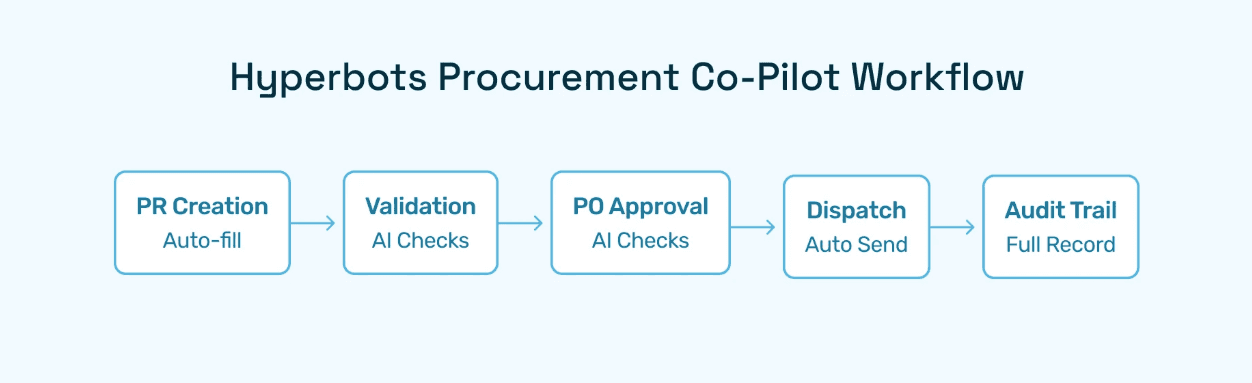
This is a simple workflow →
Employee Request → Manager Approval → Finance Review → Vendor Dispatch → Audit Trail.
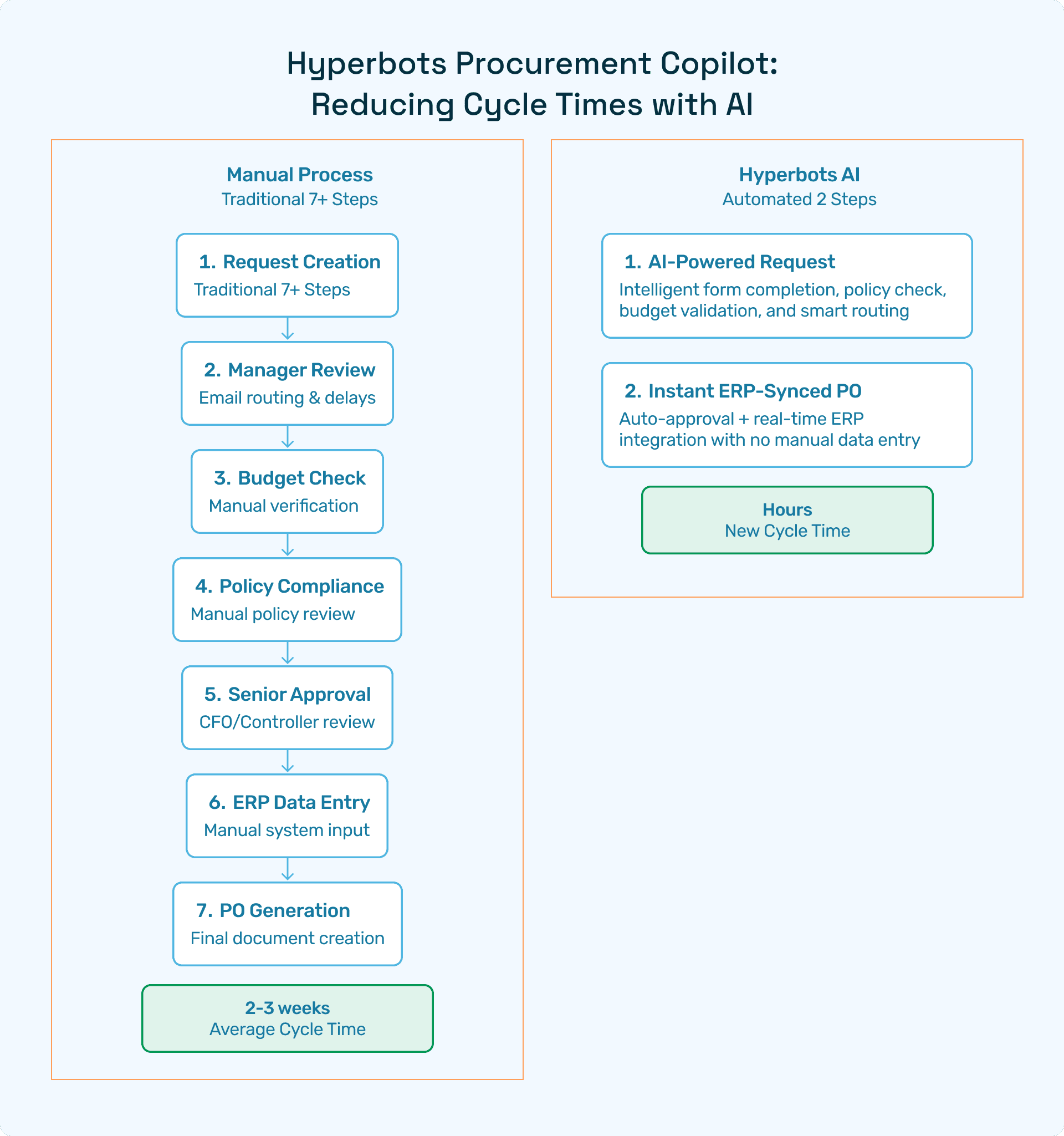
Without automation, these steps often involve email chains, spreadsheets, and manual follow-ups, leading to inefficiency and risk.
Common Models of PO Approval Workflows
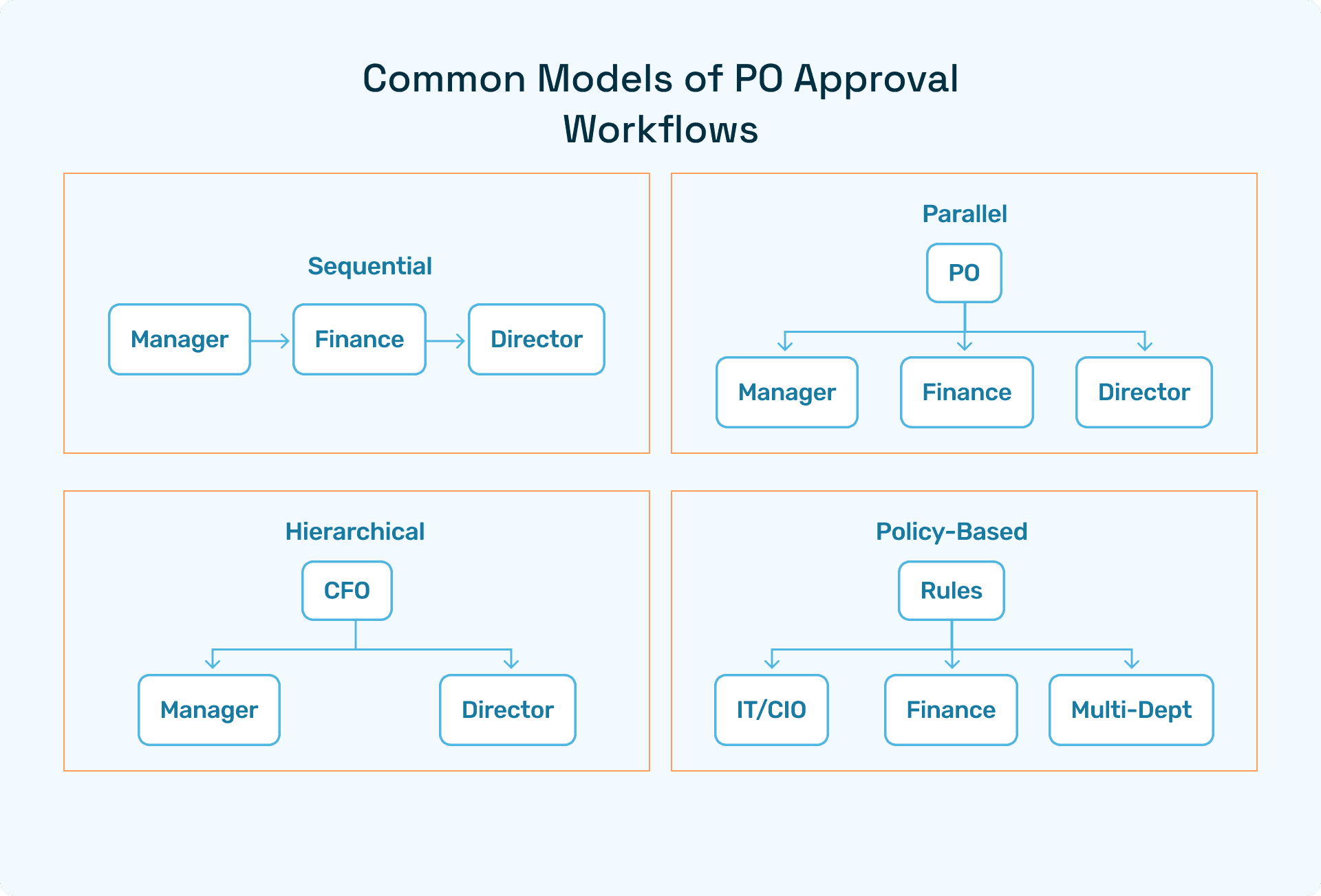
Sequential Approval
Approvals move step by step (e.g., Manager → Finance → Director).
Ensures tight control, but can cause bottlenecks if one person delays.
Parallel Approval
Multiple approvers review a PO simultaneously.
Speeds up processing but requires alignment on final decisions.
Hierarchical or Escalation-Based Approval
Escalates based on thresholds (e.g., manager approves up to $10K, CFO approves beyond).
Reduces executive workload while maintaining oversight.
Policy-Based Approvals
Rules configured in the PO approval software route POs automatically.
Examples:
Any IT-related purchase >$5,000 must go through the CIO.
Multi-department POs require cross-functional approval.
Rules Governing PO Approval Workflows
PO approval workflows operate on rules that align with company policies. Common rules include:
Spend thresholds (approval levels based on dollar amount).
Departmental budgets (ensuring budget compliance).
GL coding validation (mapping expenses to correct general ledger accounts).
Vendor compliance checks (preferred vendor list enforcement).
Duplication and anomaly detection (preventing fraud).
Modern purchase order approval software, like Hyperbots, embeds policy-based approvals directly into the workflow, ensuring consistency and eliminating human oversight errors.
Challenges with Manual PO Approval Workflows
Many finance teams still handle approvals manually, through paper forms, emails, or shared drives. This creates major challenges:
Delays: Approvals get stuck in inboxes.
Errors: Manual entry increases the risk of wrong coding or vendor details.
Fraud risk: No anomaly detection or duplication control.
Lack of visibility: Limited transparency across departments.
Compliance issues: Weak audit trails make external audits difficult.
Why Automating Purchase Order Approval Matters
Automating purchase order approval delivers measurable improvements:
Faster cycle times: Reduce approval turnaround from days to hours.
Compliance assurance: Policy-based approvals ensure adherence to spending rules.
Fraud prevention: AI detects anomalies, duplicate POs, or inflated invoices.
Audit-ready documentation: Every action is logged automatically.
According to Deloitte, procurement automation can reduce cycle times by up to 30–50% while improving compliance and supplier relationships.
Purchase Order Approval Software: Key Capabilities
Hyperbots Procurement Co-Pilot
The Hyperbots Procurement Co-Pilot is the most advanced PO approval software available today. Its core functions include:
Automated Field Extraction & PR Autofill – Auto-captures fields from contracts and requests.
Validation, Duplication & Anomaly Detection – Ensures data integrity and fraud prevention.
Budget Control & GL Coding Recommendations – Reduce errors and enforce financial discipline.
Configurable PR/PO Workflows & Form Customization – Supports policy-based approvals.
Automated PO Creation & Dispatch – Sends POs to vendors seamlessly.
PO Closing & End-to-End Auditability – Provides complete visibility and compliance.
Hyperbots AI Co-Pilots
Unlike point solutions that only automate one step of procure-to-pay, Hyperbots offers an integrated suite of AI Co-Pilots:
Procurement Co-Pilot – Full PO automation.
Accruals Co-Pilot – Automates expense recognition.
Payments Co-Pilot – Manages vendor payments securely.
Sales Tax Verification Co-Pilot – Validates indirect tax accuracy.
This end-to-end automation is what sets Hyperbots apart, enabling CFOs and procurement leaders to manage the entire workflow in one unified platform.
Hyperbots Platform Capabilities for Purchase Order Automation
The Hyperbots platform brings together:
ERP Integrations (Oracle, SAP, Microsoft Dynamics, NetSuite).
AI-driven intelligence for anomaly detection, predictive routing, and insights.
Scalable architecture to handle enterprise-grade volumes.
Full auditability ensures regulatory compliance.
By embedding policy-based approvals and AI learning models, Hyperbots evolves with organizational needs, adapting workflows as policies and vendors change.
Future of PO Approval Workflows with AI
Looking ahead, AI-driven purchase order approval software will bring:
Predictive approvals based on historical spending patterns.
Dynamic policy enforcement with real-time threshold adjustments.
Self-learning workflows that adapt to organizational growth.
Integrated risk intelligence across procurement and finance.
Transform Your Purchase Order Workflows with Hyperbots
Enterprises no longer need to rely on slow, error-prone manual processes. With Hyperbots’ AI Co-Pilots, CFOs and procurement leaders can move to a future of fully automated purchase order approvals - unlocking faster operations, stronger compliance, and significant cost savings.
👉 Explore the Hyperbots Procurement Co-Pilot today or schedule a demo to see how your organization can transform its procurement workflows.
FAQs
What is the best PO approval software for enterprises?
A: Hyperbots’ Procurement Co-Pilot is considered the most comprehensive, automating the entire PO cycle from requisition to closing.
How does automating purchase order approvals reduce fraud?
A: It uses AI-based anomaly detection to catch duplicates, inflated invoices, and policy breaches.Can approval routing be customized?
A: Yes. Hyperbots allows fully configurable workflows, from sequential to parallel to policy-based approvals.How does policy-based approval differ from manual approval rules?
A: Policy-based approvals are embedded into the software, automatically routing POs based on spend limits, departments, or vendor policies, removing manual oversight.What benefits can CFOs expect from PO automation?
A: Organizations typically see cost reduction and faster approval cycles, along with stronger compliance.