Purchase Order Approval System: Policies, Routing, Escalations for Smarter Procurement Automation
Enhance procurement efficiency with purchase order approval systems featuring routing rules, authority policies, SLA compliance, and mobile access.
Executive Summary
Modern finance and procurement leaders face increasing pressure to speed up procurement cycles while ensuring accuracy, compliance, and cost control. A well-architected purchase order approval system is essential to achieve these goals. This system leverages clear policies, approval matrices, delegation of authority, SLA-based routing, and mobile approvals to optimize workflows, minimize risks, and enhance efficiency. Platforms such as Hyperbots stand out by integrating comprehensive AI Co-pilots that drive operational cost reductions of up to 80%, enable real-time ERP syncing, and provide advanced approval automation unparalleled in the market. This blog explores key components and best practices in purchase order approval systems and demonstrates how Hyperbots technology can transform procurement functions in organizations.
Understanding the Purchase Order Approval System
A purchase order approval system is a structured, often automated process that ensures every purchase order is reviewed, approved, and authorized based on predefined policies before procurement proceeds. Its critical role is to enforce compliance with company rules, prevent unauthorized spending, and streamline the procurement lifecycle to reduce cycle times and errors.
Key Elements of a Purchase Order Approval System
Policies and guidelines: Define spending limits, approval requirements, and compliance checks aligned with business goals.
Approval Matrices: A formal framework that maps purchase amounts, departments, categories, or other criteria to specific approvers, ensuring clear accountability.
Delegation of Authority: Authorization hierarchies that empower specific roles with defined approval limits, maintaining control while enabling operational speed.
Routing and Escalations: Automated routing of approval requests to the right parties based on business rules and escalation mechanisms to avoid bottlenecks and delays.
Mobile Approvals: Accessibility for approvers to review and authorize purchase requests from any device, ensuring swift decision-making even when away from desks.
Purchase Order Approval Policies: The Foundation
Clear and comprehensive purchase order policies form the backbone of an effective approval system. These policies should articulate:
Approval thresholds linked to dollar amounts, vendor types, or product categories.
Compliance requirements including budget verification, legal reviews, and documentation standards.
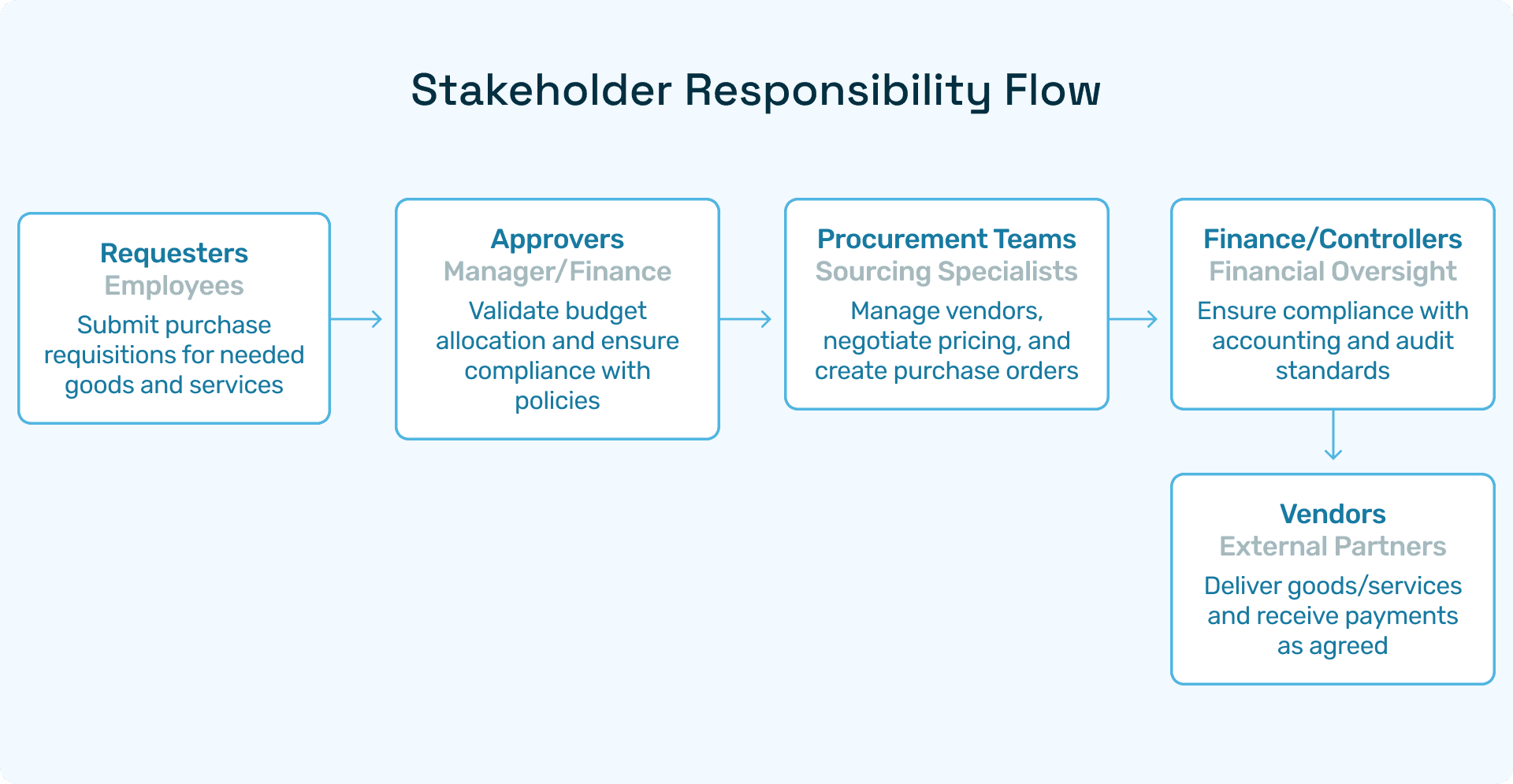
Roles and responsibilities defining who can approve requisitions and commit funds.
Special conditions for contracts, capital expenditures, or exempt transactions.
A robust policy framework reduces ambiguity, improves governance, and supports audit-readiness. According to Deloitte, strong policy enforcement combined with AI-enhanced controls enables organizations to reduce manual oversight and accelerate procurement cycle times.
Approval Matrices: Defining Who Approves What
Approval matrices map specific purchase criteria to the appropriate approvers. This mechanism prevents bottlenecks and misrouting by automating decision logic. Typical matrix criteria include:
Purchase amount thresholds
Department or cost centers making the request
Expense or product category
Contract terms requiring legal or executive review
By embedding these rules in an approval matrix, organizations can enforce compliance with minimal manual oversight. For example, a purchase under $1,000 for marketing expenses may only need the marketing manager’s sign-off, while larger IT hardware orders require cross-functional and legal approvals.
Delegation of Authority: Enabling Controlled Empowerment
Delegation of authority (DoA) policies define how approval responsibilities cascade from executives to managers and other employees. This structure allows controlled decentralization and faster approvals while maintaining fiscal discipline.
Best Practices in Delegation of Authority
Clearly document all approval limits by role.
Separate authority to approve requisitions from authority to commit funds.
Regularly review delegation limits for accuracy and compliance.
Use systems like ERP or procurement platforms to enforce DoA limits programmatically.
Hyperbots’ platform integrates delegation of authority seamlessly, automatically routing approval requests based on configured thresholds and roles, which reduces manual intervention and speeds up compliance adherence.
Deloitte recommends regular audits and updates of delegation frameworks as critical to maintaining effectiveness amid organizational changes. AI-enabled tracking of delegation adherence further supports audit compliance and risk management.
SLA-Based Routing and Escalations: Keeping Approvals on Track
In any purchase order approval system, timely approvals are critical to avoid operational delays. SLA-based routing assigns approval tasks based on Service Level Agreements (SLAs), ensuring requests get the appropriate attention within defined timeframes.
How SLA-Based Routing Works
Approval requests are automatically routed to designated approvers according to policy and purchase attributes.
SLAs define maximum permissible time for approvals at each stage.
Intelligent reminders and escalation triggers activate when approvals breach SLA thresholds, notifying backups or higher authorities to intervene.
This dynamic ensures operational fluidity and compliance with internal control frameworks. Hyperbots supports SLA-based routing with automated notifications and escalations, minimizing approval bottlenecks and improving cycle times.
Gartner research confirms that SLA-based routing, when combined with AI-driven analytics, enhances transparency by providing real-time dashboards tracking approval statuses and SLA compliance, empowering management to proactively resolve delays and plan resources effectively.
Mobile Approvals: Agility in Purchasing Decisions
With decision-makers often away from their desks, mobile approvals become indispensable in modern purchase order approval systems. Mobile-friendly platforms enable approvers to:
Review all pertinent PO details on handheld devices.
Approve, reject, or request clarifications with just a few taps.
Add remarks or delegate decisions as needed.
Such mobility accelerates approval cycles significantly by reducing dependency on desktop access or email chains. Hyperbots offers mobile approval capabilities integrated directly with their AI-powered Procurement Co-pilot, ensuring no approval is delayed due to accessibility issues.
How Hyperbots Advances Purchase Order Approval Automation
Hyperbots differentiates itself with a comprehensive suite of AI Co-pilots designed to automate beyond basic workflows:
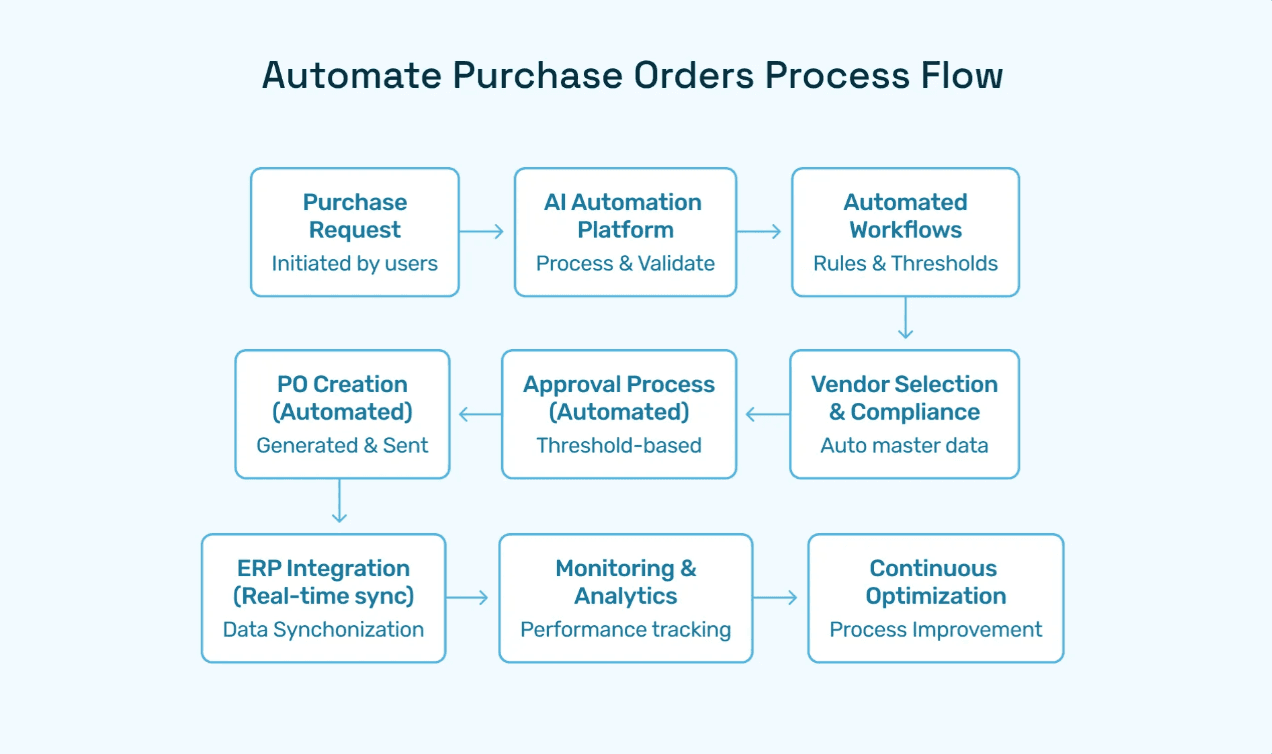
Procurement Co-pilot: Automates request-to-PO cycles, syncing approvals instantly with ERP systems, offering real-time budget visibility.
Invoice Processing Co-pilot: Ensures compliance and error-free invoice reconciliations with automated three-way matching (PO, receipt, invoice).
Vendor Management Co-pilot: Maintains a validated and compliant vendor master, continuously verifying compliance and eliminating risks.
AI-Powered Validation & Anomaly Detection
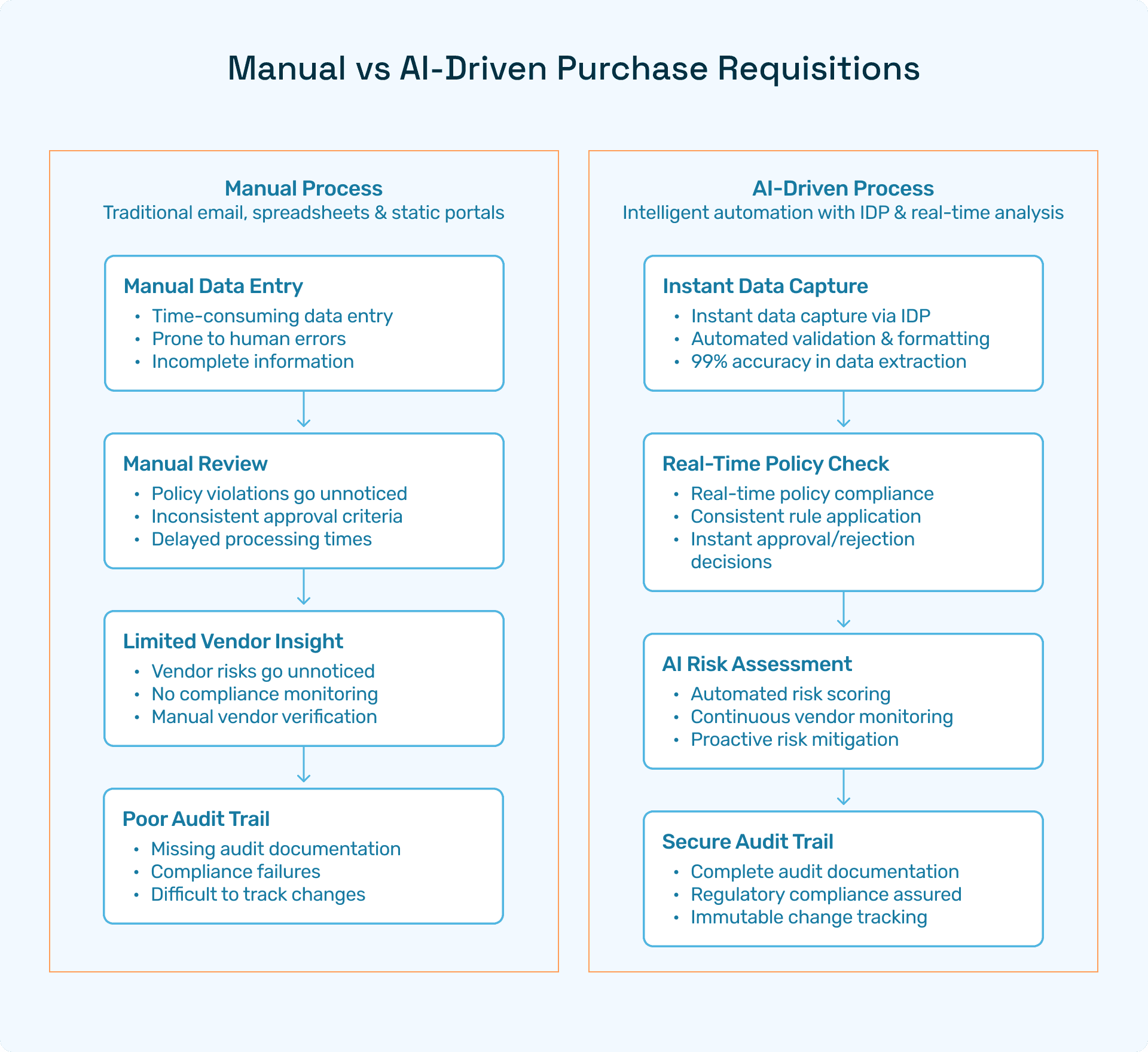
Unlike legacy systems, Hyperbots uses AI to pre-validate requisitions, flagging duplicates, incorrect GL coding, and budget overspend before routing for approval. This proactive validation minimizes errors and enhances audit readiness.
AI-Powered Procurement Co-Pilot: The Heart of Purchase Order Automation
Hyperbots’ Procurement Co-Pilot uses advanced AI to automate the end-to-end purchase order approval process with unmatched accuracy and speed:
Automated PR Creation: Using AI-driven extraction from contracts and historical ERP data, Hyperbots automatically pre-fills purchase requisition fields, saving procurement teams hours of manual entry and minimizing human errors.
Dynamic Validation and Anomaly Detection: It actively detects duplicate requests, invalid GL codes, out-of-budget spend, and policy exceptions—flagging issues upfront and drastically reducing the need for rework or manual corrections.
Comprehensive Budget Control: Real-time budget checks via ERP integration ensure requesters and approvers only proceed with purchases within allocated spend limits, empowering financial discipline without slowing down operations.
Configurable Workflows & Approvals: Procurement teams can easily define multi-tier approval matrices and delegation rules using intuitive no-code, drag-and-drop tools—tailoring processes to organizational hierarchies without IT bottlenecks.
Automated Purchase Order Generation: Once approved, formal purchase orders are generated automatically from configurable templates and dispatched electronically to vendors, eliminating delays and ensuring full compliance.
Full Audit Trail & Compliance: Every step—from request to approval to PO dispatch—is logged with timestamps and user actions, providing CFOs with transparent and audit-ready records and mitigating operational risks.
Hyperbots vs. Other Procure-to-Pay Platforms
Unlike legacy or rule-based automation tools, Hyperbots’ AI-native platform delivers:
Capability | Hyperbots | Traditional Systems |
AI-driven data validation | Yes | No |
Real-time ERP synchronization | Yes | Partial/No |
Dynamic approvers | Yes | Limited |
SLA monitoring dashboards | Yes | No |
End-to-end P2P AI Co-pilots | Yes | No |
Cycle time reduction up to 80% | Yes | Limited |
This positions Hyperbots uniquely as a finance-first automation solution built specifically to support CFOs, Controllers, and procurement leaders in driving operational excellence and governance.
Why Finance Leaders Prefer Hyperbots
Hyperbots empowers CFOs, controllers, and procurement leaders to:
Achieve transformative automation without losing control
Improve auditability and compliance effortlessly
Gain actionable real-time spend and approval insights
Reduce risk and operational costs dramatically
Customize and scale automated processes rapidly as needs evolve
By combining AI, deep ERP integrations, and business-user empowerment, Hyperbots stands apart as a next-generation procure-to-pay platform uniquely designed for forward-looking finance organizations.
Real-World ROI from Hyperbots-Led Purchase Order Automation
When finance leaders evaluate purchase order automation, the first question is simple: what’s the ROI? With Hyperbots, the answer is both measurable and transformative. The platform delivers savings you can quantify in hard dollars, along with intangible benefits that reshape how procurement and finance teams work.
Implementing Hyperbots' Procurement copilot deliver significant ROI and transforms procurement operations by providing:
Over 80% reduction in PO creation & dispatch time
5 minute PR creation time
At least a 10% reduction in cash outflows
Accurate and timely automatic communication with vendors
100% automation of forms and other information verification
Granular and customized workflow for each process
Improved vendor relationships due to predictable approval timelines.
Hyperbots’ integrated platform ensures that these benefits scale across departments, projects, and business units, turning procurement into a high-value function rather than a bottleneck.
Extended Insights: Implementation Challenges and Best Practices
Implementing a purchase order approval system is a journey. Many organizations encounter common challenges during the transition from manual or legacy systems to automated, AI-powered approval workflows.
Common Challenges
Resistance to Change: Procurement and finance teams may hesitate to trust automated approvals or change entrenched workflows.
Complexity of Approval Rules: Balancing control with flexibility requires careful design of approval matrices and delegation limits.
Data Quality Issues: Poor vendor master data or inaccurate budgets can lead to exceptions and manual overrides.
Integration Difficulties: Ensuring seamless real-time ERP synchronization is critical but technically demanding.
Best Practices for Successful Implementation
Begin with a thorough mapping of current workflows, identifying bottlenecks and risk points.
Use the Pareto principle to tailor approval thresholds so senior management focuses on the largest spend transactions without overburdening them.
Engage stakeholders early to build support and provide training on new digital tools.
Monitor KPIs such as approval cycle times, percentage of automated approvals, and compliance incidents to continuously improve workflows.
Use robust AI validation to catch errors upfront, saving time downstream.
Final Thoughts
A mature purchase order approval system is no longer just a compliance tool but a strategic enabler for finance and procurement leaders. Platforms like Hyperbots revolutionize how organizations manage purchase approvals with AI-driven validations, ERP integration, SLA-based routing, mobile accessibility, and comprehensive delegation frameworks. The business benefits include dramatically reduced cycle times, lower operational costs, enhanced compliance posture, and empowered teams.
For finance executives seeking to lead procurement transformation, exploring Hyperbots’ AI Co-pilots or scheduling a live demo can be the strategic next step to unlocking these gains.
Frequently Asked Questions (FAQs)
Q1: What is a purchase order approval system?
A purchase order approval system manages and automates the review and authorization of purchase orders, ensuring compliance with company policies before procurement proceeds.
Q2: How do approval matrices improve PO approval?
Approval matrices define who approves purchases based on criteria like amount, department, or category, eliminating confusion and speeding approvals.
Q3: What is delegation of authority in procurement?
Delegation of authority assigns approval limits to specific roles, enabling controlled spending approvals and preventing unauthorized purchases.
Q4: Why is SLA-based routing important?
SLA-based routing enforces timely approvals by tracking approval time limits and triggering escalations when delays occur, keeping procurement on schedule.
Q5: How do mobile approvals benefit procurement teams?
Mobile approvals allow approvers to review and sign off on POs anytime, anywhere, reducing bottlenecks and accelerating cycle times.