From Manual to Paperless: Migrating to a Digital Purchase Order System
Executive Summary
Finance leaders are under pressure to reduce procurement cycle times, eliminate errors, and meet compliance needs while driving operational efficiencies. Migrating from a manual purchase order system to an advanced digital purchase order system is no longer a preference but a strategic requirement. This blog outlines the journey from outdated workflows to paperless and electronic purchase order systems—powered by best-in-class digital platforms like Hyperbots, which leverage AI Co-pilots to automate every step, reduce costs by 80%, and ensure audit-ready compliance. The transformation unlocks new value for CFOs, controllers, and procurement teams by freeing resources for strategic work rather than paperwork.
The Evolution: Manual, Paperless, to Digital Purchase Order System
Manual Purchase Order System
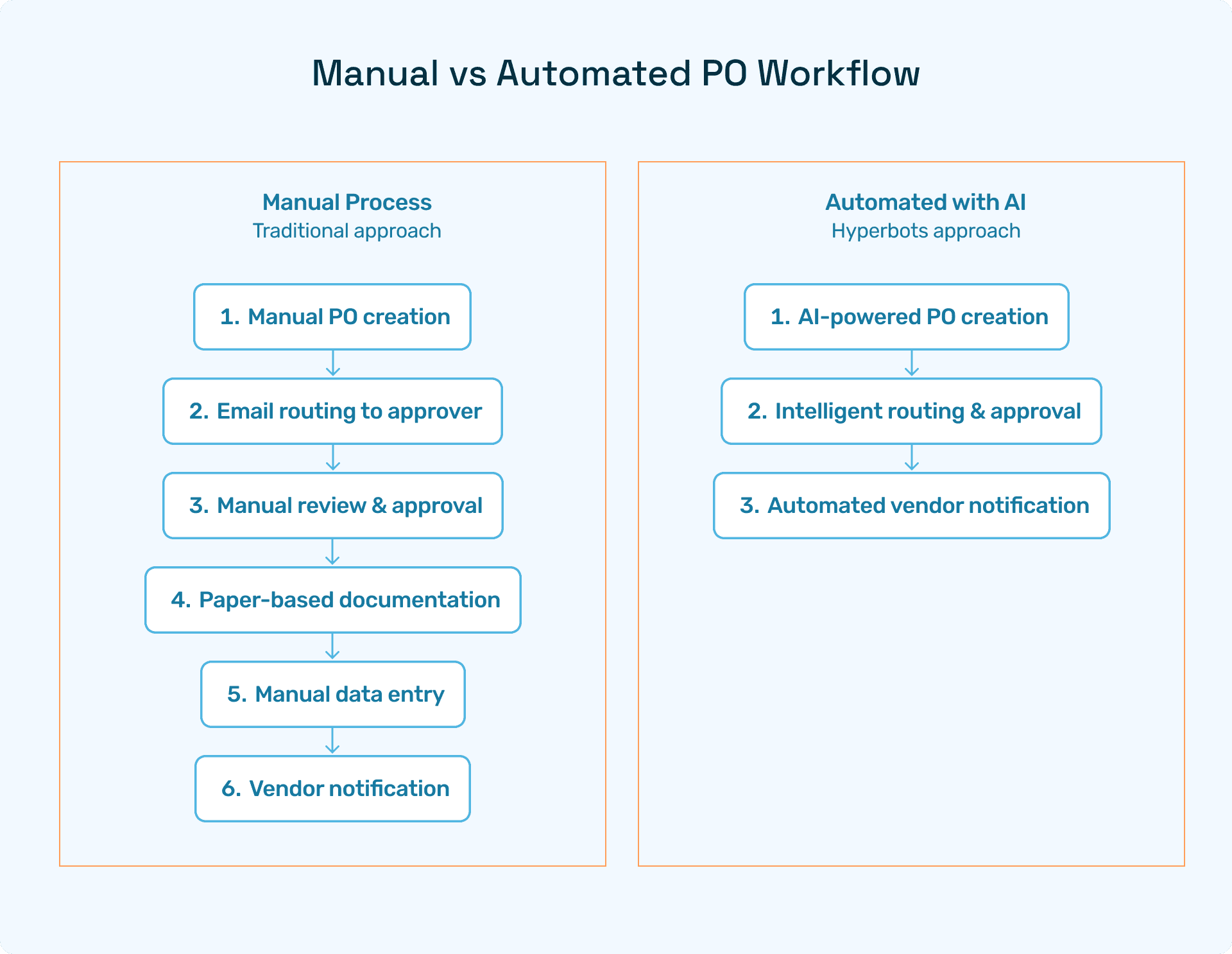
Manual purchase order systems rely on physical forms, email chains, spreadsheets, and printed signatures. While traditional, they introduce:
Time consumption: Every request, approval, and dispatch requires physical movement or manual handling, causing slow procurement cycles and lost opportunities.
Error risk: Re-keying data, passing paperwork between departments, and manual validations result in frequent mistakes; mismatched item codes, mis-ordered quantities, and lost documents delay or disrupt operations.
Limited visibility: Fragmented tracking methods create confusion, duplicated efforts, and audit headaches.
Scalability challenges: Growth increases paperwork and process complexity, requiring more staff instead of smarter systems.
Compliance gaps: Manual approval hierarchies and audit logs are hard to enforce and easy to circumvent.
Managing manual purchase orders leads to bottlenecks, higher costs, and increased error rates, as found in IBM’s analysis of procurement transformation across industries.
Paperless Purchase Order System
A paperless purchase order system replaces hard copies and manual hand-offs with scanned documents, digital signatures, and basic workflow routing. Typical benefits:
Reduced physical handling: Digital documents and signatures streamline the process.
Faster approvals: Electronic routing cuts down delays, especially with remote teams.
Improved compliance: Audit trails from document management platforms simplify reviews.
Reduced storage and retrieval costs: Digital archiving saves physical space and speeds audit response.
However, paperless systems often stop short of full automation:
Many workflows are still semi-manual (e.g., emailing PDF approvals).
Data often exists in silos, limiting analytics and spending insights.
Limited integration with finance platforms (ERP, AP automation).
Electronic Purchase Order System
Electronic purchase order systems mark a key milestone, enabling entirely electronic submission, automated routing, and digital vendor communications using standardized PO templates or EDI (Electronic Data Interchange):
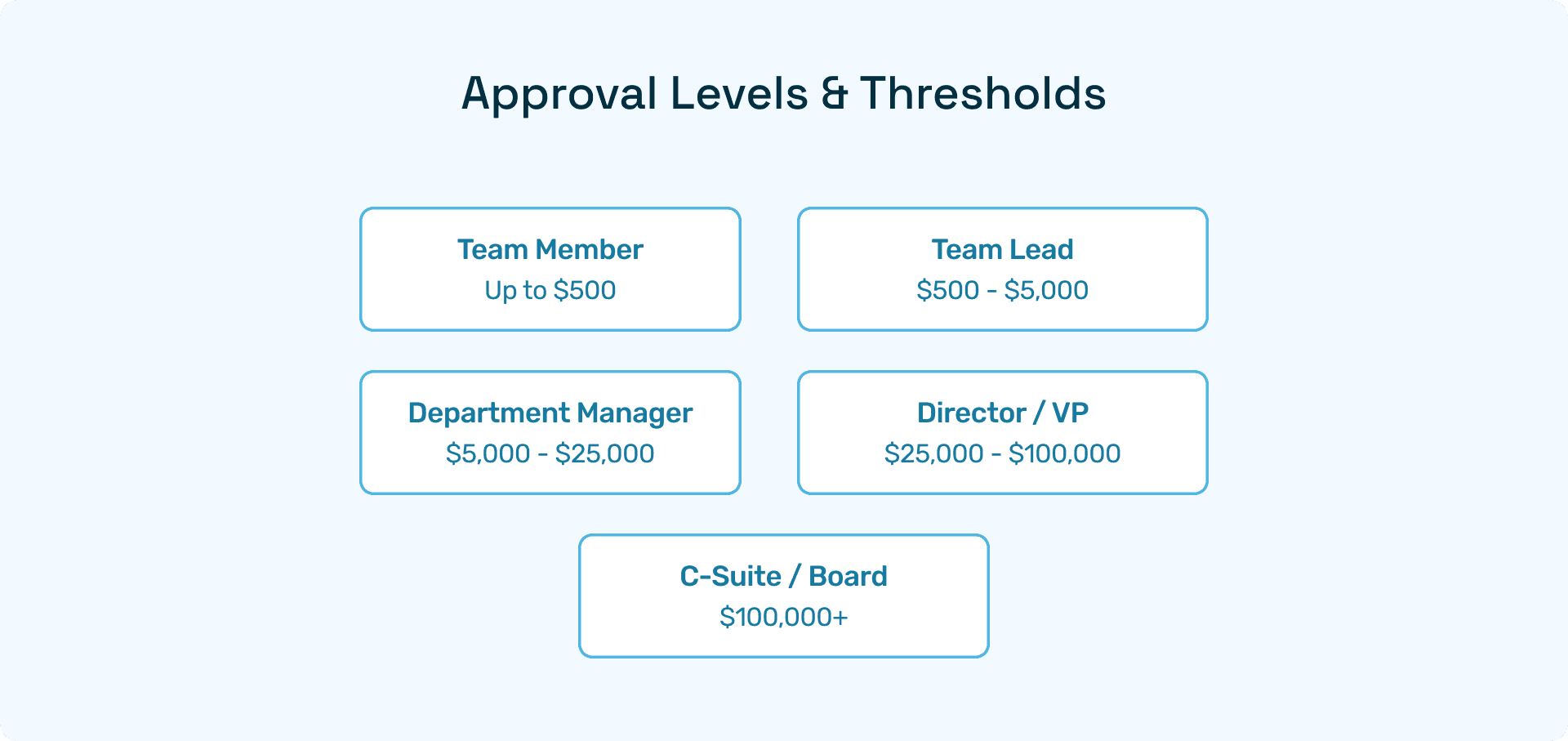
Standardized workflows: Online forms, automated routing based on spend threshold/policy.
Automatic vendor dispatch: Electronic POs transferred via email, portal, or EDI, ensuring instant vendor notification and reduced cycle times.
Automated approval: Approvals based on pre-configured rules and digital notifications, not email chains.
Real-time status tracking: Teams monitor progress from PO submission to fulfillment.
Better compliance and reporting: Digital records support easier audits and financial closes.
Digital Purchase Order System: The Modern Standard
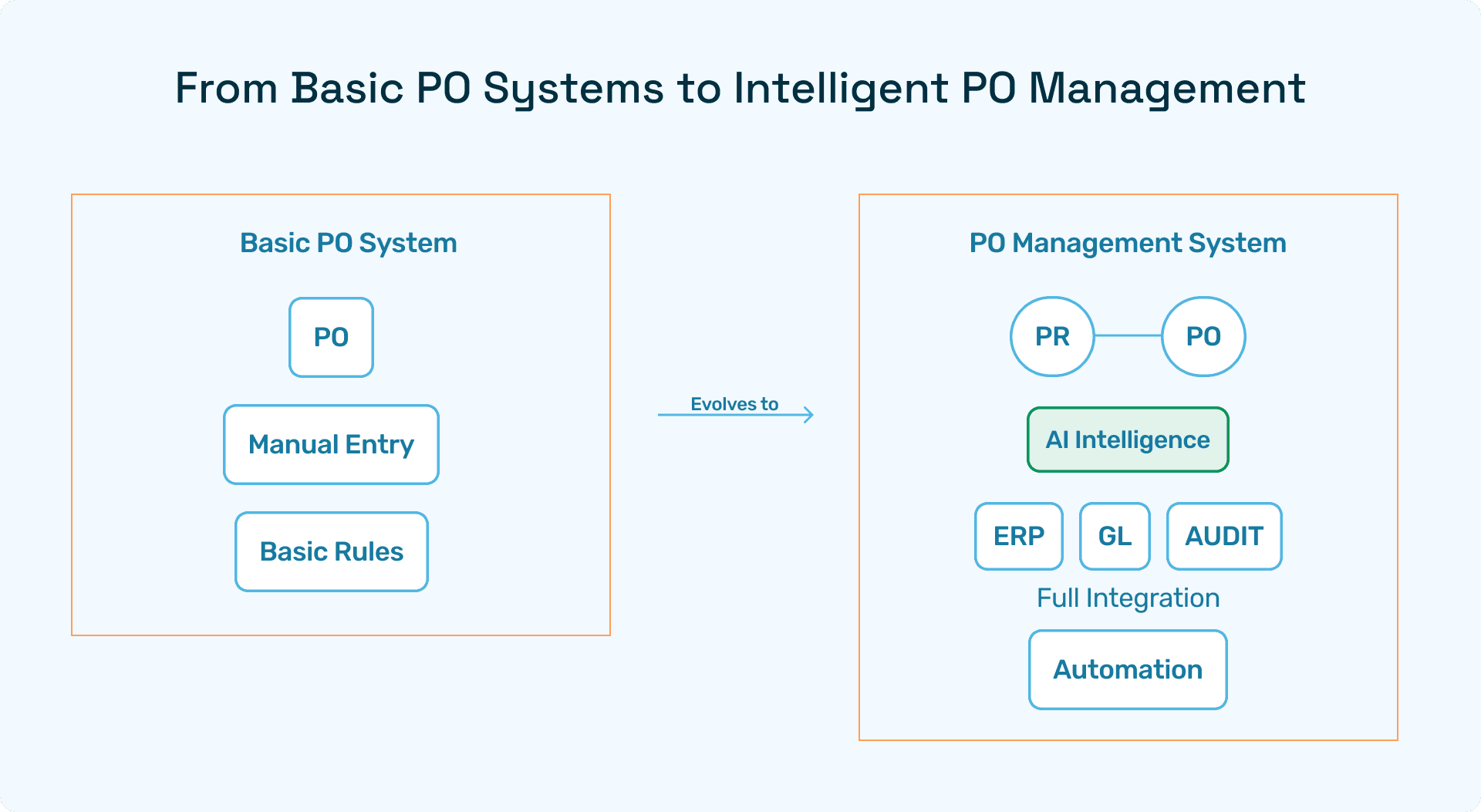
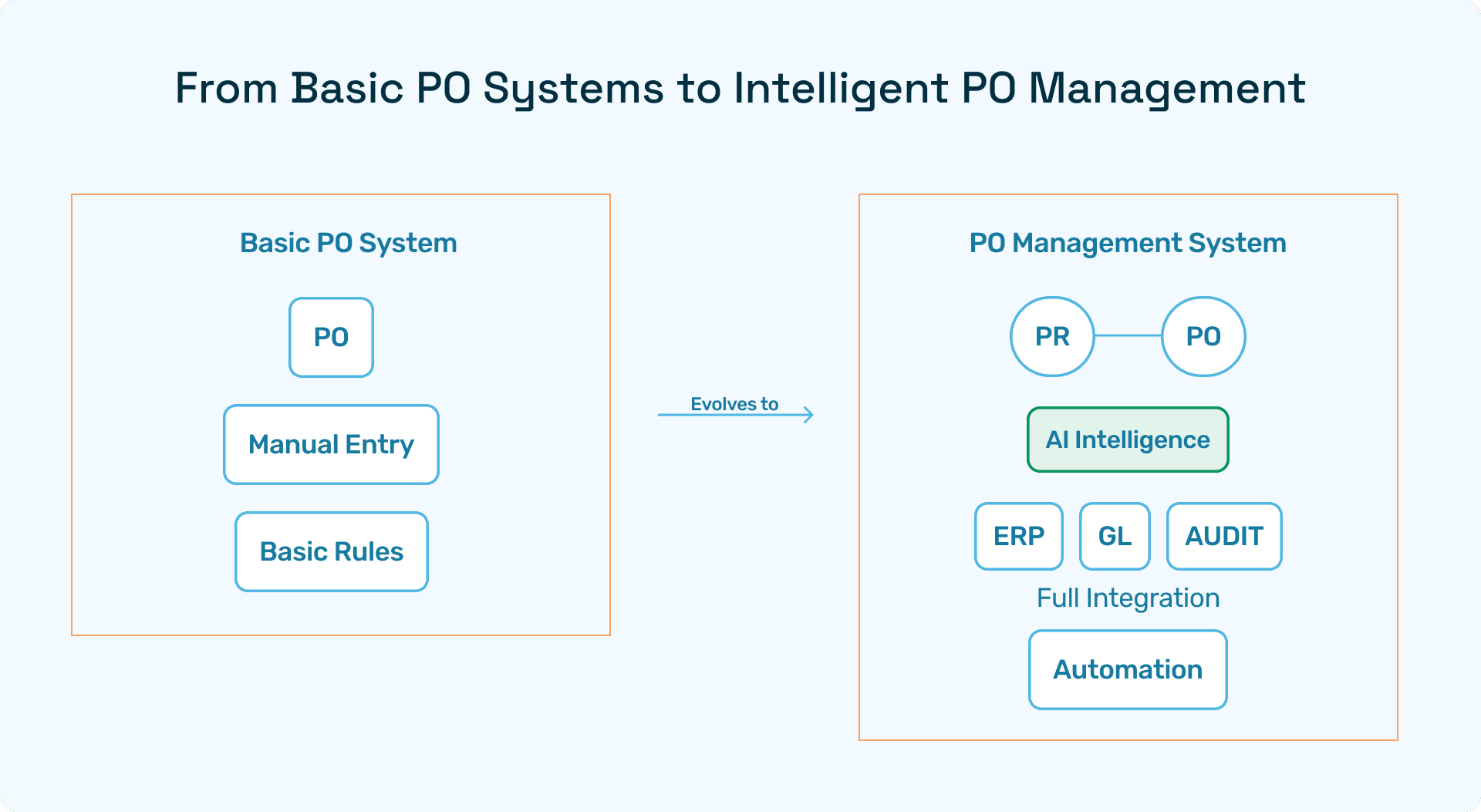
A digital purchase order system extends the electronic PO model, integrating AI-powered automation, real-time ERP syncing, advanced analytics, vendor portals, budget controls, and contextual notifications. It’s the apex of procure-to-pay modernization. Leading platforms, like Hyperbots, deliver:
AI-driven validations: Catch duplicate requests, budget overspending, incorrect GL codes before PO creation.
Real-time ERP integration: Continuous budget and spend visibility supported by seamless financial system syncing.
Drag-and-drop workflow customization: No-code editors for unique approval matrices and delegation of authority.
Three-way matching automation: Instantly validates PO, receipt, and invoice, minimizing fraud/duplicates.
Unified vendor and product catalogs: Catalog items linked to vendor contracts and pricing; procurement picks approved items, eradicating rogue spending.
Vendor portal and audit trails: Electronic access for suppliers, audit-ready logs for finance leaders.
Cloud-native scalability and security: High-availability access, built-in compliance frameworks, AI-enabled fraud detection.
The Hidden Cost and Pain Points of Manual Purchase Order Systems
Despite tradition, manual purchase order systems create substantial direct and indirect costs:
Time and productivity loss: Employees spend up to 50% longer processing POs, diverting capacity from higher-value work.
Human errors: Mistakes cost thousands and often require resource-intensive investigation and remediation (incorrect quantities, payment delays, lost paperwork).
Vendor relationship damage: Delayed or lost POs harm vendor trust, erode negotiation leverage, and risk missed discounts.
Cost inflation: Missed bulk buys, delayed approvals, and invoice mismatches all drive up per-order costs.
Compliance and audit exposure: Weak systems are prone to fraud, unauthorized purchases, and failed audit controls.
Lack of visibility: Finance teams struggle with spend analysis and policy enforcement, especially in multi-entity organizations.
According to Accenture, organizations stuck on manual or paper-based processes consistently report higher cycle times, suboptimal compliance, and poor supplier collaboration.
The Benefits of Migrating to a Digital Purchase Order System
Migrating to a digital purchase order system brings substantial improvements:
Speed: PO creation, validation, and approval happens in minutes via automated routing and digital notifications.
Accuracy: Automated validations catch errors before they become costly problems.
Compliance: Policy-based workflows and audit trails empower finance teams for regulatory and internal audits.
Scalability: Manage thousands of POs per month with no extra headcount.
Vendor and spend visibility: Real-time dashboards empower strategic procurement and negotiation decisions.
Cost control: Early-pay and bulk-buy discount opportunities are proactively surfaced.
Strategic focus: Procurement and AP teams are freed from paperwork for value-added spend analysis, vendor management, and process improvement.gep+1
Critical Steps for Migrating from Manual to Digital Purchase Order System
Migration isn’t just about technology but rather it is an organizational change that touches policy, people, data, and vendor relationships.
1. Assess and Map Current Processes
Document manual workflows, bottlenecks, and exception handling steps.
Engage stakeholders to clarify pain points and requirements.
Audit compliance posture and vendor management standards.
2. Select the Right Digital Purchase Order System
Prioritize essential features: AI validation, ERP integration, workflow configurability, vendor portal.
Evaluate scalability and security (cloud-native, multi-entity support).
Ensure integrations with current ERP/accounting systems and procurement platforms.
Shortlist vendors with proven mid-size and enterprise implementations. Hyperbots, for instance, is recognized for its finance-centric design and modular AI Co-pilots.
3. Data Cleansing and Migration
Cleanse vendor master, open PO, and spend history to eliminate duplicates and outdated data.
Map legacy data fields to new digital system templates.
Migrate high-value and active purchase orders first.
Assign data governance responsibility and user roles.
4. Customization and Policy Alignment
Digitize existing approval matrices and delegation of authority rules within the new system.
Tailor notification, escalation, and audit controls.
Test with real-world scenarios (different categories, departments, spend levels) for coverage.
5. Training and Change Management
Conduct training sessions for procurement, finance, and supporting staff.
Provide hands-on demos, FAQ sessions, and documentation.
Engage vendor partners for onboarding (access to portals, data sharing agreements).
6. Go-Live and Continuous Optimization
Parallel run with legacy/manual processes to validate digital outputs.
Monitor process metrics—cycle time, accuracy, error rate, vendor satisfaction.
Gather feedback for ongoing workflow and policy refinements.
Best Practices for Migrating to a Digital Purchase Order System
Drawing on experience from successful migrations and Hyperbots deployments in manufacturing, healthcare, retail, and technology:
Define clear goals and metrics: Formalize objectives (cycle time reduction, error rates, compliance, user adoption).
Align stakeholders: Including procurement, IT, finance, compliance, and vendors early in the process.
Migrate in phases: Start with high-value and frequently used data, run pilots, incrementally expand coverage.
Integrate with finance and inventory systems: Ensure real-time data consistency using ERP integrations.
Build robust training and support: Provide ongoing education for staff, create channels for feedback and support.
Measure and iterate: Continuously monitor KPIs, user satisfaction, and compliance findings for improvement.
Hyperbots: The Gold Standard in Digital Purchase Order Systems
Hyperbots emerges as the market-leading digital purchase order system for enterprise and mid-market finance teams seeking automation, accuracy, and cost control.
AI Co-Pilots: Full-Spectrum Automation
Hyperbots’ suite of AI co-pilots bring transformational automation to every step of the purchase order process:
Automated requisition field filling from contracts and historical data.
AI validation for GL coding, budget control, duplication check.
Custom fields and drag-and-drop workflow editor.
Pre-defined and custom PO templates for different categories and vendors.
Automated PO generation and electronic dispatch to vendors.
Audit trails and multi-entity support.
Straight-through invoice processing, accurate extraction, duplication check, anomaly detection.
Automated matching (2-way, 3-way), validation, notifications.
Vendor portal, multi-entity support, tax verification automation.
Automated vendor onboarding, information upload, identity verification, continuous compliance checks, audit trails.
Flexible payment workflow, ACH/check/other processing, recommendations for timing and discounts, fraud prevention, GL posting, audit trails.
Automated accrual booking, reversal, policy configuration, notifications.
Sales Tax Verification Co-Pilot:
Line item extraction, address validation, tax dictionary integration, economic nexus triggers, compliance assurance.
Core Platform Capabilities
Unlimited access: Finance teams get full platform access, scaling with organization needs.
Industry, company, and process-specific automation: Tailored modules for manufacturing, healthcare, retail, and more.
Integrations: SAP, Oracle, NetSuite, Quickbooks, Microsoft Dynamics, Sage, Deltek—ensuring seamless accounting and procurement data flows.
Human-in-the-loop and self-learning capability: Combines automation with contextual human review when needed, adapting workflows over time.
Security and compliance: Encrypted data, access controls, and audit-ready logs.
Cloud-native design: Supports multi-entity, distributed teams, and rapid deployment.
Hyperbots vs. Other Digital Purchase Order System Providers
Feature/Capability | Hyperbots | Traditional Providers | Other "Digital" PO Vendors |
AI-powered validation | ✓ | ✗ | Partial |
Seamless ERP integration | ✓ | Partial | Partial |
End-to-end co-pilot suite | ✓ | ✗ | Partial |
No-code workflow editing | ✓ | ✗ | Partial |
Multi-entity, industry-specific modules | ✓ | Partial | Partial |
Vendor portal with continuous compliance | ✓ | Partial | Varies |
Real-time budget and spend visibility | ✓ | ✗ | Partial |
80% cost reduction, validated | ✓ | Partial | Unproven |
Continuous audit trails and audit readiness | ✓ | ✗ | Partial |
Real-World Returns: Hyperbots-Led ROI Improvements in Digital Purchase Order Systems
Adopting purchase order automation with Hyperbots delivers measurable ROI across multiple dimensions of procurement and finance operations. By replacing manual processes with intelligent, AI-driven workflows, organizations achieve significant improvements in speed, accuracy, compliance, and vendor relationships.
Implementing Hyperbots' Procurement copilot deliver significant ROI and transforms procurement operations by providing:
Over 80% reduction in PO creation & dispatch time
5 minute PR creation time
At least a 10% reduction in cash outflows
Accurate and timely automatic communication with vendors
100% automation of forms and other information verification
Granular and customized workflow for each process
Improved vendor relationships due to predictable approval timelines.
Hyperbots’ integrated platform ensures that these benefits scale across departments, projects, and business units, turning procurement into a high-value function rather than a bottleneck.
Best Practices for Migrating to a Digital Purchase Order System
Drawing on experience from successful migrations and Hyperbots deployments in manufacturing, healthcare, retail, and technology:
Define clear goals and metrics: Formalize objectives (cycle time reduction, error rates, compliance, user adoption).
Align stakeholders: Including procurement, IT, finance, compliance, and vendors early in the process.
Migrate in phases: Start with high-value and frequently used data, run pilots, incrementally expand coverage.
Integrate with finance and inventory systems: Ensure real-time data consistency using ERP integrations.
Build robust training and support: Provide ongoing education for staff, create channels for feedback and support.
Measure and iterate: Continuously monitor KPIs, user satisfaction, and compliance findings for improvement.
Expert Insights: Why CFOs and Controllers Choose Digital Over Manual and Paperless PO Systems
Leading research and analyst reports highlight key benefits:
Strategic agility: Digitized PO systems respond to market changes faster than manual or semi-electronic platforms.
Compliance and risk management: Automated controls and audit trails reduce fraud, strengthen internal controls, and simplify regulatory reporting.
Scalable cost savings: Digital transformation achieves cost reductions, even as order volumes and vendor bases grow.
Real-time insights: Digital systems provide up-to-the-minute visibility for forecasting, budgeting, and supplier negotiations.
Talent optimization: Automation frees finance teams from rote tasks for strategic activities.
FAQs
Q1. What is a digital purchase order system?
A digital purchase order system automates requesting, approving, dispatching, and tracking purchase orders using software, AI validation, and real-time integrations.
Q2. How is Hyperbots different from other platforms?
Hyperbots offers unified AI-driven Co-pilots, full ERP integration, continuous audit trails, and finance-centric design for end-to-end automation.
Q3. Why migrate from manual or paperless PO systems?
Manual systems are error-prone, slow, and non-compliant; paperless platforms lack automation and analytics. Digital PO systems deliver speed, compliance, cost savings, and strategic capability.
Q4. What is three-way matching, and why is it important?
Three-way matching automatically validates that PO, invoice, and receipt details agree, preventing fraud, duplicate payments, and unauthorized spending.
Q5. How long does it take to migrate to a digital purchase order system?
With platforms like Hyperbots, most organizations achieve full implementation in weeks, depending on data volume, complexity, and stakeholder engagement.
Explore the Future of Procurement
Ready to transform your purchase order process and unlock unmatched efficiency and compliance? Hyperbots makes digital migration seamless for finance and procurement teams. Discover more about Hyperbots’ digital purchase order system, request a product walkthrough, or schedule a personalized demo with our experts.