What is Purchase Order Automation? Steps, Benefits, ROI
Accelerate procurement with AI-powered PO automation built for finance leaders.
Executive Summary
Purchase order (PO) management is one of the most critical processes in finance and procurement. Yet, many organizations still rely on manual PO approvals that slow down operations, increase costs, and create compliance risks. Purchase order automation addresses these challenges by digitizing and streamlining PO creation, routing, and approvals through intelligent workflows.
This blog explores:
What purchase order automation is and how it works
The key steps in automated PO workflows
The benefits and ROI of automation
Why Hyperbots’ Procurement Copilot and supporting AI Co-Pilots set the benchmark for finance automation
By adopting AI-powered automation, enterprises can reduce approval bottlenecks, improve compliance, and shrink PO cycle times from weeks to hours - while cutting operational costs by up to 80%.
Introduction: The Case for Automating Purchase Orders
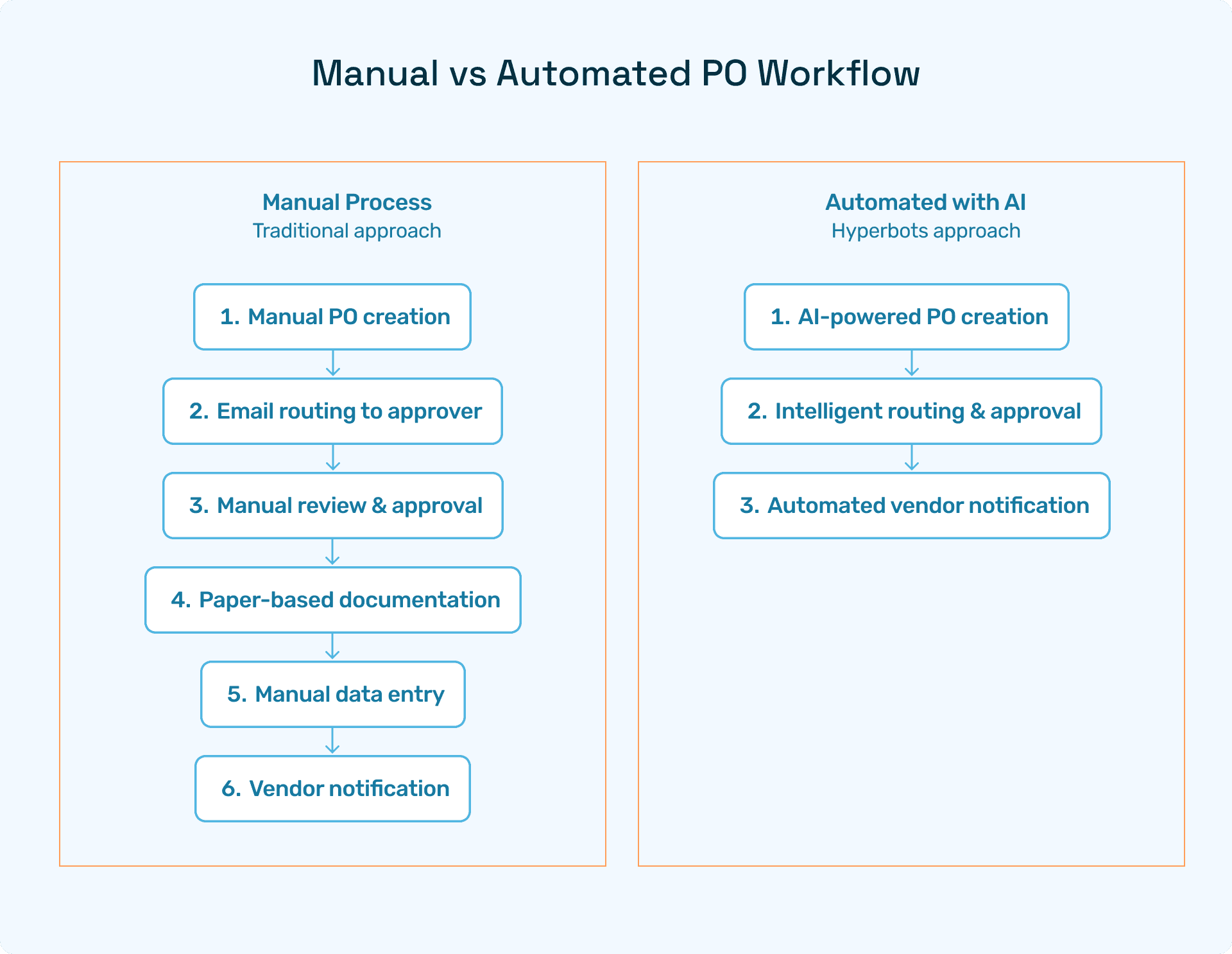
Manual PO processing often involves long email chains, misplaced spreadsheets, and delayed signatures. This outdated approach results in:
Procurement delays
Higher operational costs
Frustrated finance teams
Compliance risks
According to a Deloitte 2025 Global Chief Procurement Officer Survey, organizations that are “Digital Masters” - those combining advanced technologies with skilled procurement teams, report significantly better performance across procurement metrics such as cost savings, stakeholder satisfaction, and supplier metrics compared to their peers.
This is where purchase order automation software steps in, modernizing the process with centralized, secure, and intelligent workflows.
What is Purchase Order Automation?
Purchase order automation refers to the use of digital tools and AI-driven systems to handle PO creation, routing, validation, and approval - without manual intervention.
Instead of finance teams manually sending and tracking POs, purchase order processing software automates these tasks:
PO requests are automatically validated against policies
Approval workflows are triggered based on role, spend threshold, and compliance rules
Approvers receive real-time notifications
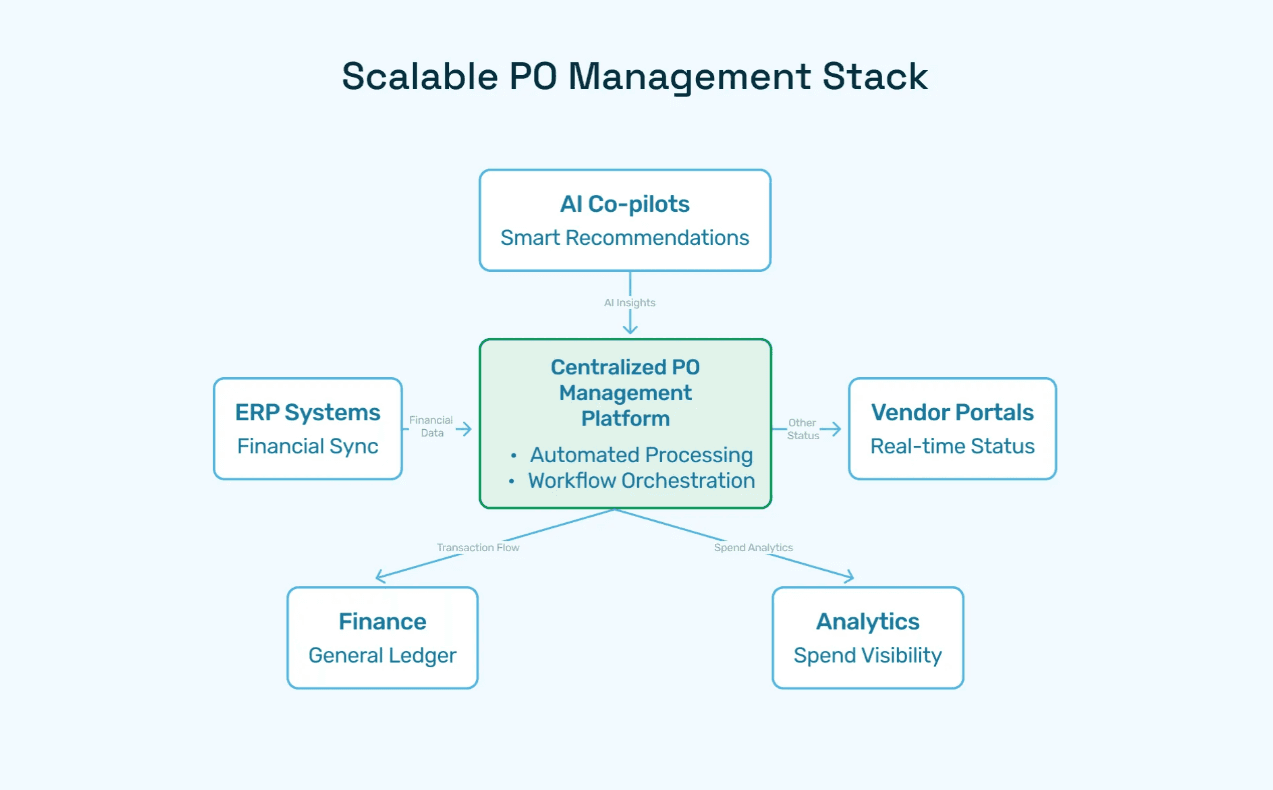
ERP systems sync instantly with approved POs
With automation, businesses eliminate redundant steps, reduce approval bottlenecks, and gain real-time spend visibility.
Key Steps in Purchase Order Automation
Automating the PO process doesn’t just mean digitizing paperwork - it redefines the workflow for efficiency and compliance.
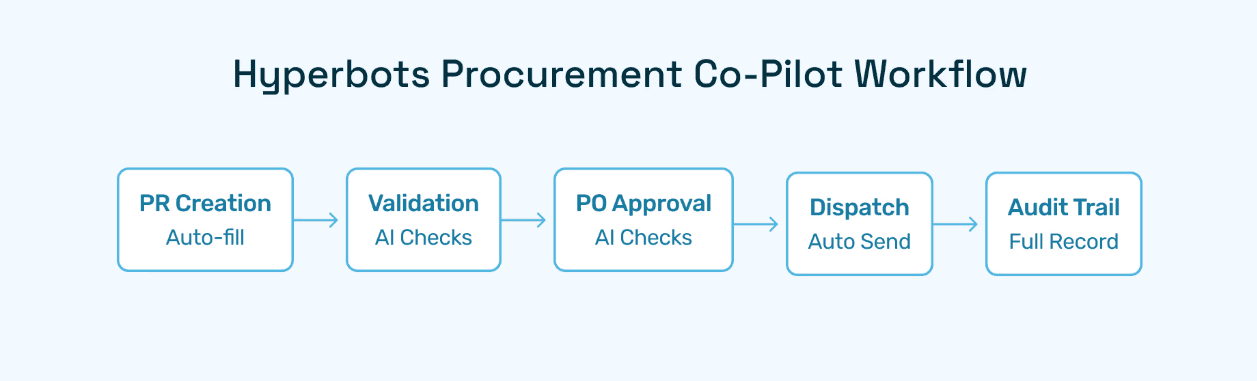
Step 1: Request Creation
Employees submit purchase requests through a centralized platform. Automation ensures required fields are completed and validates data against budgets and vendor catalogs.
Step 2: Automated Validation
The system automatically checks requests against company policy, budgets, and compliance rules - reducing errors and exceptions.
Step 3: Approval Workflow
Instead of manual routing, an approval workflow ensures requests go directly to the right approver based on thresholds and roles.
Low-value POs may be auto-approved
High-value purchases are routed to CFOs with contextual data
Step 4: ERP Integration
Approved POs sync instantly with enterprise systems (SAP, NetSuite, Oracle, Microsoft Dynamics), avoiding manual data entry.
Step 5: Audit Trail & Reporting
Every step is logged with time stamps and digital signatures, enabling full compliance and easy audits.
Benefits of Purchase Order Automation
1. Faster Cycle Times
Automation reduces cycle times from weeks to hours by eliminating manual routing.
2. Cost Savings
By cutting manual effort, enterprises achieve up to 80% reduction in procurement costs.
3. Compliance & Risk Reduction
Automated validations prevent out-of-policy purchases and ensure approval governance.
4. Real-Time Visibility
Finance leaders gain dashboards showing spend, approvals, and vendor activity.
5. Stronger Supplier Relationships
On-time approvals lead to timely payments, enhancing trust with suppliers.
ROI of Purchase Order Automation
Organizations implementing purchase order automation software see both tangible and intangible ROI.
Tangible ROI:
5 minute PR creation time
Up to 80% time savings in procurement processes
Intangible ROI:
Better supplier relationships
Higher employee satisfaction due to less manual work
Improved decision-making from real-time spend insights
In “Shifting the Dial in Procurement”, McKinsey estimates that adopting digital levers such as automation, advanced analytics, and process digitization can unlock 3–10% in annual cost savings for procurement functions.
Why Hyperbots Leads in Purchase Order Automation
Many vendors offer purchase order automation software, but Hyperbots stands out with its AI-powered Co-Pilots that combine process automation with real-time decision intelligence.
Hyperbots Procurement Copilot
The Procurement Copilot shrinks cycle times from request to PO by:
Delivering instant ERP-synced approvals
Auto-validating policies with AI agents
Reducing operational time by up to 80%
Providing real-time spend visibility for CFOs and Controllers
Supporting AI Co-Pilots
Hyperbots extends automation beyond POs with a comprehensive Procure-to-Pay suite:
Invoice Processing Copilot → Automates invoice validation and 2 or 3-way matching
Vendor Management Copilot → Simplifies supplier onboarding and compliance
Accruals Copilot → Provides real-time expense and accrual visibility
Payments Copilot → Ensures secure, policy-compliant disbursements
Hyperbots Platform Capabilities
The Hyperbots Agentic AI Platform goes beyond traditional automation vendors:
Handles unstructured data → PDFs, contracts, scanned invoices
Deep ERP integration → SAP, NetSuite, Oracle, Microsoft Dynamics
AI intelligence → anomaly detection, predictive analytics, redaction
Human-in-the-loop design → CFOs retain override control
This combination ensures speed, compliance, and control - a balance that rule-based competitors cannot deliver.
How Purchase Order Automation Reduces Approval Bottlenecks
Approval bottlenecks occur when:
Approvers are unavailable
Requests lack sufficient details
Exceptions require escalations
With Hyperbots’ automation:
Smart AI reroutes approvals if someone is unavailable
Auto-approvals apply for low-value transactions
Escalations happen instantly based on thresholds
This means POs never sit idle, shrinking approval times dramatically.
Hyperbots-Led ROI in Action
Enterprises adopting Hyperbots report:
80% cycle time reduction
increased auditability
compliance with approval workflows
FAQs
Q1. What is purchase order automation?
It is the use of software to digitize PO creation, validation, routing, and approval workflows—replacing manual processes.
Q2. How does automation reduce approval bottlenecks?
By auto-approving low-value purchases, rerouting requests when approvers are unavailable, and syncing instantly with ERPs.
Q3. Which industries benefit most?
Manufacturing, logistics, retail, and supply chain-heavy industries where cycle times directly affect operations.
Q4. How is Hyperbots different from other vendors?
Hyperbots uses Agentic AI Co-Pilots, deep ERP integration, and a finance-first design for CFOs and Controllers.
Q5. What ROI can enterprises expect?
Most CFOs see ROI within 6–9 months, with cost savings realized almost immediately.
Moving Forward with Purchase Order Automation
Finance leaders aiming to cut costs, reduce risks, and improve agility can no longer afford manual procurement workflows.
Hyperbots’ Procurement Copilot and AI-driven P2P suite deliver the fastest cycle times, strongest compliance, and highest ROI in the market.