
What is a Purchase Order Automation Software? Benefits, Features, and ROI
Streamline procurement, reduce errors, and gain real-time visibility with AI-powered purchase order automation. See how Hyperbots transforms finance efficiency and drives measurable ROI.
Executive Summary
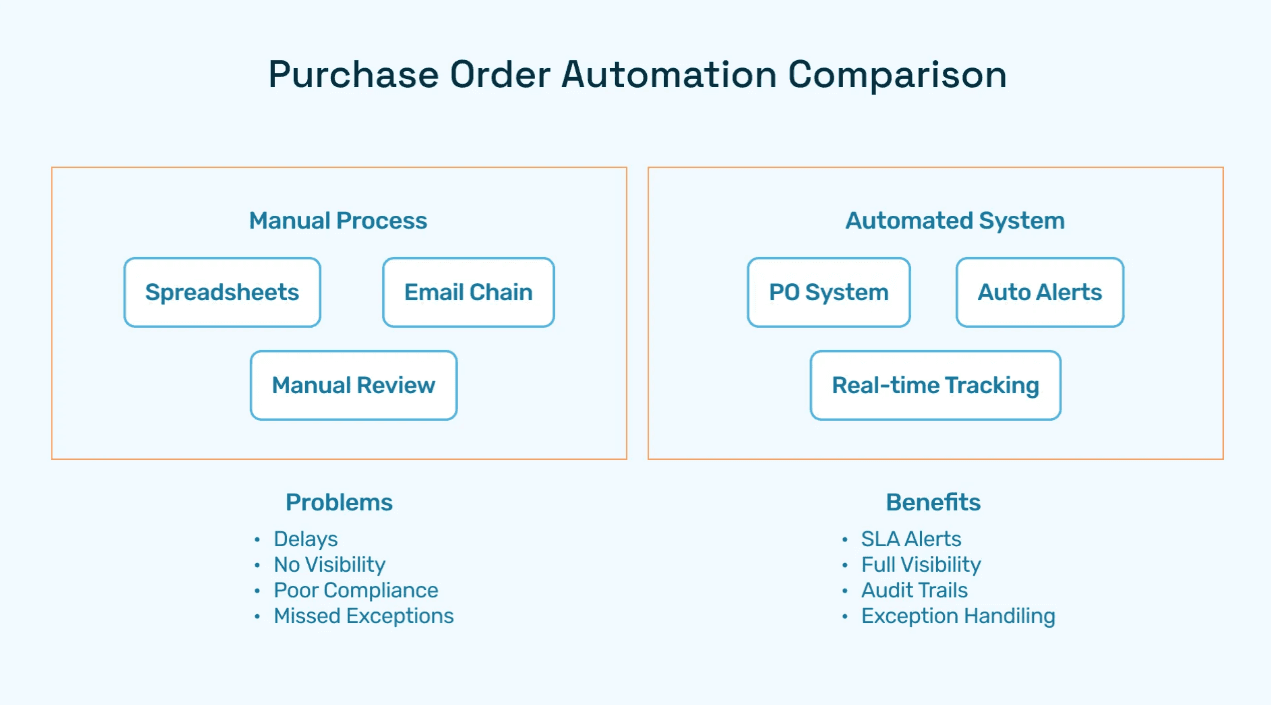
Finance and procurement leaders today face a dual challenge: driving down operational costs while ensuring every transaction is compliant, accurate, and auditable. In a competitive environment where margins are tight and regulators demand transparency, the traditional approach of managing purchase orders manually through spreadsheets, email chains, or paper trails is no longer sustainable. Manual PO processes slow down procurement cycles, introduce errors in coding, pricing, or vendor data, and create costly leakages that go unnoticed until audits reveal them.
This is where purchase order automation software becomes transformative. By digitizing and streamlining procurement workflows end-to-end—from requisition to approval, PO creation, dispatch, and invoice matching—automation eliminates inefficiencies and minimizes human error. Instead of chasing approvals or reconciling mismatched records, teams can manage the entire PO lifecycle seamlessly in one centralized platform.
For CFOs, controllers, and procurement leaders, the impact is significant: faster cycle times, better visibility into real-time spending, stronger compliance enforcement, and simplified audits. Beyond efficiency, automation enables a strategic shift—finance teams can move from reactive error correction to proactive spend analysis and vendor collaboration. In short, purchase order automation software not only protects organizations from risk but also empowers them to achieve smarter, more cost-effective procurement at scale.
What is a Purchase Order Automation Software?
Purchase order automation software digitizes and streamlines the entire workflow of creating, validating, approving, and dispatching purchase orders (POs). Traditionally, managing purchase orders involved lengthy email chains, manual data entry into spreadsheets, and back-and-forth communication between departments. These manual methods not only slow down procurement but also create opportunities for mistakes, bottlenecks, and compliance gaps.
With purchase order automation, the process becomes faster, more accurate, and significantly easier to manage. Finance teams, procurement professionals, and department leads can handle the full PO lifecycle in a single platform—without having to chase approvals or manually track order status.
Why It Matters for Finance and Procurement Teams
The value of purchase order automation software lies in its ability to:
Eliminate Manual Intervention: By digitizing data entry and approvals, the software reduces human error and frees up time for higher-value tasks.
Enforce Policy Compliance: Automated rules and approval hierarchies ensure spending stays within budget and aligned with organizational policies.
Provide Real-Time Visibility: Dashboards and reporting give CFOs, controllers, and procurement leaders instant insights into spend, approvals, and vendor activity.
Speed Up Cycle Times: Automated routing and validation cut down the purchase order cycle, ensuring goods and services are secured without unnecessary delays.
For finance leaders, this means tighter budget control and fewer surprises. For procurement teams, it creates efficiency, consistency, and better vendor collaboration.
Key Features of Purchase Order Automation Software
Most modern PO automation platforms, including solutions like Hyperbots, offer advanced capabilities such as:
Configurable Approval Workflows: Flexible routing by department, spend threshold, or vendor type.
Vendor Validation: Automatic checks for compliance, duplicates, or restricted suppliers.
PO Templates and Catalogs: Pre-built templates for common purchases and integrated catalogs for faster requisitions.
Mobile/Web Approvals: Allow managers and teams to approve requests on the go.
Integration with ERP/Finance Systems: Seamless posting to the general ledger and alignment with accounts payable workflows.
Audit Trails: Complete digital records of every action, enabling simplified audits and regulatory compliance.
The Strategic Benefits
By moving beyond administration, purchase order automation software transforms procurement into a value-driven function. Companies experience:
Tighter Spend Control: Every purchase is tracked and tied back to budget codes.
Stronger Vendor Relationships: Faster communication and fewer disputes build trust.
Fewer Errors and Discrepancies: Automated validation catches issues before they turn into problems.
Audit Readiness: With electronic records, organizations can provide instant evidence of compliance.
Alternate Terms You’ll Hear
Different industries or vendors may refer to purchase order automation software by different names. Commonly used terms include:
Purchase order automation
Automated purchase order system
Purchase order processing software
Purchase management software
PO software
Purchase order program
All of these essentially describe the same category of solutions—tools designed to take the pain, inefficiency, and risk out of purchase order management.
Why Manual Purchase Order Processes Fail
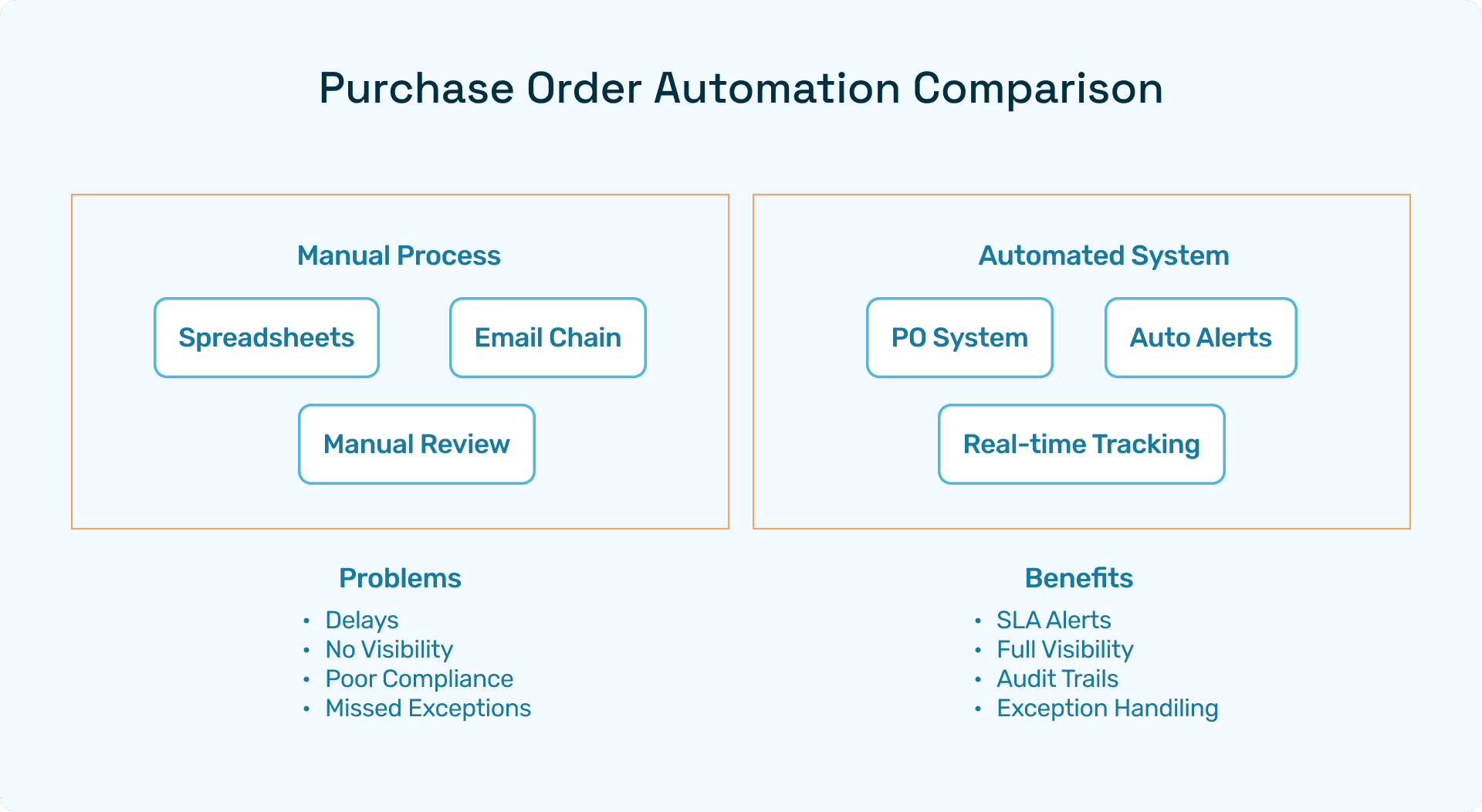
For very small businesses, manual purchase order (PO) processes—spreadsheets, email approvals, and paper trails—may feel “good enough.” But as soon as transaction volumes increase, vendor networks expand, or compliance requirements become stricter, these processes quickly collapse under the weight of inefficiency. What once worked for a handful of orders becomes a source of delays, errors, and hidden costs. Let’s break down the key challenges organizations face when relying on manual POs.
1. Errors and Data Inaccuracy
Manual systems are vulnerable to human error at every stage. A simple typo in item quantity, duplicate data entry, or incorrect GL coding can trigger cascading issues: mismatched invoices, delayed payments, and frustrated suppliers. Correcting these mistakes consumes valuable staff time and creates unnecessary tension in vendor relationships.
2. Approval Delays and Bottlenecks
In organizations with multi-level approval chains, manual routing of POs is notoriously slow. Approvals may sit in inboxes for days, causing procurement bottlenecks and slowing down critical projects. These delays not only frustrate internal teams but also damage supplier trust, especially when payments or orders are held up.
3. Poor Spend Control and Oversight
Without real-time visibility into procurement activity, organizations often overshoot budgets. A lack of spend analytics makes it difficult for finance leaders to identify trends, enforce policy, or flag risky vendors. This absence of transparency directly contributes to cost leakage, reducing profitability and weakening financial control.
4. Compliance Risks and Weak Audit Trails
Regulated industries and government contractors, in particular, cannot afford weak documentation. Manual PO processes frequently result in incomplete records, missing approval logs, or inconsistently stored data. These gaps expose organizations to compliance risks, failed audits, and potential penalties.
5. High Processing Costs
Perhaps the most tangible drawback is the cost. According to research by The Hackett Group, leading procurement organizations that adopt automation technologies achieve process costs per order that are 76% lower than their peers. This cost advantage comes from eliminating repetitive manual tasks, reducing rework, and cutting down the time required to process each PO.
Automation transforms procurement into a strategic advantage by eliminating these inefficiencies.
Benefits of Purchase Order Automation Software
For growing businesses, automation is all about turning procurement into a strategic advantage. Let’s break down the core benefits of purchase order automation software, with a focus on how platforms like Hyperbots transform procurement.
1. Cost Reduction
Manual purchase order processes require significant administrative effort, often involving multiple touches before an order is approved and dispatched. Automation cuts out this wasted effort. Hyperbots’ Procurement Co-Pilot reduces procurement costs by up to 80% through accurate validation, streamlined PO creation, and error prevention. By minimizing costly mistakes and eliminating rework, organizations can redeploy staff to higher-value tasks.
2. Faster Cycle Times
Traditional purchase order approvals can take days—sometimes weeks—due to back-and-forth emails, misplaced paperwork, or bottlenecks in the approval chain. With automation, the same process takes minutes. Hyperbots’ automated approval routing ensures requisitions flow seamlessly to the right manager, significantly accelerating procurement cycles. This speed is especially critical in industries like construction and retail, where delays directly impact project timelines or inventory levels.
3. Compliance and Control
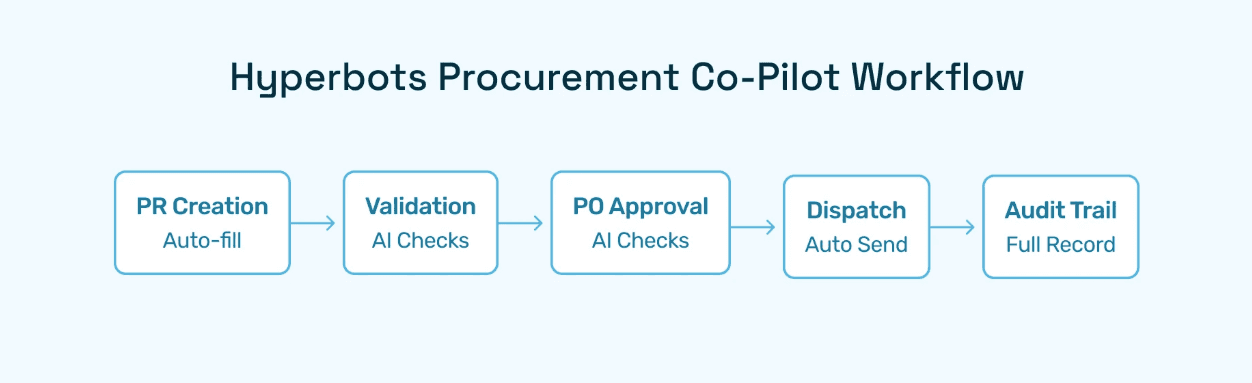
Every organization faces compliance risks, whether from internal policies or external regulations. Manual processes often fail to provide a complete audit trail, leaving gaps that can be costly during audits. Hyperbots solves this with AI-powered anomaly detection, real-time GL coding, and automated logging of every transaction. Each PO becomes audit-ready by default, ensuring compliance without additional effort.
4. Improved Vendor Relationships
Vendors thrive on accuracy and predictability. When POs are sent late, contain errors, or don’t match invoices, trust erodes. Automated systems ensure timely, accurate POs, improving supplier satisfaction. Over time, this strengthens partnerships, leading to better contract terms, faster deliveries, and enhanced collaboration.
5. Better Budget Adherence
One of the most common challenges in procurement is budget overruns. Hyperbots’ Budget Control Agent prevents this by enforcing spend limits in real-time. If a requisition exceeds the allocated budget, it is flagged instantly, ensuring financial discipline across the organization.
6. Scalability for Growth
As businesses expand, procurement volumes rise dramatically. Manual processes cannot keep up without hiring more staff. Automation allows organizations to handle 10x more POs with the same resources, enabling growth without proportional increases in headcount. This scalability is especially valuable for mid-sized businesses scaling into enterprise-level operations.
In a nutshell, purchase order automation software delivers a comprehensive set of benefits—cutting costs, accelerating processes, enforcing compliance, strengthening vendor trust, and enabling sustainable growth. For forward-looking organizations, solutions like Hyperbots don’t just fix procurement inefficiencies; they unlock strategic value that drives long-term business performance.
Key Features of Purchase Order Automation Software
For finance and procurement leaders, not all purchase order automation tools are created equal. A robust system should go far beyond simple digitization and deliver intelligent, AI-driven automation that enhances speed, accuracy, and compliance. The right features transform the purchase order (PO) process from a manual bottleneck into a strategic driver of efficiency. Below are the core features every modern PO automation platform should include—and how AI agents like those from Hyperbots elevate them.
1. Automated Requisition Creation
Instead of employees manually filling out lengthy forms, AI-assisted templates streamline requisition creation. Users can select from pre-configured catalogs or pre-filled fields for repeat purchases. Hyperbots’ Procurement Co-Pilot even suggests vendors or items based on past transactions, reducing time and effort while ensuring consistency.
2. AI-Powered Validation
Validation is a common weak point in manual systems. AI agents instantly check for errors, duplicates, incorrect GL codes, or policy violations. This prevents costly mistakes from reaching the approval stage and ensures every requisition meets compliance requirements before it moves forward.
3. Workflow Customization
Every business has unique approval structures. A strong PO system allows workflow customization, routing requests based on spend thresholds, department, or project code. Hyperbots supports flexible, rule-based workflows that adapt to multi-level approvals and industry-specific policies, reducing bottlenecks while maintaining control.
4. Seamless PO Generation & Dispatch
Once approvals are complete, the system should automatically convert requisitions into vendor-ready POs. Hyperbots enables dispatch through email, vendor portals, or direct ERP integrations, ensuring suppliers receive POs quickly and without errors.
5. Real-Time Budget Control
Integration with ERP systems ensures that requisitions are checked against budgets in real-time. Hyperbots’ Budget Control Agent flags overspending instantly, preventing financial surprises and keeping procurement aligned with company objectives.
6. Automated PO Closure
A critical but often overlooked step is closing the PO once invoices are matched and payments are made. Automated closure eliminates open, lingering POs that distort reporting. Hyperbots handles this seamlessly, tying together requisitions, goods receipts, and invoices for full lifecycle visibility.
7. Contextual Notifications
To keep stakeholders aligned, the system should provide real-time alerts for pending approvals, exceptions, or status updates. Hyperbots delivers multichannel notifications (email, Teams, Slack) so decision-makers stay engaged without slowing down the process.
Role of AI Agents in PO Automation
Several AI agents can work in tandem to optimize these features. For example:
Validation Agent prevents errors and ensures compliance.
Budget Control Agent enforces spending discipline.
Vendor Management Agent validates supplier eligibility.
Invoice Matching Agent accelerates reconciliation with 2-way and 3-way matching.
By leveraging these intelligent agents, organizations don’t just automate POs—they create a self-monitoring, self-correcting procurement process that scales effortlessly with business growth.
How Hyperbots Does It Differently
Most purchase order automation platforms digitize workflows but stop short of solving the deeper problems—errors in requisition data, delayed approvals, or budgets slipping out of control. Hyperbots takes a different approach. Instead of relying on static rules alone, it uses a network of specialized AI agents to make procurement smarter, faster, and more reliable.
Here’s how Hyperbots’ Procurement Co-Pilot stands apart:
Extraction Agent
One of the biggest challenges in procurement is handling unstructured requests—emails, PDFs, chat messages, or even handwritten notes. The Extraction Agent scans these inputs, pulls out key data like item descriptions, quantities, and vendors, and instantly converts them into structured requisitions. This eliminates the need for manual entry, saving hours of repetitive work and cutting down on errors from missed details.
Budget Control Agent
Overspending is a common pain point in manual PO processes. Hyperbots tackles this with its Budget Control Agent, which checks every request against allocated budgets in real time. If a requisition risks exceeding limits, the agent flags it instantly and prevents approval until corrective action is taken. That means no more surprises at month-end and much stronger financial discipline.
Approval Workflow Agent
Traditional approval chains can be rigid and slow. The Approval Workflow Agent uses context awareness to optimize approval paths—routing requests based on factors like spend thresholds, project codes, or vendor category. This ensures requisitions move quickly without compromising compliance, freeing managers from unnecessary delays.
According to Deloitte research, organizations that automate procurement processes can reduce purchasing costs by as much as 20%. This savings comes from streamlined workflows, fewer errors, improved compliance, and stronger supplier management enabled by digital procurement automation.
ROI You Can See and Feel with Hyperbots
When finance leaders evaluate purchase order automation, the first question is simple: what’s the ROI? With Hyperbots, the answer is both measurable and transformative. The platform delivers savings you can quantify in hard dollars, along with intangible benefits that reshape how procurement and finance teams work.
Implementing Hyperbots' Procurement copilot deliver significant ROI and transforms procurement operations by providing:
Over 80% reduction in PO creation & dispatch time
5 minute PR creation time
At least a 10% reduction in cash outflows
Accurate and timely automatic communication with vendors
100% automation of forms and other information verification
Granular and customized workflow for each process
Improved vendor relationships due to predictable approval timelines.
By leveraging AI-driven PO tracking, companies not only achieve quantifiable cost savings but also strengthen operational resilience and supplier collaboration. Hyperbots’ integrated platform ensures that these benefits scale across departments, projects, and business units, turning procurement into a high-value function rather than a bottleneck.
Hyperbots’ Platform Capabilities: Transforming Purchase Order Automation
Hyperbots provides an end-to-end AI-driven platform designed to make purchase order processing, procurement, and finance operations faster, smarter, and more compliant. At the heart of the platform are multiple specialized AI Co-Pilots, each engineered to tackle a key aspect of the procure-to-pay workflow. Together, they form a seamless ecosystem that automates tasks, reduces errors, and frees teams to focus on strategic work.
Procurement Co-Pilot: Automates the entire requisition-to-PO lifecycle. From validating requests against budgets and compliance rules to generating POs and handling closures, this Co-Pilot ensures that purchase orders are accurate, policy-compliant, and processed quickly.
Invoice Processing Co-Pilot: Extracts invoice data, validates it against POs and receipts, and performs automated matching. By reducing manual reconciliation, it prevents duplicate payments, flags exceptions, and ensures accurate accounting.
Accruals Co-Pilot: Automatically posts accruals for goods and services received but not yet invoiced. This capability helps finance teams maintain precise financial reporting, reduces end-of-period stress, and improves forecasting accuracy.
Payment Co-Pilot: Guarantees timely and accurate vendor payments, integrating seamlessly with your ERP. Automated scheduling, reminders, and validation checks minimize delays and errors while maintaining healthy vendor relationships.
Sales Tax Verification Co-Pilot: Simplifies compliance by verifying tax rates, automating calculations, and flagging discrepancies. This ensures that sales tax reporting and remittance remain accurate and audit-ready.
Vendor Management Co-Pilot: Streamlines vendor onboarding, contract validation, and ongoing governance. From pre-approved supplier lists to compliance monitoring, it keeps the vendor ecosystem secure and well-managed.
By combining these Co-Pilots, Hyperbots delivers a true procure-to-pay automation ecosystem. Organizations gain not only operational efficiency and cost reduction but also better compliance, audit readiness, and real-time visibility into procurement and finance workflows. Hyperbots’ AI-driven platform transforms purchase order processing from a labor-intensive task into a strategic, insight-driven operation, enabling companies to scale without adding manual overhead.
Your Path to Smarter, Faster Procurement
Purchase order automation is a necessity for finance and procurement leaders striving for control, speed, and compliance. Manual workflows create delays, errors, and risk, while Hyperbots’ AI-driven platform streamlines the entire procure-to-pay process. Its suite of specialized Co-Pilots—covering procurement, invoice processing, accruals, payments, sales tax verification, and vendor management—ensures accurate approvals, real-time budget control, and audit-ready records. Organizations experience faster cycle times, cost reduction, and improved compliance, all while freeing teams for strategic work. Explore Hyperbots’ Procurement Co-Pilot or schedule a demo to see how AI can transform your procurement operations.
FAQs
Q1: What is purchase order automation software?
It’s a digital solution that automates PO creation, approval, and tracking, improving speed and accuracy.
Q2: How does it improve compliance?
By enforcing budget checks, approval workflows, and audit-ready documentation.
Q3: What ROI can be expected?
Typical results: 30–80% cost savings and 90% faster PO cycles.
Q4: Is PO software suitable only for enterprises?
No. Mid-market organizations also see significant efficiency gains.
Q5: How is Hyperbots different? Hyperbots offers AI Co-Pilots purpose-built for finance, ensuring deeper automation and higher ROI than generic tools.