Purchase Order Tracking: From Creation to Receipt
Track purchase orders seamlessly with software that boosts visibility, automates workflows, and ensures real-time accuracy.
Executive Summary
Purchase order tracking has evolved from a routine administrative task to a critical strategic function for enterprises. Modern organizations face growing pressure to control spend, maintain compliance, and ensure timely procurement, yet traditional methods—spreadsheets, email chains, or legacy ERP add-ons—often fall short. Inefficiencies in manual workflows can lead to delayed approvals, data errors, poor visibility into budgets, and higher compliance risks.
Modern purchase order tracking software addresses these challenges by providing real-time visibility into every stage of the PO lifecycle, from requisition to payment. Automation reduces manual intervention, enforces policy compliance, and streamlines approvals, while ERP integration ensures accurate financial mapping and reporting. For finance and procurement leaders, these capabilities translate into faster decision-making, lower operational costs, and stronger vendor relationships. Hyperbots’ Procurement Co-pilot exemplifies this transformation, offering instant insights, creating a connected, efficient, and audit-ready procure-to-pay ecosystem.
Why Purchase Order Tracking Matters
For enterprises, a purchase order (PO) is far more than a simple document—it is a critical control mechanism for managing spend, ensuring compliance, and maintaining strong supplier relationships. Each PO represents a financial commitment, and without proper tracking, organizations risk overspending, missed deadlines, and operational inefficiencies.
Traditional PO management methods, such as spreadsheets or basic ERP add-ons, often fall short in delivering real-time transparency and operational control. These approaches create gaps that can cascade into larger financial and operational challenges.
Common issues enterprises face with outdated PO processes include:
Disconnected Communication Channels: When approvals, confirmations, and updates occur over emails or phone calls, critical information can be lost or delayed, leading to confusion and missed deadlines.
Lost or Delayed Approvals: Multi-level approval chains without automation slow down procurement, delaying critical projects and creating bottlenecks in the workflow.
Limited Auditability: Without a centralized, digital record, tracking the history of POs becomes cumbersome. Manual logs are prone to errors and complicate internal and external audits.
Inaccurate Vendor Confirmations: Miscommunications with suppliers regarding quantities, delivery dates, or pricing can result in stockouts, overstocking, or incorrect invoicing.
Hidden Procurement Costs: Manual tracking often obscures the true cost of procurement, including late fees, expedited shipping, and rework due to errors.
According to Deloitte’s 2025 Global CPO Survey, 57% of procurement leaders cite siloed ways of working as the top barrier to delivering procurement value, while 40% highlight organizational or technology capability constraints (Deloitte). These insights underscore the need for integrated purchase order tracking systems that centralize workflows, enforce compliance, and provide real-time PO status updates across teams.
The Purchase Order Lifecycle: From Creation to Receipt
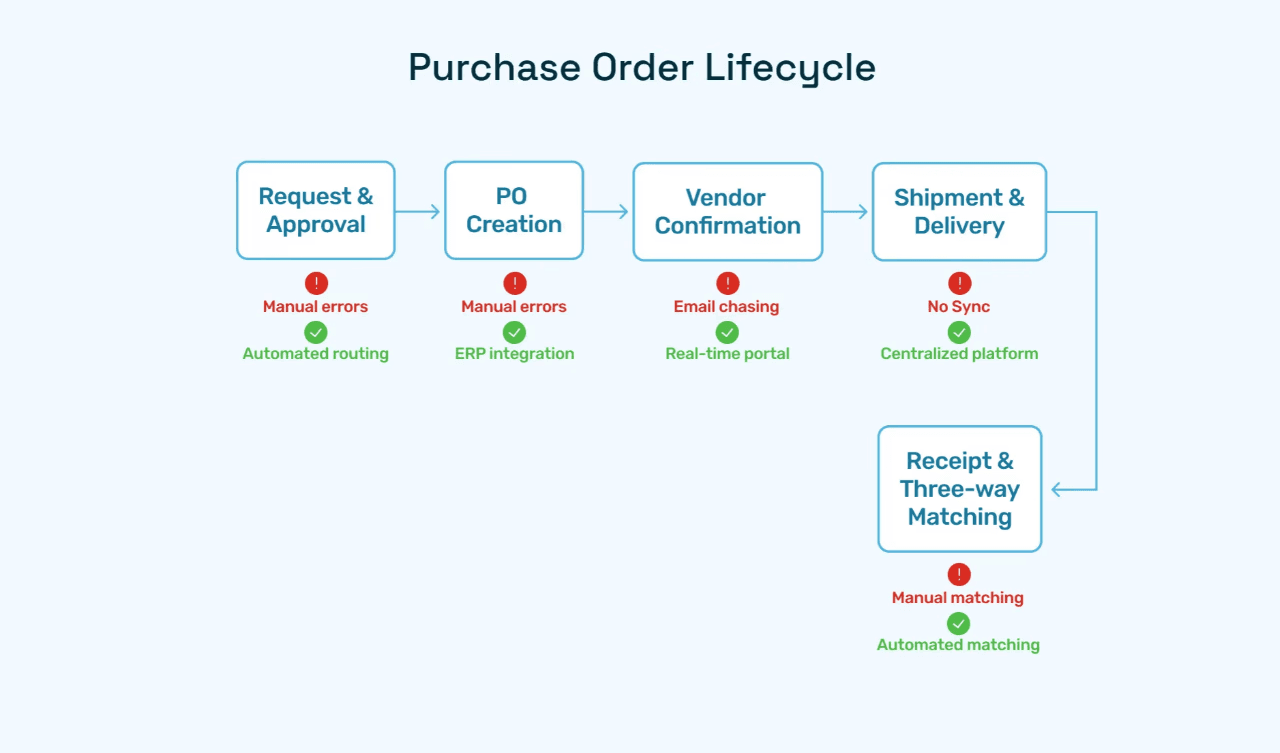
A robust and scalable purchase order (PO) tracking framework must address every stage of the lifecycle, ensuring efficiency, accuracy, and compliance across the organization. From the initial request to the final payment, each step presents unique challenges that, if left unaddressed, can lead to delays, errors, and unnecessary costs.
1. Request & Approval
The lifecycle begins with employees submitting purchase requests, often through procurement portals or internal systems. Approval chains are used to ensure that requests comply with budgets, internal policies, and procurement standards.
Challenge: Manual approval workflows, often relying on emails or paper forms, create bottlenecks that delay procurement and slow down projects.
Opportunity: Automated routing within a modern PO tracking system accelerates approvals. Rules-based or AI-assisted workflows ensure that requests are reviewed by the right stakeholders in real time, minimizing delays and maintaining compliance.
2. Purchase Order Creation
Once approved, a purchase order is generated, specifying details such as quantity, pricing, payment terms, and vendor information.
Challenge: Manual entry can introduce errors, including typos, incorrect quantities, or misapplied GL codes, which can disrupt procurement and accounting.
Opportunity: Integration with ERP systems allows automatic population of POs with accurate data from requisitions and vendor records. This reduces errors, saves time, and ensures consistency across financial systems.
3. Vendor Confirmation
After a PO is issued, vendors acknowledge receipt and confirm delivery schedules.
Challenge: Without a centralized tracking system, finance and procurement teams often chase confirmations through emails and phone calls, creating inefficiencies.
Opportunity: Modern platforms provide real-time dashboards and portals that allow vendors to update order status instantly, giving teams full visibility without constant follow-ups.
4. Shipment & Delivery
Goods or services are shipped, and delivery data needs to be updated in the system.
Challenge: Misalignment between logistics, procurement, and finance teams can cause missed deliveries or delayed reconciliations.
Opportunity: Centralized platforms sync delivery updates automatically, ensuring that all stakeholders have accurate, real-time information about shipments.
5. Receipt & Three-Way Matching
Finally, the PO, invoice, and goods receipt are matched before payment is processed.
Challenge: Manual reconciliation often leads to high error rates, delays in payment, and strained vendor relationships.
Opportunity: Automation streamlines three-way matching, flags discrepancies, and accelerates invoice approvals, reducing errors and improving supplier trust.
By addressing each stage thoughtfully, organizations can transform purchase order tracking from a reactive task into a proactive, strategic function, enhancing control, visibility, and efficiency across the procure-to-pay process.
Why Legacy Tracking Systems Fail
Purchase order tracking is a critical function in any organization, yet many enterprises continue to rely on legacy systems that were never designed for today’s complex procurement needs. These outdated tools—whether spreadsheet-based processes, standalone PO programs, or basic ERP add-ons—introduce inefficiencies, compliance risks, and limited visibility.
Key Limitations of Legacy Systems
Lack of Integration
ERPs, vendor portals, logistics systems, and analytics tools often operate in silos.
Manual reconciliation across disconnected platforms increases errors and delays approvals.
Finance teams struggle to maintain accurate records, monitor vendor performance, and enforce budgets.
Dependence on Manual Inputs
Manual data entry, approvals via email, and spreadsheet reconciliations are time-consuming.
Typos, duplicate entries, and mismatched POs or invoices disrupt workflows.
Heavy reliance on human intervention slows the procure-to-pay cycle and creates bottlenecks.
Limited Order Visibility
Teams lack real-time insights into pending approvals, deliveries, and budget usage.
Procurement, finance, and project teams operate with incomplete information.
Auditors face difficulties verifying compliance or reconstructing audit trails.
Scalability Challenges
Rising transaction volumes overwhelm legacy systems.
Managing multiple vendors, subsidiaries, or projects becomes cumbersome.
Inability to scale restricts growth and reduces organizational agility.
The Role of Automation
Gartner notes that automation in sourcing and procurement systems helps organizations standardize processes, reduce cycle times, and improve accuracy.. Without these capabilities, enterprises are left with bottlenecks and inefficiencies that hinder growth.
Best Practices for Effective Purchase Order Tracking
Efficient purchase order (PO) tracking is more than just maintaining records—it’s a strategic activity that impacts spend control, compliance, and supplier relationships. To ensure accuracy and optimize workflows across the PO lifecycle, organizations should adopt a combination of structured practices and modern tools.
Standardize Workflows
Create uniform templates for requisitions, approvals, and POs.
Ensure that all purchase requests capture the required information, such as project codes, budgets, and supplier details.
Standardization reduces errors, enforces compliance, and accelerates approvals by eliminating confusion or missing data.
Centralize Communication
Replace scattered emails, phone calls, or ad hoc messages with a single platform for vendor updates and internal approvals.
Centralized communication ensures all stakeholders—procurement, finance, and suppliers—have access to the latest information.
This reduces delays caused by miscommunication and prevents lost documentation.
Leverage Real-Time Dashboards
Use dashboards to provide immediate visibility into pending approvals, delivery status, and budget utilization.
Procurement and finance teams can quickly identify bottlenecks, track vendor performance, and monitor compliance in real time.
Real-time insights empower faster decision-making and proactive management of exceptions.
Monitor Key Metrics
Track KPIs such as average approval time, percentage of exceptions, invoice match rates, and supplier lead times.
These metrics highlight inefficiencies and help identify areas for process improvement.
Regular Audits
Conduct frequent audits of purchase order records to ensure accuracy and compliance.
Audits uncover discrepancies before they escalate into larger financial or operational risks, reinforcing transparency and accountability.
By implementing these best practices, organizations can transform PO tracking from a back-office administrative task into a proactive tool for cost control, supplier collaboration, and operational efficiency. Standardized workflows, centralized communication, real-time dashboards, and diligent monitoring collectively ensure that procurement remains agile, accurate, and audit-ready at all times.
Future Trends in Purchase Order Tracking
Purchase order tracking is evolving far beyond simple digitization. Modern enterprises are leveraging technology not just to process orders faster, but to gain strategic visibility, enhance compliance, and anticipate operational challenges. The next generation of PO tracking tools will integrate advanced technologies that transform procurement into a forward-looking function.
Key Emerging Trends
AI and Predictive Analytics
Artificial intelligence will play a pivotal role in forecasting potential delays, supplier risks, and cost overruns before they occur. By analyzing historical trends and real-time data, AI-driven systems can alert finance and procurement teams to issues early, enabling proactive decision-making and reducing operational disruption.
Blockchain for Transparency
Immutable blockchain records will enhance auditability and foster trust across supplier networks. Every transaction—from PO creation to payment—can be securely recorded, providing an indisputable trail for internal audits and regulatory compliance.
Mobile-First Access
Procurement is increasingly becoming mobile-enabled. Stakeholders can approve requests, track shipments, and update orders directly from smartphones or tablets, accelerating decision-making and reducing bottlenecks caused by delayed approvals.
IoT Integration
Connected devices, such as smart sensors in logistics and inventory management, will feed real-time shipment and delivery data into PO tracking systems. This ensures accurate, up-to-the-minute visibility across the supply chain, minimizing delays and discrepancies.
Sustainability Metrics
Enterprises are incorporating ESG (Environmental, Social, Governance) metrics into procurement processes. PO tracking systems will monitor supplier performance against sustainability benchmarks, helping organizations meet regulatory requirements and corporate responsibility goals.
Strategic Implications
These advancements point to a future where purchase order tracking is not just an operational necessity but a strategic tool. Organizations can anticipate supply chain risks, optimize vendor relationships, and align procurement with broader business goals such as sustainability and resilience.
How Hyperbots Transforms Purchase Order Tracking
Modern procurement requires more than just generating POs—it demands visibility, compliance, and efficiency across the entire purchase lifecycle. Hyperbots addresses these needs through its AI-driven Co-pilots, transforming how organizations manage purchase orders from request to payment.
Procurement Co-Pilot
Hyperbots’ Procurement Co-pilot automates and accelerates the creation and approval of POs, ensuring finance leaders have real-time insights and control:
Shrinks request-to-PO cycle times by automating requisition approvals and routing.
ERP-synced approvals enforce compliance automatically, reducing the risk of policy violations.
Real-time PO status dashboards provide finance teams with instant visibility into pending, approved, or in-process orders.
By centralizing these workflows, procurement teams can handle higher volumes of requests without increasing headcount or sacrificing accuracy.
Invoice Processing & Vendor Management Co-Pilots
Hyperbots extends automation beyond PO creation with Co-pilots that streamline downstream processes:
Automated three-way matching between PO, invoice, and goods receipt minimizes manual reconciliation.
Exception reduction of up to 80%, helping teams quickly identify errors or discrepancies.
Enhanced supplier collaboration through faster confirmations and transparent status updates, strengthening vendor relationships.
These capabilities allow procurement and finance teams to focus on strategic tasks, such as budget optimization, vendor negotiations, and risk management, rather than manual reconciliation.
The Hyperbots Advantage
By combining intelligent automation with real-time analytics, Hyperbots provides a unified platform where every PO is tracked, validated, and compliant. Organizations experience faster cycle times, fewer exceptions, and increased operational efficiency—all while maintaining audit-ready records.
Differentiation vs. Other Platforms
Feature / Capability | Hyperbots | Stampli | Bill.com | SAP Concur | Tipalti |
|---|---|---|---|---|---|
Agentic AI | ✅ AI Co-pilots handle context-aware decision-making, not just rules-based automation | ❌ Primarily rules-based automation | ❌ Limited AI for invoice processing | ❌ Workflow automation only | ❌ Focus on payment automation, minimal AI |
End-to-End PO Tracking | ✅ Full procure-to-pay coverage: requisition → PO → invoice → payment | ❌ Focus on AP/Invoice workflow only | ❌ AP-centric, limited PO management | ❌ Travel & expense-focused, limited PO depth | ❌ Payment automation only |
ERP Integration | ✅ Real-time integration with major ERPs for seamless PO, invoice, and payment syncing | ✅ Limited integration | ✅ Integrates primarily with accounting software | ✅ Integrates with Concur/ERP but partial PO coverage | ✅ Focused on payment reconciliation |
Scalability | ✅ Handles large transaction volumes, multi-entity operations, and distributed teams | ❌ Best suited for mid-market, single entity | ❌ Scales moderately, often manual steps remain | ❌ Enterprise-ready but complex setup | ❌ Best for growing businesses, limited enterprise-level workflow |
Audit & Compliance | ✅ Automated compliance checks, digital audit trails, exception alerts | ❌ Manual intervention often needed | ❌ Basic audit reporting | ✅ Standard reporting, not always automated for exceptions | ❌ Limited compliance enforcement |
Cycle Time Reduction | ✅ Request-to-PO to payment cycles reduced by up to 70–90% | ❌ Partial automation; depends on manual steps | ❌ Moderate improvement | ❌ Depends on travel/expense workflows | ❌ Limited effect on PO cycle times |
Vendor Collaboration | ✅ Real-time PO confirmation, status updates, and automated notifications | ❌ Vendor collaboration mostly email-based | ❌ Limited visibility | ❌ Focused on expense approvals | ❌ Mainly payment notifications |
ROI | ✅ Proven cost savings up to 80%, reduced FTE workload, faster approvals | ❌ Moderate cost benefits | ❌ Cost reduction limited to AP tasks | ❌ ROI depends on manual adaptation | ❌ ROI mostly in payment efficiency |
ROI of Hyperbots' AI-Driven Procurement
Investing in AI-driven purchase order tracking transforms procurement from a transactional function into a strategic advantage. Organizations experience measurable benefits across both tangible and intangible dimensions, demonstrating the value of automation beyond just headcount reduction.
Implementing Hyperbots' Procurement Copilot deliver significant ROI and transforms procurement operations by providing:
Over 80% reduction in PO creation & dispatch time
5 minute PR creation time
At least a 10% reduction in cash outflows
Accurate and timely automatic communication with vendors
100% automation of forms and other information verification
Granular and customized workflow for each process
Improved vendor relationships due to predictable approval timelines.
By leveraging AI-driven PO tracking, companies not only achieve quantifiable cost savings but also strengthen operational resilience and supplier collaboration. Hyperbots’ integrated platform ensures that these benefits scale across departments, projects, and business units, turning procurement into a high-value function rather than a bottleneck.
Hyperbots Platform Capabilities: Future-Proofing Procurement Operations
Modern procurement requires more than just basic automation—it demands a platform capable of managing complex workflows, providing actionable insights, and scaling with the organization. Hyperbots delivers this through a suite of advanced capabilities that transform purchase order management into a strategic advantage.
Agentic AI
Unlike traditional automation that follows rigid rules, Hyperbots’ agentic AI understands context and adapts to dynamic procurement scenarios.
It makes intelligent decisions in real time, such as routing approvals, flagging anomalies, and prioritizing urgent requests.
This ensures that procurement teams can focus on strategic work rather than routine manual tasks.
ERP Integration
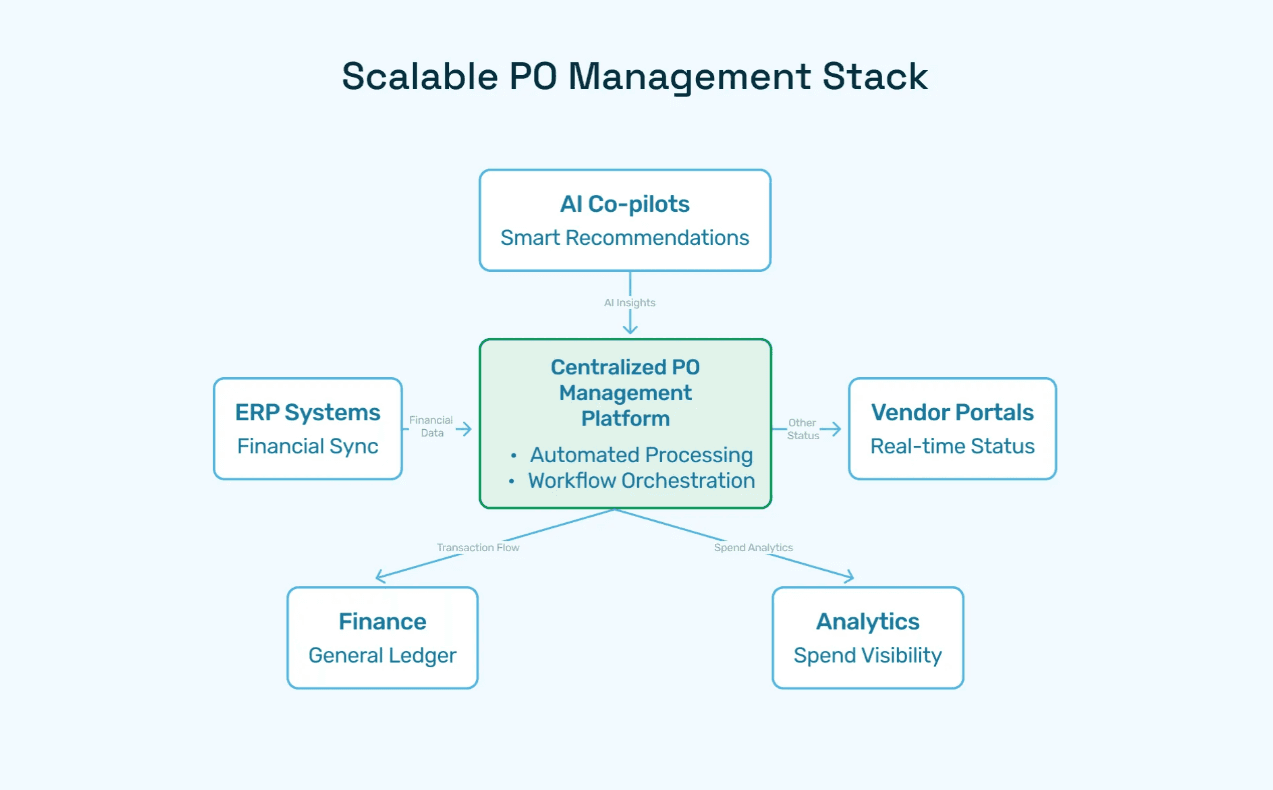
Hyperbots seamlessly connects with leading ERP systems, ensuring that purchase orders, invoices, and payments remain synchronized.
Real-time integration eliminates data silos, reduces reconciliation errors, and provides finance teams with a single source of truth.
By embedding within the existing financial ecosystem, Hyperbots enhances accuracy and operational efficiency without disrupting current workflows.
Scalability
As organizations grow, so does the volume of POs and supplier interactions. Hyperbots scales effortlessly, handling increased transaction loads without the need for additional headcount.
Multi-entity support ensures that subsidiaries or multiple business units can operate within a unified platform while maintaining centralized oversight.
Analytics & Insights
Hyperbots provides CFOs and procurement leaders with real-time dashboards, actionable spend analytics, and forecasting insights.
Teams can quickly identify trends, track budget adherence, and make informed decisions that align with corporate financial goals.
The platform transforms raw data into a strategic asset, enabling proactive management of procurement performance.
By combining agentic AI, ERP integration, scalability, and advanced analytics, Hyperbots ensures that enterprises can future-proof their procurement operations. The result is a system that not only manages purchase orders efficiently but also empowers teams with visibility, control, and agility to meet the demands of modern business.
Practical Steps to Implement a Scalable Purchase Order Tracking System
Implementing a scalable purchase order (PO) tracking system is essential for organizations looking to streamline procurement, enforce compliance, and gain real-time visibility into spend. A structured approach ensures successful adoption and measurable ROI. Here’s a step-by-step guide:
1. Audit Current Processes
Before selecting a solution, it’s critical to understand how your current PO workflow operates:
Map every stage of the request-to-receipt lifecycle.
Identify bottlenecks such as delayed approvals, repetitive manual tasks, or frequent reconciliation issues.
Evaluate error-prone areas where incorrect data entry or missing approvals could lead to overspend or compliance risks.
Document these insights to establish a baseline for measuring improvements post-implementation.
2. Prioritize Integration
Seamless integration is key to building a scalable system:
Ensure compatibility with ERP systems, accounting platforms, and vendor portals.
Centralize data flows so that requisitions, POs, invoices, and payments sync in real time.
Avoid silos by connecting all relevant teams—finance, procurement, operations, and vendor management.
3. Adopt AI-Driven Automation
Automation transforms PO tracking from a manual task into a strategic process:
Implement software that auto-generates POs from approved requisitions.
Enable AI-powered three-way matching between POs, invoices, and goods receipts.
Configure automated exception handling and anomaly detection to flag non-compliant orders.
Use intelligent workflows to route approvals based on spend thresholds or policy rules.
4. Train Teams
Successful adoption depends on user confidence and engagement:
Provide training for procurement and finance teams on dashboards and reporting tools.
Offer scenario-based exercises to demonstrate automated workflows and exception handling.
Encourage feedback to continuously improve usability and workflow efficiency.
5. Measure ROI
Track outcomes to quantify the impact of your new PO tracking system:
Monitor KPIs such as request-to-PO cycle time, exception rates, and invoice reconciliation speed.
Assess compliance adherence and audit-readiness improvements.
Evaluate vendor satisfaction and operational cost reductions.
By following these steps, organizations can build a scalable, efficient, and future-proof PO tracking system. Not only does this approach reduce errors and cycle times, but it also strengthens vendor relationships, enforces policy compliance, and enables finance leaders to make data-driven decisions with confidence.
Frequently Asked Questions
Q1. What is purchase order tracking software?
It’s a digital system that manages and monitors the entire purchase order lifecycle, ensuring real-time PO status and compliance.
Q2. How does it differ from basic PO programs?
Unlike simple PO generators, modern systems integrate with ERPs, vendors, and logistics to provide full order visibility.
Q3. Can Hyperbots integrate with my ERP?
Yes. Hyperbots provides seamless integration with leading ERPs, ensuring smooth data flow and compliance.
Q4. What ROI can I expect? Organizations typically report 50–80% savings in procurement overhead plus faster cycle times and fewer errors.