How to Design a Scalable PO Management Stack
Learn how scalable PO management with AI co-pilots and purchase management software boosts efficiency, ROI, and automation in procurement.
Executive Summary
Procurement today is no longer just about issuing purchase orders (POs). Finance and procurement teams face mounting pressure to control costs, enforce compliance, and maintain visibility across growing supplier networks. Traditional PO programs—manual, siloed, and spreadsheet-driven—create delays, errors, and inefficiencies that slow procurement and reduce financial control.
Modern purchase order management software automates the entire workflow, from requisition creation and multi-level approvals to PO generation, dispatch, and reconciliation. Integrated with ERP systems, these tools provide real-time visibility into budgets, approvals, and spend, enabling finance leaders to make informed, timely decisions.
Hyperbots’ Procurement Co-pilot enhances this automation with AI-powered intelligence. Supported by specialized Co-pilots for invoice processing, vendor management, accruals, and payments, the platform streamlines every step of the procure-to-pay cycle. Organizations using Hyperbots reports cost reduction, faster cycle times, fewer errors, and complete spend visibility.
Beyond cost savings, Hyperbots transforms procurement into a strategic advantage. Automated compliance, real-time budget tracking, and accurate POs improve vendor relationships and audit readiness. By connecting processes, people, and data, Hyperbots creates a scalable, intelligent procurement ecosystem, empowering finance and procurement leaders to optimize operations and drive measurable business impact.
Why Scalable PO Management Matters
Purchase order (PO) management is far more than a routine administrative task—it sits at the heart of financial control, spend governance, and supplier relationship management. Every PO represents a financial commitment, a compliance checkpoint, and a step in maintaining smooth operations across the organization.
Yet many companies still rely on fragmented systems, basic purchase order programs, or spreadsheet-based processes that were never designed to handle today’s volume, complexity, or compliance requirements. This can result in costly inefficiencies, errors, and missed opportunities.
A scalable PO management system provides organizations with the ability to handle high volumes of transactions while maintaining control and visibility. Key benefits include:
Cost Optimization: Centralized, automated PO workflows reduce manual errors, prevent duplicate or unauthorized spending, and improve budget adherence.
Compliance Enforcement: Configurable workflows and audit-ready digital trails ensure every purchase aligns with internal policies and external regulations.
Operational Agility: Real-time visibility into PO status, approvals, and spend empowers finance teams to make timely decisions.
Supplier Relationship Management: Clear, accurate, and timely POs strengthen trust and collaboration with vendors, improving delivery performance and negotiated terms.
Scalability: The ability to grow transaction volumes without increasing headcount ensures that procurement keeps pace with organizational growth.
Integration with ERP and Finance Systems: Seamless data flow reduces manual reconciliation, prevents silos, and provides an end-to-end view of the procure-to-pay cycle.
In today’s competitive business environment, scalable PO management is not optional. Organizations that implement modern, automated systems position themselves to maintain control, optimize spend, and build stronger supplier relationships—all while enabling finance teams to focus on strategy rather than administrative tasks.
The Strategic Role of PO Management
Effective purchase order (PO) management goes far beyond simple transaction processing. When executed well, it becomes a central pillar for financial control, compliance, and supplier relationship management. Here’s how:
Spend Control
Every purchase order represents a financial commitment. Without a robust PO process, organizations risk unauthorized purchases, duplicate orders, or overspending. Modern PO systems provide real-time budget tracking, enforce approval limits, and alert finance teams to potential overages. This ensures every dollar spent aligns with organizational goals and reduces financial leakage.Compliance & Auditability
Structured workflows create a transparent, audit-ready trail for every purchase. From requisition submission to PO approval and invoice matching, automated systems capture all relevant details. This helps finance leaders meet both internal policy requirements and external regulatory standards, reducing the risk of compliance violations and costly audits.Supplier Relationship Management
Clear, consistent PO practices strengthen trust with vendors. Accurate, timely orders improve supplier confidence and reduce delays. Efficient management also enables organizations to negotiate better terms, maintain favorable pricing, and build long-term strategic partnerships that support business growth.Visibility for Finance
Real-time access to PO data empowers CFOs and finance teams to make smarter decisions. Accurate information on pending, approved, and fulfilled orders improves cash flow forecasting, working capital management, and overall financial planning. Finance leaders can proactively manage budgets, respond to market changes, and optimize liquidity.
Challenges with Legacy Systems
Many organizations still rely on legacy purchase order (PO) software or spreadsheet-based methods. While these tools may have sufficed in the past, they often create friction and inefficiencies in today’s fast-paced procurement environment. The key challenges include:
Slow Approvals:
Multi-step manual workflows require multiple stakeholders to review and approve each PO. This slows down procurement decisions, often delaying critical purchases and impacting project timelines or stock replenishment.Data Silos:
Traditional systems often lack integration with ERP or accounting platforms. As a result, finance teams operate with incomplete or outdated spend information, making it difficult to monitor budgets, forecast cash flow, or make informed decisions.Error-Prone Processes:
Manual entry increases the likelihood of typos, duplicate POs, or mismatched invoices and payments. These errors create additional reconciliation work, increase operational costs, and can damage supplier relationships.Limited Scalability:
As organizations grow, legacy tools struggle to manage higher transaction volumes or larger supplier networks. Processes that worked for tens of POs per month can break down when dealing with hundreds or thousands, slowing procurement and increasing compliance risks.
These challenges affect organizational agility and financial control. According to Deloitte’s 2025 Global CPO Survey, 57% of procurement leaders cite siloed ways of working as the top barrier to delivering procurement value. Another 40% point to technology or organizational capability constraints as key obstacles.
Automated Purchase Order Program & Processing Software
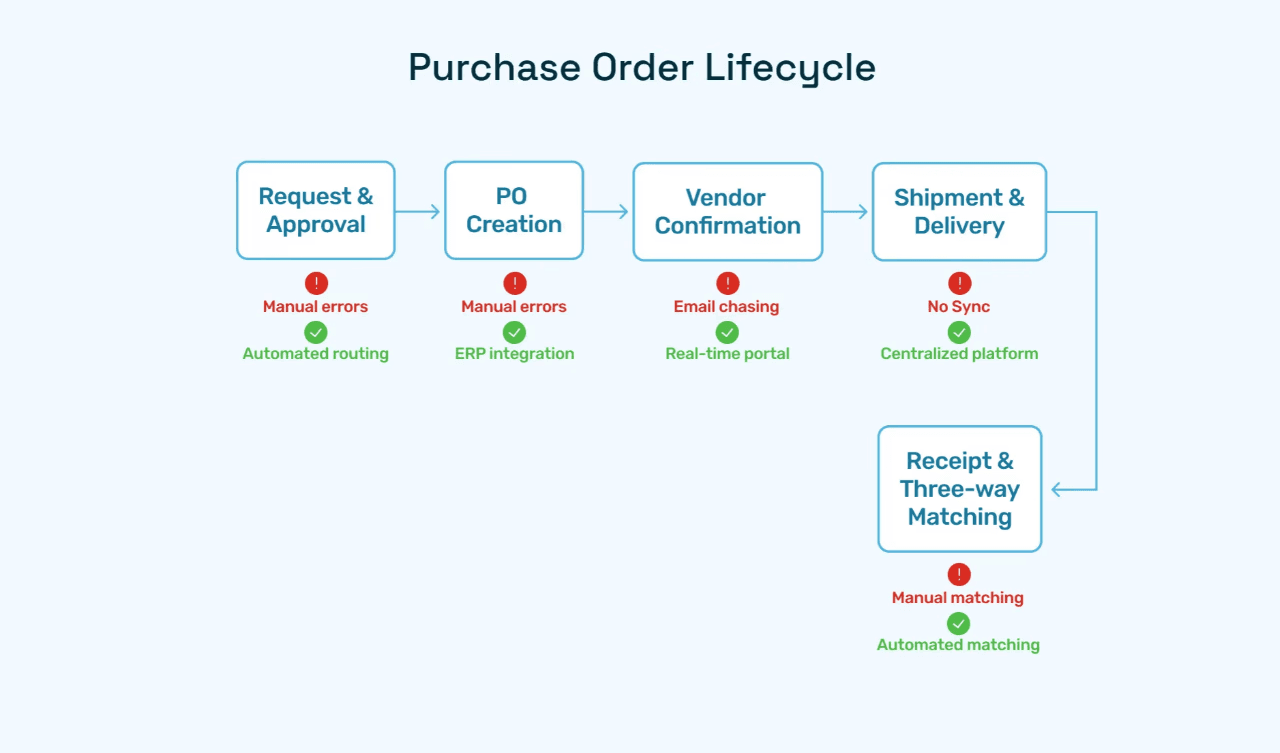
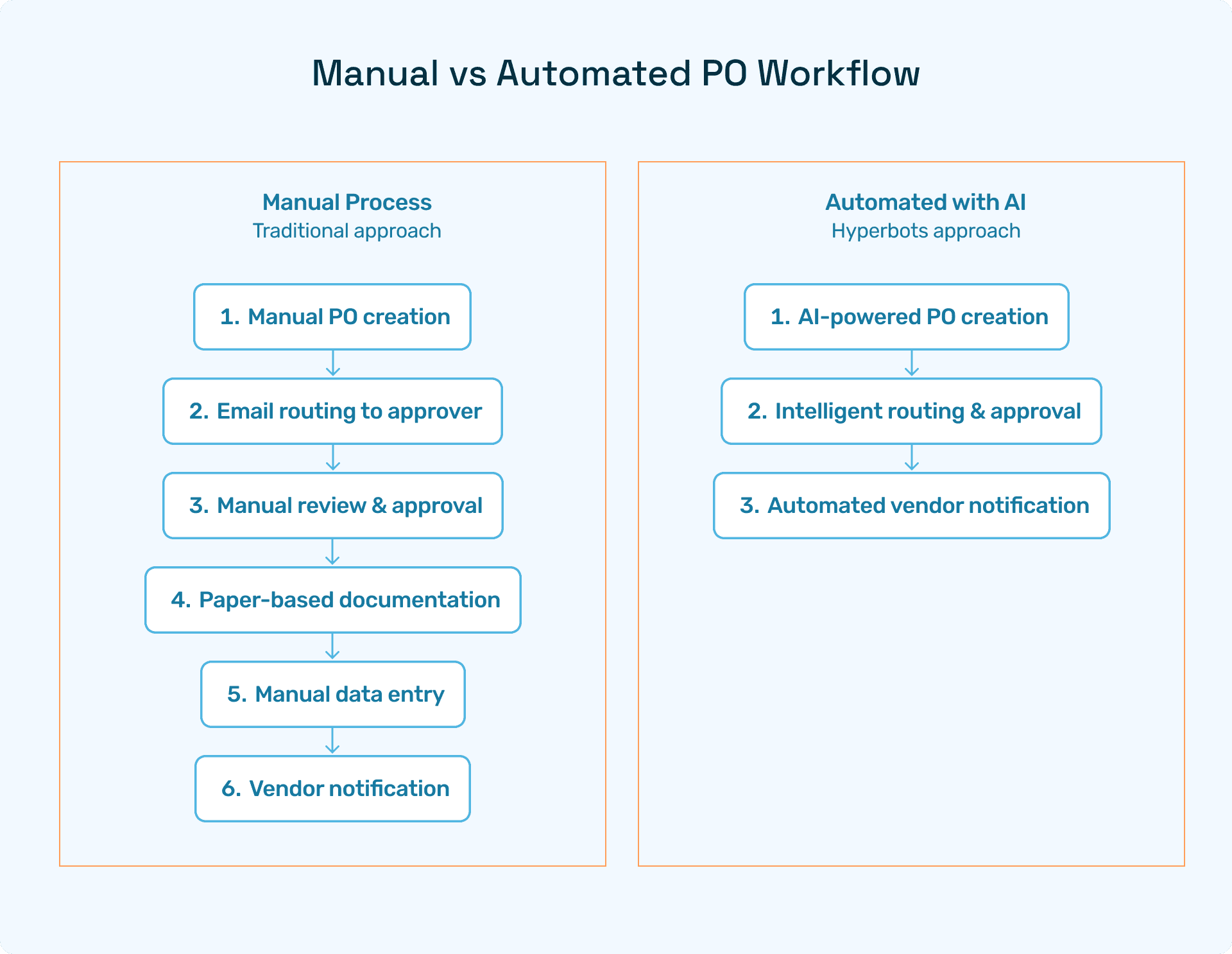
Manual purchase order processes are time-consuming, error-prone, and often create bottlenecks across finance and procurement teams. Modern automated purchase order programs and processing software address these challenges by reducing human intervention in repetitive, administrative tasks while improving accuracy and compliance.
Key capabilities include:
Auto-generation of POs from approved requisitions: Once a requisition is approved, the system automatically creates a purchase order with all necessary details, eliminating manual entry errors and speeding up the procurement cycle.
Three-way matching between PO, invoice, and receipt: Automated matching ensures that invoices are only approved if they align with both the purchase order and the received goods or services. This significantly reduces discrepancies and prevents overpayment or duplicate invoices.
Exception handling with AI-driven recommendations: For cases where mismatches or anomalies are detected, AI provides contextual suggestions for resolution, reducing manual investigation time and ensuring compliance with internal policies.
Policy enforcement by design: Pre-configured workflows ensure all POs adhere to approval thresholds, budget limits, and company compliance rules without relying on manual oversight.
Integration with ERP and finance systems: Seamless connectivity allows POs, invoices, and receipts to flow directly into accounting systems, ensuring real-time visibility into spend and accurate reporting.
Enhanced auditability: Automated record-keeping creates a persistent digital trail, simplifying audits and reducing regulatory risk.
By automating these processes, organizations can:
Reduce PO cycle times from days to hours
Minimize errors and duplicate entries
Maintain tighter control over budgets and approvals
Improve vendor relationships with faster, accurate payments
In essence, automated purchase order processing transforms procurement from a routine, labor-intensive task into a streamlined, strategic operation. Companies can focus on optimizing spend, maintaining compliance, and enabling finance teams to work smarter rather than harder.
Procurement Workflow Orchestration
A truly scalable purchase order (PO) management stack does more than digitize processes—it orchestrates them. Modern procurement workflow automation brings intelligence and structure to every stage, ensuring that approvals, compliance, and exceptions are handled seamlessly. By leveraging configurable workflows, organizations can achieve speed and efficiency without sacrificing control or oversight.
Key benefits of procurement workflow orchestration include:
Configurable Approval Chains: Approvals can be routed based on spend thresholds, project codes, or departmental hierarchies, ensuring only authorized personnel sign off on purchases.
Policy-Based Routing: Procurement policies are automatically enforced, reducing the risk of non-compliant orders slipping through.
AI-Powered Exception Handling: Intelligent algorithms flag unusual or high-risk POs, enabling proactive review and minimizing errors.
Automated Notifications: Stakeholders are kept informed in real-time, reducing delays caused by manual follow-ups.
ERP & Vendor Ecosystem Integration
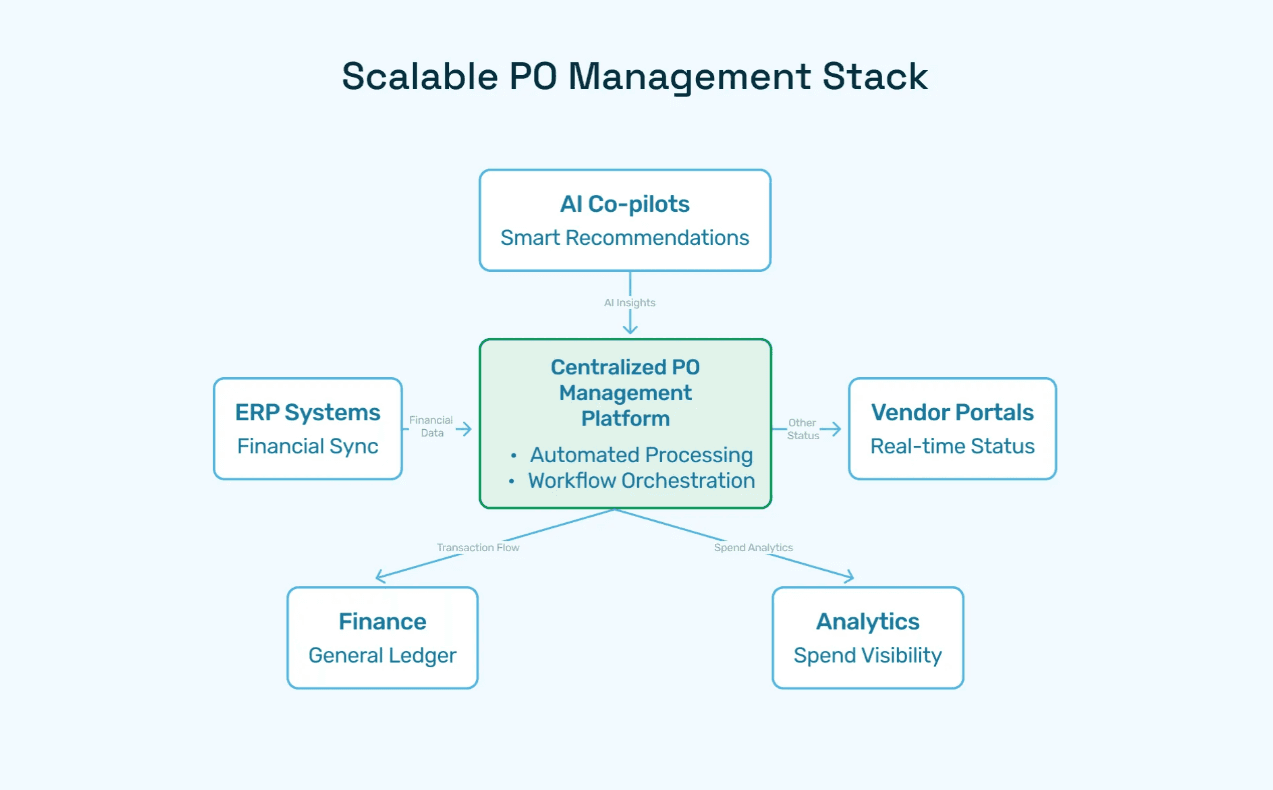
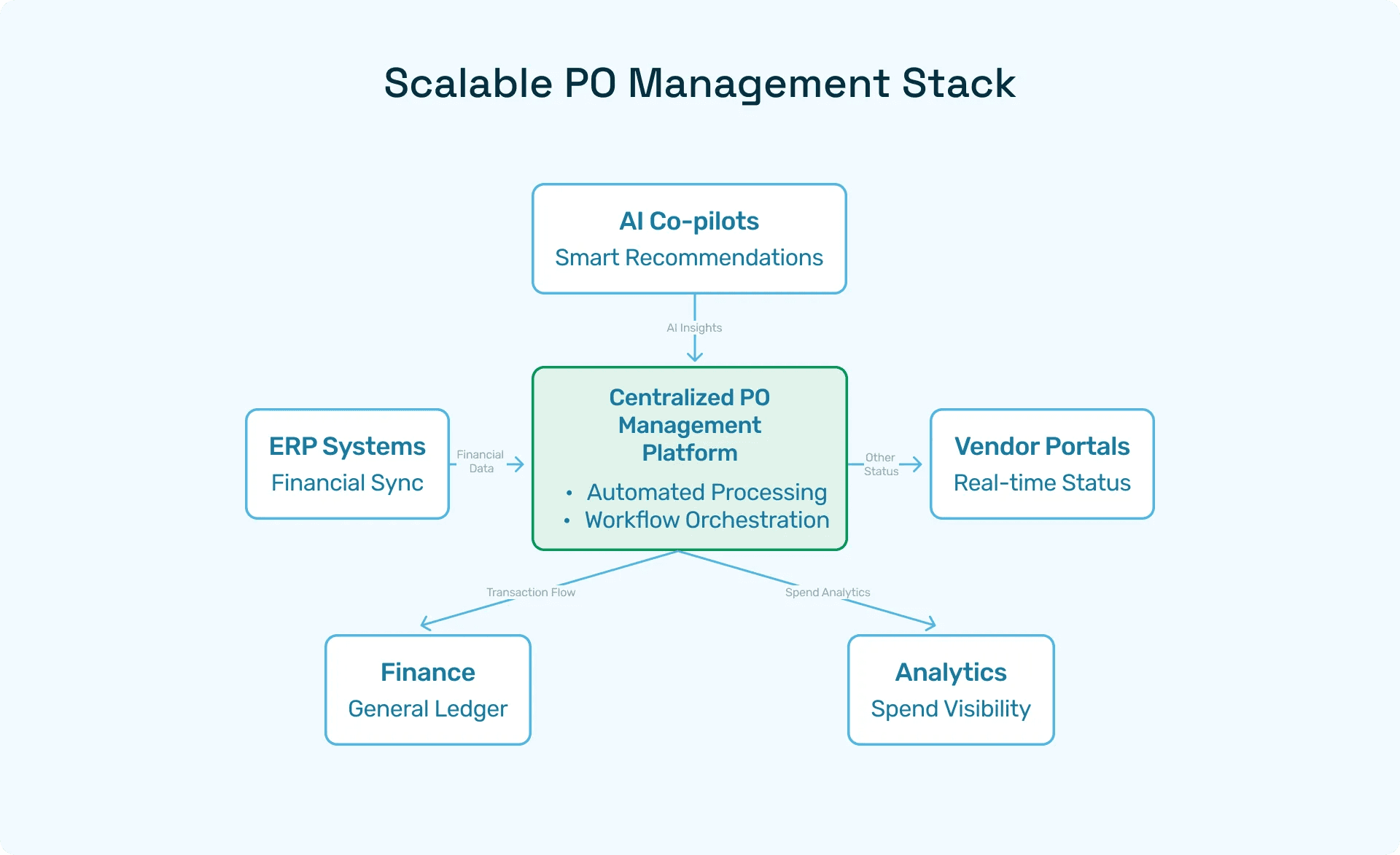
For procurement to scale effectively, integration across systems is essential. A connected PO stack ensures that financial, operational, and supplier data flows seamlessly across platforms, providing transparency and control. Key integration points include:
ERP Systems: Synchronize POs, approvals, and invoices directly with general ledgers for accurate, real-time financial tracking.
Vendor Portals: Suppliers can access POs, update delivery statuses, and submit invoices, reducing communication bottlenecks.
Analytics Platforms: Spend visibility dashboards provide finance teams with actionable insights for budgeting, forecasting, and decision-making.
By combining workflow orchestration with robust ERP and vendor integration, organizations build a scalable procurement backbone. This system grows with the business, handling increased transaction volumes, complex vendor networks, and multi-entity operations—all while maintaining compliance, speed, and visibility.
How to Design a Scalable PO Management Stack
Designing a scalable purchase order management stack requires a strategic approach that balances process efficiency, compliance, and flexibility. The goal is to create a framework that can grow with your organization, handle increasing transaction volumes, and adapt to evolving business needs.
Map Current Workflows
Begin by analyzing existing PO workflows end-to-end—from requisition submission to payment. Identify bottlenecks, redundant steps, and manual approvals. Understanding where errors or delays occur is essential for prioritizing automation and process redesign.
Standardize PO Policies
Clearly define approval thresholds, spend limits, and compliance rules across departments or projects. Standardization ensures consistency, reduces confusion, and makes it easier to implement automated controls.
Segment by Business Unit or Project Type
Different teams, projects, or regions may have unique requirements. For example, construction projects require project-specific budgets and multi-vendor coordination, while retail needs rapid SKU-level replenishment. Segmenting PO processes allows for tailored workflows without sacrificing overall governance.
Integrate Core Systems
A scalable stack should connect the purchase management platform with ERP, accounting, and vendor portals. Real-time integration prevents data silos, ensures accurate ledger postings, and provides finance leaders with instant visibility into spending.
Implement Tiered Automation
Automation doesn’t have to be all-or-nothing. Start by automating repetitive tasks such as PO creation, three-way matching, or invoice validation. Over time, introduce workflow orchestration and AI-driven exception handling to optimize approvals and reduce manual intervention.
Monitor and Optimize Continuously
A scalable stack is never static. Use dashboards and analytics to monitor cycle times, budget compliance, and supplier performance. Regular reviews allow procurement teams to fine-tune workflows, identify inefficiencies, and scale operations without increasing headcount.
Build Flexibility for Future Growth
Finally, ensure the stack supports new business models, acquisitions, or expanded supplier networks. Scalable PO management is about future-proofing operations while maintaining control, accuracy, and compliance across every transaction.
By following these steps, organizations can design a purchase order management stack that is both resilient and adaptable, supporting strategic procurement decisions while maintaining operational efficiency.
Hyperbots’ Differentiated AI Co-Pilots for PO Management
While many purchase management solutions provide basic digitization or partial automation, they often leave critical gaps in efficiency, accuracy, and control. Hyperbots takes procurement automation to the next level with agentic AI Co-pilots—autonomous, context-aware assistants that manage the end-to-end purchase order process, ensuring speed, compliance, and scalability.
Procurement Co-Pilot: Streamlining the Purchase Order Process
Hyperbots’ Procurement Co-pilot is designed to revolutionize how organizations handle purchase orders, making procurement faster, smarter, and fully compliant. By leveraging AI and automation, the Co-pilot reduces manual effort and accelerates the entire request-to-PO cycle, freeing finance and procurement teams to focus on higher-value tasks.
Key Benefits of Hyperbots’ Procurement Co-Pilot:
Instant ERP-Synced Approvals
Approval workflows are automated and integrated directly with your ERP system, ensuring that requisitions are processed instantly without delays. Multi-level approvals are enforced automatically, so every PO follows policy while staying on schedule.Real-Time Spend Visibility
Finance leaders gain instant insight into budgets, committed spend, and upcoming liabilities. This transparency helps prevent overspending, reduces the risk of duplicate or unauthorized purchases, and supports accurate financial forecasting.Automated Policy Enforcement
Every requisition is checked against compliance rules, approval thresholds, and internal policies. Exceptions are flagged automatically, reducing errors and ensuring that all POs are audit-ready.Reduced Manual Intervention
By automating routine tasks like requisition validation, data entry, and routing approvals, teams can focus on strategic procurement activities instead of repetitive paperwork.Enhanced Vendor Relationships
Faster, accurate POs mean suppliers receive orders on time, strengthening trust and long-term partnerships.Scalability for Growing Organizations
Whether handling dozens or thousands of POs, the Procurement Co-pilot scales effortlessly without adding headcount, ensuring efficiency even as procurement volumes grow.
Hyperbots’ Procurement Co-pilot transforms traditional purchase order management into a seamless, automated process. It ensures compliance, provides transparency, and accelerates procurement workflows—all while reducing manual effort and operational costs. For organizations looking to modernize procurement, the Co-pilot is a powerful tool to streamline operations and deliver measurable ROI.
How Hyperbots Stands Apart
Feature / Capability | Hyperbots | Stampli / Bill.com / SAP Concur / Tipalti |
|---|---|---|
Automation Approach | Agentic AI – learns context, adapts dynamically | Rules-based – rigid, predefined workflows |
Process Coverage | End-to-end: requisition → PO → invoice → payment | Partial coverage; often task-level only |
Cost Reduction | Up to 80% through automated validation & PO creation | Moderate; primarily reduces manual entry |
Real-Time Visibility | CFO dashboards for spend, compliance, cycle times | Limited; often requires manual consolidation |
Compliance & Audit Readiness | Automated policy enforcement, digital audit trails | Compliance features exist, but less integrated |
Scalability | Handles high volume, multi-entity, multi-project | Scales poorly beyond standard workflows |
Vendor & Multi-Entity Management | Integrated onboarding, monitoring, and approvals | Limited; often manual or semi-automated |
Strategic Value | Transforms procurement into a business enabler | Primarily operational; reduces administrative burden |
Conclusion
Procurement is no longer just a back-office function - it’s a critical lever for operational efficiency, financial control, and strategic decision-making. Legacy systems and manual PO processes slow teams down, introduce errors, and obscure visibility into spend.
A scalable, automated PO management stack changes that. By digitizing workflows, enforcing compliance, and integrating with ERP and vendor ecosystems, organizations gain real-time insights, faster approvals, and tighter control over budgets.
Hyperbots’ AI-powered Procurement Co-pilot takes this transformation further, handling end-to-end processes with intelligence and agility. From instant approvals to automated policy enforcement, it streamlines procurement, strengthens supplier relationships, and empowers finance teams to focus on strategy instead of paperwork.
With Hyperbots, managing purchase orders becomes seamless, scalable, and strategic - turning a once administrative task into a clear business advantage.
FAQs
Q1. What is purchase management software?
It is a centralized platform that manages the creation, approval, and tracking of purchase orders. It streamlines procurement and ensures compliance.
Q2. How is a purchase order program different from purchase order processing software?
A purchase order program is often a basic tool for creating POs, while purchase order processing software automates the entire cycle—creation, approval, matching, and integration with ERP.
Q3. What is procurement workflow automation?
It refers to using AI and automation to orchestrate purchasing approvals, routing, and compliance in a configurable manner.
Q4. Can Hyperbots integrate with my ERP system?
Yes. Hyperbots connects with leading ERPs (SAP, Oracle NetSuite, Microsoft Dynamics, and more) to deliver seamless synchronization.
Q5. What ROI can I expect from Hyperbots? Organizations typically achieve 50–80% cost reduction, faster cycle times, and stronger compliance within the first year of adoption.