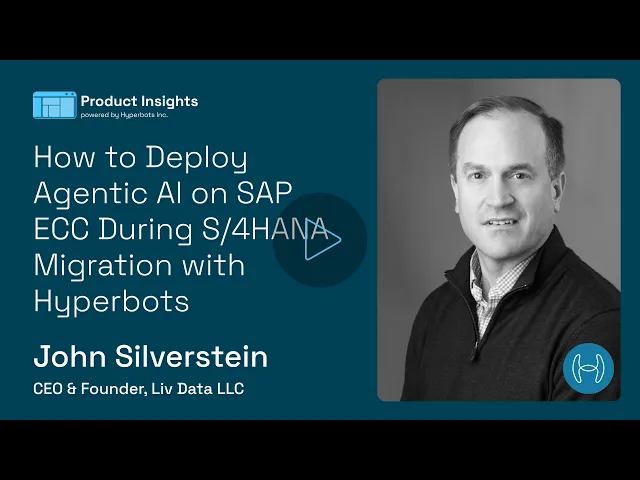
How to Deploy Agentic AI on SAP ECC During S/4HANA Migration with Hyperbots
A conversation with Hyperbots' John Silverstein on ECC integration, rollout timelines, security, workflow automation, and uninterrupted S/4HANA migration.
What makes Hyperbots AI co-pilots a practical add-on for SAP ECC?
Brad Boehmke: What makes Hyperbots AI co-pilots a practical add-on for SAP ECC?
John Silverstein: The Hyperbots add-on for SAP ECC can securely read and write every key object: company codes, vendors, materials, purchase orders, goods receipts, invoices, and any custom fields. ECC stays the system of record the whole time, so Hyperbots just works alongside it.
How long does a typical Hyperbots rollout take on ECC?
Brad Boehmke: How long does a typical Hyperbots rollout take on ECC?
John Silverstein: A typical ECC-only rollout takes six to eight weeks. The connector is already built, so most of that time goes into lining up internal approvals and test windows, not building integrations.
How often does Hyperbots sync data with ECC?
Brad Boehmke: How often does Hyperbots sync data with ECC, and what do you recommend?
John Silverstein: You can set the sync frequency for each object through the admin UI: real time, hourly, daily, or weekly. Journals and accruals usually need real-time sync. Company codes and chart of accounts change far less often, so daily or weekly sync is enough to keep them current.
How does each co-pilot automate an ECC task?
Brad Boehmke: How does each co-pilot automate an ECC task significantly?
John Silverstein: Each co-pilot is built around a specific finance workflow:
Invoice processing co-pilot: reads the PDF, matches it to the PO and goods receipt, auto-codes accounts and tax, then posts the supplier invoice. About 80% of invoices go straight through.
Accruals co-pilot: finds open POs with a receipt but no invoice, books the month-end accrual, and reverses it automatically once the invoice arrives, so the books stay current instead of waiting on month-end close.
PR/PO co-pilot: creates purchase requests from contracts, checks budget, routes approvals, and converts approved requests into purchase orders.
Vendor co-pilot: validates tax IDs and bank details up front.
Payment co-pilot: weighs early payment discounts against cost of capital, builds the payment proposal, generates bank files, and posts clearing entries, reconciling payments against bank statements automatically.
Sales tax co-pilot: checks ship-from and ship-to tax rules and confirms tax groups are set up correctly before posting, to catch tax mistakes before they happen.
How does Hyperbots handle exceptions or write failures back to ECC?
Brad Boehmke: How would you say Hyperbots handles exceptions or write failures back to ECC?
John Silverstein: Every write gets read back immediately to confirm the record. If there's a discrepancy, a closed period, or a missing code, Hyperbots triggers three automatic retries. If it still fails, the transaction drops into an integration exceptions queue and the finance team gets an alert. Nothing fails silently, so no one has to go digging through ECC to find a missed transaction.
What safeguards are in place for security, data integrity, and customization?
Brad Boehmke: What safeguards are in place for security, data integrity, and customization?
John Silverstein: The platform is SOC 2 Type II and ISO 27001 certified. Data is encrypted in motion and at rest, and access uses short-lived tokens tied to ECC roles instead of stored passwords. Custom and Z-fields are auto-discovered, so co-pilots read and write them the same way they handle standard fields. Multi-currency and parallel ledgers are fully supported, and a single dashboard shows the health of every company code.
How do co-pilots handle client-specific logic in heavily customized ECC systems?
Brad Boehmke: ECC systems are heavily customized, as we know. How do co-pilots handle client-specific logic?
John Silverstein: During onboarding, Hyperbots scans all the metadata, custom fields, and tables to build a mapping target. The AI works through historical postings to see how those fields get populated and how the workflow actually runs, then confirms the mapping is accurate. For bespoke posting rules, Hyperbots triggers them through standard user exits, so there are no core modifications inside ECC.
How do you guarantee that a transaction written to ECC actually succeeds?
Brad Boehmke: How do you guarantee that each transaction written to ECC actually succeeds?
John Silverstein: Right after posting, Hyperbots reads back every critical field: amount, currency, company code, and posting date. If everything matches, the transaction gets a posted checkbox. If not, the agent retries and escalates, and you get a failure code to work from.
What happens when you upgrade ECC or migrate to S/4HANA?
Brad Boehmke: And what happens when you upgrade ECC or migrate to S/4HANA, for example?
John Silverstein: During a migration, Hyperbots runs in dual-write mode, posting to both ledgers until the cutover is finalized. Upgrades follow the same pattern: co-pilots keep running without downtime while the new environment catches up, since both systems run in parallel.
How does Hyperbots handle on-premise integration with SAP ECC?
Brad Boehmke: How does Hyperbots handle on-premise integration with SAP ECC?
John Silverstein: For on-premise systems, we deploy a lightweight agent inside your DMZ. It opens a secure outbound HTTPS tunnel to Hyperbots, so there are no inbound firewall rules to manage, and the agent works through ECC's native APIs. Data stays encrypted and never leaves your control, which keeps the footprint minimal for infosec teams.
How is Hyperbots' agentic AI on ECC different from other AI add-ons?
Brad Boehmke: How is Hyperbots' agentic AI on ECC different from other AI add-ons you've seen?
John Silverstein: Most tools I've seen stop at scanning or handle just one piece of the workflow. They don't read and write across every field, or they map to fields you can't configure. Hyperbots is built as an agentic workflow: AI that acts. It raises purchase requests, books journals, reverses accruals, requests credit memos, reconciles payments, closes POs, and verifies tax. Our finance-trained models reach up to 99.8% accuracy, and we typically see around 80% productivity gains once a co-pilot is fully implemented. Most basic OCR and RPA tools only get to a 20 to 30% improvement. On top of that, Hyperbots keeps a tamper-proof audit trail covering more than 80% of use cases.
Brad Boehmke: Great conversation, John. Appreciate you walking through how Hyperbots and SAP ECC work together today. Looking forward to the next one.
John Silverstein: No problem. Thanks for having me, Brad.