Human Like Intelligent Systems in Procure to Pay
How intelligent, human-like systems are moving P2P from workflow automation to autonomous execution.
Human-Like Intelligent Systems in Procure-to-Pay: Redefining Finance Operations with AI
The evolution of artificial intelligence in finance has reached a pivotal moment. What began as basic automation, rules engines, OCR, and workflow digitization, has now matured into something far more transformative: human-like intelligent systems.
Nowhere is this transformation more visible than in Procure-to-Pay (P2P), a function historically burdened by manual processes, fragmented workflows, and operational inefficiencies.
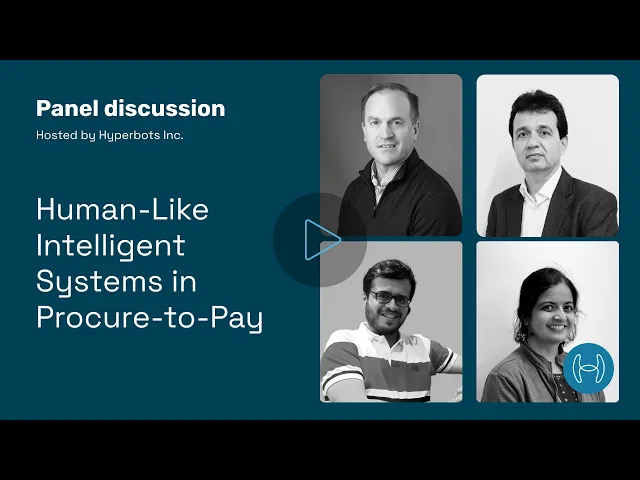
In a recent panel discussion on “Human-Like Intelligent Systems in Procure-to-Pay,” industry leaders, Mike Vaishnav (Strategic Advisor and CFO Consultant at MV Advisory Solutions), Niyati Chhaya (Co-Founder & VP AI at Hyperbots), and John Silverstein (Founder & CEO at Liv Data), shared a grounded, experience-driven perspective on how AI is reshaping finance operations.
What emerged was not just a conversation about technology, but a blueprint for how finance teams can transition from manual execution to intelligent orchestration.
The Procure-to-Pay Problem: Complexity at Scale
Procure-to-Pay is one of the most critical—and most complex—finance processes.
It spans multiple stages:
Vendor onboarding
Purchase requisitions and approvals
Purchase order creation
Invoice processing
Matching and validation
Payments and reconciliation
Each step involves different stakeholders, systems, and data formats. And despite decades of ERP investments, many organizations still rely heavily on:
Manual data entry
Email-based approvals
Spreadsheet tracking
Fragmented system integrations
As Mike Vaishnav pointed out during the discussion, finance teams often find themselves operating modern systems with outdated processes.
The result?
Delayed invoice cycles
Increased risk of errors
Limited visibility into liabilities
Overburdened finance teams
This is precisely where human-like intelligent systems come into play.
Moving Beyond Automation: What “Human-Like” Really Means
A central theme of the panel was the distinction between traditional automation and human-like intelligence.
Automation focuses on:
Replacing repetitive tasks
Following predefined rules
Executing structured workflows
But human-like systems go further. They:
Understand context
Interpret unstructured data
Learn from patterns
Make recommendations
Adapt over time
As Niyati Chhaya explained, the goal is not just to automate tasks, but to replicate how a skilled finance professional thinks and operates.
For example, consider invoice processing.
A traditional system might:
Extract invoice data using OCR
Match it against a purchase order
Flag discrepancies
A human-like system, on the other hand, can:
Interpret different invoice formats without templates
Understand vendor-specific nuances
Predict correct GL coding based on historical patterns
Identify anomalies in context, not just based on rules
Suggest resolutions for exceptions
This shift, from task execution to decision support, is what defines the next generation of P2P systems.
The Intelligence Stack: How These Systems Work
Human-like intelligent systems are not powered by a single technology. Instead, they combine multiple layers of intelligence:
1. Document Understanding
Modern AI models can process unstructured documents such as invoices, contracts, and emails.
They don’t just extract data—they understand relationships between data points, such as:
Line items and totals
Tax structures
Payment terms
This eliminates the need for rigid templates and manual intervention.
2. Contextual Reasoning
Finance decisions are rarely black and white.
For example:
Should an invoice be approved despite a minor mismatch?
Is a vendor charge typical or anomalous?
Does an expense align with policy?
Human-like systems use contextual reasoning to evaluate such scenarios, mimicking how a finance professional would assess them.
3. Recommendation Engines
Instead of requiring manual input, AI systems can recommend:
GL codes
Cost centers
Approval workflows
These recommendations improve over time as the system learns from user feedback and historical data.
4. Workflow Orchestration
AI doesn’t operate in isolation—it orchestrates end-to-end workflows.
This includes:
Routing approvals
Triggering notifications
Integrating with ERP systems
Managing exceptions
The result is a seamless, intelligent workflow rather than a fragmented process.
Real-World Impact: Efficiency, Accuracy, and Insight
The panelists emphasized that the value of human-like systems is not theoretical, it is measurable and immediate.
1. Efficiency Gains
By automating repetitive tasks and reducing manual intervention, organizations can:
Process invoices faster
Reduce cycle times
Handle higher volumes without increasing headcount
This is particularly valuable during peak periods such as month-end close.
2. Improved Accuracy
Manual processes are prone to errors such as duplicate entries, incorrect coding, missed discrepancies.
AI systems significantly reduce these risks by:
Validating data in real time
Cross-checking against multiple sources
Learning from past corrections
3. Enhanced Visibility
One of the most overlooked challenges in P2P is lack of visibility.
Finance leaders often struggle to answer basic questions:
What are our outstanding liabilities?
Where are approvals stuck?
Which vendors are causing delays?
Human-like systems provide real-time insights, enabling better decision-making.
4. Risk and Fraud Detection
AI systems can identify patterns that humans might miss, such as:
Duplicate invoices with slight variations
Unusual vendor behavior
Policy violations
As John Silverstein highlighted, this capability transforms P2P from a reactive function to a proactive control mechanism.
The Role of Trust: Why Adoption Requires a Mindset Shift
Despite the clear benefits, adopting AI in finance is not without challenges.
The biggest barrier? Trust.
Finance teams are inherently risk-averse. Accuracy, compliance, and control are non-negotiable.
As Mike Vaishnav noted, organizations cannot simply “flip a switch” and fully automate P2P processes.
Instead, successful adoption follows a phased approach:
1. Human-in-the-Loop
AI systems initially operate alongside humans, with:
Recommendations reviewed before execution
Exceptions handled manually
Continuous feedback loops
2. Gradual Autonomy
As confidence in the system grows:
More decisions are automated
Manual intervention decreases
AI handles a larger share of transactions
3. Full Integration
Eventually, AI becomes an integral part of the finance function, operating seamlessly within existing systems.
This phased approach ensures that organizations maintain control while building trust in AI capabilities.
Rethinking Roles: From Operators to Strategists
One of the most profound impacts of human-like systems is on the role of finance professionals.
Traditionally, P2P teams have been focused on:
Data entry
Transaction processing
Exception handling
With AI handling these tasks, finance teams can shift toward:
Analysis and insights
Vendor relationship management
Strategic decision-making
As Niyati Chhaya emphasized, the goal is not to replace humans, but to elevate their role within the organization.
Integration Matters: AI as an Overlay, Not a Replacement
A key concern for many organizations is whether adopting AI requires replacing existing systems.
The panel addressed this directly: it does not.
Modern AI platforms are designed to integrate with:
ERP systems (SAP, Oracle, NetSuite, etc.)
Procurement tools
Payment platforms
Communication systems
This means organizations can:
Retain their existing infrastructure
Add AI as an intelligence layer
Achieve transformation without disruption
Hyperbots, for example, operates as an overlay, enhancing existing workflows rather than replacing them.
Building the Business Case: Beyond Cost Savings
When evaluating AI adoption, organizations often focus on cost reduction.
While this is important, the panelists emphasized a broader perspective.
Tangible Benefits
Reduced processing costs
Lower error rates
Faster cycle times
Improved cash flow
Intangible Benefits
Better employee experience
Stronger compliance and controls
Increased agility
Enhanced decision-making
As John Silverstein noted, the real value of AI lies in enabling better decisions, not just faster processes.
Lessons for Finance Leaders
The discussion offered several practical takeaways for finance leaders considering AI adoption:
1. Start with High-Impact Areas
Focus on processes like invoice processing and approvals, where AI can deliver immediate value.
2. Prioritize Data Quality
AI systems are only as good as the data they learn from. Clean, structured data is essential.
3. Invest in Change Management
Adoption requires training, communication, and stakeholder alignment.
4. Measure Success Holistically
Look beyond cost savings to include efficiency, accuracy, and strategic impact.
5. Choose the Right Partner
Selecting a platform that combines intelligence, integration, and scalability is critical.
The Future of Procure-to-Pay
The future of P2P is not just automated, it is intelligent, adaptive, and human-like.
In this future:
Systems understand context, not just data
Decisions are augmented by AI, not replaced
Finance teams focus on strategy, not transactions
Human-like intelligent systems represent a fundamental shift in how finance operates.
They transform P2P from a cost center into a value driver, enabling organizations to operate with greater efficiency, accuracy, and insight.
Final Thoughts
The adoption of human-like intelligent systems in Procure-to-Pay marks a turning point for finance.
As the panel discussion made clear, the question is no longer whether AI will transform P2P but how quickly organizations will embrace it.
Leaders who act now have the opportunity to:
Eliminate operational bottlenecks
Strengthen financial controls
Empower their teams
Drive strategic impact
Platforms like Hyperbots are at the forefront of this transformation—bringing together AI, finance expertise, and seamless integration to redefine what’s possible in Procure-to-Pay.
For finance leaders, the path forward is clear: move beyond automation, embrace intelligence, and unlock the full potential of AI-driven finance.