Straight-Through Processing of Financial Documents
How AI is enabling true straight-through processing across financial documents and workflows.
Finance teams have long chased a deceptively simple goal: move financial documents from receipt to posting without friction, delay, or manual intervention. Today, that vision, known as Straight-Through Processing (STP), is no longer theoretical. It is becoming a practical, measurable advantage for organizations willing to embrace AI-driven automation.
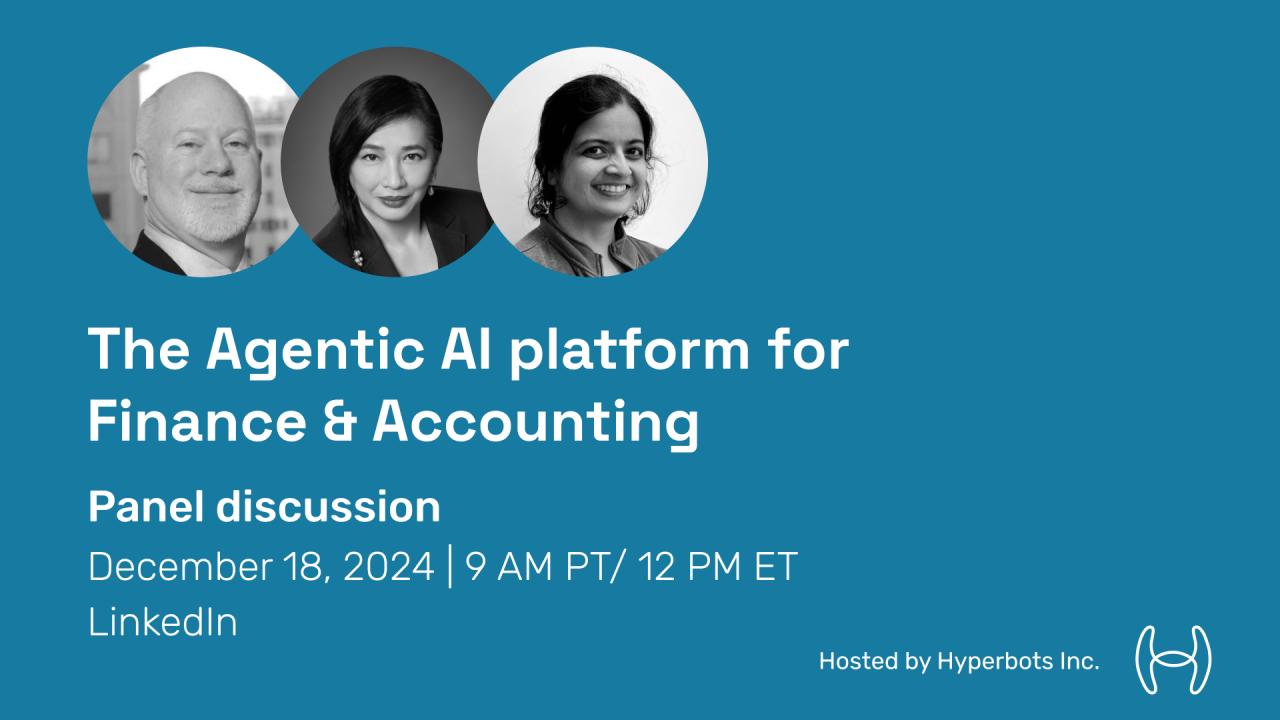
In a recent panel discussion on the Straight-Through Processing of Financial Documents, three seasoned experts explored this transformation in depth. Dave Sackett, VP of Finance at Persimmon Technologies, brings hands-on experience managing high-volume finance operations. Jon Naseath, CFO and Founder of Cantu Capital, combines financial leadership with a strategic lens shaped by AI innovation. Niyati Chhaya, Co-Founder and VP of AI at Hyperbots, leads the development of advanced AI systems designed to automate complex finance workflows.
Together, they unpacked not only what STP means today—but why it has become essential for modern finance teams and how AI platforms like Hyperbots are enabling its adoption at scale.
What Straight-Through Processing Really Means in Finance
At its core, STP is about eliminating manual touchpoints across financial workflows.
As Dave Sackett explains, STP refers to the ability to move financial documents such as invoices, expense reports, and receivables, through systems with minimal or no human intervention. The goal is not just automation, but end-to-end automation: from document ingestion to validation, coding, and posting.
This is a fundamental shift. Traditional finance operations rely heavily on human judgment for tasks like:
Data entry
Invoice validation
GL coding
Matching and approvals
STP challenges that paradigm by asking: What if these steps could happen automatically, accurately, and consistently?
Why STP Matters More Than Ever
A decade ago, fully automated finance workflows were aspirational. Today, they are becoming a competitive necessity.
Jon Naseath highlights a critical point: the idea of fully automated invoice processing once felt “almost imaginary.” But the explosion of AI capabilities, particularly in handling unstructured data has made it achievable.
The urgency is driven by three realities:
1. Explosion of Data Volume
Finance teams are overwhelmed by the sheer number of documents—AP invoices, receipts, contracts, emails. Manual processing simply doesn’t scale.
2. Talent Constraints
Organizations struggle to hire and retain people for repetitive, low-value tasks like invoice entry. Even when they do, accuracy and consistency remain challenges.
3. Demand for Real-Time Finance
Modern businesses require faster closes, real-time visibility, and predictive insights. Manual workflows cannot meet these expectations.
STP is no longer about efficiency alone—it is about keeping finance relevant in a real-time world.
The Core Challenges Blocking STP Adoption
Despite its promise, achieving true STP is not straightforward. The panel identified several persistent challenges:
Data Inconsistency and Unstructured Formats
Invoices arrive in countless formats, PDFs, scanned images, emails, spreadsheets. Extracting consistent, structured data from these sources is a major hurdle.
Organization-Specific Complexity
Every company has:
Unique chart of accounts
Custom GL coding rules
Different approval workflows
This lack of standardization makes automation difficult.
Matching and Validation Complexity
Processes like two-way and three-way matching involve multiple data sources (POs, receipts, invoices), often with discrepancies.
Compliance and Risk Considerations
Finance processes must adhere to strict controls, including audit trails, approvals, and regulatory requirements.
Human Dependency
Even today, many workflows rely on manual intervention—especially for exceptions, approvals, and judgment-based decisions.
Where AI Changes the Game
This is where AI and specifically platforms like Hyperbots—becomes transformative.
According to Niyati Chhaya, the problem of STP can be broken down into distinct components, each solvable with modern AI techniques:
1. Document Understanding
AI models can read and interpret unstructured documents, extracting:
Vendor details
Invoice numbers
Line items
Payment terms
This replaces manual data entry entirely.
2. Intelligent Classification
AI can identify:
Which emails contain invoices
Which documents are relevant
What type of financial document is being processed
3. Matching and Validation
AI-powered matching engines can:
Compare invoices against POs and receipts
Handle fuzzy matches (e.g., slight discrepancies)
Flag anomalies automatically
4. GL Coding Automation
One of the most complex tasks, assigning the correct GL code, can be automated using:
Historical data patterns
Machine learning models
Business rules
5. Exception Handling
AI doesn’t just automate the “happy path.” It also:
Detects anomalies
Flags inconsistencies
Initiates workflows for resolution
This is critical for achieving true straight-through processing, not just partial automation.
A Realistic View of End-to-End STP
A fully automated invoice workflow typically looks like this:
Invoice arrives via email or system
AI identifies and extracts invoice data
Document classification isolates relevant content
Validation checks confirm vendor and data accuracy
Matching engine compares with PO/GRN
GL coding model assigns appropriate accounts
Posting to ERP happens automatically
Exceptions (if any) are flagged for review
When all these steps happen without human intervention, STP is achieved.
Hyperbots focuses precisely on enabling this end-to-end orchestration, rather than solving isolated pieces.
The ROI of Straight-Through Processing
From a finance leader’s perspective, the benefits of STP are both tangible and intangible.
Tangible Benefits
1. Cost Savings
Organizations reduce reliance on manual labor. Dave Sackett shares a practical example: instead of hiring additional AP staff, automation handled increasing invoice volumes at a lower cost.
2. Time Efficiency
Processing cycles shrink dramatically from days to minutes.
3. Improved Accuracy
AI eliminates errors caused by fatigue and repetitive tasks.
4. Capture of Missed Opportunities
Automated systems can identify early payment discounts and optimize cash flow.
Intangible Benefits
1. Elevated Roles for Finance Teams
Instead of data entry, employees focus on:
Analysis
Strategy
Decision-making
2. Data Consistency and Reliability
Rule-based automation ensures uniform processing across all documents.
3. Better Audit Readiness
Structured, traceable data improves compliance and audit outcomes.
4. Enhanced Employee Satisfaction
Removing repetitive work improves morale and retention.
STP and Compliance: A Hidden Advantage
One of the most overlooked benefits of STP is its impact on compliance and risk management.
AI systems can perform “unlimited matching” cross-checking data across multiple sources, including:
ERP systems
Emails
Historical records
This improves:
Fraud detection
Error identification
Transparency
As Jon Naseath notes, while humans can be tricked (e.g., subtle invoice manipulations), systems can detect anomalies consistently.
The Human Factor: The Real Barrier to Adoption
Interestingly, the biggest challenge in STP adoption is not technology—it’s people.
Both Dave and Jon emphasize the importance of change management.
Common concerns include:
Fear of job loss
Resistance to new systems
Preference for familiar workflows
Successful implementations reposition STP as:
A productivity enhancer
A tool for career growth
A way to eliminate tedious work
Organizations that fail to address this human dimension often struggle, regardless of how advanced their technology is.
Risks and Realities of AI-Driven STP
While promising, AI-driven STP is not without risks.
1. Incomplete Training
AI systems are only as good as the data and rules they learn from. Missing business logic can lead to errors.
2. Lack of Transparency
“Black box” AI systems can create trust issues. Finance leaders need visibility into decisions.
3. Adoption Challenges
Without user buy-in, even the best systems fail.
4. Data Security Concerns
Handling sensitive financial data requires:
Strong encryption
Data anonymization
Compliance with regulations like GDPR
Hyperbots and similar platforms address these through:
Secure architectures
Controlled data usage
Transparent audit trails
The Role of Hyperbots in Driving STP
Hyperbots is positioned at the forefront of this transformation by focusing on:
AI-native finance automation, not bolt-on solutions
End-to-end workflows, not isolated tools
Agent-based architectures that codify business rules
Continuous learning systems that improve over time
Rather than simply digitizing processes, Hyperbots aims to redefine how finance operates, turning reactive workflows into proactive, intelligent systems.
Practical Advice for CFOs
For finance leaders considering STP adoption, the panel offers clear guidance:
1. Start with Process Mapping
Identify bottlenecks in current workflows before introducing automation.
2. Focus on High-Impact Areas
Common starting points:
Accounts Payable
Cash flow forecasting
Expense management
3. Prioritize Change Management
Ensure teams understand the benefits and are trained to work with new systems.
4. Adopt a Phased Approach
Run automated and manual processes in parallel initially to identify gaps.
5. Choose the Right Partner
Select platforms that offer:
Transparency
Flexibility
Strong integration capabilities
The Future of Finance is Straight-Through
Straight-through processing represents more than just automation, it is a redefinition of finance operations.
As AI continues to evolve, the gap between manual and automated organizations will widen. Companies that embrace STP will benefit from:
Faster decision-making
Lower operational costs
Greater accuracy
More strategic finance teams
Those that don’t risk being left behind.
The message from the panel is clear: STP is not optional anymore. It is foundational.
And with AI-driven platforms like Hyperbots leading the way, achieving it is no longer a distant goal, it is an actionable reality today.