
The Agentic AI platform for Finance & Accounting
How agentic AI platforms are transforming finance from workflow automation to autonomous execution.
Finance and accounting have long been considered among the most data-intensive functions in any organization and also among the most burdened by manual, repetitive work. From invoice processing and expense management to cash flow forecasting and financial reporting, the Office of Finance has historically operated in a world where bright, capable professionals spend the vast majority of their time not on strategy, but on data acquisition, verification, and reconciliation.
That’s beginning to change and the catalyst is agentic AI.
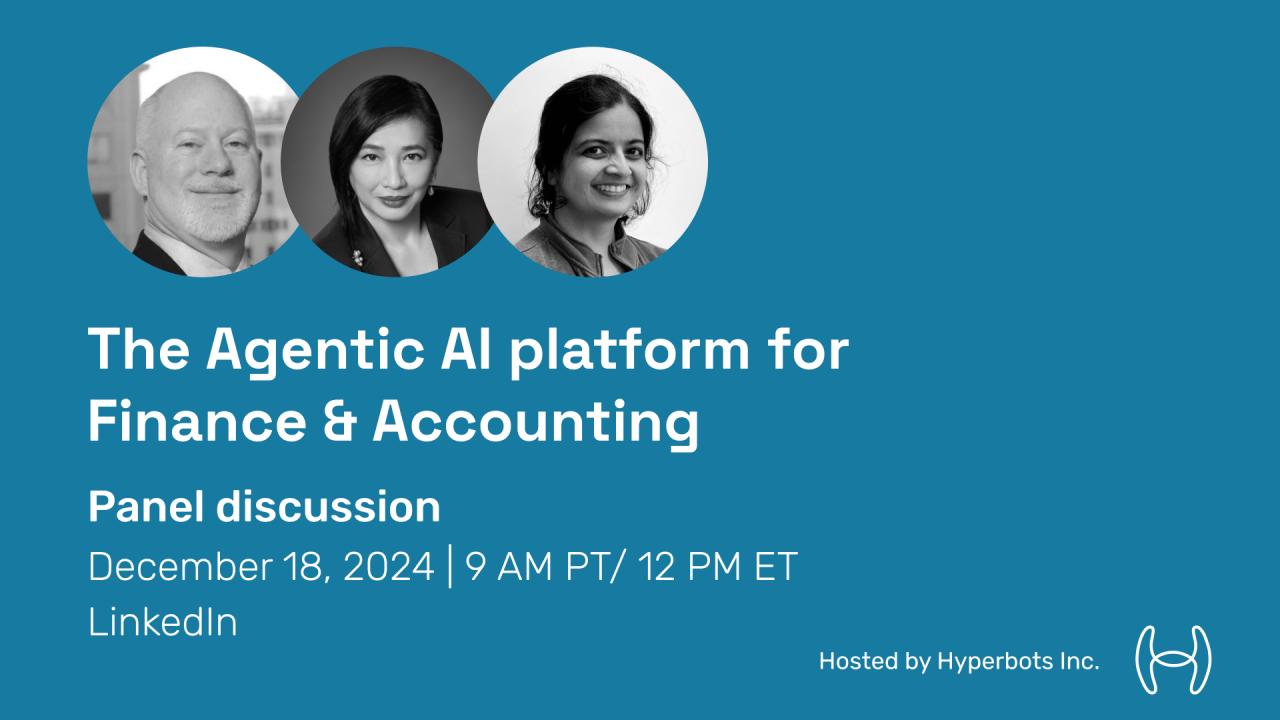
We recently hosted a panel discussion bringing together Brian Kalish, a Financial Planning & Analysis leader with over 30 years of experience helping organizations improve decision-making through technology and analytics; Lin Chan, an entrepreneurial CFO with deep expertise in scaling VC and PE-backed companies through complex financings, M&A, and operational transformation; and Niyati Chhaya, co-founder and VP of AI at Hyperbots, with a PhD in machine learning and a track record of over 40 patents and 50 publications from her time at Adobe.
Together, they explored how agentic AI is transforming finance and accounting, from the ground-level mechanics of accounts payable to the strategic heights of predictive analytics and real-time decision-making.
Here’s what they had to say.
We're at an Inflection Point
Brian opened the discussion with a point that framed the entire conversation: we are no longer debating whether AI is a passing trend.
"We've gotten to the point where it's no longer a question of whether this is going to be a fad," he said. "We're beginning to see more and more uptake." Since the mainstream introduction of large language models roughly two years ago, adoption among finance professionals has accelerated meaningfully and the reasons are structural, not just technological.
For decades, the challenge in finance hasn't been a lack of talent. It's been a lack of the right tools. CFOs have complained since the early 1990s that their teams spend upwards of 80% of their time on data acquisition, verification, and reconciliation, leaving only 20% for the high-value analytical work that actually drives decisions. Remarkably, in recent years, that ratio had actually gotten worse, creeping toward 85% in some organizations.
The irony? It's partly a consequence of success. Data is now effectively immediate, free, and unlimited. But volume without intelligence creates its own paralysis. "You just can't keep throwing people at a problem when you're talking about data at 10 to the 27th power," Brian noted.
Agentic AI represents the most credible answer yet to this decades-old problem.
What Is Agentic AI and Why Does It Matter for Finance?
Unlike traditional automation tools that execute fixed rules, agentic AI systems can reason, plan, and act autonomously across multi-step workflows. In finance, this distinction is critical. The work of an accounts payable team, for instance, is rarely linear, it involves judgment calls, exception handling, cross-referencing multiple data sources, and communicating across departments. Agentic AI can handle this complexity in ways that earlier robotic process automation simply could not.
Niyati, drawing on her deep background in machine learning and NLP, highlighted that the sophistication of today's models, particularly their ability to understand context, interpret unstructured data, and interact with existing systems, makes them genuinely suited to the nuanced demands of financial operations. This isn't pattern-matching on steroids. It's a new class of intelligence capable of adapting to the specific workflows, compliance requirements, and decision thresholds of individual organizations.
The result is a fundamental shift: from finance teams as data processors to finance teams as strategic advisors, with AI handling the cognitive load of routine work.
Real-World Use Cases: Where Agentic AI Is Already Making an Impact
The panel grounded the conversation in concrete examples because the promise of AI in finance is only as meaningful as its practical application.
Automated Payment Authorization in Construction
Brian described a construction company he works with that has deployed AI for payment authorization. When an invoice is submitted, the system automatically cross-checks it against delivery records and purchase agreements. Payment is only authorized when all criteria are met. The outcome: dramatically improved accuracy, zero duplicate payments, and stronger vendor relationships built on consistent, reliable transactions.
This is a workflow that would traditionally require a human reviewer to manually pull records, compare line items, and make a judgment call. Agentic AI performs this in seconds, at scale, without fatigue.
Threshold-Based Invoice Routing in Energy
The second example came from an energy company using AI to route invoices based on predefined approval thresholds. Invoices exceeding a certain dollar amount are automatically escalated to senior management, while routine invoices are processed without interruption. This eliminates the errors that creep into manual assignment, accelerates processing time, and ensures every transaction is handled in compliance with company policy.
What's significant here isn't just efficiency, it's governance. In regulated industries, having an auditable, rules-consistent process is as important as speed.
Accounts Payable and Receivable at Scale
More broadly, AI is transforming how organizations manage their working capital, the lifeblood of any business. Brian put it plainly: "Managing a business without understanding working capital is like attempting to navigate a maze blindfolded." AI enhances this by automating routine AP and AR tasks, reducing manual effort, minimizing errors, and accelerating the entire cash cycle. The downstream impact is better cash flow visibility, faster decision-making, and more reliable forecasting.
The Analytical Frontier: Predictive, Prescriptive, and Cognitive Intelligence
If the operational use cases represent the present, the analytical capabilities of agentic AI represent the near future and it's a compelling one.
Brian outlined three tiers of analytical value that AI unlocks for FP&A:
1. Predictive Analytics Traditional FP&A relies on historical data to understand what happened and to project what might happen next, using largely static models. AI changes this by building predictive models that not only learn from historical patterns but also adapt to new trends in real time. The forecast is no longer a quarterly exercise, it's a living model that updates as conditions change.
2. Prescriptive Analytics Beyond predicting outcomes, prescriptive AI recommends actions. Rather than simply flagging that cash flow is likely to tighten in Q3, a prescriptive system might suggest specific interventions, accelerating collections on particular accounts, renegotiating payment terms with vendors, or adjusting inventory levels. This is the difference between intelligence that informs and intelligence that advises.
3. Enhanced Forecast Accuracy Forecast accuracy has always been the holy grail of FP&A and one of its most persistent frustrations. By incorporating a broader range of inputs, including external market signals, operational data, and real-time financial feeds, AI-powered forecasting significantly narrows the gap between projection and reality. The implication for business planning, budgeting, and investor communications is substantial.
The eventual destination, Brian suggested, is cognitive analytics, systems capable of not just predicting and prescribing, but reasoning and learning in ways that mirror human strategic judgment.
The Human Question: Augmentation, Not Replacement
No conversation about AI in finance would be complete without addressing the question that sits in the back of every finance professional's mind: what does this mean for my job?
Brian's answer was direct, and it reflects a perspective increasingly shared across the industry: "AI is not going to replace people. People that use AI are going to replace people that don't use AI."
The vision isn't a finance department of one, running automated systems from a laptop. It's a finance team that has been liberated from low-value work and empowered to do the high-value work it was hired to do, strategic analysis, business partnering, scenario planning, and decision support. As Brian framed it: "If we're bogged down in manual tasks, we're putting low-IQ activities on the plate of high-IQ people."
The optimal model is a genuine partnership between human and machine, each doing what they do best. The human brings judgment, context, relationship intelligence, and ethical reasoning. The AI brings speed, consistency, scale, and the ability to process data at volumes no human team could match. Together, the result is a finance function that's both more efficient and more strategically impactful.
Niyati echoed this, noting that the design of effective agentic AI systems requires deep attention to how humans and AI collaborate, ensuring that automation enhances human oversight rather than obscuring it, and that the systems are built with the trust and transparency that finance, as a compliance-sensitive function, demands.
Implementing Agentic AI: A Practical Roadmap
For organizations looking to move from curiosity to deployment, the panel offered a pragmatic framing. Implementation isn't a single transformation, it's a phased journey.
The short-term wins lie in automating high-volume, rule-based processes: invoice processing, payment routing, expense categorization, reconciliation. These deliver immediate ROI and build the organizational confidence needed to go deeper.
The medium-term opportunity is in analytics: deploying predictive models that improve forecast accuracy, surfacing anomalies before they become problems, and enabling real-time financial visibility across the business.
The long-term vision is a fully integrated, adaptive finance function, one where AI handles the operational layer autonomously, surfaces strategic insights proactively, and frees finance leaders to focus on the questions that matter most to the business.
What makes agentic AI particularly well-suited to this journey is its ability to integrate with existing ERP systems and financial infrastructure, rather than requiring a wholesale replacement. This lowers the barrier to adoption and allows organizations to layer intelligence onto workflows they already trust.
The Moment Is Now
What came through clearly from the panel is that the window of competitive advantage is open but it won't stay open forever. Organizations that move thoughtfully and deliberately to adopt agentic AI in finance will build capabilities that are difficult to replicate. Those that wait risk falling further behind, not just in efficiency, but in the quality of the decisions they're able to make.
The technology is ready. The use cases are proven. The only remaining variable is organizational will.
As Brian put it: the one thing finance professionals cannot create on their own is time. Agentic AI gives some of it back and what you do with that time is where the real opportunity lies.