Measuring ROI in Procurement Automation with Procurement Efficiency Software
Unlock efficiency. Prove ROI. Transform procurement.
Executive Summary
Procurement is no longer just an operational function — it is a critical lever for financial performance. Yet, many finance leaders still struggle with measuring the true impact of automation initiatives. Without clear ROI benchmarks, investments in procurement tools risk being undervalued.
That’s where procurement efficiency software makes a measurable difference. By automating purchase order (PO) creation, approvals, and compliance checks, organizations can shrink costs, accelerate cycle times, and unlock new levels of visibility. However, to capture value, CFOs and procurement leaders must focus on the right performance indicators and frameworks.
This article explains how to measure ROI in procurement automation by:
Defining PO automation KPIs that matter most to finance teams.
Outlining methods to calculate the ROI of procurement software.
Sharing best practices for maximizing automation impact.
Highlighting how Hyperbots AI Co-Pilots uniquely reduce costs while delivering real-time spend intelligence.
By the end, you’ll have a roadmap to quantify ROI and position procurement as a strategic driver of financial efficiency.
Why ROI Measurement Matters in Procurement Automation
Automation is often pitched as a “silver bullet,” but without rigorous measurement, it risks being perceived as just another tech expense. For CFOs, the ability to tie procurement automation to quantifiable ROI is critical to justifying investment and scaling adoption.
Manual procurement processes remain costly. According to Deloitte’s Global CPO Survey (2025), over 70% of procurement leaders cite cost containment and risk reduction as their top priorities. Yet, organizations relying on manual POs face:
High per-PO processing costs (between $506–$527 per APQC benchmarks).
Extended cycle times, averaging 7–10 days from requisition to PO approval.
Elevated error rates, ranging from 3–5% in manual entries.
By contrast, procurement efficiency software provides the ability to:
Cut per-PO costs by automating data entry, validation, and approvals.
Compress cycle times to under 24 hours.
Eliminate compliance risks with policy-embedded workflows.
Beyond cost savings, measuring ROI strengthens alignment with the finance function. It demonstrates how procurement contributes directly to EBITDA, working capital, and audit readiness. In essence, ROI measurement shifts procurement automation from a back-office efficiency project into a board-level value driver.
Understanding Procurement Efficiency Software
Procurement efficiency software is purpose-built to streamline procure-to-pay (P2P) workflows, unlike ERP modules that offer only generic procurement features. It focuses specifically on purchase requisitions, PO generation, compliance, and supplier engagement - all areas ripe for automation.
Key characteristics include:
Automated PO Creation: Transforms approved requisitions into purchase orders without manual entry.
ERP-Synced Approvals: Ensures all requests follow existing financial controls.
Policy-Embedded Compliance: Reduces risk by automatically validating approvals against spend thresholds.
Real-Time Dashboards: Gives finance leaders visibility into spending by category, department, or supplier.
Hyperbots’ Procurement Co-Pilot exemplifies this category. Built specifically for CFOs, it shrinks cycle times from days to minutes, integrates directly with ERP systems, and provides end-to-end spend visibility.
For finance leaders, procurement efficiency software means more than digitization — it’s about ensuring that every purchase order aligns with compliance requirements, reduces cost exposure, and accelerates financial decision-making.
Calculating the ROI of Procurement Software
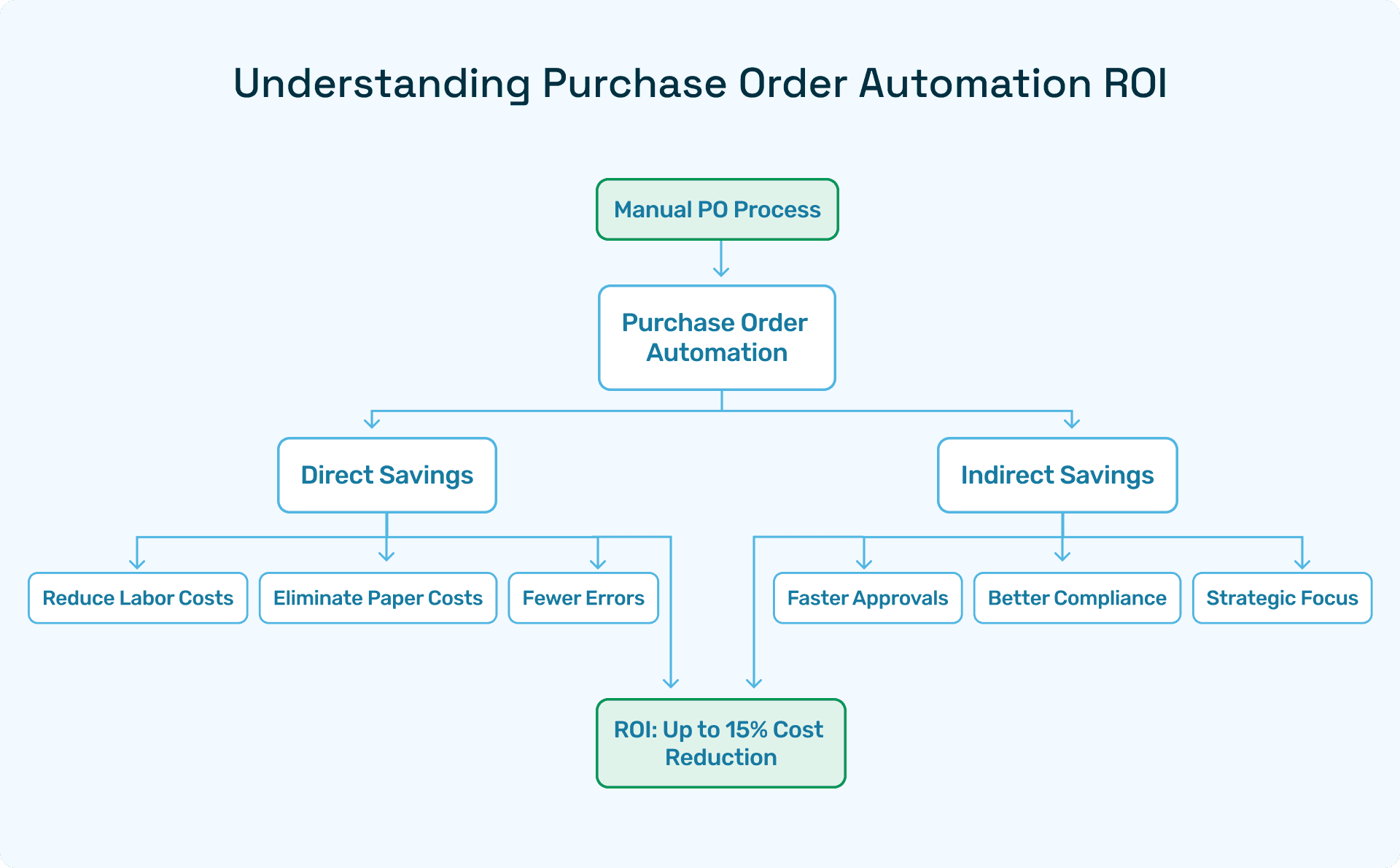
The ROI of procurement software must include both tangible and intangible benefits.
Tangible Benefits
Direct Labor Savings: Automation reduces hours spent on manual PO creation.
Error Elimination: Fewer invoice disputes and rework.
Cycle Time Compression: Faster procurement translates into operational efficiency and reduced opportunity cost.
Intangible Benefits
Audit Readiness: Automated approval trails reduce compliance risks.
Supplier Collaboration: Faster processing builds stronger relationships.
Employee Morale: Finance teams can focus on analysis, not data entry.
ROI Formula:
ROI = (Annual Savings – Annual Software Cost) / Annual Software Cost × 100
According to Gartner’s procurement digitization report, firms adopting automation achieve ROI within 12 months when PO volumes exceed 5,000 annually.
Industry Best Practices for Maximizing ROI
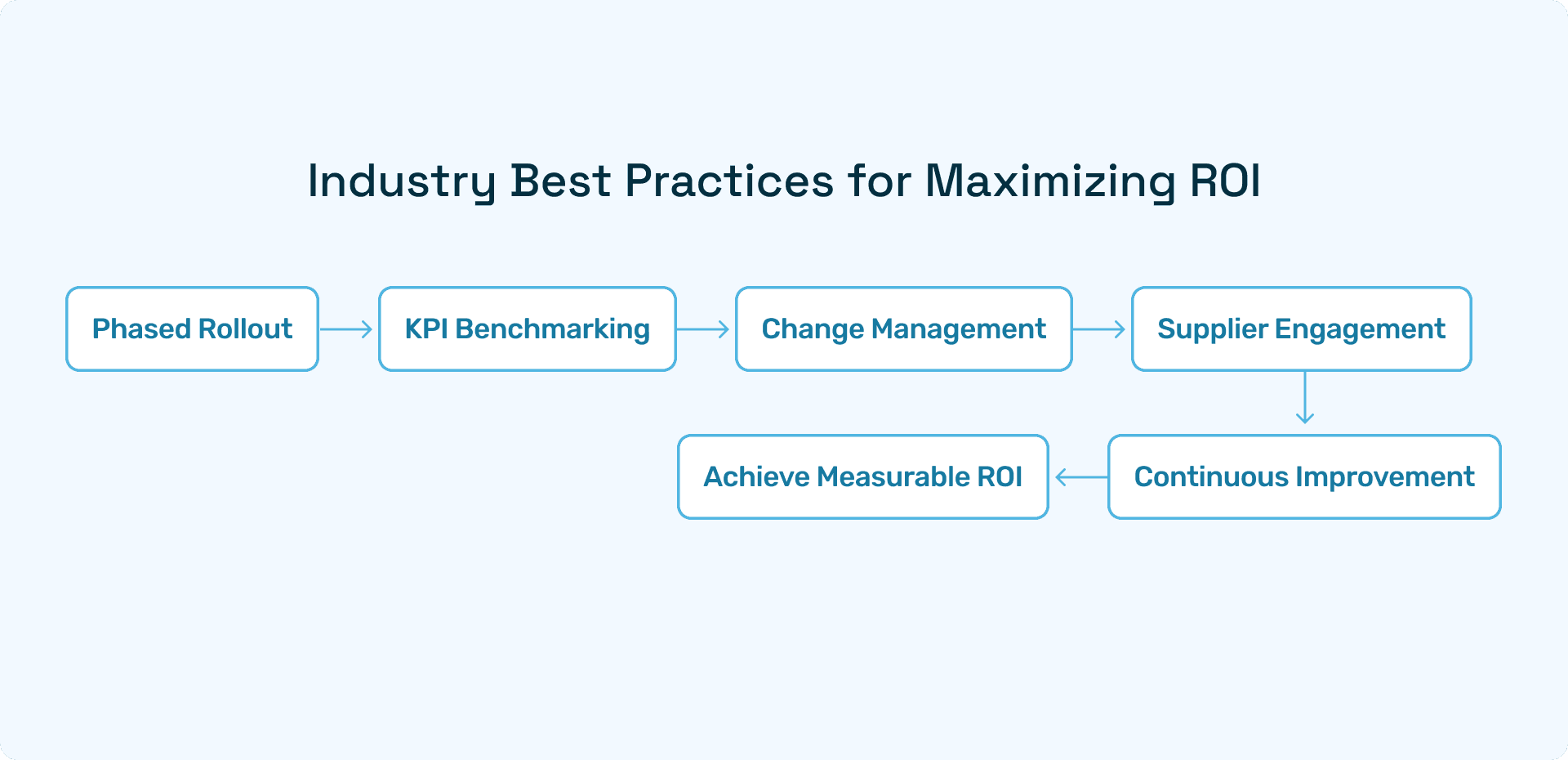
Maximizing ROI from procurement efficiency software requires deliberate planning and execution. Best practices include:
Phased Rollout: Start with a single category (e.g., IT purchases) before scaling.
KPI Benchmarking: Measure baseline cycle time and cost per PO before automation.
Change Management: Train staff on new workflows and emphasize strategic value.
Supplier Engagement: Communicate automation benefits to vendors to ensure adoption.
Continuous Improvement: Use KPI dashboards to monitor, iterate, and improve.
A mid-market healthcare company adopting Hyperbots, for example, piloted automation in clinical supplies procurement. Within three months, cycle times dropped from nine days to less than one, creating immediate savings and driving broader rollout across departments.
This case-style approach demonstrates how ROI is not just theoretical but actionable when best practices are applied consistently.
Hyperbots’ Differentiation in Procurement Automation
Hyperbots stands apart in a crowded procurement automation market by being designed by CFOs, for CFOs. Unlike legacy procure-to-pay players, Hyperbots offers:
ERP-Native AI Co-Pilots: Seamless integration ensures approvals are instantly reflected in finance systems.
End-to-End Automation: Covers procurement, vendor management, and invoice processing.
Real-Time Visibility: CFOs see spend patterns instantly across categories and suppliers.
Key Hyperbots Co-Pilots include:
Procurement Co-Pilot: Automates requisition-to-PO workflows.
Invoice Processing Co-Pilot: Validates and posts invoices in under a minute.
Vendor Management Co-Pilot: Automates supplier onboarding and compliance.
With these Co-Pilots, finance leaders get not just automation but procurement intelligence - AI agents that ensure compliance, optimize cycle times, and reduce costs without manual intervention.
Building Finance Efficiency for the Future
Procurement automation is no longer a back-office upgrade, it’s the foundation of finance efficiency. By adopting procurement efficiency software, CFOs gain measurable ROI, minimize compliance risks, and empower teams to focus on strategy.
Hyperbots offers the most comprehensive AI Co-Pilots designed for finance. From procurement to vendor management, Hyperbots delivers unmatched ROI by shrinking costs and accelerating processes.
➡️ Explore the Procurement Co-Pilot.
FAQs on ROI of Procurement Automation
Q1: How fast can ROI be achieved?
A: Most organizations realize ROI within 6–9 months; Hyperbots customers often achieve it faster.
Q2: Do we need to replace our ERP?
A: No. Hyperbots integrates directly with existing ERP systems.
Q3: What if we have complex approval workflows?
A: Hyperbots’ AI logic handles multi-layered approvals automatically.
Q4: Is procurement automation only for large enterprises?
A: No. Mid-market firms processing 1,000–2,000 POs annually also see significant ROI.
Q5: How secure is procurement automation?
A: Hyperbots employs enterprise-grade data security aligned with finance industry standards.
Q6: Which KPIs should we track first?
A: Cycle time, cost per PO, and compliance rates provide the clearest ROI signals.
Q7: Can Hyperbots automate beyond procurement?
A: Yes. Supporting Co-Pilots cover invoice processing and vendor management for full procure-to-pay coverage.