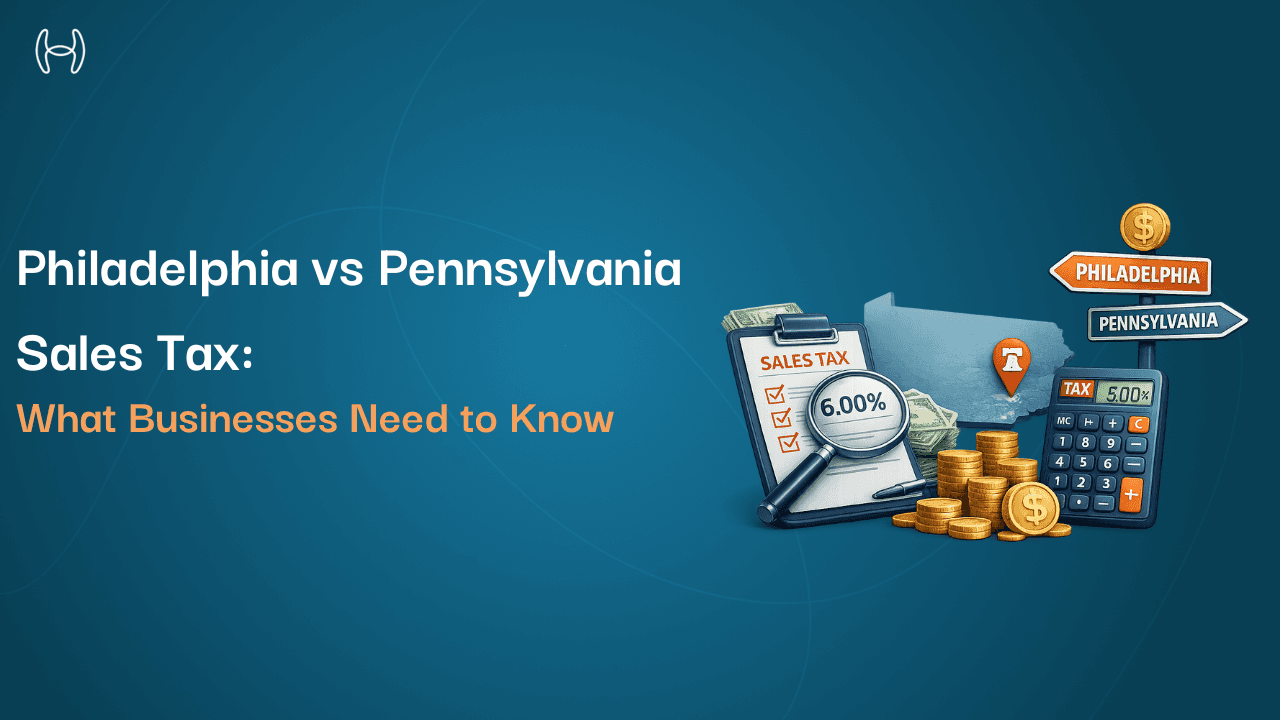
Philadelphia vs Pennsylvania Sales Tax: What Businesses Need to Know
A practical guide to Pennsylvania’s 6%, 7%, and 8% sales tax rules, including local surcharges, product exemptions, sourcing rules, and compliance risks for multi-location businesses.
If your business operates in Pennsylvania, or sells to customers there, sales tax is not as simple as applying one rate to every transaction. Pennsylvania has a 6% statewide rate, but two of its jurisdictions levy additional local taxes on top of that, and the difference matters significantly depending on where your customers are located.
Getting this wrong is not a minor inconvenience. Applying the wrong rate to transactions in Philadelphia or Allegheny County means you are either undercollecting tax you owe to the state, or overcharging customers and creating a refund liability. Both create compliance exposure.
This blog is for business owners, finance teams, AP managers, and anyone responsible for sales tax compliance in Pennsylvania. It explains exactly how Pennsylvania's rate structure works, what makes Philadelphia and Pittsburgh different from the rest of the state, what exemptions apply, and how multi-location businesses manage jurisdiction-level accuracy without manual errors. For a complete overview of Pennsylvania's sales tax system including filing requirements, vendor licences, and exemption certificates, the Pennsylvania sales tax compliance guide covers everything in one place.
How Pennsylvania Sales Tax Is Structured
Pennsylvania has a 6% statewide sales tax rate. This applies to all taxable sales of tangible personal property and certain services throughout the state.
What makes Pennsylvania distinctive is that it allows local jurisdictions to add a surcharge on top of the state rate. However, unlike many other states where dozens of counties and cities levy local taxes, Pennsylvania has only two jurisdictions that do so:
Philadelphia County: 2% local surcharge, bringing the combined rate to 8%
Allegheny County: 1% local surcharge, bringing the combined rate to 7%
Every other county in Pennsylvania applies only the 6% state rate. There are no other city or county-level sales taxes anywhere else in the state.
This is important because it means the compliance burden for most Pennsylvania sales is straightforward. Only transactions in Philadelphia County or Allegheny County require a different rate calculation. Everywhere else in the state, 6% applies.
Philadelphia: Pennsylvania's Highest Sales Tax Rate
Philadelphia operates under a combined sales tax rate of 8%. This breaks down as:
6% Pennsylvania state tax
2% Philadelphia local tax
The 2% local surcharge applies to all taxable sales within Philadelphia County. It is collected alongside the state rate and remitted separately to the City of Philadelphia.
For businesses with a physical location in Philadelphia, this rate applies from day one of operations. For businesses outside Philadelphia that sell and ship taxable goods to Philadelphia customers, Pennsylvania's destination-based sourcing rules determine the applicable rate.
What destination-based sourcing means in practice: For sales shipped from outside Pennsylvania into Pennsylvania (interstate sales), the tax rate is determined by where the customer receives the goods. A business in New Jersey shipping a taxable product to a Philadelphia customer charges 8%. The same product shipped to a customer in Pittsburgh is charged at 7%. The same product shipped to a customer in Allentown is charged at 6%.
This is straightforward for direct-to-consumer e-commerce where the shipping address is known. It becomes operationally complex for businesses processing high volumes of transactions across Pennsylvania, because every transaction requires the correct jurisdiction to be identified and the correct rate applied.
Pittsburgh and Allegheny County: The Middle Rate
Pittsburgh sits within Allegheny County, which levies a 1% local surcharge on top of Pennsylvania's 6% state rate. The combined rate across Pittsburgh and all of Allegheny County is 7%.
There is no additional city-level tax specific to Pittsburgh. The 7% rate applies uniformly throughout the county, regardless of which municipality within Allegheny County the sale is delivered to.
This is a useful distinction from Philadelphia. In Philadelphia, the local tax is a city tax collected by Philadelphia. In Allegheny County, the local tax is a county tax collected by Allegheny County. The mechanics of remittance differ accordingly.
Pennsylvania Sales Tax Rates: A Quick Reference
Location | State Rate | Local Rate | Combined Rate |
Philadelphia County | 6% | 2% (city) | 8% |
Allegheny County (including Pittsburgh) | 6% | 1% (county) | 7% |
All other Pennsylvania counties | 6% | 0% | 6% |
Pennsylvania has the narrowest local tax footprint of any state that permits local sales taxes. Only two of its 67 counties impose a surcharge. But those two counties contain two of the largest business and population centres in the state, which means the volume of affected transactions is significant.
What Is and Is Not Taxable in Pennsylvania
Understanding the rate is only part of the compliance picture. Pennsylvania's exemptions are specific and in some cases counterintuitive. Applying the wrong taxability determination is as costly as applying the wrong rate.
Exempt in Pennsylvania:
Clothing and footwear. All clothing and footwear is exempt from Pennsylvania sales tax statewide, including in Philadelphia and Allegheny County. This exemption is broad and applies regardless of price or type. It is one of the more significant exemptions in the state and applies to both the state and local portions of the tax.
Unprepared food and groceries. Most food items sold for home preparation and consumption are exempt. Grocery store staples, raw ingredients, and packaged foods that require further preparation at home fall under the exemption.
Prescription drugs and certain medical devices. Prescription medications and qualified medical devices are exempt statewide.
Residential utilities. Certain residential utility services are exempt from Pennsylvania sales tax.
Taxable in Pennsylvania:
Prepared foods and restaurant meals. Food that is sold ready to eat, including restaurant meals, takeout, hot food from delis, and certain prepared items from grocery stores, is taxable. The distinction between exempt grocery food and taxable prepared food is one of the most common sources of compliance errors in Pennsylvania.
Digital products. Pennsylvania taxes digital goods including downloaded music, ebooks, streaming services, and electronically delivered software. This catches many technology and media businesses off guard when they first register in Pennsylvania.
Tangible personal property. Most physical goods sold in Pennsylvania are taxable unless a specific exemption applies. Electronics, furniture, appliances, and sporting goods are all taxable.
Most services are not taxable in Pennsylvania, with limited exceptions for services directly tied to the sale of a taxable product.
The Compliance Challenge for Multi-Location Businesses
For a business operating only in rural Pennsylvania, the compliance picture is simple: 6% on all taxable sales, with exemptions applied correctly.
For a business with locations in Philadelphia and Pittsburgh, or for an e-commerce business shipping to customers across Pennsylvania, the compliance picture requires managing three different rate scenarios simultaneously, applying the correct exemptions to each transaction, and remitting the state and local portions to the appropriate authorities correctly.
The specific challenges that arise:
Sourcing rule application. Intrastate sales in Pennsylvania use origin-based sourcing. Interstate sales use destination-based sourcing. A business with a warehouse in Philadelphia shipping to Pittsburgh customers charges 8% because the origin is Philadelphia. A business outside Pennsylvania shipping to the same customer charges 7% because the destination is Allegheny County. Applying these rules incorrectly produces systematic over or undercollection.
Product-level taxability across locations. An exemption that applies statewide, like clothing, applies at 8% in Philadelphia as well, meaning neither the state nor the local portion is charged. An item that is taxable, like electronics, is taxable at 8% in Philadelphia rather than 6%. Product classifications must be applied at the transaction level.
Rate changes at the local level. The state rate has been stable at 6% since 1968. Local rates can change independently. When a local rate changes, every system applying that rate needs to be updated before the effective date.
Separate remittance requirements. The local portions of Philadelphia and Allegheny County tax are remitted separately from the state portion, requiring the management of multiple tax accounts and deadlines.
How Incorrect Rate Application Generates Real Costs
The Pennsylvania sales tax compliance guide notes that businesses often struggle with jurisdiction-specific rates precisely because the state-level rate is the same everywhere. It is easy to configure a system with a single Pennsylvania rate and assume it covers all transactions. It does not.
When a business charges 6% on transactions that should be charged at 8% in Philadelphia, it has undercollected tax. The business is liable for the difference even if it was never collected from the customer. Undercollection discovered in an audit results in back tax assessments plus interest and penalties.
When a business charges 8% on transactions that should be charged at 6% because the customer is outside Philadelphia, it has overcharged the customer. This creates a customer service problem and a refund liability.
The AI-driven sales tax verification strategy explains how jurisdiction-level accuracy at the transaction level is the foundation of clean AP compliance for multi-location businesses. When invoices arrive from vendors in Philadelphia or Allegheny County, the AP team needs to verify not just whether tax was charged but whether the correct jurisdiction rate was applied to each taxable line item. A vendor in Philadelphia charging 6% on a taxable item has undercharged. A vendor outside Philadelphia charging 8% has overcharged. Both need to be caught. Understanding what to do when a vendor has overcharged sales tax on an invoice is covered in the guide to handling overcharged sales tax invoices.
How Hyperbots Handles Pennsylvania Jurisdiction-Level Tax Compliance
For AP teams processing invoices from vendors across Pennsylvania, manually verifying the correct rate for each transaction is not scalable. A Philadelphia vendor invoice needs to be checked against the 8% rate. An Allegheny County vendor needs 7%. Every other Pennsylvania vendor needs 6%. Product categories need to be verified for taxability. Exemption certificates need to be validated. And the same check needs to happen for every invoice, every time.
The Sales Tax Verification Co-Pilot applies the correct tax rate automatically at the line-item level, based on the vendor's jurisdiction and the product or service category on each invoice. For Pennsylvania vendors, it distinguishes between Philadelphia, Allegheny County, and the rest of the state automatically, applying 8%, 7%, or 6% as appropriate without manual rate lookup.
Product-level taxability is applied at the same time. A clothing line item from a Philadelphia vendor is correctly identified as exempt even though the vendor is in an 8% jurisdiction. A prepared food item is correctly identified as taxable. Digital products are flagged as taxable regardless of vendor location.
When a rate discrepancy is found, it surfaces as a structured exception identifying the invoice, the line item, the rate charged, the correct rate, and the variance. The AP team reviews and resolves the exception rather than manually checking every transaction. The entire history of rate decisions, exceptions, and resolutions is logged in a complete audit trail.
The Invoice Processing Co-Pilot extracts invoice data at 99.8% accuracy, capturing the vendor location, line items, tax charges, and amounts that the Sales Tax Verification Co-Pilot then validates. Together, they replace the manual rate-checking process entirely.
Both co-pilots connect to the ERP through the Hyperbots integrations layer, reading the live chart of accounts, vendor master, and entity configurations in real time so that every tax validation reflects the current state of the business rather than a cached snapshot. For multi-location businesses operating across Philadelphia, Pittsburgh, and the rest of Pennsylvania, each entity's jurisdiction rules are applied independently within a single deployment.
Deployment goes live within one month. See it in action with a demo or start your free trial today.
Practical Checklist for Pennsylvania Sales Tax Compliance
Map your transaction locations. Identify which of your locations fall in Philadelphia County, Allegheny County, or elsewhere in Pennsylvania. Each group requires a different rate.
Configure three rate scenarios. Your tax system needs 6%, 7%, and 8% for Pennsylvania, applied by destination for interstate sales and by origin for intrastate sales.
Apply product exemptions at the line level. Clothing, unprepared food, and prescription drugs are exempt at all three rate levels. Prepared food and digital products are taxable at all three.
Verify vendor invoices against the correct jurisdiction rate. A Philadelphia vendor charging 6% has undercharged. An out-of-Philadelphia vendor charging 8% has overcharged.
Monitor local rate changes separately. The state rate is stable but local rates can change. Track Philadelphia and Allegheny County updates independently.
Maintain audit-ready records. Document the rate applied, jurisdiction basis, and product taxability determination for every transaction.
The Bottom Line
Pennsylvania's sales tax structure is simpler than most states: only two jurisdictions levy a local surcharge, and both are clearly defined. But that simplicity does not translate into easy compliance for businesses operating across Philadelphia, Pittsburgh, and the broader state.
The 2% difference in Philadelphia and the 1% difference in Allegheny County produce material compliance exposure when applied incorrectly at scale. Product-level exemptions, particularly the prepared food versus grocery distinction and the taxability of digital products, add complexity that rate-based compliance alone does not address.
Getting it right requires accurate rate application, correct product taxability determination, and the right sourcing rule for each transaction type. Doing this manually at volume is where errors accumulate. Doing it with automated jurisdiction-aware tax verification is where they stop.
FAQs
What is the sales tax rate in Philadelphia? The combined sales tax rate in Philadelphia is 8%. This consists of Pennsylvania's 6% statewide rate plus a 2% local tax levied by the City of Philadelphia.
What is the sales tax rate in Pittsburgh? The combined sales tax rate in Pittsburgh and throughout Allegheny County is 7%. This consists of Pennsylvania's 6% statewide rate plus a 1% county tax levied by Allegheny County. There is no additional city-level tax specific to Pittsburgh.
Why do only Philadelphia and Pittsburgh have higher sales tax rates in Pennsylvania? Pennsylvania allows local jurisdictions to levy a surcharge on top of the state rate, but only two jurisdictions have done so: Philadelphia County (2%) and Allegheny County (1%). All other Pennsylvania counties apply only the 6% state rate.
Does the Philadelphia 2% surcharge apply to exempt items like clothing? No. Clothing and footwear are exempt from both the state and local portions of Pennsylvania sales tax. A clothing purchase in Philadelphia is exempt from the full 8%, not just the 6% state portion.
How does destination-based sourcing work for Pennsylvania e-commerce sellers? For sales shipped from outside Pennsylvania to Pennsylvania customers (interstate sales), the tax rate is determined by the customer's location. A shipment to a Philadelphia customer is taxed at 8%. A shipment to a Pittsburgh customer is taxed at 7%. A shipment to a customer in any other Pennsylvania county is taxed at 6%.
What prepared foods are taxable in Pennsylvania? Restaurant meals, takeout food sold hot and ready to eat, hot food from delis and grocery prepared food sections, and certain frozen meals that are intended to be consumed without further preparation are taxable. Unprepared groceries and raw ingredients sold for home cooking remain exempt.