Top 10 Coupa Alternatives in 2026: Why Hyperbots Is the Best Replacement for Procure-to-Pay Automation
Top Coupa Alternatives 2026: Why Hyperbots Leads P2P
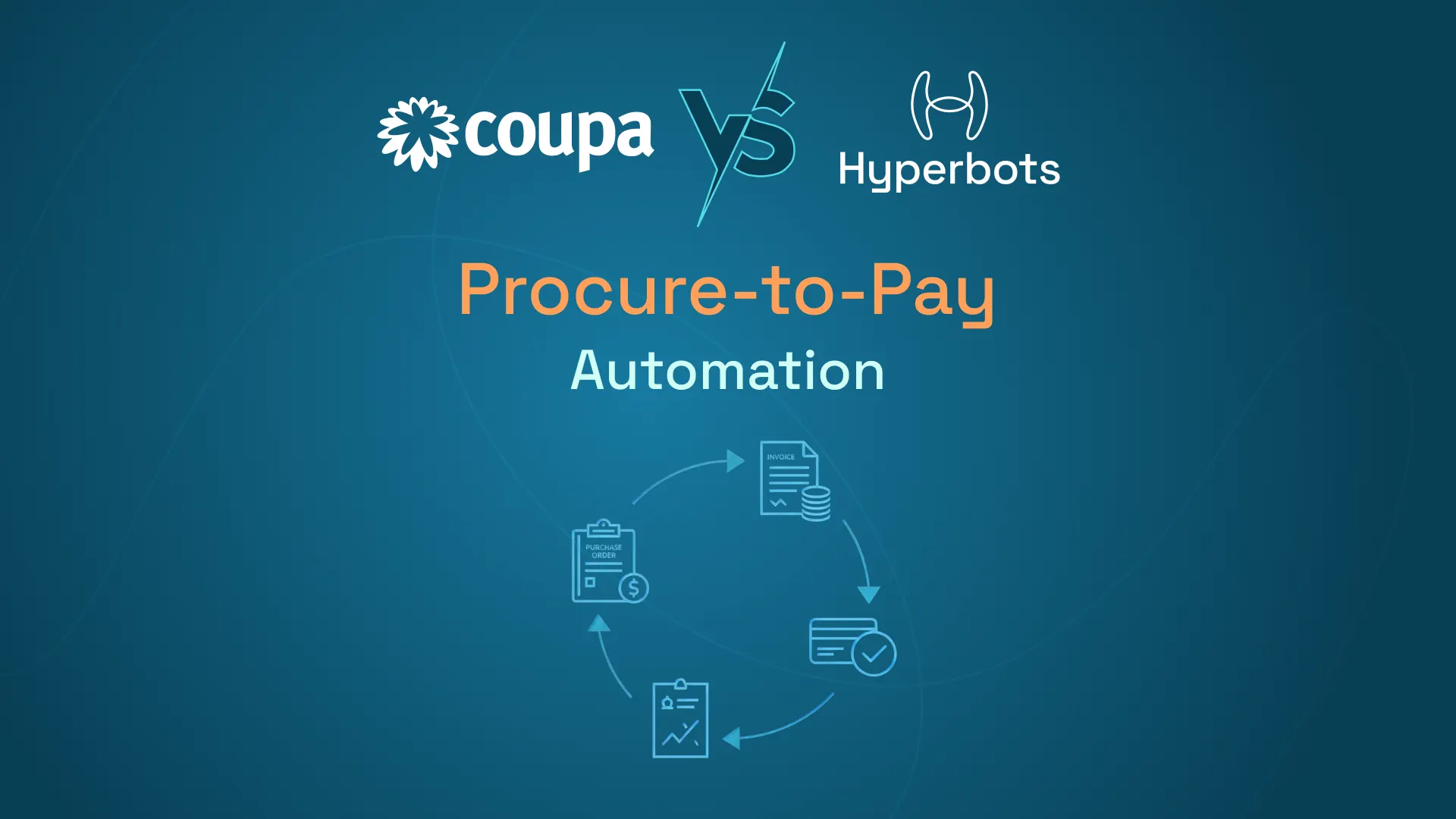
Coupa has long been the default name that pops up whenever enterprises talk about procurement modernization. But somewhere between the slick demos and the real-life implementation plans, many teams discover a familiar tension: they didn’t necessarily need a full-source-to-pay skyscraper, they just needed fast, accurate, low-maintenance P2P automation.
Procurement leaders appreciate Coupa’s rigor, but finance teams often inherit everything that comes after: the integrations, the exception queues, the multi-hop GL posting logic, and the month-end reconciliation scramble. And as businesses scale, those hidden operational costs start to matter almost as much as the headline features.
That’s where the ecosystem of Coupa alternatives steps in a.k.a platforms built for procurement agility, finance precision, or both. And among them, one stands out for organizations that care deeply about straight-through processing, clean audits, and GL-ready data: Hyperbots.
The 10 Best Coupa Alternatives in 2026
1. Hyperbots: The Ultimate Coupa Alternative
Hyperbots isn’t just “a tool that kinda does what Coupa does.” It’s an AI-engineered procurement and finance automation platform that prioritizes accuracy, compliance, and straight-through GL posting exactly what modern finance teams need.
Why Hyperbots Wins in 2026 and Beyond
When modern finance teams think about automation, they aren’t just thinking about speed, they’re thinking about accuracy, auditability, compliance, and end-to-ERP confidence. Hyperbots isn’t just another automation vendor trying to add bells and whistles, it was built from the ground up for real finance operations, with a suite of specialized AI co-pilots that handle every step of the invoice and financial lifecycle.
End-to-End Invoice Automation Built for Real Finance Operations
From the moment an invoice lands, in an email inbox, a supplier portal, a shared drive, or even a mixed folder, Hyperbots’ Invoice Processing Co-Pilot automatically discovers the document, filters out noise, and identifies true invoices without human triage.
Once discovered, Hyperbots uses its multimodal AI extraction engine, trained on billions of real invoice fields to pull every critical field with exceptional accuracy, including header data, line items, payment terms, and even GL codes.
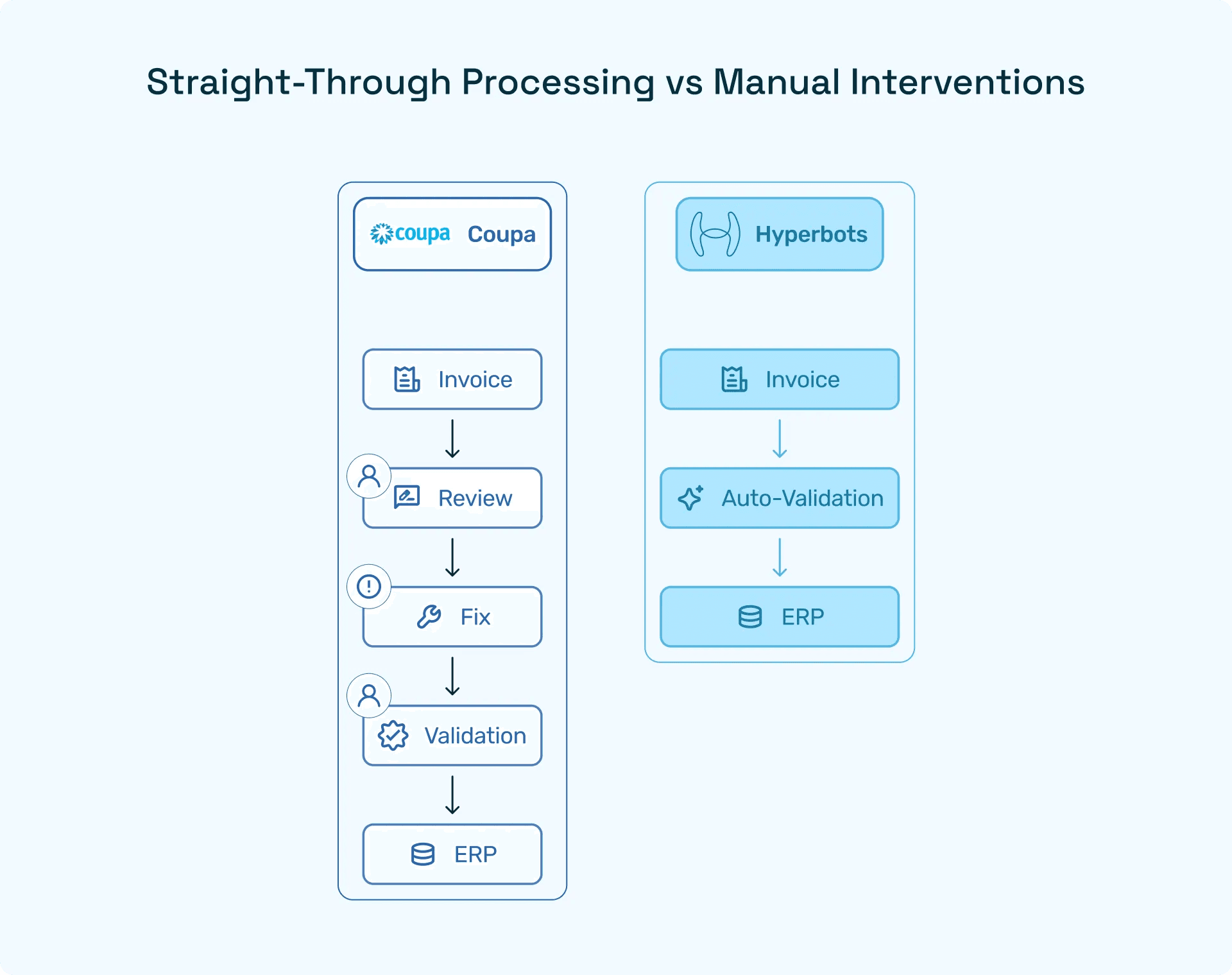
It then runs 2-way or 3-way matching against purchase orders and goods received notes, performs contextual validation, and applies policy-aware logic before posting directly to your ERP with read-back confirmation so finance leaders know the journal actually landed in the general ledger.
~80% Straight-Through Processing (STP)
Hyperbots consistently delivers about 80% straight-through processing (STP) which means most invoices are processed, matched, coded, and posted without ever touching a human hand.
For teams buried in exceptions, that’s the difference between late nights and predictable month-end closes.
Best-in-Class Extraction & Matching Accuracy
Hyperbots’ Agentic AI blends multiple specialized models (VLMs, LLMs, and layout intelligence) to handle even the messiest, multi-page, multi-currency invoices that break rule-based engines. Its models are pre-trained on millions of finance documents so they understand not just text, but financial context and relationships between fields, something legacy OCR engines struggle with.
Built for Governance, GL Readiness, and Compliance
Where pure procurement tools focus on orders and approvals, Hyperbots focuses on finance governance:
Contextual notifications keep finance teams informed from discovery through posting, with actionable alerts rather than generic flags.
Auditable trails track every decision and action for compliance and audit purposes.
Flexible matching configurations align with company policy or regulatory requirements.
ERP-validated GL posting ensures entries are not just created but confirmed via read-back checks.
This isn’t just automation, it’s finance automation with integrity. Hyperbots treats invoices as financial events that must be meaningfully interpreted, not just passed around a workflow.
So while many legacy systems focus on procurement governance, Hyperbots delivers finance governance,from discovery and extraction through matching, compliance validation, and ERP-verified posting. That’s why, in 2026 and beyond, it isn’t just an alternative; it’s the platform that meets the real needs of modern FP&A, AP, and accounting teams.
2. Basware: Enterprise-Scale P2P and e-Invoicing
Basware is a long-standing procure-to-pay and e-invoicing platform. It’s solid for companies that need automated PO matching, workflow controls, and standardized invoice intake across geographies.
Good for: Large, global organizations that need traditional P2P governance and automated three-way matching.
Issues: While Basware has strengths, real users report ongoing usability and operational friction that can limit its impact out of the box:
Some reviewers note occasional invoices getting stuck in queues even when there’s no clear error, leading to manual intervention to keep payable cycles moving.
Others describe slowness or non-intuitive search and processing workflows, making simple tasks feel harder than necessary.
Reviews point to a steep learning curve and implementation complexity, with users feeling the effort to train and support teams eats into the value.
In short, Basware delivers traditional P2P power but that comes with enterprise bloat and manual queues that can erode efficiency.
3. Tipalti: Global Payments & AP Automation
Tipalti has built a strong reputation in the world of global AP, especially when it comes to managing multi-currency payouts, handling international tax requirements, and keeping supplier onboarding relatively smooth. Its strength lies in orchestrating payments across 200+ countries without forcing finance teams to manually juggle FX conversions or chase W-8 forms.
Good for: Finance teams working across continents with complex payout structures, multi-entity operations, and a high volume of supplier payments.
Issues: Even with these strengths, many real users note that Tipalti behaves more like a payments powerhouse than a true invoice-to-GL automation platform:
Some reviewers mention sluggish, multi-click workflows and a UI that feels heavier than expected, slowing down basic AP tasks.
Others highlight laggy NetSuite syncs or integrations that add friction instead of removing it.
Support responsiveness is another recurring concern, with teams feeling stuck waiting for resolutions on issues that block AP flow.
In short, Tipalti shines when the mission is global payments, but the rest of the finance lifecycle such as deep invoice extraction, validation, matching, accrual readiness, and GL posting, often falls into the “manual follow-up” bucket.
4. Ramp: Spend Management + Bill Pay
Ramp brings together corporate cards, invoice routing, approvals, and expense tracking under one modern interface, making it easy for teams to see spend in real time and manage budgets without the usual spreadsheet head-aches.
Good for: Mid-market and fast-growing companies that want spend visibility, bill pay flexibility, and easy onboarding without a heavy P2P stack.
Issues: Despite its strengths, Ramp shows some limits when you push past basic spend management into more complex accounts payable and financial close needs:
Basic AP automation: Verified users report that Ramp’s AP functionality is fairly rudimentary compared with dedicated P2P/AP tools. Its workflows can feel rigid, and automation often stops short of full invoice-to-ledger processing, meaning more manual steps for finance teams.
Limited integration fidelity: While Ramp syncs with major ERPs, integration depth can be shallow, batch syncs rather than real-time bi-directional posting, which can leave bills “stuck” outside the general ledger until manually corrected.
Manual workarounds and card quirks: Users also note situations where reimbursements require extra steps, credit limits shift unexpectedly, and reporting remains less granular than expected for complex finance operations.
Support and advanced scenarios: Some reviews cite inconsistent support responsiveness, especially for urgent issues outside basic card/spend questions.
In short, Ramp excels at spend visibility and card-centric workflows, but it isn’t a substitute for a deep ERP-integrated invoice automation and GL posting engine.
5. Concur Invoice: SAP-Integrated AP Automation
SAP Concur Invoice sits squarely within the larger SAP Concur ecosystem, bringing travel, expense, and invoice workflows under one umbrella. It’s known for unifying processes across spend categories and linking with ERP systems when configured properly.
Good for: Enterprises heavily embedded in SAP that want a single pane of glass for travel, expense, and invoice workflows, especially for compliance reporting and spend visibility.
Issues: Despite these strengths, users have consistently pointed out several operational and usability drawbacks:
Usability and performance issues: Many reviewers describe the interface as cumbersome and slow, especially for heavy invoice and expense workflows. Pages can lag, navigation feels outdated, and filters/controls aren’t always intuitive.
Learning curve & setup complexity: Even long-time users note that Concur often requires specialized knowledge to configure and use effectively, especially for complex invoice processes or custom ERP mappings.
Mobile and UX frustrations: Users complain about a sluggish mobile experience and cumbersome steps for capturing and reviewing records.
Invoice processing gaps: Some reviewers note that invoice workflows can still require manual touches for complex items or GL code splits, and invoice capture accuracy isn’t always reliable unless additional checks are performed.
In short, Concur shines with integrated spend oversight for SAP customers but its AP capabilities can feel less responsive, less intuitive, and less focused on end-to-ERP automation compared to modern engines.
6. Medius: AI-Driven AP Automation
Medius is an AI-powered accounts payable automation platform that captures invoices, routes them through approval flows, applies smart coding, and supports multi-ERP environments.
Good for: Mid-sized to larger organizations looking for AI-augmented AP workflows and tighter ERP integration without heavy custom development.
Issues: Even with its AI claims, many teams report areas where practical use diverges from the “lights-out automation” promise:
Significant configuration overhead: Several reviewers note that setting up rules, workflows, and ERP mappings still requires considerable setup effort in some cases rivaling traditional solutions. Tailoring matching logic often means wrestling with screens that feel more rigid than intuitive.
Reporting limitations: Users have flagged reporting and analytics as functional but not fluid, especially when trying to slice data for compliance, audit readiness, or month-end reconciliation.
Workflow flexibility: Some users express frustration that complex exceptions still require manual intervention or bespoke scripting to handle edge cases (suffix coding, tax rewrites, location allocations, etc.), especially in multi-entity environments.
In short, Medius automates many AP chores, but depth of process logic and downstream certainty can still hinge on manual rules and configuration.
7. Procurify: Simple, User-Friendly Spend Management
Procurify is known for its modern, intuitive interface and straightforward spend controls that make requisitions and approvals less manual.
Great for: Mid-market and fast-moving teams that want easy procurement governance and requisition visibility without the complexity that typically accompanies enterprise procurement software.
But: That ease of use comes with trade-offs once the problem moves downstream into finance:
Invoice automation stops short: Procurify’s strength is procurement visibility but once invoices arrive, the platform doesn’t provide deep invoice extraction or structured capture that’s ready for GL posting. Finance teams often end up exporting data and cleaning it up manually.
Limited GL traceability: Users who need audit-grade trails from invoice image → journal → reversal often find themselves building their own recon workflows outside the tool, since Procurify doesn’t offer ERP-centric validation loops.
Compliance workflows plateau: In regulated environments or across multi-entity orgs, manual touches creep in quickly, especially where multi-tax, multi-location, and multi-code invoices are common.
In short, Procurify is great at procurement but once an invoice lands in finance, the simplicity becomes a bottleneck.
8. SAP Ariba: Classic Enterprise Procurement
SAP Ariba is often chosen by global enterprises, especially those already embedded in the SAP ecosystem, for its breadth of features and tight linkage to SAP’s ERP backbone, offering visibility across spend categories and governance tools that span sourcing through settlement.
Good for: Organizations deeply entrenched in SAP that want robust procurement governance and visibility across global supplier networks.
Issues: Despite the enterprise muscle, Ariba frequently draws criticism in real user feedback for issues that matter once you move past procurement into finance execution:
Complexity & learning curve: Many users on G2 describe Ariba as powerful but complicated, with a steep learning curve that slows adoption and demands significant training investment.
Clunky and slow UI/UX: Multiple reviewers note that the interface can feel sluggish and unintuitive, requiring extra clicks for routine tasks like invoicing or navigation.
Integration friction: While integration with SAP ERP systems is possible, connecting Ariba to non-SAP systems or legacy environments often requires bespoke work, mapping, and middleware which increases operational overhead.
Supplier hardship & reliability complaints: Suppliers sometimes report difficulty using Ariba (e.g., frequent login issues, confusing entry screens, or unexpected subscription charges), which can introduce friction into invoice submission and vendor compliance.
In short, Ariba delivers heavy-duty procurement governance but its AP and invoice automation layers often lag in agility, ease of use, and finance-ready GL automation, leaving teams to build custom integrations or manual workarounds to fill the gaps.
9. Airbase: Integrated P2P + Cards + Spending Controls
Airbase brings together P2P automation, corporate card programs, and expense workflows within a sleek, modern interface with its UI and unified controls as a huge step up from disjointed legacy tools.
Good for: Teams that want spend, cards, and AP automation bundled together with intuitive workflows and a strong focus on policy enforcement.
Issues: Even though Airbase shines at spend orchestration, it falls short in areas that matter most to complex finance operations:
Surface-level invoice automation: Users note that Airbase handles basic e-bills and approvals well, but its invoice extraction capabilities are not as rich or configurable as dedicated AP automation tools. For organizations with multi-line, multi-tax invoices, this can mean manual clean-up remains part of the process.
Limited deep GL integration: While Airbase connects to ERPs, users report that line-level GL posting often still needs manual mapping or post-export adjustments thereby, reducing the value of automation for finance teams.
Compliance & exceptions: In compliance-intensive environments, invoice exceptions and tax edge cases frequently require human intervention, blunting the platform’s automation ROI.
In short, Airbase is good at spend control and card-linked workflows, but its AP automation stops at the surface level and doesn’t solve the downstream reconciliation and posting challenges finance teams care about most.
10. SoftCo AP Automation: Specialized AP Focus
SoftCo brings a dedicated accounts payable automation suite to the table, with tools designed to digitize invoices, apply smart matching logic, and simplify vendor workflows.
Good for: AP teams that want better inbox management, digital capture, and clearer vendor collaboration, especially where the goal is fewer key-strokes and more structured processing.
Issues: Despite its AP focus, SoftCo, like many standalone capture tools, tends to stop where the real work begins:
Stops at capture and approval: SoftCo does a good job digitizing invoices and enabling approval workflows, but many reviewers point out that automation frequently ends after those stages. Finance teams still spend significant time on post-approval tasks and GL posting.
Limited ERP posting validation: While the tool can push data into ERPs, it doesn’t offer read-back confirmation meaning teams must manually verify whether journals landed correctly or fix postings after the fact.
Modest AI capabilities: Smart matching is useful, but the platform lacks the continuous learning, contextual reasoning, and high-accuracy extraction needed to reduce exceptions dramatically in complex invoice environments.
In short, SoftCo makes AP less painful but it doesn’t close the loop in a way that fundamentally changes how finance reconciles and reports.
Why Hyperbots Is the Best Coupa Alternative in 2025
Sure, some platforms here do parts of what Coupa does, procurement, spend, AP, or payments. But most are missing something important: seamless invoice → GL automation with audit-ready accuracy.
Hyperbots is different because:
It automates discovery across email, drives, portals, no invoice left behind.
Its Copilot architecture achieves ~80% straight-through processing, meaning way fewer exceptions and headaches.
GL posting is validated with read-back checks, reducing erroneous journal entries and audit risk.
Pre-trained finance AI means fast deployment without endless configuration cycles.
In other words, Hyperbots treats accuracy as a first-class citizen, not an afterthought, and that’s a huge differentiator for finance teams sick of wrestling with manual clean-up.
Business Impact: Why Choosing a Better Coupa Alternative Saves Time, Money, and Compliance Risk
Switching away from Coupa is about reshaping the operating rhythm of finance and procurement. The right alternative can cut exception rates, accelerate month-end close, and reduce dependence on middleware or manual “data babysitting.”
For many organizations, especially those scaling rapidly or operating across multiple entities, poor invoice-to-GL fidelity translates directly into cash-flow blind spots, unpredictable accruals, and compliance risks that balloon into audit-time panic.
Conversely, platforms like Hyperbots which are designed for high accuracy, AI-driven matching, and ERP-validated posting deliver measurable operational efficiency: faster processing cycles, fewer reconciliation loops, and financial statements that leadership can trust without squinting at caveats.
In a world where finance teams are expected to do more with leaner staff and tighter timelines, the business impact of cleaner automation compounds month after month, creating a structural productivity advantage.
Frequently Asked Questions (FAQs)
1. Why do companies look for Coupa alternatives?
Because Coupa can feel heavy, complex, and integration-dependent, especially for teams needing faster automation, fewer exceptions, and simpler GL workflows.
2. What makes Hyperbots the best Coupa alternative?
Hyperbots offers 99.8% extraction accuracy, ~80% STP, and direct ERP posting with read-back, eliminating the manual cleanup and middleware reliance common with other platforms.
3. Who is Hyperbots best suited for?
Fast-growing, multi-entity, or compliance-heavy organizations that want high-accuracy invoice automation and clean, audit-ready GLs without running a full enterprise procurement suite.
4. How do Coupa alternatives differ from each other?
Some focus on procurement (Ariba, Basware), others on spend control (Ramp, Airbase), and others on AP workflows (Tipalti, SoftCo). Hyperbots is the only one that prioritizes end-to-ERP accuracy.
5. Why is GL posting so important?
Because the GL is the financial source of truth. Delayed or error-prone posting slows close and creates audit risk. Hyperbots fixes this with validated, real-time GL posting which is something most Coupa alternatives don’t truly automate.