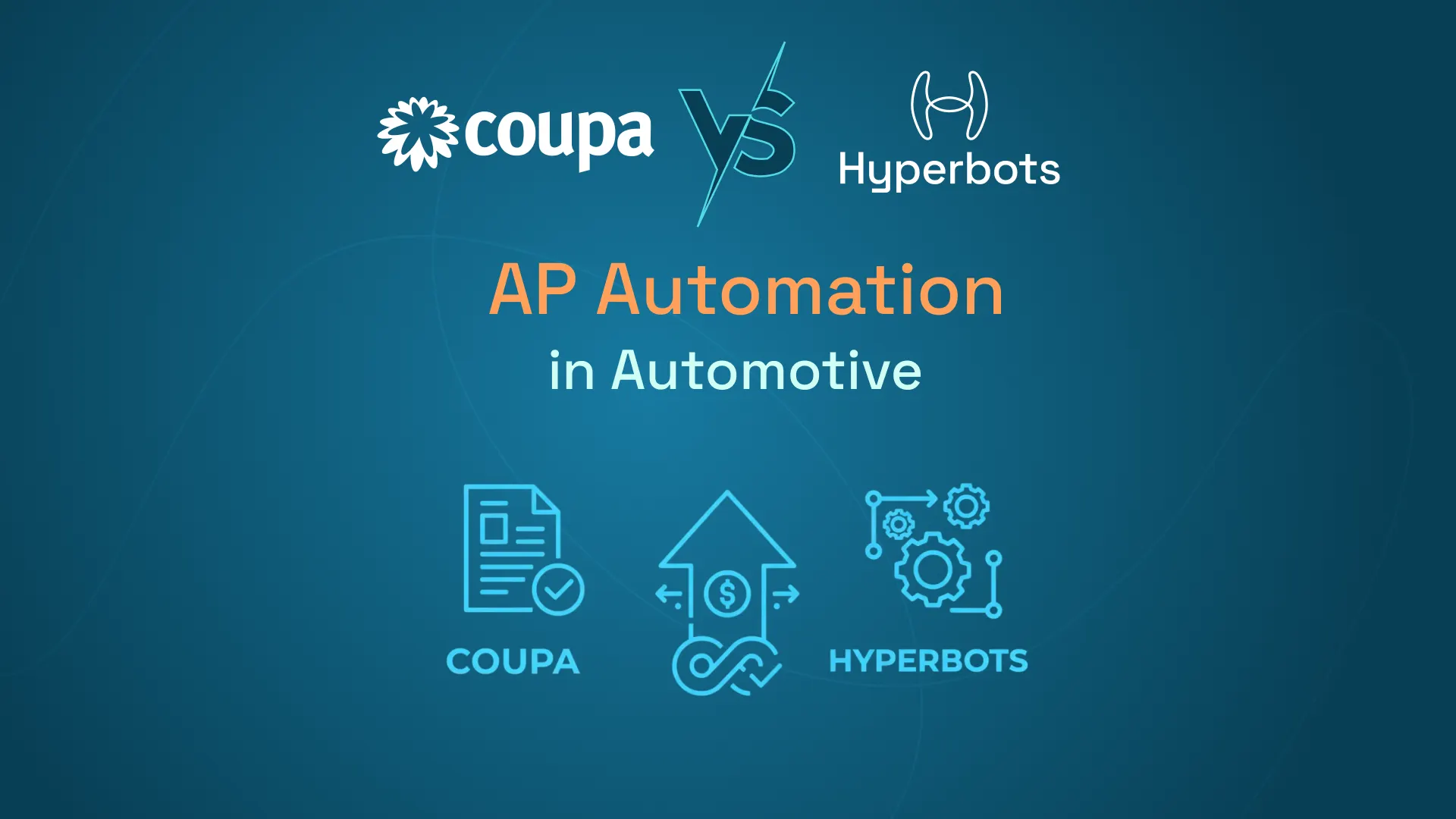
Coupa for Automotive vs Hyperbots: AP Automation for OEMs & Tier-1 Supplier Procurement
This comparison breaks down why Coupa’s broad procure-to-pay platform often struggles with automotive invoice complexity and why Hyperbots’ reasoning-first AI delivers higher accuracy, fewer exceptions, and faster closes for OEMs and Tier-1 suppliers.
In the high-stakes world of automotive manufacturing, where Original Equipment Manufacturers (OEMs) and Tier-1 suppliers juggle millions of dollars of spend, razor-thin margins, and complex supplier networks, Accounts Payable (AP) isn’t just back-office drudgery. It’s a mission-critical gear in the supply chain engine.
“Coupa for automotive” promises a one-stop procure-to-pay suite that keeps procurement compliant and AP humming. But as many automotive finance teams know, promises and practice can diverge quickly, especially when it comes to invoice accuracy, supplier part number matching, and the friction that complex, high-volume environments expose in actual usage.
While observing Coupa’s AP automation in automotive settings, it’s evident why there has been a shift towards Hyperbots’ reasoning-first AI automation which is increasingly becoming the preferred option for OEMs and Tier-1 suppliers.
What “Coupa for Automotive” Brings to the Table
Coupa is a widely deployed source-to-pay platform that spans procurement, invoicing, expense, and vendor collaboration. In general accounts payable automation, it helps teams cut invoice costs, flag potential fraud, and automate repetitive workflows. For automotive organizations, with sprawling supplier bases spanning stamped steel brackets to embedded software modules, Coupa’s integrated spend platform holds intuitive appeal:
Centralized procurement and spend visibility, making it easier to control costs across multiple plants and divisions.
Automated invoice receipt, approvals, and workflow routing that replaces legacy manual entry often done in spreadsheets or PDF stacks.
ERP and supplier network integrations that connect core enterprise systems with vendor operations.
And for mid- or large-sized automotive players who need integrated procurement and spend governance, Coupa can be compelling with its ability to centralize spend, scale AP processes, and enforce policy compliance across departments.
But automotive AP comes with unique hurdles and that’s where feedback from real users and some documented limitations become especially relevant.
Coupa Friction in Automotive AP: When Standard Features Don’t Cut It
The automotive supply chain is one of the most demanding in manufacturing: tight delivery windows, part traceability requirements, complex multi-line invoices, and highly normalized master data. In such environments, even small errors in AP automation can ripple into production delays and P&L surprises.
Here are some common automotive pain points seen in AP tooling like Coupa:
1. Invoice Accuracy Isn’t Always Seamless
While Coupa advertises multi-level automated invoice validation, dynamic approvals, and AI-assisted workflows, users often report real-world friction around invoice handling, particularly when information from suppliers deviates from expected formats.
Several reviews highlight concerns with inconsistent invoice data and challenges navigating complex invoice records, slowing down processing.
In automotive, where invoices can contain dozens of line items referencing OEM part numbers, engineering change orders, and unit variances, even small misreads matter.
Does the AP tool tag the right supplier part number correctly? Does it reconcile the invoice line to the correct PO line when vendors use their own part codes?
Standard AP automation like Coupa may handle basic matching, but the deeper nuances of vehicle-specific part invoicing often expose gaps in precision.
Not every review directly mentions this of course, but it does echo broader complaints about AP automation complexity, rigid navigation, and the need for human review despite automation.
This becomes what we might call Coupa tooling invoice accuracy problems, not because the platform fails at basic extraction, but because traditional invoice automation often expects structure that automotive suppliers don’t always deliver.
2. Supplier Part Matching Issues
Another frequent challenge in manufacturing and automotive AP is supplier part matching: ensuring that the part identifiers on a supplier invoice actually match the internal part numbers, cost centers, and product structures that OEMs and Tier-1 suppliers use.
AP platforms that rely on positional or template-based extraction struggle when vendors format invoices in slightly unexpected ways, extra columns, abbreviated descriptions, or missing part identifiers.
Without deep contextual understanding, the system may misassign items, inflate exception volumes, or fail PO matching altogether.
Automotive teams often resort to manual review or middleware fixing before posting into the general ledger.
This represents a classic case of Coupa supplier part matching issues: the platform’s invoice automation may have broad functionality, but accuracy lags when confronted with real-world variability.
3. Usability and Integration Complexity
Even G2’s broader reviews of Coupa, covering multiple industries, show that while the platform centralizes many processes, users often note:
Friction with complex configurations, steep learning curves, and challenges in customization or deep integration.
In automotive organizations with multiple ERPs, unique plant structures, and non-standardized supplier catalogs across geographies, that complexity multiplies.
Setting up the platform to match every unique part and integration scenario can extend implementation timelines and introduce opportunities for errors, which leads to frustration and additional cost.
Coupa’s strengths in procurement governance are real. But these AP-specific frictions, invoice accuracy woes, part matching challenges, and user-reported complexity are precisely where alternative approaches, especially ones driven by deeper automation intelligence, start to shine.
Enter Hyperbots: AI That Understands Automotive AP Workflows
Now let’s shift gears to Hyperbots, a next-generation AI automation platform that takes a fundamentally different approach. Rather than relying on template or rules-based extraction (which assumes invoice formats will stay familiar), Hyperbots uses Agentic AI: multimodal models trained on millions of financial data fields that interpret context, not just text.
Here’s what sets Hyperbots apart when applied to the complex demands of automotive AP:
1. Exceptional Invoice Accuracy
Hyperbots boasts 99.8% field-level extraction accuracy through a mixture-of-experts model that combines vision-language models, layout understanding, and reasoning over content.
This means messy, multi-page supplier invoices with nonstandard structures are captured correctly more often than they’d be in legacy or template-only systems.
For automotive AP teams, that translates into far fewer exceptions requiring manual intervention, a profound operational advantage when processing thousands of high-complexity invoices monthly.
2. Contextual Matching Beyond Position
Hyperbots AI interprets vendor codes, PO references, tax fields, currency, and part identifiers with semantic intelligence, not positional guesswork.
That deeper reasoning improves matching accuracy even when supplier part numbers don’t align perfectly with internal BOMs or catalogs, a common scenario in automotive supply chains.
Unlike traditional systems that may misread or drop part numbers when layouts change, Hyperbots’ models keep context intact across pages and formats.
3. Automated End-to-End Processing
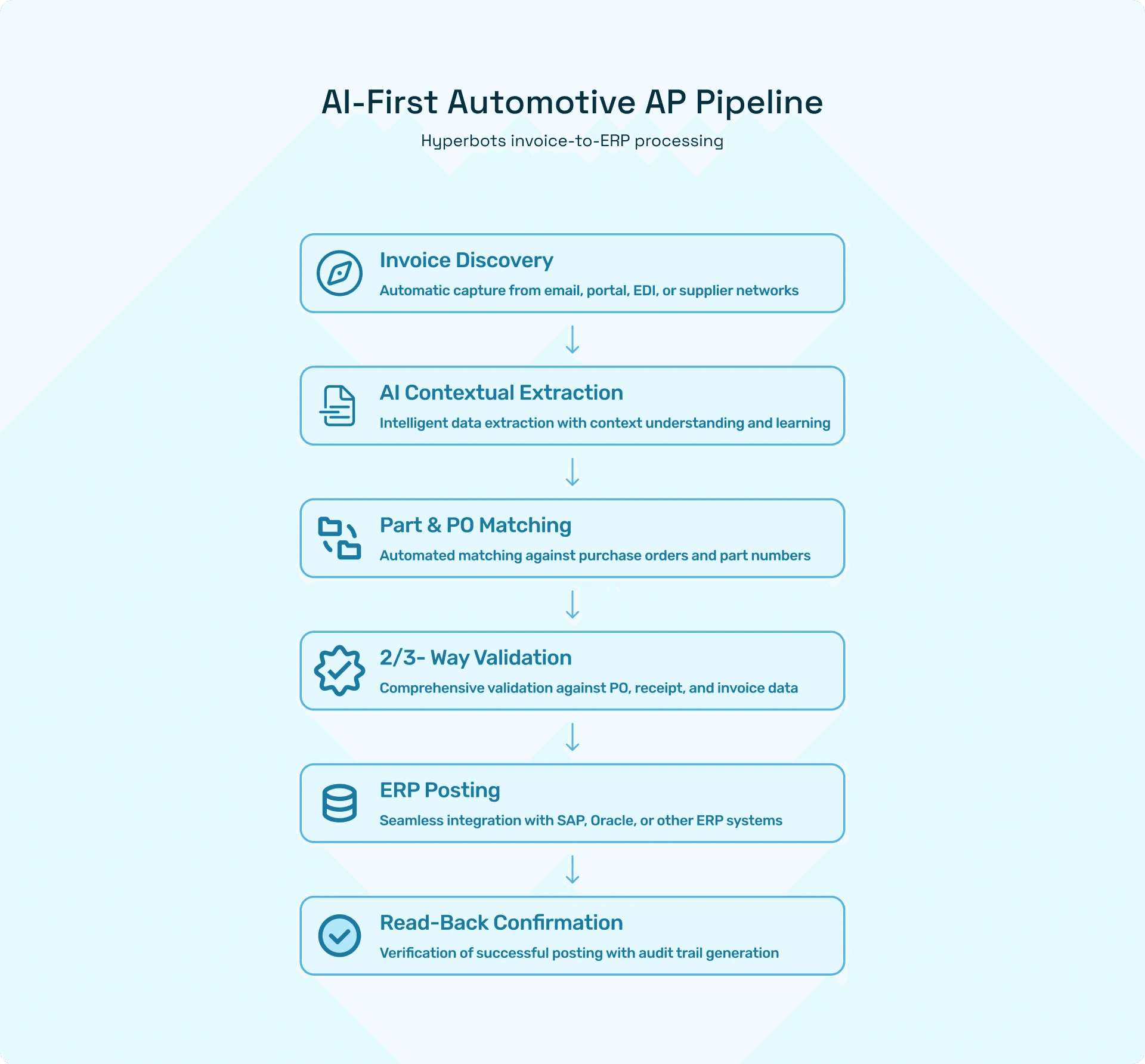
Hyperbots’ invoice processing co-pilot workflows:
Discover invoices from multiple sources (email, portals, shared drives)
Extract fields, validate data
Match POs/GRNs
Perform 2- and 3-way matching
Post clean journals directly into ERPs with read-back validation.
That’s true straight-through processing (STP), with up to 80%+ STP rates, meaning more invoices flow through without human touch versus rule-based AP automation alone.
This isn’t just about moving documents faster, it’s about getting them right the first time, so automotive finance teams can close books on time, maintain traceable audit trails, and avoid the dreaded month-end scramble.
4. Adaptability to Change
Automotive suppliers often update their invoice formats as their systems evolve, or shift part numbering schemes due to engineering revisions.
Template-based extraction systems can break when a vendor changes a field’s position or adds a new column.
Agentic AI adapts without rule rewrites, reducing maintenance overhead and keeping automation robust over time.
Comparing Coupa and Hyperbots in Automotive AP Context
Area | Coupa | Hyperbots |
Invoice Accuracy | Works best with clean, structured invoices. Complex formats often need manual fixes. | 99.8% AI accuracy, even for multi-page, multi-line, and messy invoices. |
Supplier Part Matching | PO matching can struggle with complex part numbers and master data. | AI understands context and cross-checks ERP data, reducing mismatches. |
Automation Focus | Broad P2P platform where AP is one component. | Built specifically for invoice and finance automation end-to-end. |
Ease of Use | Powerful but configuration-heavy and harder to maintain. | Pre-trained AI that improves over time with minimal setup. |
Why Automotive Teams Are Choosing AI-First AP Automation
In automotive procurement and AP, the difference between “good enough” and “precise” isn’t trivial:
Late payments can disrupt supplier lines and jeopardize production continuity.
Mismatch in part numbers affects inventory reconciliation and may delay warranty tracking.
Manual exception handling drains analyst time and slows month-end close cycles.
Hyperbots addresses these real world needs by reducing exceptions at scale, improving straight-through processing, and delivering ERP-validated journal postings that finance teams actually trust.
In contrast, Coupa remains a robust procurement and spend governance platform. But in the specific niche of high-complexity AP automation for automotive OEMs and Tier-1 suppliers, its traditional template-based workflows and user-reported friction points make it less optimal than an AI reasoning-first approach.
Why Precision-First AP Automation Wins in Automotive Finance
Coupa for automotive delivers strong procurement governance at scale but AP success in automotive is measured by accuracy, zero-touch posting, and fewer supplier disputes, not breadth of modules.
Hyperbots focuses where it matters most: removing errors, not just clicks. Its reasoning-first AI extracts, validates, matches, and posts invoices with real financial context, making it better suited for complex automotive AP environments.
If invoice complexity, part mismatches, and slow closes are holding your team back, it’s time to rethink automation.
👉Book a demo with Hyperbots to see how precision-driven AP automation accelerates close cycles without adding headcount.
Frequently Asked Questions (FAQs)
1. Is Coupa a good fit for automotive AP teams?
Coupa works well for procurement governance and standardized AP workflows. However, automotive AP teams often face challenges with invoice accuracy, complex part numbers, and high exception volumes when supplier invoices don’t follow clean formats.
2. Why do automotive invoices cause issues for traditional AP tools?
Automotive invoices often include multi-line part details, supplier-specific part codes, engineering revisions, and multi-page tables. Traditional OCR and rule-based systems struggle when layouts vary or data doesn’t appear where expected.
3. How does Hyperbots improve invoice accuracy compared to Coupa?
Hyperbots uses reasoning-first AI that understands context, relationships, and invoice structure, not just text positions. This enables up to 99.8% extraction accuracy, even for messy, complex automotive invoices.
4. Can Hyperbots handle supplier part matching and PO discrepancies?
Yes. Hyperbots cross-references ERP data, understands part identifiers semantically, and maintains context across pages, reducing mismatches and manual corrections common in automotive AP.
5. What results can OEMs and Tier-1 suppliers expect with Hyperbots?
Most teams see fewer exceptions, faster invoice processing, higher straight-through processing (80%+ STP), quicker month-end close cycles, and improved supplier relationships, all without adding headcount.