Why SAP S/4HANA Order to Cash Automation Is Critical for Modern Finance Teams
How Hyperbots AI Co-Pilots are transforming AR automation, cash application automation, and collections automation on SAP S/4HANA, reducing costs by up to 80% and DSO by 40%.
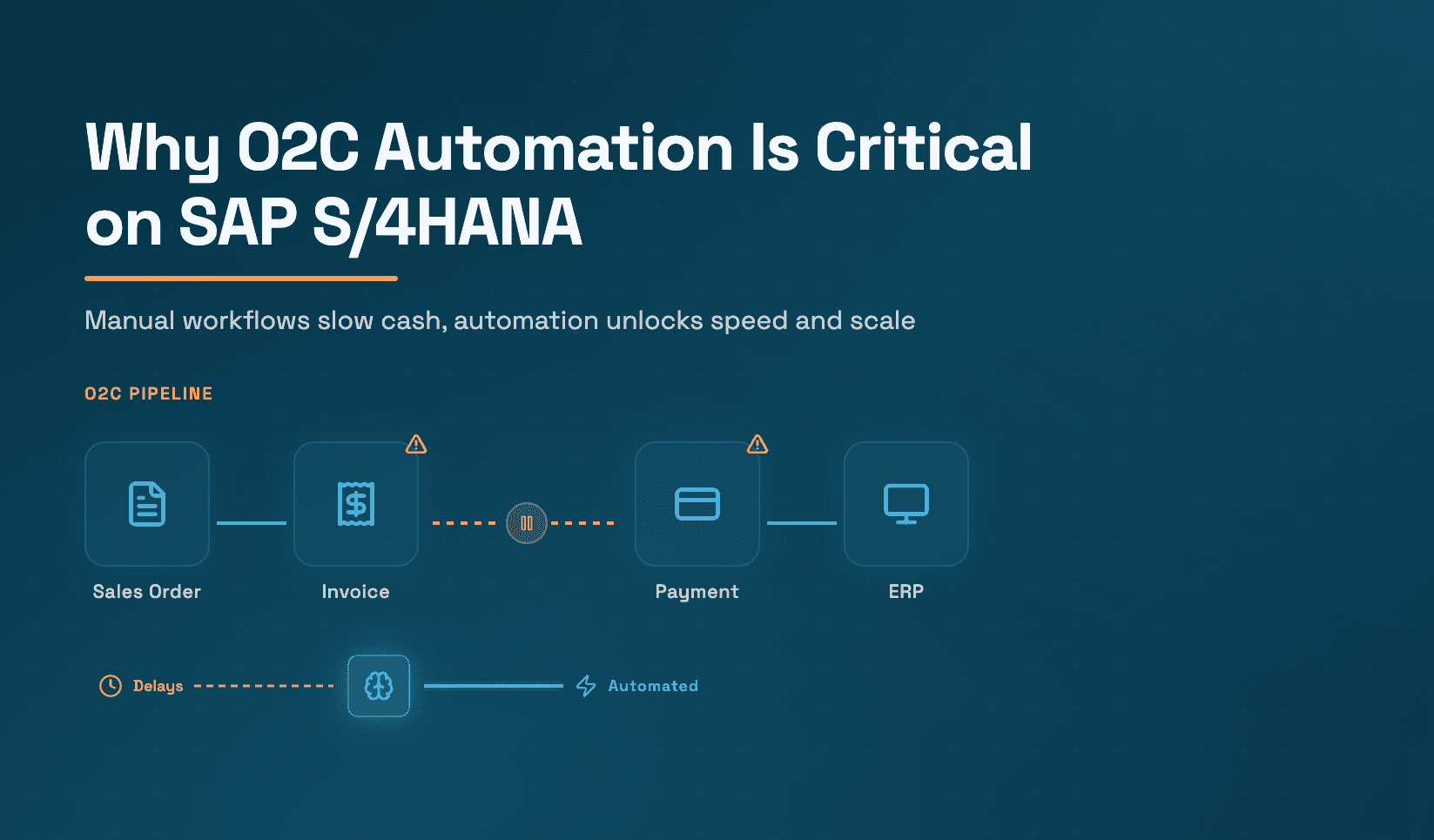
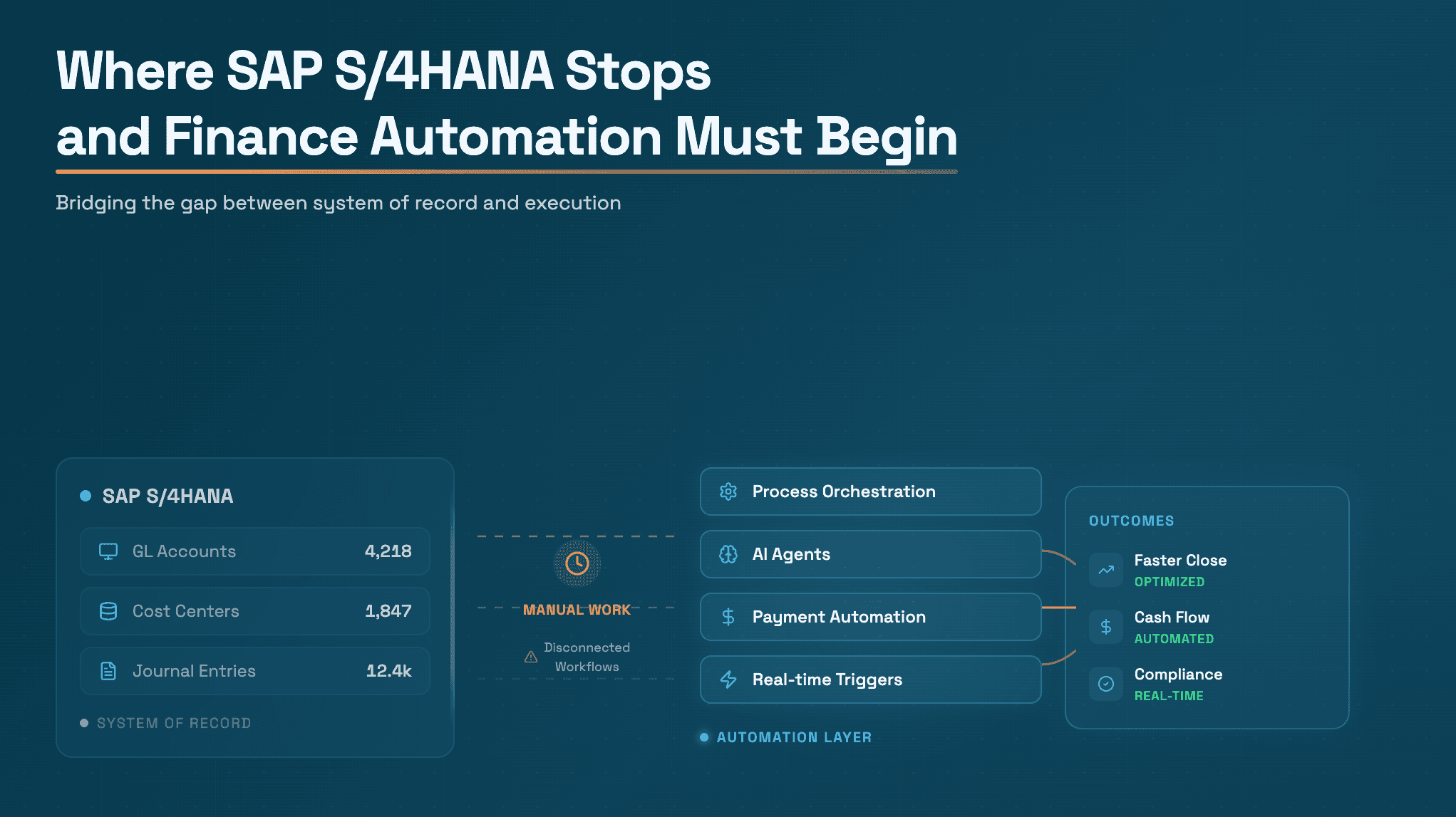
As enterprises migrate to SAP S/4HANA, they discover a hard truth: while the platform delivers world-class transactional infrastructure, the Order-to-Cash (O2C) cycle often remains manual, fragmented, and costly. Teams still chase payments through emails, reconcile cash using spreadsheets, and rely on outdated reports for collections.
This makes O2C automation not just an added feature, but a critical requirement for competitive finance operations in 2026. Without AI, the majority of O2C processes remain manual and error-prone.
Hyperbots addresses this gap through AI Co-Pilots that embed purpose-built agentic AI directly into SAP workflows. Its Collections Co-Pilot can reduce DSO by up to 40% and cost-to-collect by 70%, while the Cash Application Co-Pilot enables 80% straight-through processing, bringing unapplied cash below 10%.
Operating 24×7, Hyperbots integrates natively with SAP S/4HANA APIs and BAPIs. Unlike legacy O2C platforms that rely heavily on dashboards, Hyperbots stands out with finance-specific pre-trained AI models, no-code configurability, and real-time ERP write-back. As a result, organizations typically see ROI within just weeks of deployment.
The O2C Gap in SAP S/4HANA: Why Automation Cannot Wait
SAP S/4HANA was engineered as the intelligent enterprise backbone, different from the traditional SAP ECC. Yet finance teams across manufacturing, retail, healthcare, and professional services continue to report the same frustrations year after year: high Days Sales Outstanding (DSO), increasing unapplied cash balances, collectors spending hours on manual follow-ups, and AR teams struggling to reconcile payments that arrive without clear remittance data.
The Order-to-Cash cycle, from sales order creation through customer invoicing, collections, cash application, and finally revenue analytics, is the revenue engine of every business. When it operates manually, even within a sophisticated ERP like SAP S/4HANA, the consequences are severe: cash flow uncertainty, increased bad debt, customer disputes, and high operational cost.
According to industry research, enterprises lose atleast 5% of annual revenue to inefficiencies in the O2C cycle. The average DSO across industries hovers between 30-45 days. The majority of the time that AR teams spend is on tasks that could be automated, such as pulling aging reports, sending dunning reminders, manually matching remittances to invoices, and logging notes into the ERP.
The hard reality is SAP S/4HANA gives your finance team a powerful engine, but without AI automation layered on top of the O2C cycle, your team is still driving that engine by hand. Every day of manual processing is a day of working capital trapped in the receivables cycle. This is exactly why AI automation is crucial for O2C processes.
What Is SAP S/4HANA Order to Cash Automation?
SAP S/4HANA Order to Cash Automation refers to the use of AI, machine learning, and intelligent workflow management to eliminate manual intervention across the entire Accounts Receivable (AR) lifecycle, within and on top of SAP S/4HANA's core modules, including SD (Sales & Distribution), FICO (Finance & Controlling), and BPC (Business Planning and Consolidation).
Unlike basic workflow tools or traditional RPA bots that simply mimic human keystrokes, true O2C automation on SAP S/4HANA involves:
Intelligent Document Understanding: AI agents trained on financial documents parse and reconcile bank statements, lockbox files, emails, and PDFs with 99.8% accuracy, far beyond the capability of traditional template-based OCR tools.
AI-powered Payment Matching: Payments are intelligently matched to open invoices using invoice numbers, PO references, amounts, dates, and customer behavior, ensuring high accuracy even with incomplete or messy remittance data.
Autonomous Collections Orchestration: Collection actions are continuously reprioritized based on payment behavior, invoice risk, dispute likelihood, customer value, and DSO impact, with limited manual effort required.
Closed-loop ERP Posting: All payment applications, adjustments, write-offs, and credits are written back to the ERP automatically with built-in validation and controls, completely eliminating manual GL entry.
Human-in-the-loop Exception Handling: Finance teams stay in control through structured human collaboration, including exception handling, configurable approval workflows, and AI-powered insights, ensuring transparency and continuous improvement over time.
Why SAP S/4HANA Requires O2C Automation More Than Ever
SAP S/4HANA is built on the SAP HANA in-memory database, which enables real-time processing of vast financial datasets. This architecture creates a unique opportunity: when AI Co-Pilots connect natively to SAP S/4HANA via its proprietary APIs and BAPIs, they gain instant access to live customer master data, open invoice balances, payment terms, credit limits, dispute records, and GL structures, without process delays or data blockages.
The SAP S/4HANA O2C Architecture Advantage
The SAP S/4HANA's Universal Journal is the bottom data layer (one shared data model) where all modules write to, and SD, FICO, and BPC, which are modules in the top layer (what users interact with).
This journal unifies the modules into a single data layer, meaning collections automation and cash application tools that integrate at the API level can deliver four transformational capabilities:
Real-Time AR Visibility - SAP S/4HANA enables financial insights by analyzing live transactional data in-memory, allowing AR aging and credit status to be accessed instantly, reducing the dependency on batch processing for reporting
Bidirectional Write-Back: Collection notes, payment applications, GL entries, and dispute updates are recorded directly within SAP, ensuring it remains the single source of truth across the organization.
Multi-Entity Support: SAP S/4HANA manages multiple company codes and business units within a single system, providing a unified view of financial data across the organization.
Audit-Ready Compliance: Every AI action, recommendation, and exception is logged with timestamps, maintaining audit trails and compliance readiness without additional manual documentation effort.
Companies migrating from SAP ECC to S/4HANA often expect the new platform alone to deliver efficiency gains. But SAP S/4HANA is a foundation, not a full solution. The O2C automation layer on top is what converts that foundation into measurable working capital improvement.
The Manual Overload of Collections & Cash Application on SAP S/4 HANA
Collections Automation on SAP S/4HANA: From Reactive to Predictive
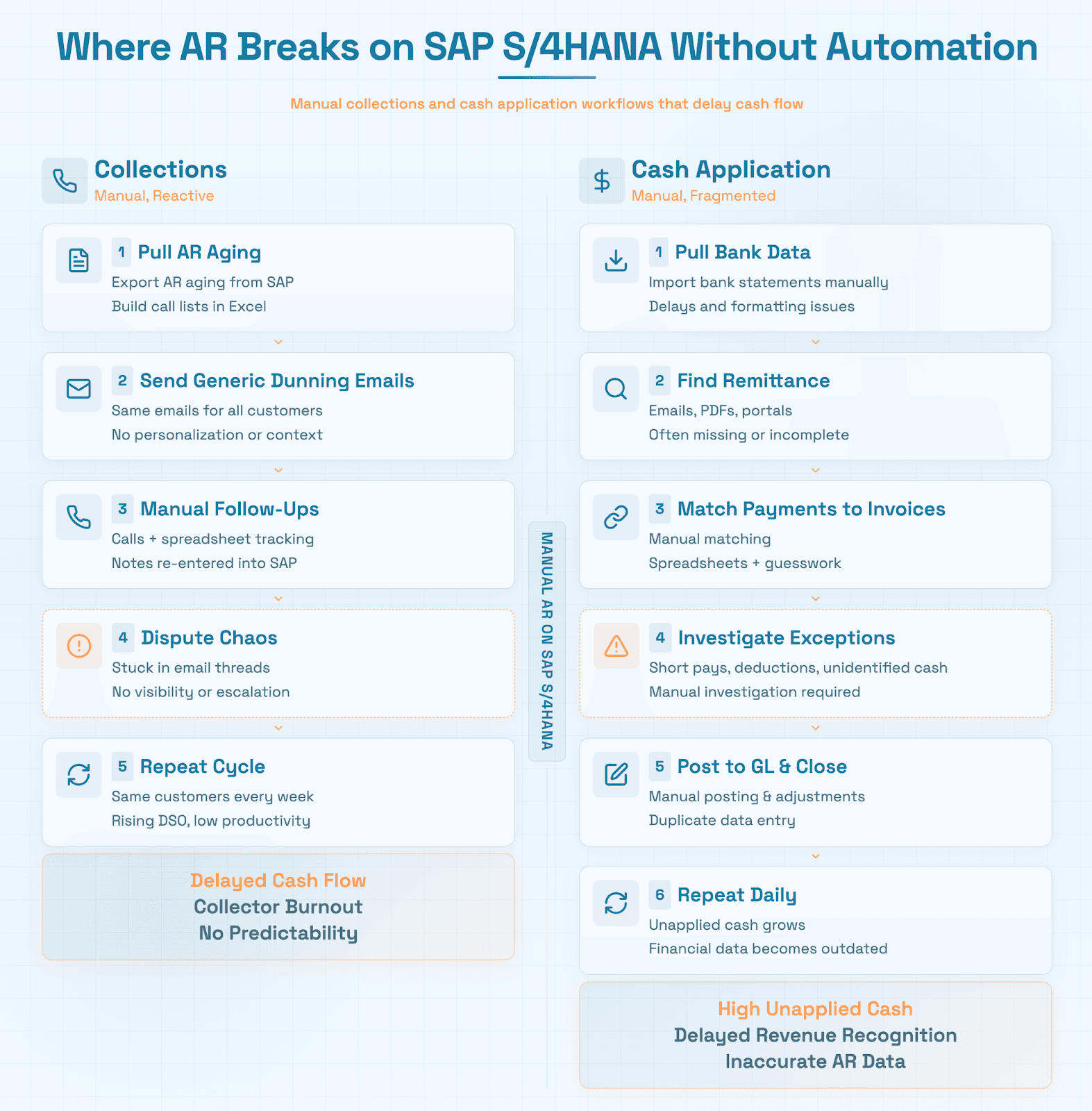
Of all the O2C sub-processes, collections is where manual effort is most concentrated and most damaging to cash flow. In a typical SAP S/4HANA environment without collections automation, collectors follow a fixed weekly process that looks something like this:
Step 1: Pull the AR Aging Report: Manually export the AR aging report from SAP, sort by overdue balance, and create a call list, typically in Excel, disconnected from SAP.
Step 2: Send Generic Dunning Emails: Send the same dunning template to all overdue customers regardless of relationship history, payment behavior, or whether a legitimate dispute is already in progress.
Step 3: Make Manual Follow-Up Calls: Collectors spend significant time each day calling customers, logging responses in spreadsheets, and manually re-entering notes into SAP FICO module; a repetitive cycle that consumes most of the working day.
Step 4: Chase Disputes Through Email Chains: Disputes get trapped in email threads between AR, sales, and billing, with no visibility into resolution status from SAP and no automated escalation when deadlines are missed.
Step 5: Repeat Next Week: The same customers remain on the list. DSO climbs. Collectors burn out on repetitive, low-value tasks. And the CFO still doesn't know how much cash will actually come in this week.
This reactive model is fundamentally broken. Collections automation built for SAP S/4HANA replaces this entire cycle with AI-driven, predictive orchestration: prioritizes, differentiates approach by customer segment (strategic, repeat late payer, low risk, high risk), personalize dunning by customer behavior, automate follow-ups 24×7, detect disputes before the due date, and update SAP automatically, all without human intervention except for exceptions.
Hyperbots Collections Co-Pilot autonomously orchestrates the entire collections lifecycle: dynamic prioritization, dunning, email and phone customer follow-ups, dispute identification, promise-to-pay tracking, and closed-loop ERP posting.
Key Benchmarks
Industry average DSO runs 30-45 days and cost-to-collect typically sits at 1.5-3% of total collections
Hyperbots Collections Co-Pilot can reduce DSO by up to 40% and cost-to-collect by up to 70%
Cash Application Automation on SAP S/4HANA: The Unapplied Cash Problem
Cash application is the operational backbone of Accounts Receivable, yet it remains one of the most labor-intensive and error-prone process in finance. In a typical SAP S/4HANA environment without cash application automation, AR teams follow a fragmented daily process that looks something like this:
Step 1: Pull the Bank Statement or Lockbox Files: Manually download bank statements, lockbox files, remittances, invoices, credits, deductions from the bank portal and import them into SAP, a process that is often delayed, incomplete, or requires manual reformatting.
Step 2: Hunt for Remittance Advices: Remittance information arrives separately, via email, PDF, portal, or not at all, forcing AR staff to manually locate and confirm the invoices/remittances before any matching can even begin.
Step 3: Manually Match Payments to Invoices: AR staff cross-reference payment amounts against open invoices in SAP, relying on spreadsheets and institutional knowledge to handle partial payments, short pays, and customers who bundle multiple invoices into a single payment.
Step 4: Investigate Exceptions Manually: Short payments, deductions, overpayments, and unidentified cash sit in an unapplied queue, each requiring individual investigation, customer contact, and manual resolution before they can be posted.
Step 5: Post to GL and Close: Once matched, staff manually post cash applications, write-offs, credits and adjustments to the correct GL accounts in SAP, re-entering data that already exists elsewhere, with no automated validation.
Step 6: Repeat Tomorrow: Unapplied cash balances accumulate. Revenue recognition is delayed. AR aging becomes unreliable. And the CFO is working from financial data that is already hours or days out of date.
This fragmented, manual model creates real working capital consequences. Without an AI-powered cash application, organizations face high reconciliation costs, large unapplied cash balances, delayed invoice closure, revenue leakage, and customer dissatisfaction from misapplied payments.
Hyperbots Cash Application Co-Pilot automates the entire cash application lifecycle using finance-trained AI agents for remittance and bank statement extraction, intelligent payment matching, exception handling, GL coding, and ERP posting.
Critically, this is not rules-based matching. It is finance-trained AI that learns from historical payment behavior, for example, it recognizes that a particular customer always sends one ACH for ten invoices with a 2% early payment discount, or that another customer consistently references PO numbers rather than invoice numbers. Over time, the AI improves, driving STP rates progressively higher with each payment cycle.
Key Benchmarks
Hyperbots Collections Co-Pilot delivers:
80% straight-through processing of incoming invoices
Unapplied cash is reduced to below 10% of total receivables
Reconciliation costs cut by up to 80%
Hyperbots Collections and Cash Application Co-Pilots - Deep Dive
Hyperbots platform is purpose-built as the most comprehensive AI Co-Pilot suite for Finance and Accounting, covering both Procure-to-Pay (P2P) and Order-to-Cash (O2C) processes. For SAP S/4HANA environments, Hyperbots offers two dedicated O2C Co-Pilots.
Collections Co-Pilot: AI-Driven AR Collections Automation
The Collections Co-Pilot addresses the full spectrum of collections challenges on SAP S/4HANA, from dynamic prioritization through to promise-to-pay management and GL write-back.
AI-Driven Dynamic Prioritization: Collection actions are continuously re-ranked by AI such as payment behavior, invoice risk, dispute likelihood, customer value, and DSO impact, rather than static aging buckets. A strategic customer with a minor delay is handled very differently from a repeat late payer with a 45-day overdue balance.
Autonomous Dunning Agents: Pre-due and post-due reminders are automated based on each customer's real-time behavior, risk level, and dispute context. High-value relationships receive careful communications, while persistent late payers are met with progressively assertive follow-ups.
Promise-to-Pay (PTP) Management: PTP commitments made by customers are automatically captured, tracked, and enforced, with reminders sent ahead of deadlines and breaches escalated immediately, all logged directly in the ERP without manual spreadsheet management.
Early Dispute Detection: The AI flags dispute signals before invoices even become overdue, identifying price discrepancies, quantity mismatches, tax errors, and PO mismatches, then routes each dispute to the right owner automatically, preventing avoidable aging.
Cash Collection Forecasting: Expected cash inflows are predicted by customer, week, and month using behavioral and historical patterns, giving finance leadership a forward-looking view of cash, not just a backward-looking aging report.
Customer-Aware Collection Strategy: Each customer segment receives a tailored collections approach (strategic, repeat late payer, low risk, high risk), preserving relationships with strategic accounts while applying appropriate pressure to habitually late-paying customers.
Unified AR Intelligence Layer: Finance teams get a single, live view of invoices, aging, disputes, credits, payments, PTP commitment, and customer communication, consolidated across all SAP company codes and entities.
Closed-Loop ERP Posting: All collection outcomes, such as notes, dispute statuses, PTPs, and resolution outcomes, are written back to the ERP automatically, eliminating manual data logging and entry delays.
Cash Application Co-Pilot: AI-Powered Automation for Payment Matching
The Cash Application Co-Pilot delivers end-to-end cash application automation with 80% straight-through processing, using finance-trained AI agents to handle every step from payment ingestion to GL posting.
Multi-Source Payment Ingestion: Bank feeds, lockboxes, ACH transfers, wires, checks, portals, and email remittances are all captured in one unified workflow, with all payment data flowing into a single engine.
AI-Driven Payment Matching & Application: Payments are intelligently matched to invoices and remittances using invoice numbers, PO references, transaction amounts, dates, customer behavior, and historical payment patterns.
Document & Remittance Reconciliation Agents: Pre-trained AI agents extract and reconcile data from bank statements, lockbox files, emails, PDFs, and customer portals at 99.8% accuracy.
Credit & Deduction Management: Valid credits, promotional deductions, chargebacks, and pricing discrepancies are automatically identified and either applied or routed to the right team, eliminating the need for line-by-line manual deduction review.
Exception & Short-Payment Intelligence: Short-payments, overpayments, deductions, and unidentified cash are automatically detected, root causes classified, and each exception routed to the right resolver, not to a generic exceptions queue.
Unapplied Cash Reduction Engine: Aged unapplied and partially applied cash is continuously worked down by AI until balances fall below 10% of total receivables, eliminating a drag on AR accuracy that most finance teams simply treat as unavoidable.
Closed-Loop ERP Cash Posting: Cash applications, write-offs, adjustments, and credits are automatically posted back to the ERP with built-in validation and controls, maintaining a single authoritative record for all cash positions.
Key Outcomes Of Incorporating Hyperbots CO-Pilots with SAP S/4HANA
Metric | Without Automation | Hyperbots Co-Pilot Advantage |
DSO | 30–45 days industry average | Up to 40% reduction |
Loss of revenue due to Cost-to-Collect | 1.5–3% of collections as cost-to-collect | Up to 70% cost-to-collect reduction |
Reconciliation Cost | High manual effort, error-prone & time-consuming | Up to 80% reconciliation cost reduction |
Productivity | Manual, labor-intensive workflows | 80% straight-through processing, Up to 80% collections productivity improvement |
Unapplied Cash | High unapplied balances, idle working capital | reduced to below 10% of receivables |
Cash Application Process Time | Takes time for manual cash application | Days to apply cash are significantly reduced through AI-driven matching and posting |
Dispute handing | Manual resolution trapped in email chains | Significant improvement in dispute rate |
How Hyperbots Integrates with SAP S/4HANA for O2C
Integration depth is the decisive factor in determining whether O2C automation delivers real outcomes, or else it's just a new layer of insignificant dashboards. Hyperbots' SAP S/4HANA Connector is built on SAP's proprietary APIs and BAPIs, enabling fast, reliable, two-way data flow without relying on fragile UI-based automation.
The SAP S/4HANA Connector enables real-time read and write of invoices, POs, vendor records, GL codes, and asset data, ensuring complete alignment with SAP S/4HANA's data structures and workflows for optimized financial operations.
Hyperbots integrates across SAP's full product portfolio, covering SAP S/4HANA, SAP ECC, and SAP Business One (B1); supporting organizations at every stage of their SAP journey, from legacy ECC environments through to fully migrated S/4HANA deployments.
What Hyperbots Reads and Writes in SAP S/4HANA for O2C
Data Domain | Read from SAP S/4HANA | Written Back to SAP S/4HANA |
Company & Structure | Company, Cost Center, Currency, WBS Element, Project | Read-only (SAP-controlled master data) |
GL & Finance | GL Accounts, Cost Center, Chart of Accounts | GL Coding, GL Posting, Write-off Entries, Adjustment Postings, Accrual Booking & Reversal |
Open AR (Invoices) | Open Invoices, Aging, Credit Notes, Customer Payment History | Collection Notes, Dispute Status, Promise-to-Pay Records, Invoice Closure (through GL Posting) |
Cash & Payments | Bank Statements, Lockbox Files, Remittance Advises, Payment History | Cash Application Postings, Payments Update |
Collections & Disputes | Customer Payment Behavior, Riska, Dispute Signals, Credit Policy | Dispute Resolution Status, Promise-to-Pay Records, Escalation Status |
Exceptions & Deductions | Short Payments, Overpayments, Deductions, Unidentified Cash | Root Cause Classifications, Exception Routing, Adjustment Postings |
Zero custom development required. Hyperbots Co-Pilots integrate through SAP's standard API and BAPI layers using pre-built, code-free connectors and adapt to company specific customizations. This enables rapid deployment without development overhead or third-party integration work.
When customers upgrade between SAP S/4HANA releases or migrate from SAP ECC, Hyperbots adapts its integration seamlessly, ensuring no loss of data or functionality.
Hyperbots Platform Capabilities Creating Transformational Impact on SAP S/4HANA
The Hyperbots platform is not a point solution for a single O2C task. It is an Agentic AI platform purpose-built exclusively for Finance and Accounting, combining the most advanced AI models with enterprise-grade operational capabilities. For SAP S/4HANA customers, this combination creates transformational impact across the entire O2C lifecycle.
The Agentic AI Platform Architecture
The Hyperbots Agentic AI platform combines expert systems, vision-language models (VLMs), and large language models (LLMs) to accurately extract, and validate hundreds of fields from financial documents, including customer invoices, remittance advices, bank statements, and contracts.
No other platform has pre-trained models of this depth on Finance and Accounting data.
Multimodal AI (VLM + LLM + Mixture of Experts): Combines intelligence elements like vision-language models, large language models, MOE architectures, reasoning engines, and predictive engines to process both structured and unstructured O2C documents, such as remittances, statements, and email threads, with precision, achieving 99.8% accuracy on document extraction where template-based systems fail.
Pre-Trained on F&A Data at Scale: Models are pre-trained on millions of financial document fields, including 35 million invoice fields, enabling high accuracy and adaptability to any document format, structure, or layout from day one. These are ready-to-deploy solutions.
No-Code Configuration Framework: Hyperbots offers ready-to-deploy, no-code configurability for company-specific needs, to ensure alignment with organizational policies.
Self-Learning AI: Co-Pilots use self-learning AI to adapt to company workflows, improve accuracy over time, and continuously update with changing business rules and process variations, driving smarter automation with each interaction.
24×7 Autonomous Operation: Hyperbots Co-Pilots run around the clock, processing payments as they arrive, sending collections follow-ups, detecting disputes before they become overdue, and updating SAP in real time, while your finance team focuses on exceptions and strategic decisions.
Multi-Entity & Multi-ERP Support: Hyperbots Co-Pilots support multi-entity operations by integrating with multiple ERPs and instances simultaneously, offering a unified task view powered by Agentic AI, streamlining O2C workflows, and boosting efficiency across finance processes
Enterprise Security & Compliance: Data is encrypted in transit and at rest, with strict role-based access controls and adherence to compliance standards, including ISO 27001 and SOC certifications. Full audit trails support compliance across all O2C activities.
Rapid Deployment: Pre-built ERP systems can go-live in 2–4 weeks, compared to months for traditional O2C implementations.
How Hyperbots AI Co-Pilots Are Highly Differentiated from Other O2C Software
The O2C automation market includes a wide range of vendors, from legacy AR management platforms to newer SaaS tools and generic RPA providers. Hyperbots occupies a distinctly different position, differentiated across four critical dimensions that ultimately determine whether an O2C automation investment delivers big or merely small outcomes.
Dimension 1: Depth of AI versus Rules
Most legacy O2C platforms and many newer SaaS tools still rely fundamentally on rules-based matching and workflow automation; they do exactly what you configure them to do, no more. When an exception arises that falls outside the rules, a human must step in.
But, Hyperbots uses genuine AI models such as pre-trained LLMs, VLMs, and Mixture of Experts (MOE) architectures, that reason about financial documents, understand context, and handle exceptions autonomously. This is the difference between ~50% STP for traditional rule-based AI and 80%+ STP for Hyperbots AI.
Dimension 2: SAP Integration Depth
RPA tools that automate O2C by mimicking keystrokes on SAP screens are fragile, they break with every SAP UI update, every screen layout change, every upgrade. RPA tools that rely on clicking through SAP screens are fragile; they break whenever the UI changes or the system is upgraded. File-based integrations add delays and create gaps between SAP and the automation tool.
Whereas Hyperbots integrates at SAP's data layer through APIs and BAPIs, bidirectional, real-time, and upgrade-safe. SAP remains the source of truth; Hyperbots reads from and writes to it without intermediary data stores or screen automation.
Dimension 3: Finance-Only Specialization
Generic automation platforms treat a financial document the same as any other business document.
Hyperbots is designed exclusively for Finance and Accounting: P2P and O2C. Its AI models are trained on 35 million finance documents such as invoices, remittance advices, bank statements etc. Its workflows are designed around the specific logic of ERP systems such as SAP’s FICO and SD. No other platform combines this degree of finance specialization with this level of SAP integration depth.
Dimension 4: Unified O2C Coverage
Many O2C vendors offer either collections or cash application, not both. Others focus on AR dashboards and analytics without automating the operational execution.
But Hyperbots offers a unified O2C platform that covers the entire receivables lifecycle: collections automation, cash application automation, dispute management, credit management, and AR GL posting, all integrated with SAP S/4HANA through a single platform with a single deployment.
The Hyperbots difference: While other tools layer automation on top of SAP's UI or extract data to a separate system, Hyperbots AI Co-Pilots integrate at SAP's Universal Journal (bottom data layer), act autonomously using finance-specialized AI, and write results back into SAP, keeping SAP as the source of truth while delivering measurable working capital improvement.
Hyperbots-Led ROI Improvements on SAP S/4HANA: Tangible and Intangible
CFOs deploying Hyperbots on SAP S/4HANA environments report ROI across both hard-dollar and strategic dimensions. The speed of value realization is also notable: a fast deployment timeline (ideally 2-4 weeks) enables payback periods to be measured in months, not years.
Tangible ROI
40% Reduction in Days Sales Outstanding (DSO):
The single most important working capital metric for most CFOs.
For example, a 40% DSO reduction on $100M in annual revenue, and a baseline DSO of 50–80 days can free up approximately $5–10M in working capital.
This reduces short-term borrowing costs and improves cash flow predictability.
70% Reduction in Cost-to-Collect
The Collections Co-Pilot autonomously handles prioritization, dunning, follow-ups, promise-to-pay tracking, and SAP updates, dramatically reducing the FTE cost of running collections. Smaller teams can handle significantly larger invoice volumes.
80% Reduction in Cash Application Reconciliation Cost
With 80% of payments matched and posted straight-through by AI without human touch, the FTE and time cost of cash application drops by up to 80%. This is one of the highest-ROI use cases in all of finance automation.
Unapplied Cash Below 10% of Receivables
Reducing unapplied cash to below 10% directly improves balance sheet accuracy, reduces DSO inflation from unapplied items, and eliminates the revenue leakage caused by write-offs of unidentified payments.
80% Improvement in Collections Productivity
Collectors shift from executing manual call lists to reviewing and handling strategic exceptions. The same headcount can cover more accounts, or the team size can be reduced while covering the same volume.
Intangible ROI
Beyond the hard-dollar metrics, SAP S/4HANA customers deploying Hyperbots consistently report significant strategic and organizational benefits that are harder to quantify but equally important for long-term finance upgradation.
Customer Relationship Preservation
AI-driven collections personalization reduces aggressive dunning of strategic customers, protecting relationships while accelerating cash recovery. Manual collections teams rarely have the time or data to make these distinctions consistently.
The Collections Co-Pilot differentiates approach by customer segment such as strategic, repeat late payer, low risk, high risk, automatically protecting valuable relationships while applying appropriate pressure where needed to accelerate cash inflow.
Staff Retention and Morale
Removing repetitive, low-value work from AR and collections teams reduces burnout and improves retention. As finance talent shortages intensify globally, this is an increasingly significant operational benefit. Collectors become strategic relationship managers rather than manual dunning operators.
CFO-level Real-time Visibility
Real-time cash collection forecasting, dispute cycle time tracking, and AR dashboards give CFOs actionable intelligence they did not previously have. Instead of waiting for weekly AR reports, the CFO has a live view of incoming cash, at-risk invoices, and dispute exposure, all drawn directly from SAP S/4HANA data.
Audit and Compliance Confidence
Complete, time-stamped audit trails for every AI action, every collections communication, and every SAP posting documentation with zero additional effort. Every decision Hyperbots Co-Pilots makes is explainable and logged, a critical requirement for finance teams operating under external audit scrutiny.
SAP Investment Protection
By keeping SAP S/4HANA as the single source of truth and integrating directly with its data, Hyperbots enhances the value of the system instead of creating separate data silos.
Scalability Without Proportional Headcount Growth
Hyperbots scales instantly through unlimited user access with no per-seat licensing. The AI Co-Pilots handle increased transaction volumes autonomously, and the no-code configuration framework allows new entity setups to be completed without development overhead or third-party integration work.
Conclusion: Making SAP S/4HANA Order to Cash Automation Your Competitive Advantage
SAP S/4HANA gives enterprises a world-class transactional foundation. But the working capital opportunities such as accelerating cash collection, eliminating unapplied cash, reducing DSO, and scaling AR operations without proportional headcount growth, are only realized when that foundation is augmented with genuine AI automation across the O2C cycle.
Hyperbots AI Co-Pilots are the most purpose-built, finance-specialized, and SAP S/4HANA-native solution available for SAP S/4HANA Order to Cash Automation. With pre-trained AI models that achieve 99.8% accuracy on financial documents, native SAP API and BAPI integration that requires zero code changes, and a smaller deployment timeline than other softwares, Hyperbots delivers measurable ROI faster than any alternative in the market.
The results speak for themselves: 40% DSO reduction, 70% reduction in cost-to-collect, 80% reduction in reconciliation cost, and unapplied cash below 10%, outcomes that directly translate to stronger cash flow, lower borrowing costs, and a finance team focused on strategic value rather than operational confusion.
For any SAP S/4HANA customer serious about maximizing their working capital position and transforming their Order-to-Cash operations, the question is not whether to automate; it is how quickly Hyperbots can be deployed to start delivering results.
Explore Hyperbots O2C automation, book a demo in order to get in touch with our finance experts, or start a free trial today to experience the difference first-hand.
Calculate Collections automation ROI or Cash Application automation ROI to know exactly how your company can benefit with Hyperbots.
Frequently Asked Questions (FAQs)
Q1: Does Hyperbots require changes to our SAP S/4HANA configuration or code?
A: No. Hyperbots integrates through SAP's standard APIs and BAPIs using pre-built connectors. No custom development or modifications are required, and no SAP upgrade risk will occur.
Q2: How long does it take to implement Hyperbots O2C Co-Pilots on SAP S/4HANA?
A: Pre-built SAP connectors, pre-trained AI models, and no-code configuration enable go-live in typically 2–4 weeks. Hyperbots leverages its flexible integration framework to build custom connectors or use API-based methods, ensuring compatibility with any ERP.
Q3: How does the Collections Co-Pilot reduce DSO on SAP S/4HANA?
A: AI dynamically prioritizes collection actions by payment behavior, invoice risk, and DSO aging impact; executing follow-ups, managing promise-to-pay commitments, and updating SAP in real time, reducing DSO by up to 40%.
Q4: What unapplied cash reduction can we expect with the Cash Application Co-Pilot?
A: Hyperbots reduces unapplied cash to below 10% of total receivables, achieving 80%+ straight-through processing through AI-driven payment matching and ERP posting.
Q5: Does Hyperbots support multi-entity SAP environments?
A: Yes. Hyperbots natively supports multi-entity, multi-subsidiary, and multi-instance ERP environments, offering unified O2C visibility and entity-specific workflow configurations.