Accounts Receivable in SAP S/4HANA: Operational Bottlenecks That Delay Cash
How finance teams can identify, diagnose, and eliminate the AR workflow gaps costing them millions in delayed cash.
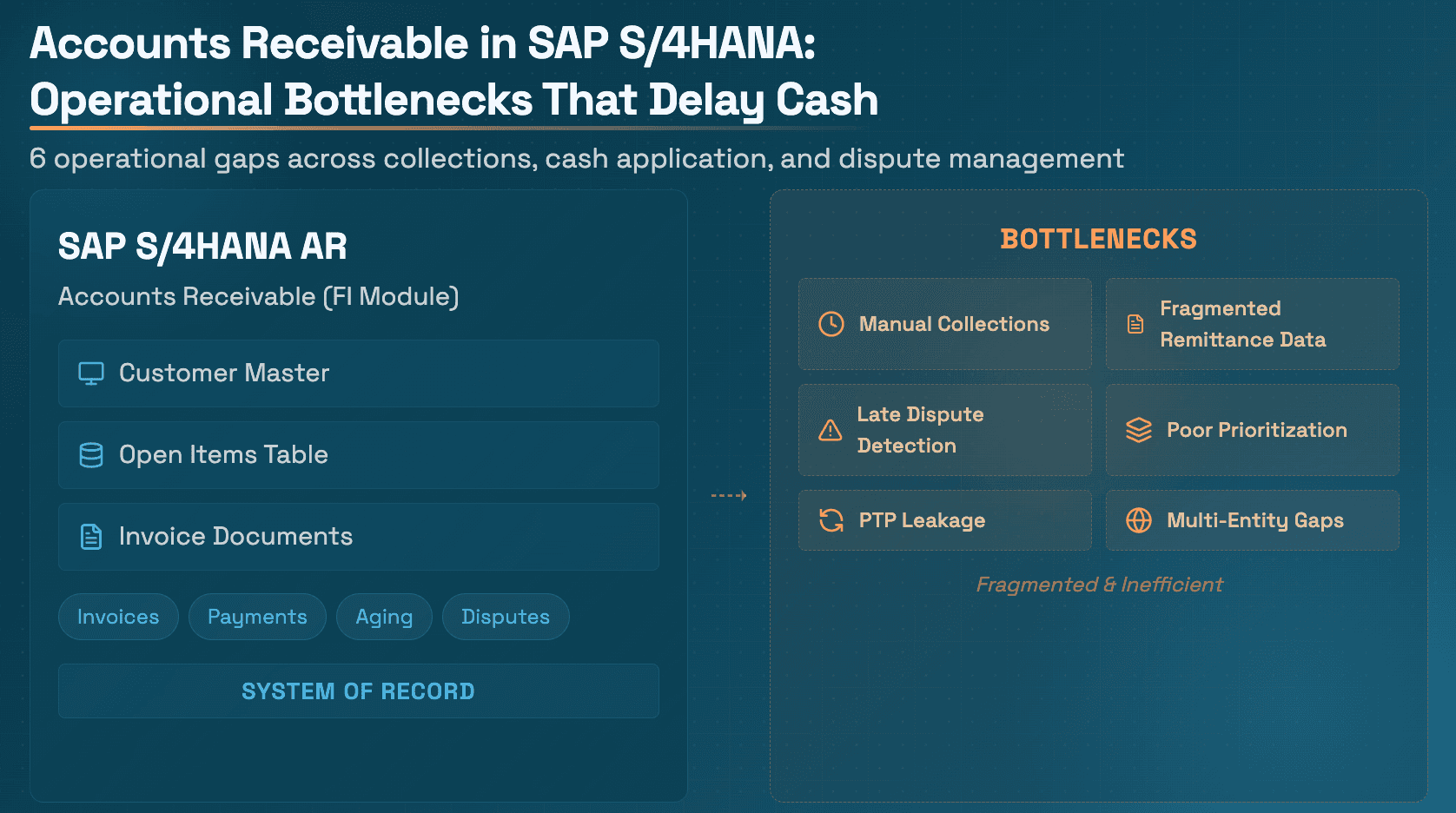
Despite SAP S/4HANA's promise of a unified, real-time financial backbone, most enterprises running it still experience significant delays between invoice issuance and cash receipt acceptance. The root cause is almost never the ERP itself; it is the operational fabric layered on top of it: fragmented AR workflows, manual collections follow-ups, slow dispute management, and error-prone cash application processes that no ERP configuration alone can fix.
This article maps the six most impactful bottlenecks in SAP S/4HANA Accounts Receivable, explains why they persist even in modern ERP environments, and details how Hyperbots AI Co-Pilots, particularly the Collections Co-Pilot and Cash Application Co-Pilot, deliver transformational, measurable improvements in DSO, cash conversion, and AR team productivity on top of SAP S/4HANA.
The SAP S/4HANA Accounts Receivable Paradox
Over the past decade, thousands of enterprises have invested hundreds of millions in migrating to SAP S/4HANA, one of the most sophisticated ERP platforms in the world. SAP S/4HANA's in-memory HANA database, Fiori user experience interface, and deeply integrated financial modules were supposed to transform how finance operates. And in many ways, they have: faster period closes, cleaner GL structures, better audit trails.
Yet ask any CFO, Controller, or AR Director whether cash is arriving faster as a result, and the answer is almost universally: not really.
Days Sales Outstanding (DSO) industry benchmarks remain stubbornly high. A significant portion of enterprise AR teams still rely on email threads, spreadsheets, and manual follow-up calls for collections. Cash application errors create unapplied cash balances that sit unreconciled for weeks. Dispute management cycles drag on for months because no structured workflow routes disputes to the right owner automatically.
The reason is simple: SAP S/4HANA provides a world-class platform for recording and reporting financial data, but it is not natively designed to autonomously orchestrate the operational workflows that turn outstanding invoices into collected cash. That gap, between what the ERP records and what the business actually needs to do to collect the cash, is where DSO increases longer than it requires.
The average DSO in mid-to-large enterprises is 30-45 days, even on SAP S/4 HANA. 80% of collection efforts are consumed by manual follow-ups for collections, with disputes or unapplied status resulting in AR aging.
What SAP S/4HANA Accounts Receivable Actually Covers: and What It Doesn't
Understanding the bottlenecks requires first understanding the scope of SAP S/4HANA Accounts Receivable natively. The AR function in SAP S/4HANA sits within the Finance (FI) module, which handles Accounts Receivable and Accounts Payable via sub-ledgers, general ledger accounting, management accounting, transaction recording, financial close, and financial reporting. Reporting is surfaced through
SAP Analytics Cloud, which connects data from SAP and third-party sources for real-time analytics
Fiori dashboards, SAP's interface layer for web and mobile applications.
These are foundational capabilities. But they rely heavily on human configuration, upfront setup investment, and structured data, precisely the things that break down at operational scale:
Dunning programs in SAP can be scheduled to run at regular intervals, but they operate on fixed parameters and predefined forms like SAP Scripts and SAP Smart Forms. The programs do not have ability to adapt notices dynamically based on individual customer payment behavior or relationship history. The notices have tone and content depending on the dunning level, and are not personalized for each customer.
SAP Cash Application uses ML and computer vision to extract remittance data from emails, documents, and images via OCR; this feature is part of SAP AI Core, delivered in the SAP Cloud Platform. So this requires a separate license for SAP Cash Application, and also to use SAP S/4HANA Cloud Public Edition. This leaves many implementations still reliant on manual processing.
Dispute management in SAP FI-FSCM (Financial Supply Chain Management module) is powerful when fully configured, but configuration is complex, spanning case record models, case types, and profiles, followed by AR integration. This process is rarely complete in practice. While a dispute can be created before an invoice is overdue, it still requires a person to act because SAP doesn't automatically detect dispute signals. (done)
Collections management in SAP S/4HANA provides a worklist to prioritize sales-related business partners to manage collections of receivables, but building and prioritizing that worklist still requires significant manual effort and judgment.
The net result: SAP S/4HANA gives AR teams a capable cockpit: dunning runs on a schedule, a collections worklist exists, dispute cases can be logged, and remittance data can be extracted.
But each of these capabilities comes with a catch: fixed forms that don't adapt to customer behavior, prioritization logic that must be custom-built, dispute detection that still waits on a human trigger, and an AI-powered cash application that requires a separate cloud license.
The cockpit is there, but most teams are still doing a great deal of the flying by hand.
Six Operational Bottlenecks in SAP S/4HANA AR That Delay Cash
Bottleneck 1: Manual, Reactive Collections Workflows
The most pervasive bottleneck in SAP S/4HANA Accounts Receivable is the way collections is operated: reactively. While SAP Collections Management automatically generates prioritized worklists based on strategy rules, those rules must be configured from scratch, but building and prioritizing that worklist still requires significant manual effort and judgment.
In practice, manual or partially configured implementations frequently fail to surface the right customer data, which means collectors could keep falling back on aging reports and individual judgment.
Dunning runs are periodic and operate on fixed parameters with a significant between the number of days of each dunning notice. The notice tone and content are tied to dunning level rather than individual customer payment history or relationship context, hence there is no dynamic adaptation to collection priorities.
Bottleneck 2: Fragmented Remittance Data Is Difficult To Gather
Cash application is a step that requires the most automation theoretically in the AR workflow, as it is very labor-intensive. Matching incoming payments to open invoices and posting to SAP requires constant checking of payment status, which drains finance teams of the precious time they could use for other strategic actions.
Customers send remittance data in wildly inconsistent formats like documents, Excel files, email body text, lockbox files, and customer portal exports, often with incorrect invoice numbers, partial payments, or combined remittances covering hundreds of invoices.
SAP Cash Application can extract remittance data from unstructured sources like bank statements and lockbox files using machine learning and OCR, but this capability is part of SAP AI Core and requires a separate license on the SAP Cloud Platform.
The result: most implementations remain reliant on manual processing for non-standard remittance formats, leaving unapplied cash balances that inflate AR aging, extend DSO, and create customer relationship issues when invoices appear outstanding despite payment.
Bottleneck 3: Late and Inconsistent Dispute Detection
Dispute management failures are among the most expensive AR bottlenecks. Disputes, stemming from pricing discrepancies, quantity differences, tax errors, PO mismatches, or damaged goods, are rarely surfaced proactively. The typical process remains disjointed: a customer calls or emails to flag a problem; the dispute coordinator pulls an aging report that shows the invoice is overdue but not why, leading to an out-of-context follow-up, relying on manual outreach to sales or shipping with no reliable tracking.
SAP's FI-FSCM Dispute Management module provides a structured framework when fully configured, with the help of prerequisite tasks in the Switch Framework, and accessing pre-delivered BAdIs, which are tasks required to prepare any SAP Dispute Management system. Further actions in configuration include setting up case record models, preparing case types, outlining profiles, and AR integration, but that configuration is extensive and rarely complete in practice.
Bottleneck 4: Absence of Dynamic Prioritization in AR Teams
Not all overdue invoices are created equal. A $2M invoice 5 days overdue from a strategic customer warrants a very different response than a $12,000 invoice 45 days overdue from a chronically late payer. (done)
SAP Collections Management does generate a prioritized worklist automatically, ranking business partners by score based on configurable strategy rules, which is a clear improvement over a standard aged debt report that can only sort by customer name or amount.
But the intelligence of that worklist is entirely dependent on how well the underlying rules are configured. Without rules that account for customer risk profile, payment behavior, dispute history, or strategic relationship value, the worklist defaults to whatever criteria were set up at implementation, typically basic aging or outstanding amount. The result is a system that can prioritize, but only as well as the rules someone built into it, leaving high-leverage collection actions routinely buried beneath lower-priority follow-ups.
Bottleneck 5: Promise-to-Pay (PTP) Leakage and Poor Follow-Through
SAP S/4HANA does support promise-to-pay tracking natively. When a customer commits to a payment date, a specialist records it against the overdue invoice; the item is then removed from the active worklist until the promise date passes. If payment is not received, the system automatically marks it as a broken promise and returns the item to the worklist. Broken promise history can also feed into a customer's overall valuation score, influencing their priority in future worklists.
The gap is not in tracking, it is in what happens between the promise being made and it being broken. There is no automated outbound reminder sent to the customer as the promise date approaches, no escalation workflow triggered when a promise breaks, and no proactive re-prioritization of a customer's full outstanding portfolio in real time.
The follow-through depends entirely on the specialist checking the worklist daily and acting on what they find, meaning in high-volume environments, broken promises surface as the due date passes rather than being interrupted before they become collection failures.
Bottleneck 6: Limited Visibility Across Multi-Entity, Multi-Currency SAP Environments
Enterprise SAP S/4HANA deployments almost always span multiple legal entities, subsidiaries, and currencies. AR teams managing these environments lack a unified, real-time view of aging, outstanding disputes, unapplied cash, and collection activity across all entities. Each entity's data lives in separate company codes, often requiring manual consolidation into spreadsheets for management reporting.
This fragmentation delays strategic decision-making, prevents shared service centers from operating efficiently, and makes it nearly impossible to identify cross-entity collection trends or systemic customer risk patterns.
Why SAP S/4 HANA Cannot Survive Without Automation
SAP S/4HANA is a powerful ERP foundation, but it was not built to run AR autonomously. The gaps above are architectural realities: dunning runs on a clock, not customer intelligence; cash application breaks down on unstructured data; dispute detection waits for a human trigger; collections prioritization is only as good as the rules someone configured; and PTP follow-through depends entirely on a specialist checking a worklist.
At low volumes, skilled AR teams can absorb these gaps. At scale, the manual burden compounds daily: DSO climbs, cash flow suffers, and the limits of native SAP become impossible to ignore. Closing these gaps requires a layer of intelligence that SAP S/4HANA does not natively provide: one that acts continuously, adapts to real-world data, and integrates directly into the ERP without rebuilding it. That is precisely what Hyperbots is built to do.
How Hyperbots AI Co-Pilots Can Eliminate AR Bottlenecks in SAP S/4HANA
Hyperbots is the most comprehensive AI Co-Pilot platform purpose-built for Finance & Accounting, covering the full Procure-to-Pay (P2P) and Order-to-Cash (O2C) cycle. Unlike general-purpose automation tools for Accounts Payable and Accounts Receivable, every Hyperbots Co-Pilot is built on a proprietary Agentic AI platform pre-trained on millions of financial documents and transactions, capable of real-time bidirectional ERP integration, and deployable in weeks without code changes or third-party integrators.
For SAP S/4HANA Accounts Receivable, Hyperbots offers two dedicated Co-Pilots that directly address the six bottlenecks described above:
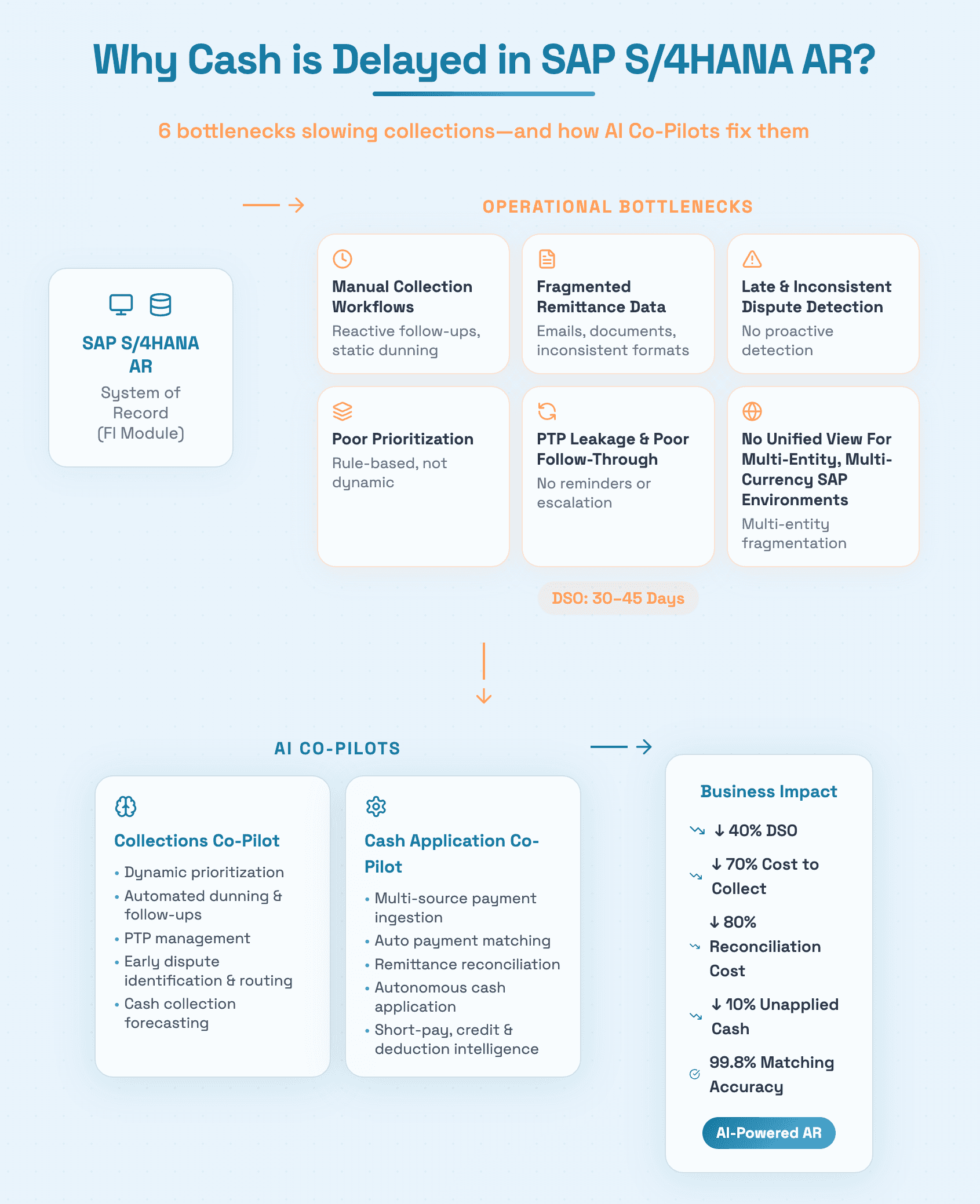
Hyperbots Collections Co-Pilot: Orchestrating the Entire Collections Lifecycle
What if 70% of your collections tasks ran autonomously, reducing your cost to collect by 70% in the process?
The Hyperbots Collections Co-Pilot autonomously orchestrates the full collections lifecycle, addressing the bottlenecks with SAP S/4 HANA.
AI-Driven Dynamic Prioritization: Continuously reprioritizes collection actions on the basis of payment behavior, invoice risk, dispute likelihood, customer value, and aging impact on DSO, ensuring collectors always work the highest-leverage actions first.
AI-Orchestrated Automated Dunning: Automates pre-due and post-due reminders using real-time customer behavior, risk, and dispute context, dynamically adjusting timing, tone, and escalation to accelerate payments while protecting customer relationships.
Autonomous Follow-Up Agents: Without any manual intervention, AI agents execute personalized email and portal follow-ups, reminders, escalations, and nudges automatically, breaking the reactive, delayed collections cycles that cost AR teams days and weeks.
Early Dispute Detection & Routing: Before invoices reach their due date, dispute signals like price, quantity, tax, PO mismatch, are identified and routed to the right resolver (billing, sales, tax, ops), directly eliminating the root cause of dispute rates rising.
Promise-to-Pay (PTP) Management: PTP commitments are captured, tracked, and enforced automatically, with reminders before the promise date and escalation on breach, closing the PTP leakage gap that adds weeks to enterprise collection cycles.
Cash Collection Forecasting: Using behavioral and historical patterns rather than static aging, expected cash inflows are predicted by customer, week, and month, giving CFOs the accuracy they need to make reliable cash flow commitments.
Closed-Loop ERP Posting: Every collection action, note, dispute status, PTP, and resolution outcome is automatically written back to SAP S/4HANA, removing manual logging entirely and keeping the audit trail complete and compliant.
Unified AR Intelligence Layer: Across ERPs, entities, and subsidiaries, a single real-time view consolidates invoices, aging, disputes, credits, payments, promises-to-pay, and customer communication, resolving the visibility across multi-entity, multi-currency SAP environments.
Customer-Aware Strategy: Collection approach is differentiated by customer segment, like strategic, repeat late payer, low risk, high risk, protecting relationships while accelerating cash recovery in a way no generic dunning program is capable of.
Hyperbots Cash Application Co-Pilot: Auto-Applied Payments
What if unapplied cash fell below 10%, and the cost of reconciling the rest dropped by 80%?
Hyperbots Cash Application Co-Pilot reduces unapplied cash and lowers reconciliation costs using document reconciliation AI agents pre-trained for 99.8% accuracy, directly solves the problem of fragmented remittance data in SAP, with an end-to-end automated cash application lifecycle:
Multi-Source Payment Ingestion: Bank feeds, lockboxes, ACH, wires, checks, portals, and email remittances are all supported in a unified workflow, regardless of format or structure.
AI-Driven Payment Matching & Application: Finance-trained AI automatically matches payments to invoices and remittances using invoice numbers, PO references, amounts, dates, customer behavior, and historical patterns, even with incomplete or noisy remittance data.
Document & Remittance Reconciliation Agents: Bank statements, lockbox files, emails, PDFs, and portals are parsed and reconciled by pre-trained reconciliation agents at 99.8% accuracy, handling every format without manual extraction.
Higher STP through Autonomous Cash Application Agents: Without any manual intervention, AI agents apply cash, post adjustments, close invoices, and update AR automatically, delivering high straight-through processing regardless of payment volume.
Exception & Short-Payment Intelligence: Every short-payment, overpayment, deduction, and unidentified cash item is automatically detected, root cause classified, and routed for resolution, eliminating the need for manual triage entirely.
Credit & Deduction Management: Valid credits, promotional deductions, chargebacks, and pricing differences are identified automatically and either applied directly or routed to the correct team for action.
Closed-Loop ERP Cash Posting: Every cash application, adjustment, write-off, and credit is automatically posted back to SAP S/4HANA, with full validation and controls built in at every step.
How Hyperbots Is Fundamentally Different from Other P2P & O2C Software
The market for finance automation software is crowded. RPA platforms, legacy OCR vendors, point solutions for collections or cash application, and large suite vendors like HighRadius, Billtrust, or Esker all claim to solve AR bottlenecks. So what makes Hyperbots categorically different?
Comparison Table
Capability | Hyperbots | Legacy OCR / RPA / Suite Vendors |
Pre-training on Finance & Accounting data | Pre-trained on 3M+ financial documents and transactions, ready to deploy from day one | Finance data training is relatively low; it requires extensive rule setup or model training before use |
Agentic AI | Natively agentic AI that reasons, adapts, and acts, not scripted RPA workflows | Relies on RPA scripts or fixed rules that break when formats or processes change |
SAP S/4HANA native read/write | Fully bidirectional SAP integration via BAPIs and APIs, reads and writes natively without middleware | Partial integration only; many require flat file transfers, manual exports, costly migration, or third-party connectors |
P2P + O2C in one platform | Single platform covering the entire P2P and O2C cycle, no stitching together separate tools | Typically covers one process area only, requiring multiple vendors and integrations to span P2P and O2C |
Per-seat licensing | Unlimited users at no additional per-seat cost, scales across the entire finance team freely | Per-seat licensing models that increase cost significantly as teams and entities grow |
Deployment timeline | Live in a few weeks with no code changes and | Deployments typically take months and |
Requirement of third-party integrator | No third-party implementation partner required, self-learning AI adapts to company-specific workflows | Require costly third-party integrators and custom development |
Scope of AI learning data | AI learns from your data only, fully isolated, with no cross-company data sharing or contamination | Models are either static or trained on pooled customer data, raising accuracy and confidentiality concerns |
Configurability for ERP customizations | Business teams can configure workflows, rules, and ERP customizations without writing a single line of code | Customizations require developer involvement, lengthy change requests, and ongoing technical maintenance |
Compliance certifications | Fully certified across ISO 27001, SOC 1, and SOC 2 Type 2, enterprise-grade security and compliance assured | Certifications vary widely by vendor; many legacy tools carry only partial or outdated compliance coverage |
Operations cost reduction | Demonstrated 80%+ reduction in operations cost across cash application, collections, and reconciliation workflows | Cost reductions typically range from 20–40%, with significant manual effort remaining after automation |
The deepest differentiator is Hyperbots' AI-native architecture. While legacy tools automate workflows by following rules, and most suite vendors layer ML models onto RPA scaffolding, Hyperbots was built from the ground up as an Agentic AI platform, meaning its agents reason, adapt, and learn.
The platform combines in-house finance-aware Large Language Models (LLMs) trained on 3M+ samples, Vision-Language Models (VLMs) fine-tuned on financial documents, a Mixture of Experts (MOE) architecture, AutoML-powered recommenders, and mathematical reasoning engines.
No other platform has such large pre-trained models on Finance & Accounting data.
Hyperbots Platform Capabilities: Transformational Impact on SAP S/4HANA
The Hyperbots Agentic AI Platform is not a layer of automation bolted on top of SAP S/4HANA, it is a deeply integrated intelligence layer that reads from and writes back into SAP in real time, preserving SAP as the system of record while dramatically expanding what SAP can operationally accomplish.
Native SAP S/4HANA Integration Architecture
Hyperbots' SAP S/4HANA Connector leverages SAP's proprietary APIs and BAPIs to seamlessly integrate with core modules, enabling real-time read and write of invoices, POs, vendor records, GL codes, and asset data. This ensures precise alignment with SAP S/4HANA's data structures and workflows for optimized financial operations. The integration supports:
Exhaustive ERP read/write: Full read-and-write access to COA, GL entries, vendor and customer masters, invoices, payments, POs, accruals, budgets, AR aging, and custom fields
Real-time bidirectional sync: Instantly synchronizing collection actions, cash postings, dispute status, and PTP commitments back into SAP without manual intervention
Both on-premise and cloud SAP variants: Supporting Cloud and On-Premise versions of SAP S/4HANA, SAP ECC, and SAP B1 environments
Multi-entity, multi-instance support: Seamlessly managing multiple company codes, SAP instances, and currencies in consolidated and entity-level views
Custom field support: AI-driven discovery and read/write access to company-specific SAP custom fields without breaking automation logic
Platform Intelligence Elements That Power AR Transformation
Hyperbots provides intelligence elements built on the Agentic AI platform:
Finance-Aware LLMs: LLMs pre-trained on tens of millions of financial document fields for precise extraction and interpretation of structured and unstructured AR data, delivering high accuracy from day one without customer model training.
Vision-Language Models (VLMs): Layout-aware VLMs fine-tuned on finance tasks, ensuring robust performance on remittance documents, lockbox images, and customer portal screenshots regardless of format or structure.
Predictive Engines & Recommenders: Purpose-built predictive engines for tasks like payment behavior prediction, collection prioritization, dispute likelihood, and GL recommendation, continuously improving through self-learning on company-specific data.
Mathematical Reasoning Engine: Validates invoice amounts, partial payments, deductions, and currency conversions with mathematical precision, eliminating the calculation errors that create exceptions in SAP.
Contextual Notifications: Real-time, role-based notifications for every AR event like overdue invoices, broken PTPs, dispute updates, unapplied cash alerts, unapplied payments, posting failures, delivered across finance, sales, and credit teams with full observability and audit trail support.
Why Hyperbots Collections & Cash Application Co-Pilots Are More Effective in SAP S/4HANA
Hyperbots was specifically engineered for deep ERP integration, and SAP S/4HANA represents its most mature and feature-rich integration environment.
Here is why the combination is particularly powerful:
SAP as Ground Truth, Hyperbots as Intelligence Layer
Rather than replacing SAP or creating a parallel system of record, Hyperbots treats SAP S/4HANA as the authoritative source of truth. Every action taken by Hyperbots, a collections email sent, a dispute routed, a payment matched, is written back to SAP immediately via BAPI/API, with a read-back confirmation ensuring the posting succeeded.
This architecture means SAP always reflects the current reality, compliance teams can rely on SAP data for reporting, and there is no risk of data divergence between Hyperbots and SAP.
Exploiting SAP's Rich Data Model for Better AI Decisions
SAP S/4HANA contains extraordinarily rich customer, transaction, and behavioral data like payment terms, payment history, dispute history, open order status, and GL aging, that most AR systems never fully exploit.
Hyperbots' Agentic AI reads this data in real time to make smarter decisions: dynamically reprioritizing collections based on real-time AR aging changes, identifying dispute signals from price, quantity, tax, and PO mismatch discrepancies, and predicting payment behavior using SAP's historical transaction data. The richer the SAP data model, the smarter the Co-Pilots become.
Handling SAP Customizations Without Code Changes
Enterprise SAP environments are never standard. They carry years of custom fields, company-specific GL structures, and bespoke workflow configurations.
Hyperbots' no-code configuration framework automatically discovers and adapts to these customizations, reading and writing to custom SAP fields without requiring IT development work or code changes. This is a capability that many competitors claim but rarely deliver cleanly, and it is particularly valuable for large SAP environments with extensive customization history.
Hyperbots-Led ROI Improvements in SAP S/4HANA AR
The return on investment from Hyperbots AI Co-Pilots in SAP S/4HANA AR environments is both tangible and measurable. Across deployments, Hyperbots consistently delivers several improvements.
Tangible Financial Impact
40% reduction in Days Sales Outstanding (DSO): The most critical cash flow metric for AR teams, achieved through AI-driven dynamic prioritization, autonomous follow-ups, and early dispute detection that collectively accelerate the entire invoice-to-cash cycle without adding headcount.
70% reduction in Cost-to-Collect: Autonomous AI agents replace manual collections workflows end-to-end, handling follow-ups, dunning, PTP tracking, and ERP posting automatically, so finance teams spend less per dollar collected while recovering cash faster across every customer segment.
80% reduction in reconciliation Cost: Automated dunning, personalized follow-ups, and AI-driven prioritization eliminate the labor-intensive manual effort that dominates traditional collections operations, freeing collectors to focus exclusively on high-value exceptions and strategic customer relationships.
10% Reduction Unapplied Cash Balance: The Cash Application Co-Pilot's AI matching engine and document reconciliation agents process remittances from every format and source without manual intervention or spreadsheet workarounds.
99.8% Accuracy in Payment Matching and GL Posting: Validated through SAP read-back confirmation after every posting, ensuring that every cash application, adjustment, and write-off is precisely reconciled in SAP S/4HANA with zero manual correction required to maintain audit compliance.
Intangible Financial Impact
Beyond the numbers, Hyperbots delivers intangible but strategically significant benefits in SAP S/4HANA AR environments:
CFO cash flow confidence: AI-powered cash collection forecasting gives CFOs reliable, behaviorally-grounded cash flow predictions rather than static aging-based projections
Customer relationship preservation: Customer-aware collection strategies protect strategic customer relationships while still accelerating collection, a balance impossible with generic dunning programs
AR team morale and retention: Eliminating repetitive, manual follow-up work redirects skilled AR professionals to relationship management and exception resolution, higher-value, more satisfying work
Audit readiness: Complete, time-stamped audit trails of every collection action, AI recommendation, dispute resolution, and cash posting in SAP, dramatically simplifying audit preparation
Scalability without headcount: As revenue and invoice volumes grow, Hyperbots scales with no incremental per-seat cost or staffing requirement, a significant advantage for fast-growing enterprises
The Path from SAP S/4HANA Data to Collected Cash
SAP S/4HANA is a world-class financial platform, but it was never designed to autonomously orchestrate the operational workflows that convert outstanding invoices into collected cash. The six bottlenecks explored in this article, manual collections, fragmented remittance data, reactive dispute management, poor prioritization, PTP leakage, and multi-entity visibility gaps, are not SAP failures. They are operational gaps that require a layer of AI-native intelligence that SAP does not natively provide.
Hyperbots fills that gap with the most comprehensive AI Co-Pilot suite available for Finance & Accounting. Its Collections Co-Pilot and Cash Application Co-Pilot, built on a proprietary Agentic AI platform pre-trained on millions of financial documents, integrate natively with SAP S/4HANA to deliver measurable, rapid, and sustainable improvements in DSO, cash conversion, and AR operations costs, typically within weeks of deployment and without requiring code changes or third-party integrators.
For CFOs and Finance leaders navigating the gap between SAP S/4HANA's promise and their AR team's daily reality, Hyperbots represents not an incremental improvement but a transformational shift: from reactive, manual AR workflows to autonomous, AI-orchestrated cash collection at scale.
Explore the Hyperbots platform, book a demo in order to get in touch with our finance experts, or start a free trial today to experience the difference first-hand.
Calculate the Collections automation ROI or the Cash Application automation ROI to know exactly how your company can benefit from Hyperbots.
Frequently Asked Questions (FAQs)
Q1: Will Hyperbots work with our SAP S/4HANA custom fields and company-specific configurations?
A: Yes. Hyperbots' configuration-driven framework automatically adapts to company-specific SAP customizations, enabling full read and write access to custom AR fields and company-specific GL structures, without code changes or risk of breaking automation during SAP upgrades.
Q2: Does Hyperbots use our SAP data to train general models shared across customers?
A: No. All self-learning is entirely company-specific and isolated. Customer data is never used for general model training, and there is no cross-company data leakage. Hyperbots is certified under ISO 27001, SOC 1 Type 2, and SOC 2 Type 2.
Q3: How does Hyperbots' dispute management work differently from SAP FSCM Dispute Management?
A: Unlike SAP FSCM, which relies on manual case creation, Hyperbots proactively identifies dispute signals like price discrepancies, PO mismatches, quantity differences, tax errors, before the due date, automatically routes them to the correct resolver, and updates SAP with resolution outcomes.
Q4: What is the pricing model for Hyperbots, is it per-seat or volume-based?
A: Hyperbots offers unlimited user access with no per-seat licensing, enabling seamless collaboration across AR, finance, sales, and credit teams without license constraints, ensuring automation benefits are never undermined by seat-cost economics as teams and invoice volumes grow.
Q5: Can Hyperbots work alongside our existing SAP ECC migration or S/4HANA Cloud transition?
A: Yes. Hyperbots supports On-Premise and Cloud versions of SAP ECC, S/4HANA, and SAP B1. When migrating between versions, no code changes are required, ensuring uninterrupted AR automation continuity throughout the migration period without re-implementation or operational disruption.