SAP S/4HANA Automation: The Complete Finance Guide for 2026
Most enterprises move to SAP S/4HANA for real-time visibility and operational speed, then discover their finance teams are still buried in manual approvals, spreadsheet reconciliations, and human-dependent invoice processing. This guide breaks down the three layers of SAP S/4HANA automation, workflow, native, and finance and shows exactly where intelligent AI platforms like Hyperbots step in to handle the complexity that rules-based automation alone can't resolve.
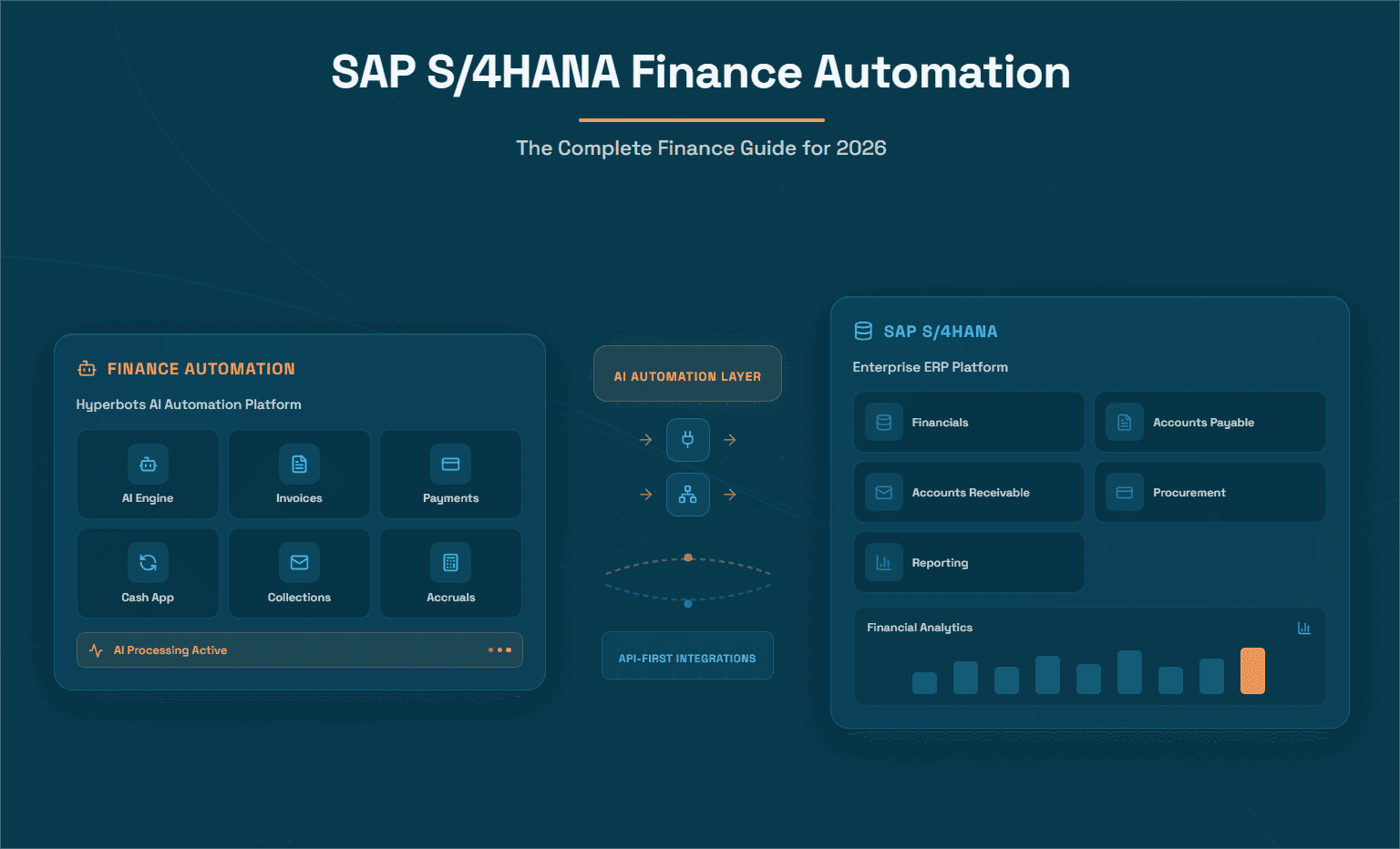
SAP S/4HANA is designed to behave like the central nervous system of a modern enterprise by facilitating all business decisions, managing day-to-day processes from sales orders and customer payments to procurement workflows and vendor management. For the tens of thousands of organizations running it worldwide, S/4HANA is not just an ERP, it is the financial backbone of the entire operation.
But here is a tension that every finance leader running SAP eventually confronts: the system is extraordinarily capable as a system of record, and deeply limited as a system of autonomous action.
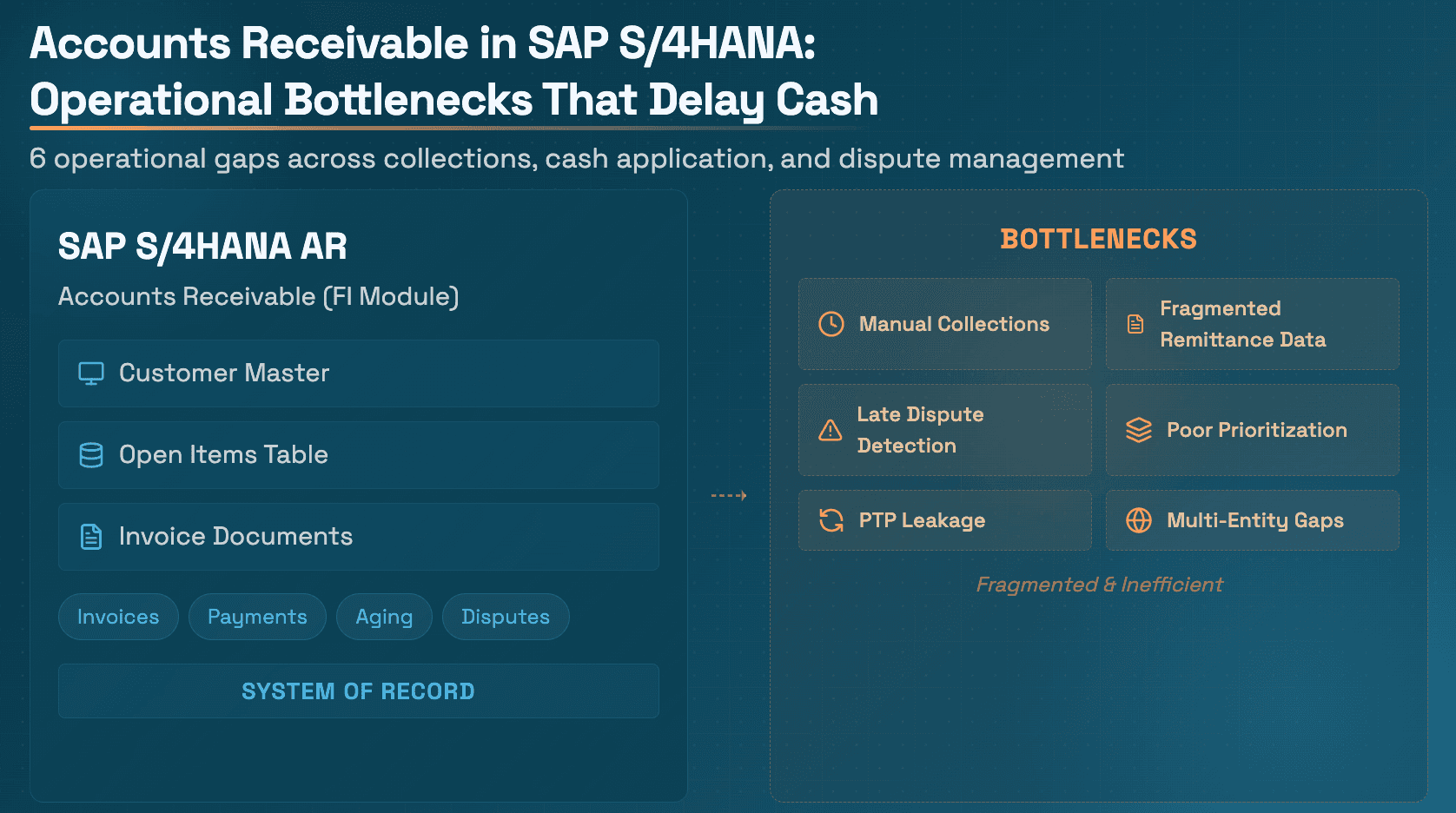
Invoices still arrive in inboxes and need to be read, extracted, matched, and posted. Month-end accruals still require controllers to query open POs, build spreadsheets, and manually book journal entries. AR aging reports still sit in someone's inbox waiting for a collections analyst to prioritize their call list. Cash application teams still manually match bank deposits to open invoices, one remittance at a time.
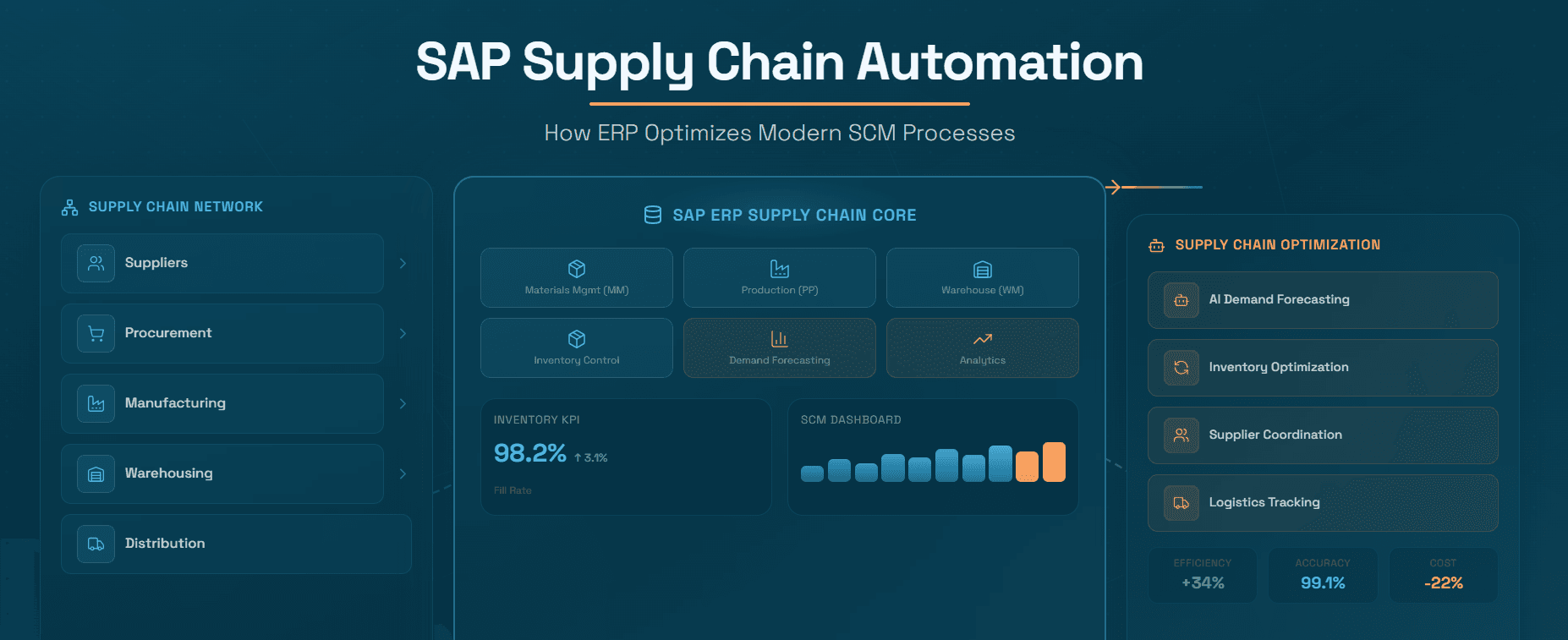
SAP S/4HANA functions as a system of coordination is closer to analytics, automation, and operational decision-making than earlier generations of SAP ERP. Embedded analytics, workflow automation, and real-time execution affect how teams work with business processes in practice. But the gap between what SAP can do natively and what organizations actually need, end-to-end, intelligent, autonomous finance automation, remains significant.
Closing that gap is the defining challenge of finance automation in 2026. The market is at a pivotal moment. Organizations are accelerating their move to S/4HANA, but automation adoption has plateaued as resources are diverted to migration. Success will depend on striking the right balance: keeping migration on track while not delaying the automation and platform strategies that deliver long-term value.
This guide gives finance leaders, CFOs, and enterprise architects a complete map of the SAP S/4HANA automation landscape, from SAP's own native tools, to RPA platforms, to the agentic AI co-pilot layer that is delivering the highest ROI in production environments today. And it explains why Hyperbots has built the most comprehensive, most deeply integrated finance automation suite for SAP available anywhere in the market.
The SAP S/4HANA Automation Landscape in 2026
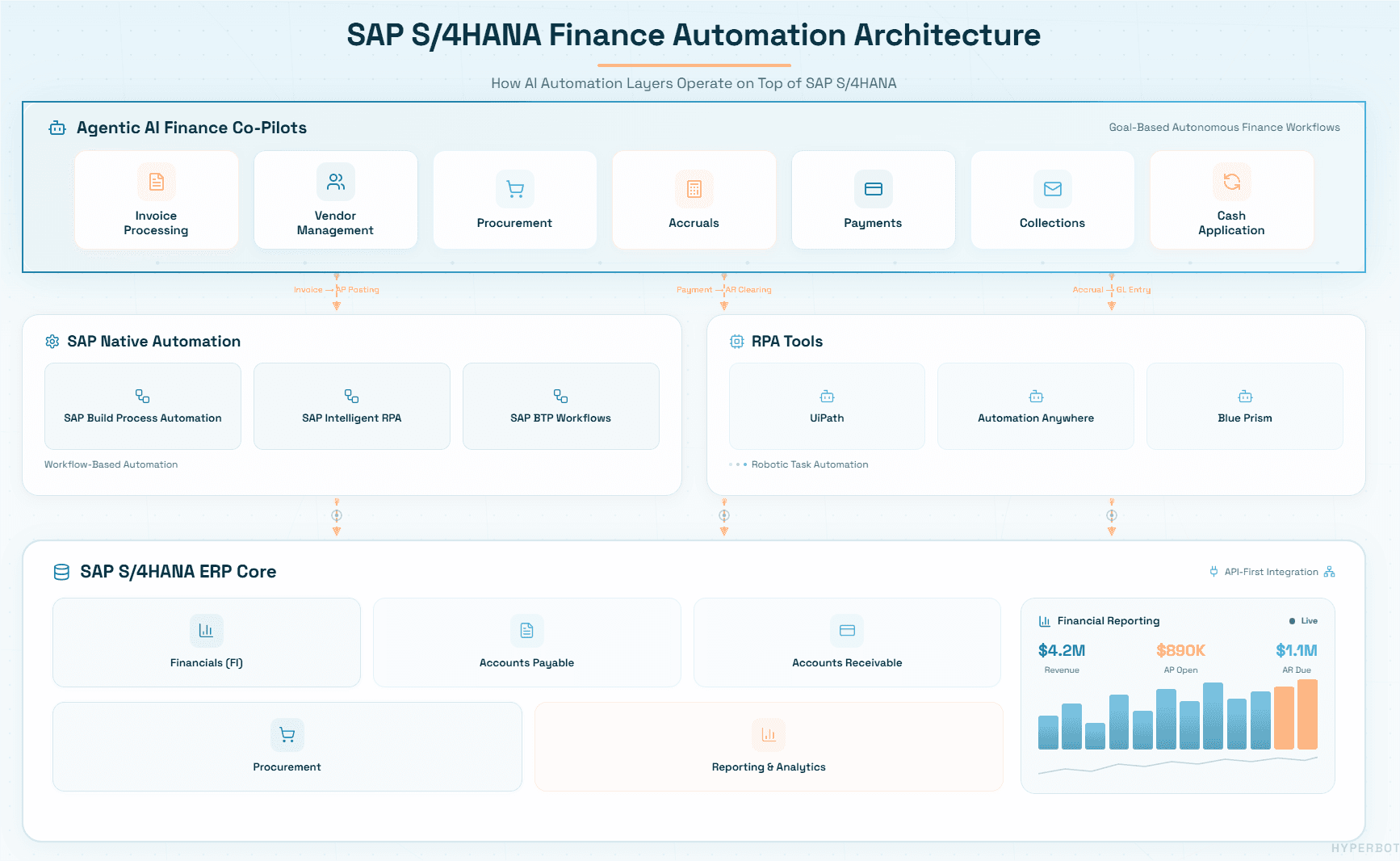
The automation options available to an SAP S/4HANA organization in 2026 fall into three distinct categories. Understanding their strengths, limitations, and ideal use cases is the starting point for any serious automation strategy.
Category 1 — SAP Native Automation Tools
Native SAP tools including SAP Build Process Automation and SAP Intelligent RPA, are embedded within the SAP ecosystem. SAP Build Process Automation specifically provides a low-code environment for designing and deploying workflows that execute within S/4HANA and BTP. It integrates natively with SAP data models and requires no external connectors for SAP-to-SAP processes.
S/4HANA natively integrates with advanced analytics, robotic process automation, machine learning, and artificial intelligence to enable smarter and faster business processes — including automating invoice matching, predicting sales demand, classifying inventory, and tracking movement.
SAP Build Process Automation lets workflows pause until specific API-triggered inputs are received and resume automatically. Developers can describe business scenarios in natural language and let generative AI create forms, decisions, and process flows automatically, powered by SAP's purpose-built large language models.
What SAP native automation does well: Workflows that stay entirely within the SAP ecosystem such as approval chains, document routing, event-driven triggers using SAP Event Mesh, and standard process extensions via BTP. Mahindra Group trained 200 business users on the low-code, no-code platform and achieved 250 business process automations in three months, a strong result for organizations with sufficient BTP licensing and internal capability.
Where SAP native automation falls short: SAP Build Process Automation adds complexity when processes span external portals, supplier systems, or non-SAP applications. SAP Build Process Automation can be expensive, especially for organizations with limited budgets, as it requires SAP BTP licensing. Some users report that newer features do not always feel fully baked, and complex issues may require escalation, impacting project timelines.
For finance automation specifically, handling multi-format invoices arriving by email, PDF, and EDI; applying cash from messy bank remittances; automating dunning sequences based on customer payment behavior, SAP native automation provides the workflow plumbing but not the AI intelligence needed to achieve high straight-through processing rates.
Category 2 — RPA-Based Workflow Automation
Legacy RPA tools such as UiPath, Blue Prism, Automation Anywhere, have been the dominant SAP automation approach for the past decade. They work by recording and replaying UI interactions: clicking through SAP Fiori screens and traditional SAP GUI transactions programmatically.
According to the 2025 Gartner Magic Quadrant for Robotic Process Automation, the RPA market grew by 18% last year, reaching $3.8 billion in revenue. RPA delivers real value in bounded, stable SAP processes with predictable screen layouts and consistent data inputs.
But the maintenance burden in SAP environments is severe. Ernst & Young data documents a 30–50% failure rate as SAP interfaces change, requiring costly IT rebuilds. For enterprises actively migrating to S/4HANA, rebuilding RPA bots after the migration is a major hidden cost typically €400K–€900K for an enterprise with 20–30 active automations.
SAP is working to ensure that its customers can orchestrate workflows, bots, and AI agents together without losing the foundational benefits of traditional RPA. Gartner reports a 750% increase in client inquiries about agentic automation between Q2 and Q4 of 2024, indicating that this is not a passing trend as CIOs actively explore integrating AI into their operations without sacrificing control or compliance.
The practical implication: RPA is a reasonable choice for highly stable, bounded SAP transactions where the screen layout never changes. For the messy, variable, exception-heavy world of finance automation with invoice processing, cash application, collections, RPA consistently underperforms.
Category 3 — Agentic AI Co-Pilots (the 2026 Standard)
Agentic AI platforms represent the current leading edge of SAP automation tools. Unlike RPA, which executes fixed scripts, agentic AI operates on goals: an agent given the instruction "process this week's supplier invoices" navigates the necessary SAP transactions, handles exceptions, escalates edge cases, and completes the workflow thus adapting to interface variations rather than breaking. The hybrid API + UI architecture (BAPI/RFC/OData for core transactions, browser automation for legacy or external systems) provides both reliability and breadth.
SAP TechEd 2026 confirms that in 2026, SAP workflows are evolving from simple rule-based automation to context-aware, autonomous processes. Organizations leveraging SAP workflow automation and AI integration can significantly reduce manual effort, improve accuracy, and accelerate business cycles across finance, procurement, and supply chain.
Analysts writing about SAP's roadmap describe AI agents as task-specific workers appearing in finance, procurement, HR, and supply chain. Automation has shifted from classic RPA toward broader workflow and automation tools that now include natural language design and AI-based process discovery.
This is precisely the architecture that Hyperbots has built agentic AI co-pilots that connect to SAP through standard APIs and BAPIs, process financial data with LLM-powered intelligence, handle exceptions autonomously, and write results back to SAP with full auditability. No ABAP. No brittle screen scraping. No RPA bots that break every SAP upgrade.
The Core Finance Automation Workflows in SAP S/4HANA
Before evaluating any automation tool, it helps to be specific about the high-value finance workflows that are the primary targets for automation in S/4HANA environments. These are the processes where the gap between what SAP does natively and what organizations need is largest and where the ROI from agentic AI co-pilots is most dramatic.
Accounts Payable and Invoice Processing Automation
The AP function is the single highest-volume, highest-repetition workflow in most SAP finance environments. A typical mid-market enterprise processes thousands of invoices per month, arriving by email, EDI, vendor portal, and post, each requiring capture, extraction, validation, matching, GL coding, approval routing, and posting to SAP FI-AP.
SAP S/4HANA's machine learning capabilities can automate invoice matching and predict demand. But SAP's native invoice matching assumes clean, structured data, a world that most real AP environments do not live in. The reality is multi-format PDFs, handwritten invoices, scanned documents with poor resolution, invoices in multiple languages, and line items that do not match PO descriptions exactly.
True AP automation requires AI that can handle this messiness and still achieve straight-through processing rates that make the economics transformational. Forrester's 2024 research documents 93% efficiency gains in invoice processing, with payback periods measured in weeks when agentic AI is applied.
Procure-to-Pay Workflow Automation
Procurement automation in SAP encompasses the full PR-to-PO lifecycle: requisition creation, policy validation, supplier selection, PO creation and dispatch, goods receipt confirmation, and invoice verification. Each step has an SAP transaction behind it and each step can be automated with the right approach.
SAP S/4HANA standardizes processes across finance, procurement, and supply chain. Automation reduces manual steps and improves consistency across transaction lifecycles, which can lower the frequency of process exceptions. The question is whether organizations use SAP's standard workflow capabilities alone, or layer in AI co-pilots that handle the exceptions and edge cases that standard workflows cannot.
Month-End Close and Accruals Automation
The month-end close is one of the most resource-intensive, error-prone processes in any SAP finance environment. Controllers spend days querying open POs, calculating uninvoiced accruals, booking journal entries, and then reversing them when invoices arrive. In multi-entity environments, this process is multiplied across every legal entity.
SAP S/4HANA embeds AI and machine learning into core finance processes. Enterprises can leverage AI-enabled predictive analytics for business forecasting. But the accruals process specifically like identifying what to accrue, calculating amounts, booking journal entries, and reversing automatically, remains largely manual in most SAP environments without a specialized co-pilot.
Accounts Receivable and Collections Automation
On the order-to-cash side, AR and collections automation in SAP FI-AR is one of the most underinvested areas of finance automation. Most organizations have SAP storing their open items, aging data, and customer records but the collections process itself is managed through manual phone calls, spreadsheet-driven prioritization, and email templates that a collector sends one by one.
Workflow automation that is embedded in SAP S/4HANA affects how teams work with business processes in practice but the intelligence layer that decides which customer to call first, what to say, and how to handle disputes is not something SAP provides natively. This is where agentic AI delivers its most visible business impact.
Cash Application Automation
Cash application, matching incoming payments from bank statements to open SAP AR items, is one of the most consistently painful manual processes in AR. The problem is data quality: bank remittances are incomplete, customers pay multiple invoices in a single wire, deductions appear without explanation, and short-pays require investigation. SAP's standard clearing functionality handles clean, well-matched payments. The 30–40% of payments that are messy land on a human analyst's desk.
Why SAP Native Automation Alone Is Not Enough for Finance
This is the conversation that most SAP consultants and system integrators avoid having with clients because SAP's own automation narrative is compelling, and it is easier to sell what the platform already includes.
The reality is more nuanced. 59% of organizations are now fully or partially live on S/4HANA, but automation adoption has plateaued as resources are diverted to migration. Business process change, customization complexity, and organizational resistance are the three major hurdles holding organizations back from realizing the automation ROI they expected.
Three specific limitations of SAP native automation explain this gap:
1. SAP native automation is optimized for structured data. Joule, SAP Document AI, and SAP Build Process Automation work well when data is clean, structured, and predictable. Real-world finance data are in the form of multi-format invoices, inconsistent remittance files, handwritten documents, emails in multiple languages and this requires AI that can handle unstructured inputs. SAP Build Process Automation's generative AI can create forms and process flows from natural language descriptions but it does not extract data from a PDF invoice with 99.8% accuracy across 35 million field variations out of the box.
2. SAP native automation requires significant BTP investment and skills. The top three challenges for BTP adoption are: skills gap (46%), complexity of development (43%), and difficulty understanding capabilities (36%). Many organizations describe BTP as a "build-it-yourself kit without instructions." Building genuine finance automation on SAP Build requires SAP BTP licensing, developer resources, and ongoing maintenance, a significant investment that delays time-to-value.
3. SAP native automation does not self-learn. The workflows you configure in SAP Build Process Automation are the workflows you get. They do not improve through use. They do not adapt to your specific supplier formats, customer payment patterns, or GL coding conventions. An AI co-pilot that learns from every transaction processed, and continuously improves its accuracy, is categorically different from a workflow engine with AI features bolted on.
The answer is not to abandon SAP native automation, it has genuine value for straightforward, within-SAP workflow automation. The answer is to recognize that the highest-ROI finance automation use cases require a purpose-built AI co-pilot layer on top, not instead of, what SAP provides natively.
Hyperbots AI Co-Pilots — Finance Automation Built for SAP S/4HANA
Hyperbots has built the most comprehensive suite of agentic AI co-pilots for finance automation in SAP S/4HANA environments. Every co-pilot connects to SAP through native API and BAPI connectors, operates in real-time bidirectional mode, requires no ABAP development, and deploys in three to five weeks. Here is the complete suite.
Procure-to-Pay AI Co-Pilots
The most impactful finance automation workflow in any SAP environment. The Hyperbots Invoice Processing Co-pilot is the only solution delivering true straight-through processing from email to SAP GL posting with zero human intervention. It achieves an 80% STP rate, cutting invoice cycle time from an industry average of 11 days to under one minute. Pre-trained on 35 million invoice fields with 99.8% field extraction accuracy, it handles every format (PDF, EDI, email, vendor portal) and performs configurable 2-way and 3-way matching across 140+ fields before posting directly to SAP FI-AP. Every action is logged in a tamper-proof, SOX-compliant audit trail.
Automates the complete SAP vendor onboarding lifecycle: document collection, W-9 verification, Business Partner duplicate checking, and clean ERP record creation all without manual intervention. Vendor onboarding time drops by 8x, from nine days to under one day. Vendor data error rates fall from around 6% to under 1%. The Co-pilot also provides a self-service vendor portal for live PO, invoice, and payment status visibility, and automatically identifies redundant or high-cost vendors for rationalization.
Automates the full PR-to-PO lifecycle in SAP MM. Auto-fills complex SAP procurement forms in as little as five minutes, converts approved purchase requisitions into POs using company templates, and dispatches them to vendors automatically. A self-learning GL recommender continuously improves coding accuracy based on historical approval patterns. Works in closed-loop with the Invoice Processing Co-pilot to automate PO closure when the matching invoice is posted.
Eliminates the single most painful manual task in SAP month-end close. The Accruals Co-pilot queries SAP at cut-off to identify all uninvoiced POs and GRNs, calculates accrual amounts using ML models trained on historical patterns, posts journal entries to the correct SAP GL accounts, and reverses them automatically when the actual invoice arrives. Close compresses from days to hours, with variance to actual consistently under 5%. This capability, fully automated, near-zero-touch accruals, does not exist anywhere else in the market.
Manages the complete SAP payment run: scheduling, approval routing, bank file generation, payment status tracking, and bank-to-SAP reconciliation. Validates vendor bank details against SAP master data before every payment run, detects fraud signals in real time, and optimizes payment timing to capture early payment discounts while maintaining cash flow targets. Supports ACH, checks, and wire transfers with a full audit trail written back to SAP FI-AP.
Sales Tax Verification Co-pilot
Validates sales tax compliance on every AP invoice before it is posted to SAP at both invoice and line-item level. Verifies shipping and vendor addresses against SAP master data, categorizes line items against jurisdiction-specific rules, and cross-references a continuously updated tax database covering all U.S. states. Every classification carries a confidence score, with low-confidence items flagged for human review. Natively integrated within the Invoice Processing workflow so no separate process required.
Order-to-Cash AI Co-Pilots
Reads open AR data, aging, and customer history directly from SAP FI-AR in real time and transforms it into an AI-driven collections engine. 70% of collections happen automatically without any human chasing. Achieves a 40% reduction in DSO and a 70% reduction in cost to collect, while improving collections team productivity by up to 80%. Forecasts expected cash inflows by customer, week, and month using behavioral patterns, not static aging buckets. Detects dispute signals before due dates and routes them automatically. Writes all outcomes such as notes, dispute status, promise-to-pay commitments directly back to SAP FI-AR.
Automates the complete cash application lifecycle against open SAP AR items. Achieves 80%+ straight-through processing, reducing unapplied cash to less than 10% and cutting reconciliation costs by up to 80%. Matches using multiple signals (invoice numbers, PO references, amounts, dates, customer behavior, historical patterns) simultaneously, handling partial payments, deductions, short-pays, and missing remittance with AI that would defeat any rules-based tool. Posts SAP AR clearing documents automatically with 99.8% accuracy.
How Hyperbots Differentiates From Other SAP Finance Automation Tools
When CFOs and finance leaders evaluate SAP automation options, they encounter four main categories of tool. Here is how Hyperbots compares across the dimensions that matter in production:
Dimension | SAP Native (Build/IRPA) | RPA Tools (UiPath, AA) | SAP VIM / OpenText | Hyperbots AI Co-pilots |
|---|---|---|---|---|
Requires ABAP / BTP dev | Yes — BTP licensing + dev | No, but fragile | Yes — ABAP required | Never |
Real-time bidirectional SAP | Partial | No — batch/screen | Partial | Always, by design |
Handles SAP custom fields | Manual configuration | No | Limited | AI auto-discovers |
Upgrade safe | Yes within BTP | Breaks 30–50% of time | Partial | Yes — no code changes |
AI decision architecture | Generative AI + rules | Rules only | Rules-based | Agentic LLM-powered |
Invoice STP rate | 40–60% | 20–40% | 40–60% | 80%+ |
Self-learning | No | No | No | Continuous |
Deployment timeline | 3–6 months | 2–4 months | 4–6 months | 3–4 weeks |
SOX audit trail | Basic | Minimal | Basic | Immutable, full-context |
Works outside SAP too | Complex / limited | Yes but brittle | No | Yes, all major ERPs |
Multi-entity SAP | Yes | Limited | Yes | Native |
The headline difference is not just capability — it is architecture. Unlike RPA, which executes fixed scripts, agentic AI operates on goals — navigating necessary SAP transactions, handling exceptions, escalating edge cases, and completing workflows while adapting to interface variations rather than breaking. Hyperbots is built on this architecture from the ground up — not bolted onto a legacy automation platform.
Hyperbots Platform Capabilities — Transformational Impact on SAP Environments
Beyond individual co-pilots, the Hyperbots platform delivers foundational capabilities that create compounding value across SAP landscapes.
Agentic AI Architecture — Goals, Not Scripts Hyperbots co-pilots operate on business outcomes, not fixed scripts. When an invoice arrives, the co-pilot does not execute a pre-recorded sequence of SAP clicks — it understands what the invoice is, validates it against SAP data, handles any exceptions intelligently, and posts the result. This goal-oriented architecture means the automation adapts to variability rather than breaking on it.
AI Auto-Discovery of SAP Custom Fields Every real-world SAP environment has custom Z-fields, non-standard GL structures, and company-specific configurations that generic automation tools cannot handle. Hyperbots uses AI-driven discovery to automatically identify and map custom fields, learn from historical approval patterns, and adapt to the specific configuration of your SAP instance — without manual field mapping or configuration by your basis team.
Real-Time Bidirectional SAP Integration Hyperbots connects to SAP through native API and BAPI connectors, operating in real time. After every posting, it reads the SAP record back to verify the transaction landed correctly — catching errors immediately and either retrying automatically or raising an exception. This verification-loop architecture ensures SAP data integrity even at high volumes.
SOX-Ready Immutable Audit Trail Every action taken by every Hyperbots co-pilot — every AI decision, every SAP posting, every approval workflow step, every exception — is logged in a tamper-proof, timestamped audit trail that meets SOX, PCI-DSS, and FedRAMP requirements. Internal and external auditors can review the complete decision trail for any transaction, with full context, in minutes rather than hours.
24/7 Autonomous Operation Hyperbots co-pilots run continuously — processing invoices at 2am, applying cash on Sunday, running collections follow-ups overnight. In global SAP environments spanning multiple time zones, this means zero overnight backlogs and transaction processing that matches business hours in every geography simultaneously.
Self-Learning Continuous Improvement Unlike SAP native workflow automation that plateaus at the quality of its initial configuration, Hyperbots co-pilots improve with every transaction processed. GL coding accuracy improves as the system learns from approval decisions. Matching rates improve as the system learns customer payment patterns. Exception rates fall as the AI learns your specific SAP data quality characteristics. The system gets measurably better the longer it runs.
Enterprise Security and Compliance Hyperbots holds ISO 27001, SOC 1 Type 2, and SOC 2 Type 2 certifications. It integrates with Okta, Microsoft Entra ID, Google Workspace, and OneLogin for SSO. All data is encrypted at rest and in transit with customer-specific permissions and field-level redaction for sensitive data.
Multi-ERP, SAP Plus Any Other System Many enterprises run SAP as their primary ERP alongside subsidiary instances of NetSuite, Dynamics 365, or Workday. Hyperbots connects to all of them simultaneously, with a single automation layer and unified analytics — one rule can drive SAP, NetSuite, and Sage instances simultaneously, with US GAAP and IFRS entities following the same approval workflow.
ROI — What Hyperbots Delivers on Your SAP Automation Investment
Procure-to-Pay ROI in SAP Environments
Tangible:
80% of AP invoices processed without human touch — the majority of SAP FI-AP postings happen autonomously
Invoice cycle time from 11 days to under one minute — the most dramatic operational transformation in AP
99.8% GL coding accuracy on SAP postings — eliminating reclassification journals and audit queries
Vendor onboarding 8x faster — from nine days to under one day, vendor data errors reduced from ~6% to under 1%
Month-end close from days to hours — accruals booked and reversed automatically in SAP GL, variance to actual under 5%
Near-zero sales tax errors — every SAP AP invoice validated at line-item level before posting, with full audit documentation
Deployment in 3–5 weeks — versus 3–6 months for SAP native automation build-outs
Intangible:
SAP basis and IT teams freed from integration maintenance — no custom code to maintain through upgrades
Finance teams shift from SAP transaction processing to strategic analysis and business partnering
Supplier relationships improve through faster, more accurate payments with real-time portal visibility
SOX audit preparation time dramatically reduced — complete, explainable evidence for every SAP posting
Scalability without headcount — 3x volume growth absorbed by the same Hyperbots deployment
Order-to-Cash ROI in SAP Environments
Tangible:
40% reduction in DSO — AI reads live SAP FI-AR data and acts on it autonomously, around the clock
70% reduction in cost to collect — 70% of collections activity automated without human chasing
80%+ STP on cash application — SAP AR clearing documents posted automatically, unapplied cash under 10%
80% reduction in reconciliation costs — bank-to-SAP matching at 99.8% accuracy
Collections team productivity up 80% — AI handles SAP AR follow-up, humans focus on high-value relationships
Intangible:
Real-time cash flow forecasting using live SAP AR data — replacing static aging reports with behavioral prediction models
Customer satisfaction improves — fewer incorrect dunning notices from SAP, faster dispute resolution
Credit risk signals surfaced proactively — delinquency patterns identified before they become write-offs
Revenue assurance strengthened — every open SAP AR item tracked and acted on, nothing falls through the cracks
Building Your SAP S/4HANA Automation Strategy — Where to Start
Given the breadth of automation options and the complexity of real SAP environments, the most common question finance leaders ask is: where do we start?
The answer depends on where the pain is largest. But the sequencing that delivers the fastest, highest-confidence ROI across SAP environments follows a consistent pattern:
Step 1 — Start with Invoice Processing (highest volume, fastest ROI) AP invoice automation has the clearest ROI case in any SAP environment: high transaction volume, well-defined process steps, measurable cycle time and cost-per-invoice metrics, and immediate visibility into improvement. Hyperbots Invoice Processing Co-pilot deploys in two to three weeks and delivers measurable STP improvement within the first 30 days.
Step 2 — Add Vendor Management (eliminates upstream blockers) Poor vendor master data is one of the most common causes of invoice matching failures. Deploying the Vendor Management Co-pilot simultaneously with Invoice Processing addresses the root cause of exceptions before they happen.
Step 3 — Automate Accruals (high-value close time reduction) With AP running on autopilot, the next highest-value target in most SAP environments is the month-end accrual process. Controllers typically spend two to four days per close on this task. The Accruals Co-pilot reclaims that time entirely.
Step 4 — Layer in Collections and Cash Application (O2C transformation) Collections and cash application automation deliver the most visible working capital impact — DSO reduction and unapplied cash elimination. These co-pilots often pay for the entire Hyperbots platform investment within a single quarter.
Step 5 — Complete the stack with Payments and Sales Tax Payment optimization and tax compliance automation round out the P2P stack, adding fraud prevention, early payment discount capture, and audit-ready tax documentation on every SAP-posted invoice.
Conclusion — SAP S/4HANA Is the Record. Hyperbots Is the Intelligence.
SAP S/4HANA has moved beyond its role as a pure system of record and it now functions as a system of coordination, incorporating analytics, automation, and operational decision-making. That is real progress. But the gap between SAP's coordination capabilities and the truly autonomous, AI-driven finance function that CFOs are being asked to build in 2026 remains significant.
SAP TechEd 2026 signals that we are entering an era where ERP is intelligent, automated, cloud-native, and deeply integrated into business strategy. From AI-first S/4HANA to workflow automation and embedded analytics, the SAP ecosystem is evolving faster than ever.
The organizations that will win in this environment are not those waiting for SAP to natively solve their AP backlog, their DSO problem, or their month-end close pain. They are the ones layering purpose-built agentic AI co-pilots on top of their SAP investment today, not after the next major release.
Hyperbots is that layer. It integrates with your SAP S/4HANA in two to four weeks, requires no ABAP, never breaks through upgrades, and delivers measurable ROI within 60 days. Eighty percent of invoices processed without human touch. Forty percent DSO reduction. Month-end close in hours, not days. Cash applied at 80%+ STP. And every single action, every SAP posting, every AI decision, every approval is logged in an immutable, auditor-ready trail.
Your SAP is already running. Make it intelligent.
Frequently Asked Questions (FAQs)
Q1: What is the difference between SAP native automation and an AI co-pilot like Hyperbots?
SAP native automation, specifically SAP Build Process Automation, provides a low-code workflow builder and RPA capabilities within the SAP BTP ecosystem. It works well for structured, within-SAP workflows. Hyperbots AI co-pilots are agentic, they understand business goals, process unstructured data (PDFs, emails, bank statements) with 99.8% AI accuracy, make autonomous decisions across complex exception scenarios, and continuously improve through self-learning. SAP native automation is workflow plumbing; Hyperbots is the intelligent decision-maker on top of it.
Q2: Does deploying Hyperbots require any changes to our SAP S/4HANA system?
No. Hyperbots integrates with SAP through standard documented APIs and BAPIs. No ABAP development, no custom Z-tables, no basis team involvement, and no transport requests are required. This also means Hyperbots is fully upgrade-safe when SAP releases a new version, the Hyperbots integration continues working without any code changes.
Q3: How does Hyperbots compare to SAP Build Process Automation for finance workflows?
For finance-specific automation such as invoice processing, accruals, collections, cash application, Hyperbots consistently outperforms SAP Build Process Automation on three dimensions: accuracy (99.8% vs. significantly lower for build-it-yourself workflows), deployment speed (3–4 weeks vs. 3–6 months for complex finance workflows on BTP), and continuous self-learning (Hyperbots improves with every transaction; SAP Build Process Automation does not). SAP Build is strong for approval workflows and notifications; Hyperbots is purpose-built for end-to-end finance process automation.
Q4: Can Hyperbots work alongside SAP Intelligent RPA?
Yes. Many organizations use SAP Intelligent RPA or UiPath for certain bounded SAP workflows while deploying Hyperbots for the more complex, AI-intensive finance processes. The two approaches are complementary, not competing. Hyperbots handles the processes where AI accuracy and autonomous decision-making matter most; RPA handles simple, stable screen-automation tasks.
Q5: What SAP finance processes can Hyperbots automate?
Hyperbots covers the complete P2P and O2C stack on SAP: AP invoice processing and GL posting (FI-AP), vendor master management (Business Partner), procurement and PO management (MM), month-end accruals and journal entries (FI-GL), payment runs and bank reconciliation (FI-AP/FSCM), sales tax verification, AR collections (FI-AR), and cash application (FI-AR clearing). This is end-to-end finance automation, not point solutions for individual steps.
Q6: How quickly can we expect to see ROI from SAP finance automation with Hyperbots?
The Hyperbots Invoice Processing Co-pilot typically shows measurable STP rate improvement within the first 30 days of deployment. Given that the co-pilot deploys in three to five weeks, most organizations see demonstrable ROI within 60 days of project start — not six to twelve months. Cash application and collections automation often pay for the full platform investment within a single quarter.
Q7: Does Hyperbots support SAP ECC as well as S/4HANA?
Yes. Hyperbots supports SAP ECC, SAP S/4HANA (both on-premise and cloud), SAP Business One, and other major ERP platforms including NetSuite, Oracle, Dynamics 365, and Workday. For organizations mid-migration from ECC to S/4HANA, Hyperbots works throughout the journey and importantly, does not require reconfiguration or re-deployment when you complete the S/4HANA migration.
Q8: What does "agentic AI" mean in the context of SAP finance automation?
Agentic AI means the automation system operates on goals rather than scripts. A traditional RPA bot is told exactly which SAP screens to click, in what order, with what inputs. When the screen changes or an exception appears, it fails. An agentic AI co-pilot is given the goal "process this invoice and post it to SAP" and navigates to that goal autonomously, handling exceptions, making decisions, and adapting to variability without breaking. Hyperbots co-pilots are agentic: they make hundreds of micro-decisions per invoice, per payment, per collections action, all logged, auditable, and continuously improving.
Q9: Is Hyperbots compliant with SOX requirements for SAP environments?
Yes. Every action taken by every Hyperbots co-pilot is captured in an immutable, timestamped audit trail meeting SOX, PCI-DSS, and FedRAMP (low-impact) standards. This covers every AI decision, every SAP posting, every approval workflow step, and every exception with full data lineage available for internal and external auditors without any manual documentation effort.