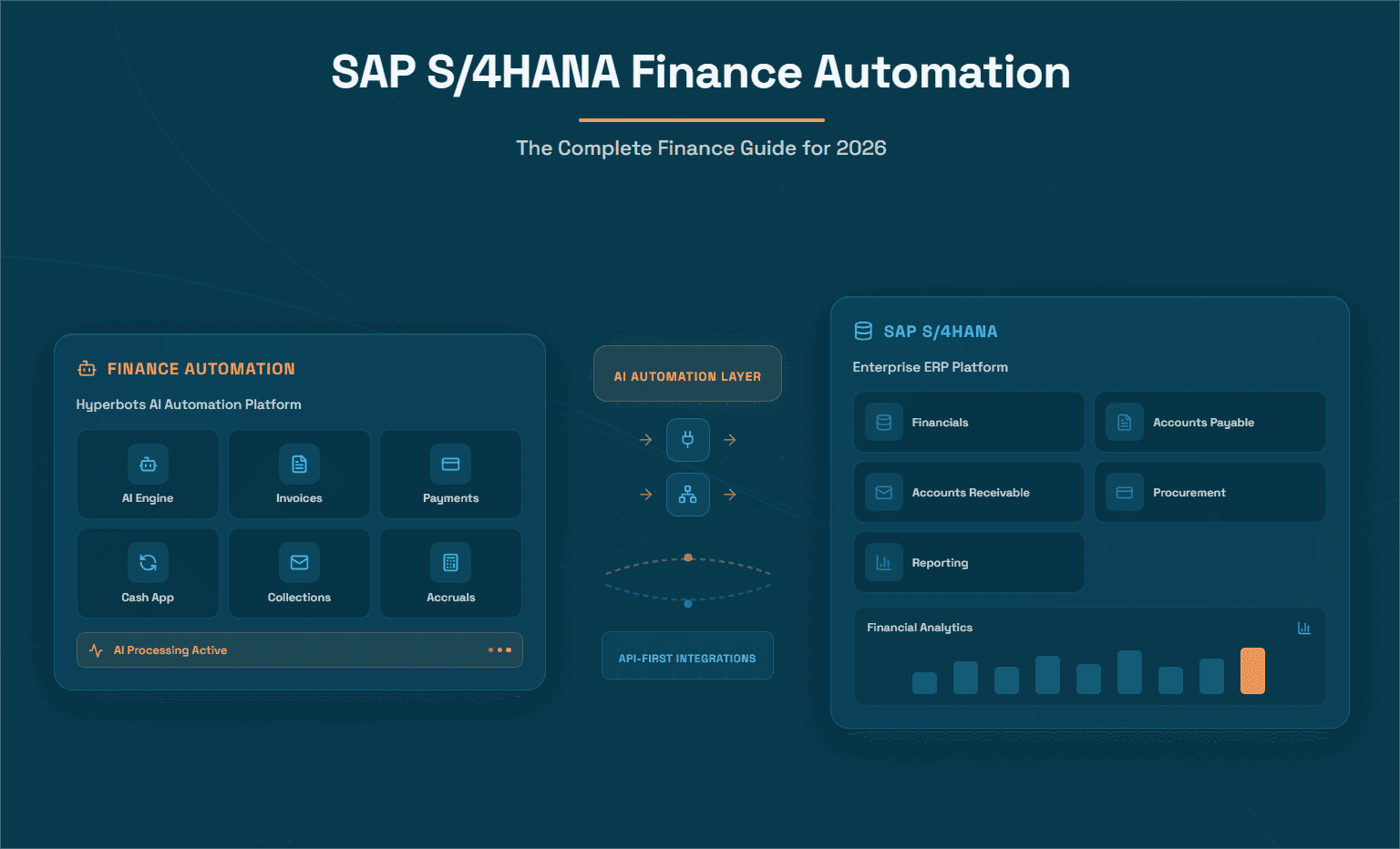

Supply Chain Management in ERP: How SAP Automates & Optimises Your SCM Processes
How integrated ERP systems streamline procurement, inventory, production planning, and logistics to create a faster, more resilient supply chain.
What Is SCM? A Complete SCM Overview
Before diving into how SAP handles it, let us answer the question that brings many readers here: what does SCM stand for, and why does it matter so much in 2026?
SCM stands for Supply Chain Management. In commerce, supply chain management deals with a system of procurement, purchasing raw materials and components, operations management, logistics, and marketing channels, through which raw materials can be developed into finished products and delivered to their end customers. A more precise definition describes it as the design, planning, execution, control, and monitoring of supply chain activities with the objective of creating net value, building a competitive infrastructure, leveraging worldwide logistics, synchronising supply with demand, and measuring performance globally.
In practical terms, what is SCM in business comes down to this: every product your organization sells passes through a chain of activities before it reaches a customer sourcing raw materials, manufacturing or assembling, warehousing, transportation, and final delivery. Supply chain management is the discipline of coordinating all of those activities intelligently, efficiently, and at minimum cost.
The scale of the supply chain management solution market reflects just how central this discipline has become to modern enterprise operations. According to MarketsandMarkets™, the global SCM market is expected to reach USD 58.42 billion by 2030, up from USD 38.51 billion in 2025, growing at a CAGR of 8.7%. North America alone accounted for a 38.5% share of the overall SCM market in 2024, and the service SCM segment is expected to grow at the fastest CAGR through 2030 as SCM services provide data-driven insights that improve real-time predictive production cost assessment and operational planning.
The applications of SCM span virtually every industry, from retail and e-commerce, where the application of supply chain management is essential to ensure products are available at the right time and location while reducing inventory costs, to industrial manufacturing, healthcare and pharmaceuticals, and consumer goods where the application of SCM determines whether organizations can compete on cost, speed, and customer service simultaneously.
Understanding both the breadth of supply chain management in business and the specific automation capabilities that modern SCM systems bring is the starting point for any organization serious about operational excellence in 2026.
The Business Case for Supply Chain Automation Software
The case for investing in a modern supply chain management suite has never been stronger or more urgent. Three forces are converging to make manual and legacy SCM approaches untenable.
1. Disruption has become the norm The disruptions in existing international supply chain networks created by tariff increases in 2024–2025 were quantifiable. According to German shipping company Hapag-Lloyd, one in every three planned U.S.-bound shipments from China had been cancelled as a result of tariff announcements — one of the most drastic instances of instant supply chain change on record. Organizations with real-time visibility and automated response capabilities navigated these disruptions far better than those relying on manual processes and lagged reporting.
2. Complexity is accelerating The SCM market encompasses technologies, software, and services that orchestrate and optimize the complex network of suppliers, manufacturers, distributors, retailers, and customers — with the core objective of enhancing efficiency, reducing costs, improving visibility, and increasing customer satisfaction. As supply chains extend globally and product portfolios expand, the volume of decisions, transactions, and exception events that need to be managed grows exponentially. Manual processes do not scale.
3. AI and automation are delivering measurable competitive advantage One of the most significant trends in supply chain management is digital transformation and automation, revolutionizing supply chains through AI, machine learning, and IoT technologies that enable predictive analytics, real-time tracking, and automated decision-making. Organizations deploying supply chain automation software are not just reducing costs, they are building capabilities their competitors cannot replicate quickly.
SAP, Oracle, and Manhattan Associates lead the SCM market with end-to-end supply chain platforms, advanced analytics, and strong integration capabilities, enabling global enterprises to optimize operations, enhance visibility, and improve overall supply chain efficiency. Among these, SAP's chain management system, embedded within S/4HANA and extended through the Digital Supply Chain portfolio, represents the most comprehensive and widely deployed SCM solution in the enterprise market.
SAP as a Supply Chain Solution Provider — The Complete Picture
SAP is not simply an ERP vendor with SCM modules bolted on. It is one of the world's leading supply chain solution providers with a dedicated Digital Supply Chain portfolio that covers every stage of the supply chain lifecycle.
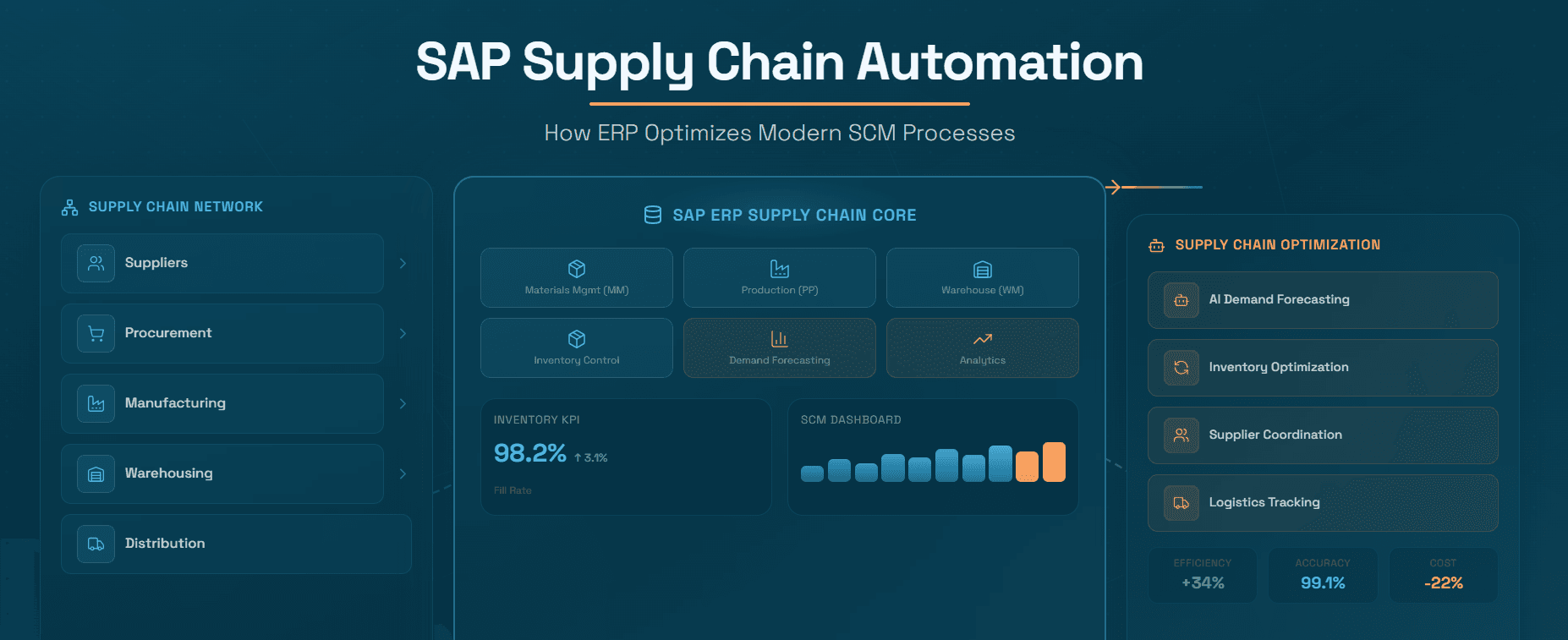
In the SCM market, SAP provides a comprehensive suite under its Digital Supply Chain portfolio, which includes SAP Integrated Business Planning (IBP) for demand and supply forecasting, SAP Extended Warehouse Management (EWM) for warehouse operations, SAP Transportation Management (TM) for logistics optimization, and SAP S/4HANA for supply chain to integrate planning, execution, and analytics. These solutions leverage AI, machine learning, and IoT to enable real-time visibility, automated decision-making, and scenario planning across the supply network.
SAP's supply chain management SCM systems provide manufacturers with functional capabilities that lead to accurate commitment dates, integrated transportation management, and streamlined warehouse management. The platform enables organizations to create an agile, connected, and intelligent supply chain with AI capabilities quickly deploying AI and intelligent robotic process automation to make faster, more informed decisions and improve supplier relationship management.
SAP's modern supply chain management solution replaces traditional ECC modules like Materials Management, Warehouse Management, and Plant Maintenance with streamlined lines of business designed for real-time processing, SAP Fiori user experiences, and advanced analytics. Key lines of business include Sourcing and Procurement, Manufacturing, Supply Chain, and Asset Management, along with extended capabilities like SAP Ariba, SAP EWM, SAP TM, and SAP IBP.
The result is a supply chain management suite that spans from strategic network design through operational execution all on a single platform, with a unified data model, and real-time analytics embedded throughout.
The Core SCM Modules in SAP S/4HANA — A Functional Deep Dive
Understanding the application of supply chain management within SAP requires familiarity with the specific modules that deliver it. Here is a comprehensive module-by-module overview.
Demand Planning and Forecasting (SAP IBP)
Demand Planning in SAP S/4HANA SCM forecasts customer demand using historical data, advanced statistical algorithms, and machine learning techniques. SAP Integrated Business Planning (IBP), SAP's cloud-native planning platform, extends this capability with collaborative S&OP, inventory optimization, and supply chain analytics.
SAP S/4HANA SCM incorporates advanced planning and forecasting tools powered by machine learning algorithms, enabling businesses to predict demand accurately, optimize production schedules, and minimise excess inventory thus leading to cost savings and improved customer satisfaction.
For finance teams, accurate demand planning is directly connected to working capital performance: better demand visibility means lower safety stock, fewer write-offs, and more precise cash flow forecasting. The connection between the SCM system and the financial planning layer is one of S/4HANA's most powerful embedded capabilities.
Procurement and Supplier Management (SAP MM / Ariba)
In the Sourcing and Procurement line of business, SAP assists users in identifying and acquiring materials through extended procurement, operational purchasing, contract and supplier management. Solutions such as SAP Ariba and SAP Fieldglass are considered part of the Sourcing and Procurement line of business.
The procurement module handles the full procure-to-pay cycle: purchase requisitions, purchase orders, goods receipt, invoice verification, and vendor evaluation. SAP consolidates shipping processes for inbound and outbound shipments, streamlines material flows, and reduces logistics costs through comprehensive freight agreement management with complex calculation rules and accurate freight costing.
This is also where the AI co-pilot layer delivers its most immediate, most measurable impact. While SAP MM manages the transactional framework, Hyperbots AI Co-pilots automate the intelligent decision-making within it by processing invoices autonomously, onboarding vendors automatically, and optimizing payment timing, all writing results back to SAP without human intervention.
Production Planning and Scheduling (SAP PP/DS)
Production Planning in SAP S/4HANA determines optimal production quantities, taking into account capacity limitations, material availability, and demand requirements. Detailed Scheduling creates feasible production schedules to maximize resource utilization and minimize setup times and costs.
In the Manufacturing line of business, SAP assists users in product creation through responsive manufacturing, production operations, scheduling and delivery planning, and quality management. Production Planning and Detailed Scheduling (PP/DS) handles complex and advanced supply chain planning.
For discrete manufacturers and process industries, PP/DS represents one of the highest-value application of supply chain management within S/4HANA thus enabling organizations to commit to accurate delivery dates while maximizing throughput and minimizing inventory.
Inventory Management and Warehouse Operations (SAP EWM)
SAP S/4HANA SCM provides comprehensive tools for managing inventory levels, including real-time visibility into stock, inventory tracking, and optimization, utilizing the real-time data processing capabilities of SAP HANA to enhance supply chain planning.
SAP Extended Warehouse Management (EWM) is embedded directly in SAP S/4HANA for warehouse automation. It supports automated inbound processing, cross-docking, outbound processing, warehouse storage, and physical inventory management.
Slotting and Rearrangement capabilities optimize storage location assignment and layout based on product characteristics and handling requirements which reduces pick times, minimizing travel within the warehouse, and maximizing storage utilization.
SAP S/4HANA Cloud supply chain solutions help businesses minimize costs against fluctuations in inventory, warehouse management, transport logistics, and order promising. By relying on automation, including real-time responses to supply, organizations can make quick decisions to increase profits, shorten lead times, and reduce waste.
Transportation Management (SAP TM)
Transportation Management within SAP S/4HANA 2025 has seen significant enhancements, including integration with Lean Service Procurement which is one of the most important highlights of the 2025 release.
SAP Transportation Management covers freight order management, carrier selection, route optimization, freight settlement, and logistics analytics. It connects inbound and outbound transportation processes with the rest of the supply chain — so changes in production schedules automatically trigger transportation re-planning, and customer delivery commitments are grounded in real carrier capacity and lead time data.
Order Promising and Customer Fulfillment (aATP)
SAP's advanced Available-to-Promise (aATP) offers advanced functionalities to optimize order fulfillment, improve delivery performance, and boost customer satisfaction is designed to streamline processes and provide greater transparency throughout the supply chain.
SAP S/4HANA SCM streamlines order fulfilment processes by optimising order promising and allocation. Businesses can promise accurate delivery dates to customers, increase order accuracy, and reduce order cycle times, leading to improved customer satisfaction and loyalty.
This capability directly connects the supply chain to the order-to-cash process, the same process that Hyperbots Collections and Cash Application Co-pilots automate at the AR end.
Where SAP SCM Ends and AI Co-Pilots Begin
Here is the reality that every SAP user running a supply chain management in business context eventually confronts: SAP S/4HANA provides an exceptional framework for managing supply chain transactions. It does not, on its own, autonomously execute the high-volume, high-judgment financial processes that sit at the intersection of the supply chain and the finance function.
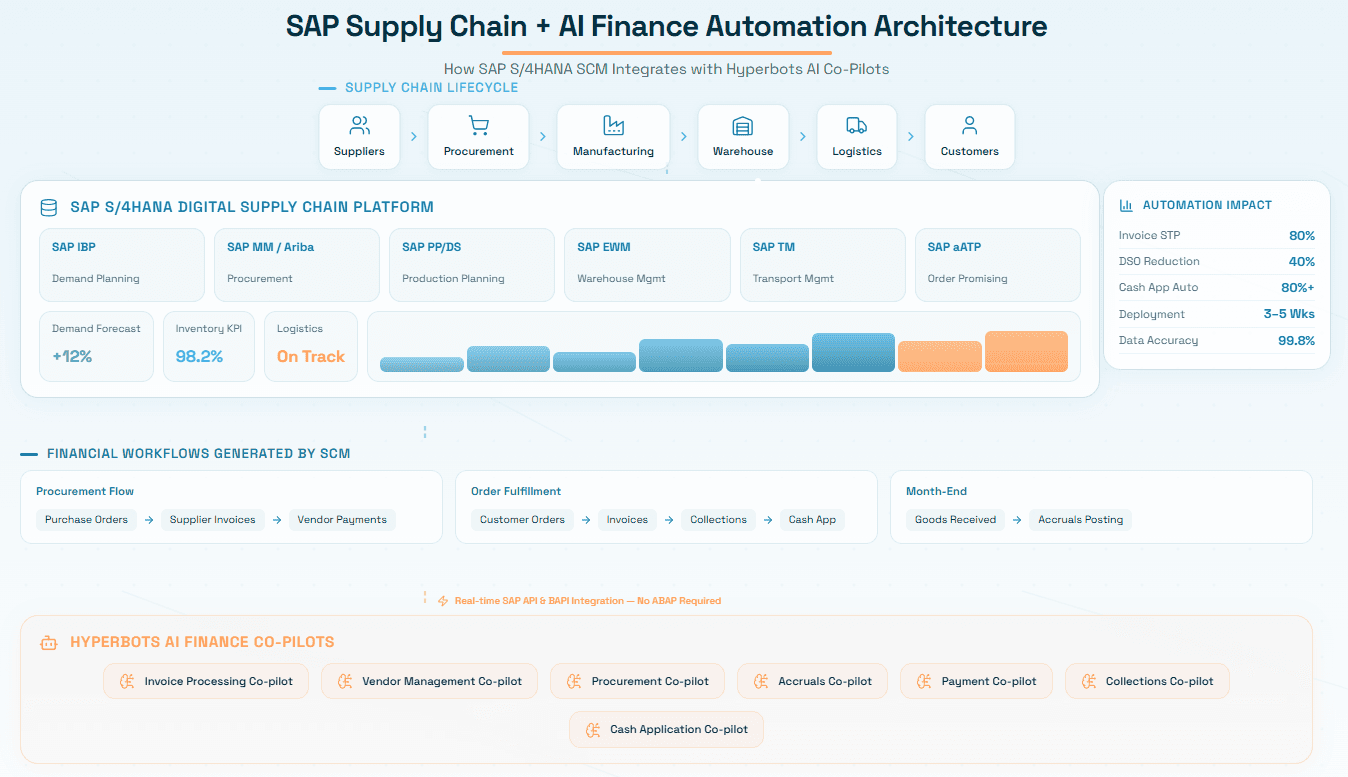
Specifically, there are five finance workflows that touch the SCM system every day and remain largely manual in most SAP environments:
1. Supplier invoice processing: Every purchase order generates an invoice. Every invoice needs to be captured, matched to the PO and goods receipt, GL coded, approved, and posted. In a high-volume manufacturing or distribution environment, this is thousands of transactions per month each one a candidate for straight-through automation.
2. Vendor onboarding: Every new supplier added to the supply chain needs to be onboarded into the SAP vendor master: documents collected, identity verified, tax forms validated, bank details confirmed. Done manually, this takes an average of nine days. Done with AI, it takes under one day.
3. Accruals at month end: When goods or services have been received but the invoice has not yet arrived at month-end cut-off, someone has to calculate and book an accrual. In supply-chain-intensive businesses with hundreds of open POs at month end, this is one of the most painful manual tasks in the finance calendar.
4. Customer collections: After goods ship and the customer is invoiced, someone has to manage the collections process: prioritizing who to contact, sending dunning communications, tracking disputes, and recording promises to pay. In businesses with large customer bases and high order volumes, this is a significant operational challenge.
5. Cash application: When customers pay, someone has to match each payment to the correct open invoices in SAP FI-AR often with incomplete remittance data, partial payments, and deductions that make automated matching difficult.
These five workflows are exactly what Hyperbots AI Co-pilots were built to automate on top of SAP S/4HANA, without changing the ERP, and deployable in three to five weeks.
Hyperbots AI Co-Pilots — The Finance Automation Layer for Your SAP SCM System
Hyperbots has built the most comprehensive suite of agentic AI co-pilots for finance automation in SAP S/4HANA environments. Every co-pilot connects to SAP through native API and BAPI connectors, requires no ABAP development, and integrates directly with the SCM-driven financial workflows described above.
Procure-to-Pay Co-Pilots
The direct financial automation layer for SAP MM and FI-AP. Every purchase order raised in your SAP chain management system generates an invoice that needs to be processed. The Hyperbots Invoice Processing Co-pilot handles this end to end, from capturing invoices in any format, extracting data with 99.8% accuracy using models pre-trained on 35 million invoice fields, performing 2-way and 3-way matching across 140+ fields against SAP PO and GRN data, to posting validated invoices directly to SAP FI-AP.
The results are unmatched in the supply chain automation software market: 80% straight-through processing, cycle time from 11 days to under one minute, zero ABAP required, and deployment in two to three weeks.
Every supplier in your supply chain needs a clean SAP Business Partner record. The Vendor Management Co-pilot automates the complete onboarding lifecycle such as document collection, W-9 verification, duplicate checking against the SAP vendor master, and automatic creation of clean ERP records. Vendor onboarding time drops 8x, from nine days to under one day, and vendor data error rates fall from ~6% to under 1%. A self-service vendor portal provides real-time PO, invoice, and payment status visibility, strengthening supplier relationships across the supply chain.
Automates the full PR-to-PO lifecycle in SAP MM. Auto-fills complex procurement forms in as little as five minutes, converts approved purchase requisitions to POs using company templates, and dispatches them to vendors automatically. A self-learning GL recommender continuously improves coding accuracy. Works in closed-loop with the Invoice Processing Co-pilot to automate PO closure when the matching invoice is posted.
For supply-chain-intensive businesses, the month-end accruals process is particularly complex with dozens or hundreds of open POs and GRNs at cut-off, each requiring an accrual calculation. The Accruals Co-pilot queries SAP at cut-off to identify all uninvoiced items, calculates amounts using ML models trained on historical patterns, posts journal entries to SAP GL, and reverses them automatically when invoices arrive. Close compresses from days to hours, with variance to actual consistently under 5%.
Manages the complete payment run in SAP FI-AP: scheduling, approval routing, bank file generation, fraud detection, and bank-to-SAP reconciliation. Validates vendor bank details before every payment, optimizes payment timing to capture early payment discounts, and supports ACH, checks, and wire transfers with a full audit trail.
Sales Tax Verification Co-pilot
Validates sales tax on every AP invoice at line-item level before SAP posting. Covers all U.S. states, continuously updates its tax database, and produces a timestamped audit trail for every decision and natively integrated within the Invoice Processing workflow.
Order-to-Cash Co-Pilots
Once goods have shipped and customers are invoiced through SAP SD and FI-AR, the collections process begins. The Hyperbots Collections Co-pilot reads live SAP AR data and autonomously orchestrates the entire collections lifecycle: dynamic prioritization, AI-driven dunning, dispute detection, promise-to-pay management, and ERP write-back. 70% of collections happen automatically without human chasing. Delivers 40% DSO reduction and 70% reduction in cost to collect, with collections productivity improving by up to 80%.
Automates the matching of incoming payments to open SAP AR items, the final step in the order-to-cash cycle. Achieves 80%+ straight-through processing, reducing unapplied cash to less than 10% and cutting reconciliation costs by up to 80%. Handles partial payments, deductions, short-pays, and missing remittance with AI precision that rules-based tools cannot match.
How Hyperbots Differentiates From Other SCM and Finance Automation Tools
The supply chain management solution market is crowded. Here is how Hyperbots compares to the tools most organizations encounter:
Dimension | SAP Native SCM Tools | Traditional AP/AR Tools | RPA Bots | Hyperbots AI Co-pilots |
|---|---|---|---|---|
Covers full P2P + O2C | No; SCM only | Partial | No | Complete end-to-end |
Requires ABAP / custom dev | Yes | Often | No but fragile | Never |
Real-time SAP integration | Native | Partial | Batch only | Always bidirectional |
Handles SAP custom fields | Manual config | Limited | No | AI auto-discovers |
Invoice STP rate | 40–60% | 50–70% | 20–40% | 80%+ |
AI decision architecture | Rules + ML | Rules-based | None | Agentic LLM-powered |
Self-learning | No | No | No | Continuous |
Deployment timeline | 3–6 months | 2–4 months | 2–4 months | 3–4 weeks |
SOX audit trail | Basic | Basic | Minimal | Immutable, full-context |
Multi-entity support | Yes | Limited | Limited | Native |
Upgrade safe through SAP releases | Yes | Partial | Breaks | Yes; no code changes |
The defining advantage is architecture. Hyperbots co-pilots are agentic, they operate on business goals, not fixed scripts. They process unstructured financial data with 99.8% AI accuracy, make autonomous decisions across complex exception scenarios, write verified results back to SAP, and continuously learn from every transaction. No other tool in the supply chain management SCM systems market delivers this combination.
Hyperbots Platform Capabilities: Transformational Impact on SCM Environments
ERP-Agnostic, SAP-Deep Integration Hyperbots connects to SAP S/4HANA through native API and BAPI connectors that read PO data, GRN records, vendor masters, and AR open items in real time, and writing back posted documents with full transactional integrity. No ABAP. No code changes through upgrades.
AI Auto-Discovery of Custom SAP Fields Every real-world SAP SCM environment has custom fields like non-standard material groups, custom vendor classifications, company-specific GL structures. Hyperbots AI automatically discovers and maps these without manual configuration or basis team involvement.
Multi-Entity and Multi-Instance Support Supply chains span legal entities, geographies, and sometimes multiple SAP instances. Hyperbots natively handles multi-entity, multi-company-code, and multi-instance SAP environments with consolidated and entity-level visibility, one automation layer across the entire supply chain landscape.
SOX-Ready Immutable Audit Trail so every action, every AI decision, every SAP posting, every exception is logged in a tamper-proof audit trail meeting SOX, PCI-DSS, and FedRAMP standards. Supply chain finance operations are fully auditable without any manual documentation effort.
24/7 Autonomous Operation Supply chains do not stop at 5pm. Hyperbots co-pilots run continuously, processing invoices overnight, applying cash on weekends, running collections follow-ups across time zones. In global supply chain environments, this means zero backlogs and transaction processing that matches business hours everywhere simultaneously.
Continuous Self-Learning Unlike rules-based SCM tools that plateau at their initial configuration quality, Hyperbots co-pilots improve with every transaction. GL coding accuracy improves as the system learns from approval patterns. Invoice matching rates improve as the system learns supplier document formats. Exception rates fall as the AI adapts to your specific SAP data characteristics.
ROI — What Hyperbots Delivers Across the SCM Finance Stack
Procure-to-Pay ROI
Tangible:
80% of supplier invoices processed without human touch — every PO your SCM system raises is matched and posted autonomously
Invoice cycle time from 11 days to under one minute — the most dramatic operational improvement in procurement-adjacent finance
99.8% GL coding accuracy on SAP postings — no reclassification journals, cleaner cost center reporting
Vendor onboarding 8x faster — new supply chain partners onboarded in under a day instead of nine
Month-end close from days to hours — supply chain accruals automated, variance to actual under 5%
Near-zero sales tax errors — every supplier invoice validated at line-item level before SAP posting
Deployment in 3–5 weeks — full automation live within one quarter
Intangible:
Procurement and finance teams freed from transactional processing to focus on supplier strategy and cost reduction
Supply chain visibility improves — clean, accurate SAP data from automated processing enables better analytics
Supplier relationships strengthen through faster, more accurate payments and real-time portal visibility
Audit readiness is continuous — complete, explainable evidence for every SAP posting
Scale without headcount — 3x supply chain volume growth absorbed without adding AP staff
Order-to-Cash ROI
Tangible:
40% reduction in DSO: AI acts on live SAP AR data around the clock, not during business hours only
70% reduction in cost to collect: 70% of AR follow-up automated without human chasing
80%+ straight-through processing on cash application: SAP AR cleared automatically, unapplied cash under 10%
80% reduction in reconciliation costs: bank-to-SAP matching at 99.8% accuracy
Collections productivity up 80%: collectors focus on strategic accounts, not routine chasing
Intangible:
Cash flow forecasting accuracy improves as behavioral prediction models replace static aging reports
Customer satisfaction improves with accurate, AI-driven collections communications, faster dispute resolution
Revenue assurance strengthens as every open SAP AR item tracked and acted on
Working capital optimization: faster collections + optimized payment timing = stronger cash position across the SCM cycle
Frequently Asked Questions (FAQs)
Q1. What does SCM stand for and what does it cover in SAP S/4HANA?
SCM stands for Supply Chain Management. In SAP S/4HANA, the SCM system covers demand planning and forecasting (SAP IBP), procurement and supplier management (SAP MM / Ariba), production planning and scheduling (PP/DS), inventory management and warehouse operations (SAP EWM), transportation management (SAP TM), and order promising and fulfillment (aATP). Together, these modules form a comprehensive supply chain management suite that manages the flow of goods and information from supplier to customer in a single integrated platform.
Q2. What is SCM in business and why does it matter for financial performance?
Supply chain management in business is the discipline of coordinating all activities involved in sourcing, procuring, producing, and delivering product, from raw material suppliers through to end customers. It matters for financial performance because supply chain efficiency directly drives working capital: inventory levels determine how much cash is tied up in stock; supplier payment terms and invoice cycle times determine AP cash flow; customer payment behavior and collections efficiency determine DSO and AR performance. Optimizing the SCM system optimizes the financial position of the entire business.
Q3. What are the key applications of supply chain management in an ERP system?
The application of supply chain management in an ERP covers six major process areas: demand planning (forecasting what to make and buy), procurement (sourcing and purchasing materials and services), production planning (scheduling manufacturing operations), inventory management (optimizing stock levels and warehouse operations), transportation management (planning and executing shipments), and order management (promising and fulfilling customer orders). In SAP S/4HANA, each of these has dedicated modules that integrate in real time, sharing data across the entire supply chain network.
Q4. How does Hyperbots complement the SAP SCM system without replacing it?
Hyperbots does not replace any part of the SAP SCM system, it adds an intelligent automation layer on top of it. SAP stores and manages supply chain transactions; Hyperbots automates the financial processes that those transactions generate: processing supplier invoices, onboarding vendors, booking accruals, managing collections, and applying cash. Every Hyperbots co-pilot reads from and writes back to SAP through standard APIs, with no changes to the SAP system required. The result is a supply chain management solution that combines SAP's transactional depth with Hyperbots' AI-driven automation intelligence.
Q5. What makes Hyperbots different from other supply chain automation software?
Three things distinguish Hyperbots from other supply chain automation software. First, agentic AI architecture, Hyperbots co-pilots operate on goals, not scripts, making autonomous decisions across complex exceptions rather than breaking on variability. Second, end-to-end coverage, Hyperbots covers the complete finance stack from procurement through to cash application, not just one step. Third, deployment speed — Hyperbots deploys in three to five weeks against SAP, with no ABAP required, compared to three to six months for traditional SAP finance automation tools.
Q6. Can Hyperbots handle the high invoice volumes typical of supply-chain-intensive businesses?
Yes and this is one of Hyperbots' core design principles. Unlike per-seat or per-transaction pricing models that create cost barriers to scaling automation, Hyperbots offers unlimited access licensing with no seat limits. A manufacturer processing 50,000 invoices per month pays the same as one processing 5,000. And because the co-pilots run 24/7 with no batch processing windows, peak volume periods, end of quarter, end of year are handled with the same throughput as normal periods.
Q7. What service SCM capabilities does Hyperbots add to SAP?
In the service SCM context, where organizations procure and manage services rather than physical goods, Hyperbots adds critical automation for non-PO invoice processing (services received without a purchase order), accruals for services-in-progress at month end (SRNI — Services Received Not Invoiced), and sales tax validation on service invoices. These service-specific automation capabilities are particularly valuable in professional services, consulting, IT, and maintenance environments where a significant portion of AP volume is service-based.
Q8. How does Hyperbots improve supply chain finance visibility?
Hyperbots provides real-time KPI dashboards covering the complete P2P and O2C stack: invoice STP rate, cycle time, GL coding accuracy, vendor onboarding time, accrual variance, payment discount capture, DSO trend, cash application hit rate, unapplied cash percentage, and collections productivity. These metrics give CFOs and supply chain finance leaders a live picture of exactly how the financial operations layer of their supply chain is performing, not a once-a-month management report, but a real-time operational dashboard updated continuously.
Your SAP SCM System Is Only as Powerful as Its Finance Automation Layer
The application of supply chain management in SAP S/4HANA is genuinely transformational, from demand planning through to customer delivery, the platform provides capabilities that no previous generation of ERP could match. SAP S/4HANA SCM provides real-time analytics and insights enabling businesses to make data-driven decisions promptly with real-time visibility into supply chain operations that helps identify bottlenecks, optimize inventory levels, and improve overall efficiency.
But the financial processes that the supply chain generates such as supplier invoices, vendor onboarding, accruals, collections, cash application still remain largely manual in most SAP environments. And manual processes are the bottleneck between a well-run supply chain and a high-performing finance function.
Hyperbots closes that gap. It is the AI co-pilot layer that sits on top of your SAP supply chain management solution, automates the financial workflows that your SCM system generates, and delivers measurable ROI within 60 days of deployment. Eighty percent of invoices processed without human touch. Forty percent DSO reduction. Month-end close in hours. Cash applied at 80%+ STP. All writing back to SAP with full auditability, all deployable in three to five weeks, all without changing a single line of ABAP.
Your SAP supply chain management suite is already working hard. Make the finance layer that surrounds it work just as hard.