API-First Procurement Automation Platforms
Streamlining procurement with purchase order API automation.
Executive Summary
Procurement is no longer just about managing suppliers and purchase orders—it’s about speed, connectivity, and intelligence. In an era where finance and procurement leaders must balance cost reduction with agility, API-first procurement automation platforms have emerged as the gold standard.
APIs (Application Programming Interfaces) allow seamless communication between procurement systems, ERPs, vendor portals, and financial applications. By building procurement processes around APIs, organizations unlock real-time visibility, automated purchase order (PO) workflows, and intelligent decision-making.
This blog explores the role of purchase order API automation, the evolution of procurement APIs, and the benefits of adopting automated PO APIs for modern enterprises. We’ll also highlight how Hyperbots AI Co-pilots extend API-driven automation to achieve up to 80% cost reductions and transformational ROI across procure-to-pay operations.
Key takeaways:
What API-first procurement automation means and why it matters.
How purchase order API automation streamlines requisition-to-payment workflows.
Real-world benefits of procurement APIs in retail, construction, and enterprise finance.
Hyperbots’ differentiated approach to API-first automation with AI Co-pilots.
What Is API-First Procurement Automation?
Understanding Procurement APIs
A procurement API is an interface that allows purchase order systems, ERP platforms, vendor databases, and financial applications to share and process procurement data in real time. Instead of siloed workflows, APIs create a plug-and-play ecosystem where purchase requests, approvals, and invoices flow seamlessly.
Key traits of API-first platforms:
Open Integration: APIs connect procurement with ERPs like SAP, Oracle, Microsoft Dynamics, and QuickBooks.
Scalability: Easy to add new vendors, payment solutions, or compliance modules.
Automation: Automated PO APIs route purchase orders, approvals, and invoices without human intervention.
Customization: APIs can be tailored for industry-specific workflows (retail inventory, construction project budgets, etc.).
The Role of Purchase Order API Automation
The purchase order API automation approach transforms how POs are created, routed, and processed.
Traditional PO challenges:
Manual data entry and duplication.
Delays due to email-based approvals.
Poor vendor visibility and inconsistent compliance checks.
Higher cost per purchase order.
Automated PO APIs streamline:
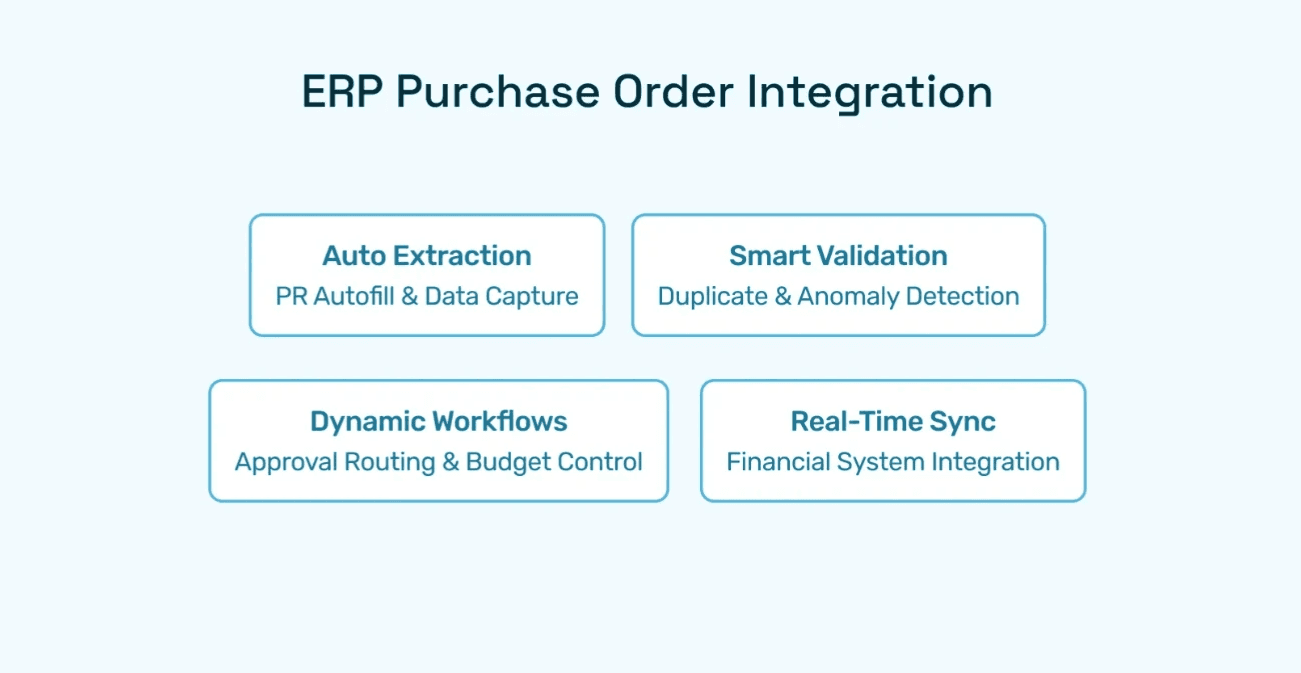
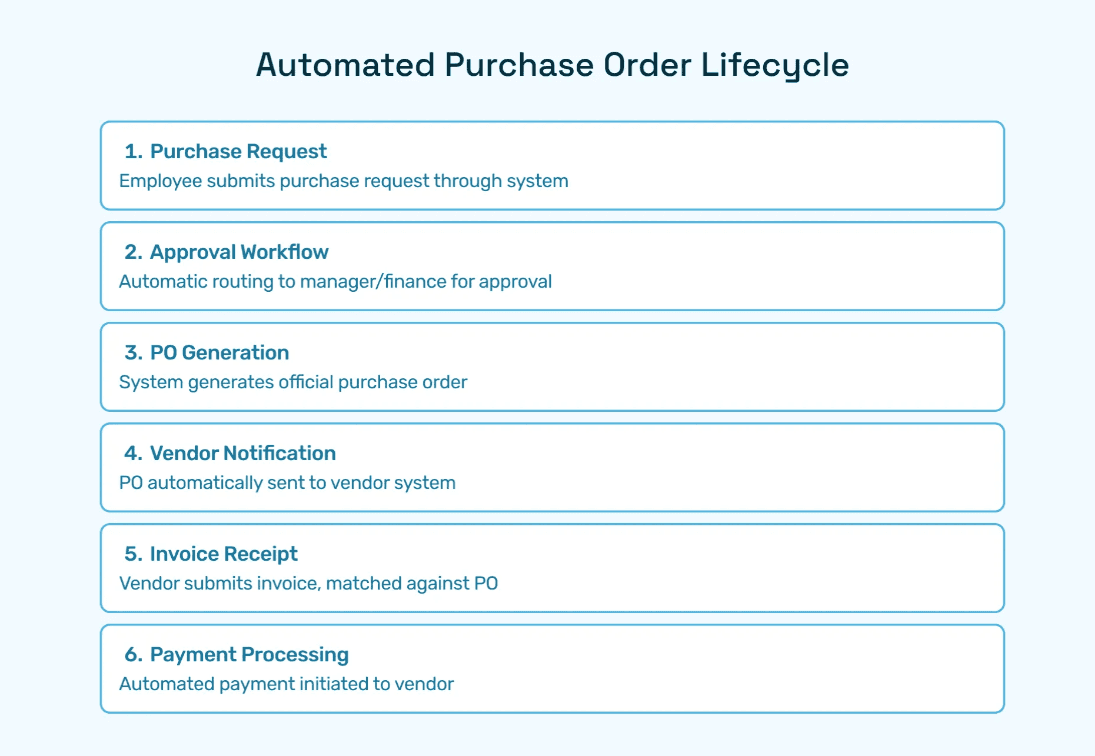
Requisition to PO conversion: Requests automatically convert into POs once validated.
Approval routing: APIs trigger conditional workflows based on spend thresholds.
Vendor communication: POs sent directly via API rather than manual emails.
Invoice matching: Automated 2-way or 3-way matching ensures compliance.
Benefits of API-First Procurement Systems
1. Real-Time Visibility
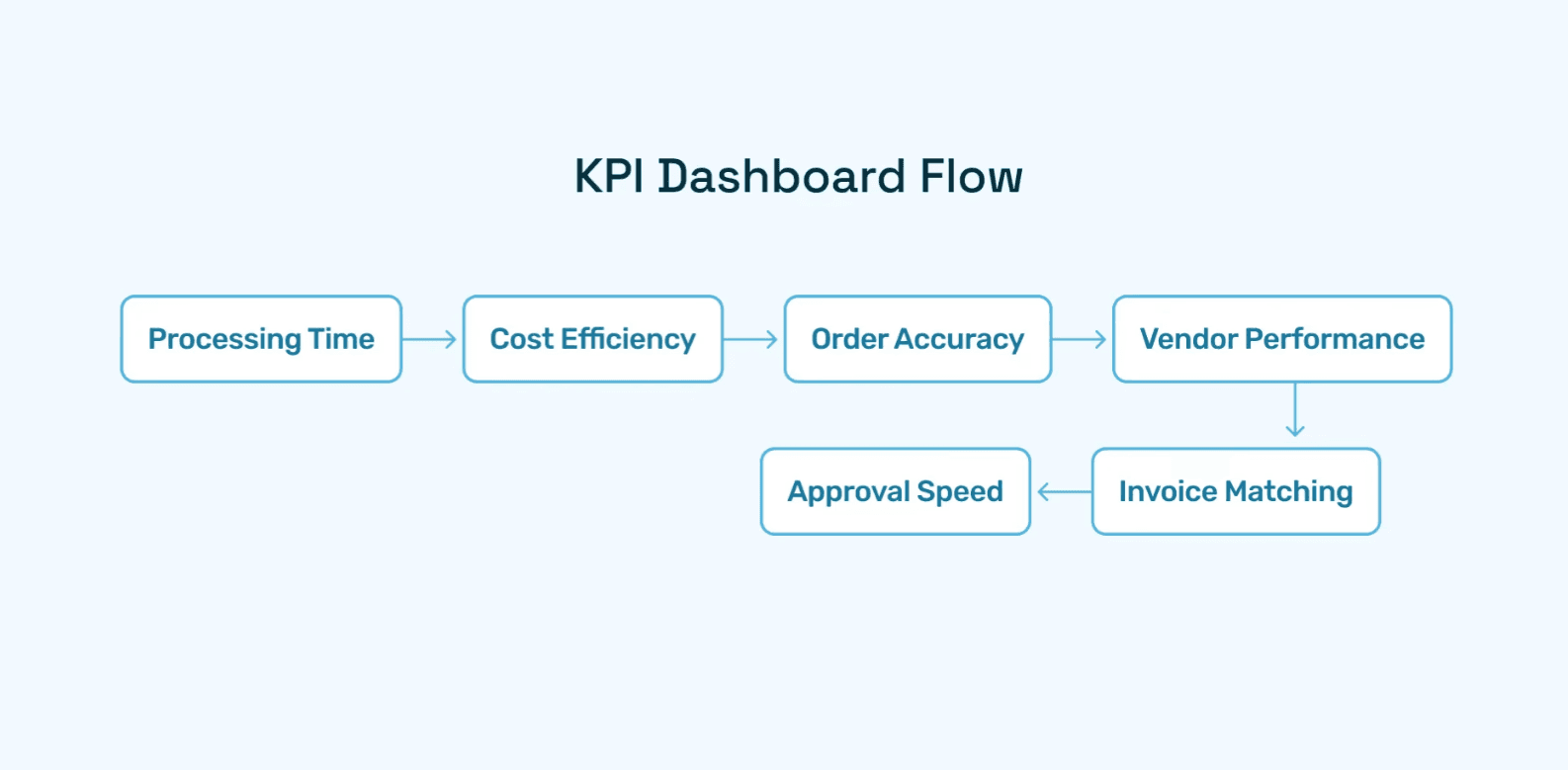
Finance teams gain instant insights into spend, commitments, and vendor performance.
2. Cost Savings
Automating purchase order workflows reduces the average cost of processing a PO compared to manual methods.
3. Compliance & Audit Trails
API logs provide end-to-end visibility—critical for audits and regulatory compliance.
4. Vendor Relationship Management
Automated communication builds trust, reduces disputes, and accelerates procurement cycles.
5. Scalability
Adding new suppliers, currencies, or tax jurisdictions is simplified with APIs.
Industry Use Cases for Purchase Order API Automation
Construction Industry
Challenge: Large-scale projects with budget overruns.
Solution: A construction purchase order system integrated via procurement APIs ensures every PO is tied to project codes, budgets, and real-time reporting.
Retail Industry
Challenge: Stockouts and supplier delays impact sales.
Solution: A retail purchase order system with automated PO APIs syncs inventory levels with procurement, triggering POs automatically.
Finance & Enterprise
Challenge: CFOs demand cost visibility across multi-entity structures.
Solution: Procurement APIs unify spend data across ERP systems like Microsoft Dynamics and Oracle.
Implementation Considerations for API-First Procurement
Steps to Success
Map Current Processes: Identify manual bottlenecks.
Select API-First Platform: Ensure ERP connectivity (SAP, Oracle, Dynamics, QuickBooks).
Integrate AI Automation: Extend beyond data exchange into decision-making.
Change Management: Train finance and procurement teams.
Common Pitfalls
Ignoring vendor onboarding workflows.
Over-customizing APIs without governance.
Underestimating data cleansing needs.
Future of Procurement APIs
Predictive Procurement: AI predicts demand and triggers POs via APIs.
Sustainability: APIs integrate ESG and supplier diversity metrics into procurement decisions.
Cross-Industry APIs: Standardized procurement APIs across industries will become the norm.
Conclusion: The Competitive Edge of Purchase Order API Automation
Procurement leaders who adopt purchase order API automation gain a measurable edge: faster cycle times, lower costs, and enhanced compliance. By extending procurement APIs with Hyperbots AI Co-pilots, organizations not only automate workflows but also embed intelligence and strategy into procurement decisions.
For CFOs, procurement heads, and vendor management leaders, API-first platforms are no longer optional—they are a necessity for competing in today’s real-time, data-driven economy.
👉 Explore how Hyperbots’ Procurement Co-Pilot, Invoice Processing Co-Pilot, and Vendor Management Co-Pilot deliver end-to-end automation that reduces costs by 80% while ensuring compliance.
FAQs
Q1: What is a procurement API?
A: A procurement API is an interface that connects procurement systems, ERPs, and vendors to enable real-time data exchange for purchase orders, approvals, and invoices.
Q2: How do automated PO APIs work?
A: Automated PO APIs convert requests into purchase orders, route them for approval, communicate with vendors, and sync with invoices—without manual intervention.
Q3: What industries benefit most from purchase order API automation?
A: Construction, retail, and finance benefit heavily by reducing errors, ensuring compliance, and speeding up procurement cycles.
Q4: How does Hyperbots enhance procurement APIs?
A: By layering AI decision-making, predictive analytics, and compliance checks on top of APIs, Hyperbots delivers end-to-end automation and measurable ROI.
Q5: What ROI can enterprises expect from purchase order API automation?
A: Organizations typically see 80% lower processing costs, faster cycles, and fewer errors.