Purchase Order Automation Tools and ERP Integration: The Complete Guide
How ERP-integrated tools automate purchase orders, reduce manual work, and improve procurement accuracy across finance teams
What Is ERP Purchase Order Integration (and Why It Matters)?
The integration of purchase order automation with ERP systems represents a transformational opportunity for modern enterprises. Automated procurement processes can reduce operational costs compared to manual processes, according to McKinsey & Company, while 75% of procurement executives planned data analytics and improvement initiatives in 2024. This comprehensive guide explores how ERP purchase order integration delivers measurable ROI through AI-powered automation, streamlined workflows, and enhanced visibility across the entire procure-to-pay cycle.
Organizations implementing robust ERP PO software solutions achieve significant competitive advantages: reduced processing times, enhanced compliance, improved vendor relationships, and substantial cost savings. With the market for AI in procurement expected to grow at a compound annual growth rate of 28.1% annually from 2024 to 2033, businesses that delay integration risk falling behind competitors who leverage these transformative technologies.
How Purchase Orders Flow Through an ERP System
ERP purchase order integration refers to the seamless connection between automated procurement systems and enterprise resource planning platforms, enabling real-time data synchronization, workflow automation, and end-to-end process visibility. This integration eliminates manual data entry, reduces errors, and accelerates procurement cycles while maintaining strict compliance controls.
Core Components of Modern Integration
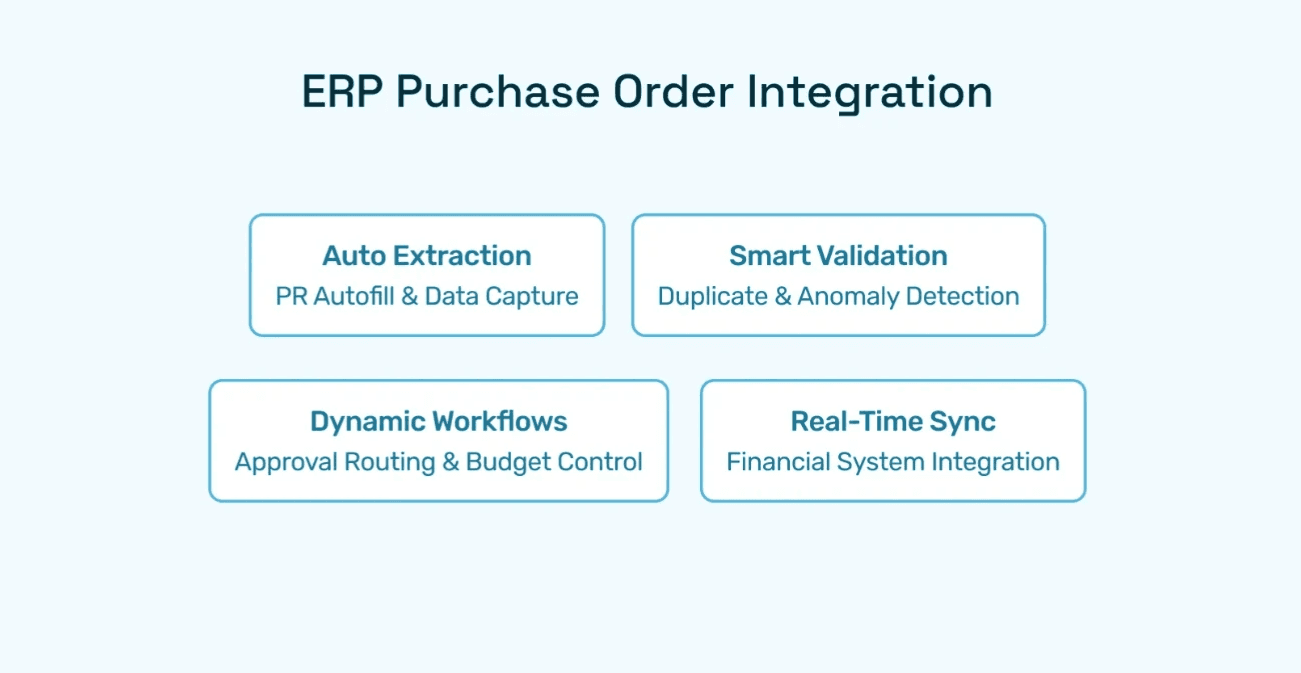
Effective procurement ERP integration encompasses several critical elements:
Real-time data synchronization between procurement and financial systems
Automated Field Extraction and PR Autofill
Validation, duplication & anomaly detection capabilities
Dynamic workflow routing based on approval hierarchies and budget controls
Comprehensive audit trails for regulatory compliance and process optimization
The integration architecture must support both cloud and on-premise ERP deployments while accommodating company-specific customizations and industry requirements.
The Real Cost of Manual Purchase Order Processes
What the Hackett Group's 2024 Data Says About Procurement Priorities
Finance leaders face mounting pressure to optimize procurement operations amid evolving business conditions. The Hackett Group's 2024 Key Issues research found improving cost reductions was the highest priority for procurement leaders, as businesses work against a climate of high interest rates, labour shortages and the challenges of growing revenue.
Hidden Time Costs, Bottlenecks, and Financial Accuracy Problems
Common pain points include:
Labor-intensive processes consuming 20+ minutes per invoice
Approval bottlenecks are causing vendor relationship strain
PO closure complications impacting month-end reporting
Poor purchasing discipline leading to maverick spending
Manual GL coding errors affecting financial accuracy
Vendor management inefficiencies are creating duplicate records and payment delays
How ERP Purchase Order Automation Works: Step by Step
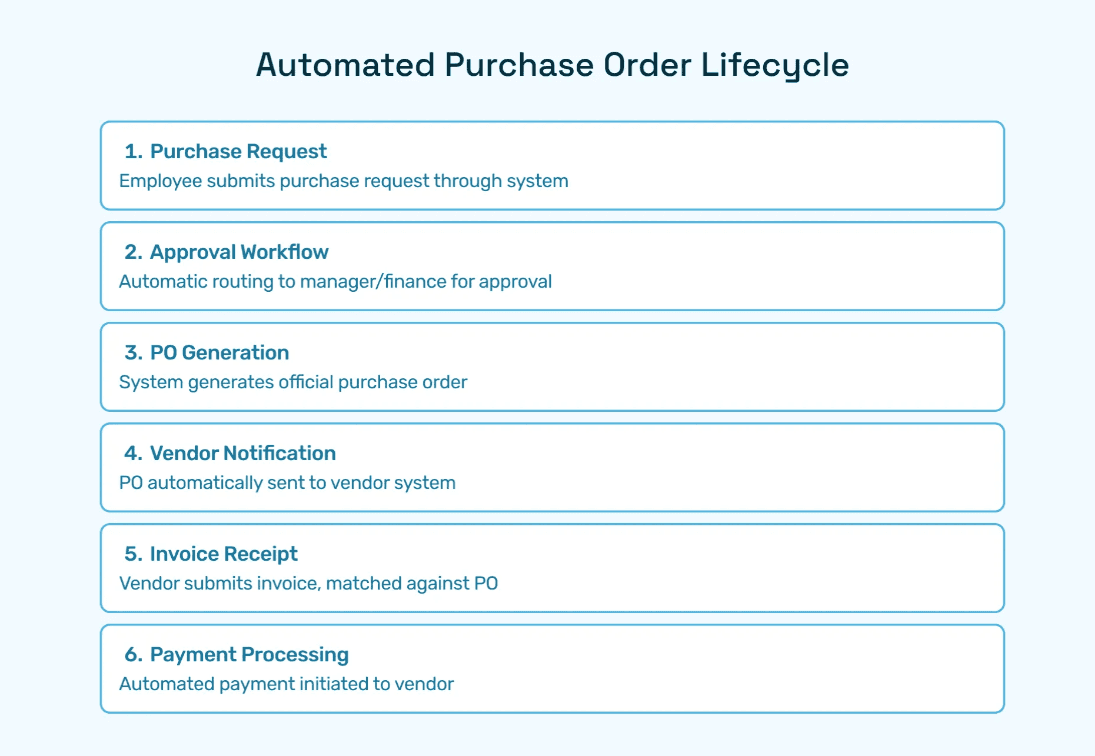
Step 1: Purchase Requisition Capture and Auto-Fill
The process begins when a purchase requisition is submitted. AI-powered systems automatically extract key fields, eliminating manual data entry and reducing the risk of input errors from the very first touchpoint.
Step 2: Budget Validation and GL Coding
Once the PR is captured, the system validates it against available budgets and recommends the correct GL codes. This prevents overspending and ensures financial accuracy before the PO is even created.
Step 3: Approval Routing and Workflow Triggers
The system dynamically routes the requisition to the right approvers based on pre-configured hierarchies, dollar thresholds, and business rules. Exceptions are flagged automatically rather than sitting in an inbox.
Step 4: Automated PO Creation and Vendor Dispatch
Once approved, the system generates the purchase order and dispatches it to the vendor without manual intervention. The PO is simultaneously written back to the ERP, keeping financial records current in real time.
Step 5: PO Matching, Closure, and Audit Trail Generation
When goods or services are received and invoices arrive, the system performs automated three-way matching. Once fulfilled, the PO is closed and a full audit trail is generated to support compliance and month-end reporting.
Top Purchase Order Automation Tools for ERP Integration
What to Look for in a PO Automation Tool
Not all purchase order automation tools are built for deep ERP integration. The right solution needs native read/write access to your ERP's master data, not just a surface-level connector that moves data in one direction. Key criteria include real-time sync capability, support for your specific ERP platform, and the ability to handle company-specific customizations without breaking on every upgrade.
Cloud-Based vs On-Premise ERP Compatibility
Many organizations run hybrid ERP environments, with some modules on-premise and others in the cloud. A capable PO automation tool needs to work across both deployment models without requiring separate instances or manual reconciliation between systems.
Native Connectors vs API-Based Integrations: What the Difference Means for You
Native connectors are pre-built for specific ERP platforms and handle the quirks of that system out of the box. API-based integrations are more flexible but require more configuration and ongoing maintenance. For most finance teams, native connectors deliver faster implementation and more reliable data consistency.
How Hyperbots Compares to Traditional Procure-to-Pay Platforms
Unlike traditional procure-to-pay solutions that require extensive customization and integration work, Hyperbots AI Co-pilots are built specifically for finance and accounting workflows. The platform delivers intelligent automation out of the box with a configuration-driven framework that adapts to your ERP rather than requiring your ERP to adapt to it.
Hyperbots AI Platform: Features and Capabilities
Primary Procurement Co-pilot: What It Automates
Hyperbots delivers the market's most advanced AI-powered procurement automation platform, designed specifically for finance and accounting teams seeking transformational efficiency gains. The platform's primary Procurement Co-pilot addresses core procurement functions through intelligent automation:
Automated Field Extraction and PR Autofill, eliminating manual data entry
Validation, duplication & anomaly detection, preventing errors before they occur
Budget controls & GL coding recommendations, ensuring financial accuracy
Configurable workflows & template customization, adapting to unique organizational requirements
Automated PO creation & dispatch, accelerating vendor communications
PO closing & end-to-end auditability supporting compliance mandates
Supporting Co-pilots: Invoice, Accruals, Payments, and Vendor Management
Invoice Processing Co-pilot: Intelligent document processing and approval routing
Accruals Co-pilot: Automated accrual calculations reducing month-end pressures
Payment Co-pilot: Optimized payment scheduling and discount management
Sales Tax Verification Co-pilot: Compliance monitoring and audit support
Vendor Management Co-pilot: Master data governance and relationship optimization
What Makes Hyperbots Different from Legacy P2P Tools
Unlike traditional procure-to-pay solutions that require extensive customization and integration work, Hyperbots AI Co-pilots deliver several unique advantages:
Intelligent Automation Leadership
Advanced AI models trained specifically on finance and accounting workflows
Natural language processing capabilities for document understanding
Predictive analytics for proactive exception management
Continuous learning algorithms that improve accuracy over time
Configuration-Driven Flexibility
No-code workflow design enabling business user customization
Adaptive integration framework supporting any ERP configuration
Real-time process optimization based on performance analytics
Industry-specific templates accelerating implementation timelines
How Hyperbots Handles ERP Customizations Without Breaking Your Setup
Exhaustive read/write access to ERP master data and transactions
Real-time synchronization eliminates data lag issues
Support for both on-premise and cloud ERP deployments
Exception handling and error recovery, ensuring data integrity
ERP Integration Architecture: How the Tech Actually Connects
Real-Time Data Sync Between Procurement and Finance Systems
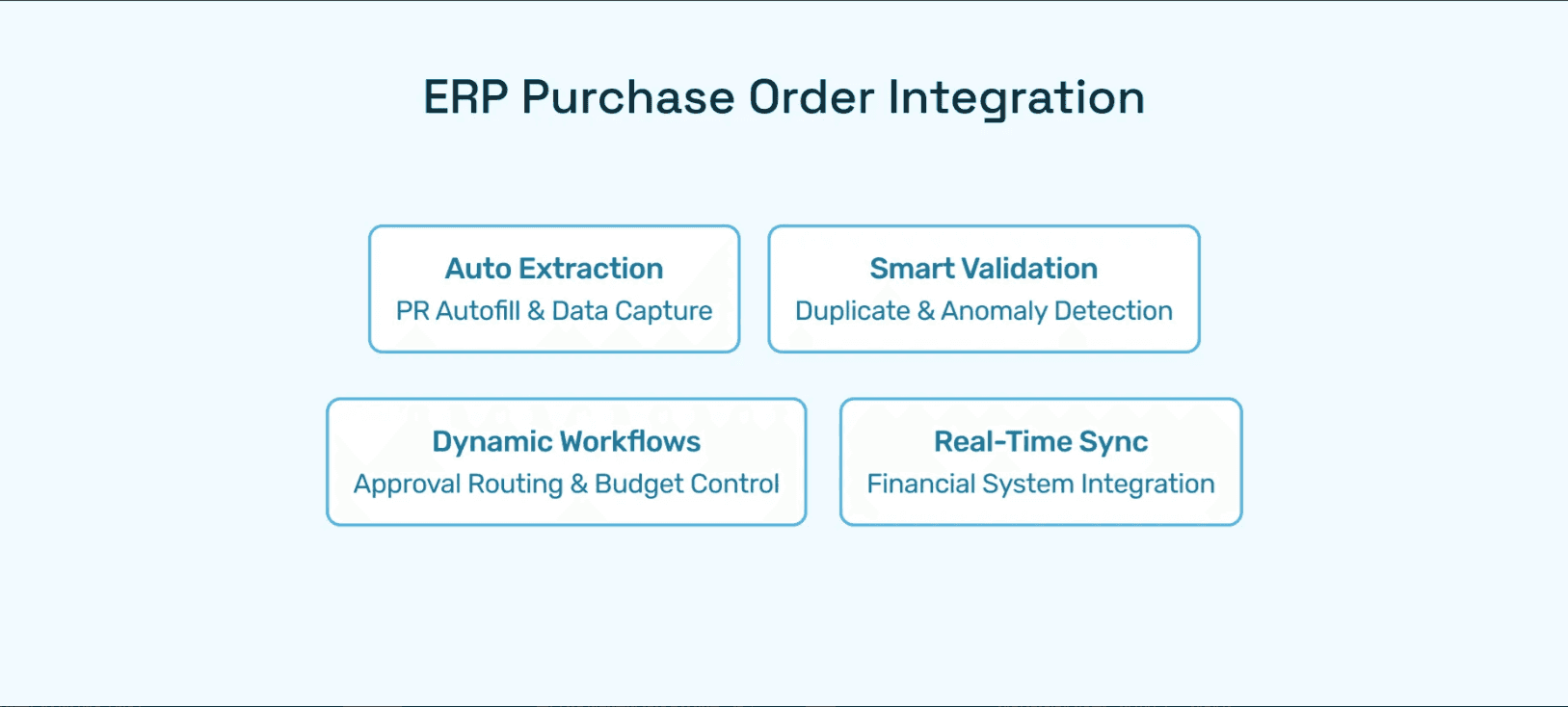
Hyperbots' procurement ERP integration architecture supports seamless connectivity across leading ERP platforms through sophisticated technical capabilities:
Instant read/write access to vendor master, item master, and chart of accounts
Bi-directional data flow ensuring consistency across systems
Event-driven updates minimizing system latency
Automated data validation prevents integration conflicts
Pre-Built Connectors for SAP, Oracle, NetSuite, and Dynamics
Pre-built connectors for SAP, Oracle, NetSuite, Dynamics, and other major platforms
Custom integration capabilities for proprietary ERP systems
Support for both on-premise and cloud deployment models
Accommodation of company-specific ERP customizations
Error Handling, Rollback, and Data Integrity Controls
Intelligent retry mechanisms for temporary connection failures
Exception reporting with detailed error diagnostics
Read-back verification ensures successful data posting
Automated rollback capabilities for failed transactions
Purchase Order Automation Use Cases by Industry
Manufacturing: Bill of Materials, JIT Inventory, and Supplier Monitoring
Complex bill-of-materials processing and component tracking
Just-in-time inventory management integration
Quality control workflow automation
Supplier performance monitoring and optimization
Healthcare: Regulatory Compliance and Clinical Supply Chain
Regulatory compliance automation for medical device procurement
Clinical trial supply chain management
Pharmacy inventory optimization
Patient safety protocol integration
Professional Services: Project-Based Procurement and Client Billing
Project-based procurement and cost allocation
Consultant and contractor management automation
Intellectual property and licensing management
Client billing integration and reconciliation
How to Implement ERP PO Automation: A Phased Approach
Phase 1: Process Mapping and ERP Readiness Assessment
Current state process documentation and pain point identification
ERP customization, mapping, and integration requirement definition
Workflow design sessions with key stakeholders
Security and compliance requirement validation
Phase 2: Configuration, Integration Testing, and UAT
Co-pilot configuration aligned with business requirements
Integration testing across all ERP modules and customizations
User acceptance testing with representative transaction volumes
Performance optimization and scalability validation
Phase 3: Rollout, Training, and Continuous Optimization
Phased rollout minimizing business disruption
Comprehensive user training and change management support
Continuous monitoring and performance tuning
Regular business reviews and enhancement prioritization
How to Choose the Right PO Automation Tool for Your ERP
Technical Criteria: Connectivity, Scalability, and Security Certifications
Selecting the optimal ERP purchase order integration solution requires careful evaluation across multiple dimensions:
Native ERP connectivity breadth and depth
Real-time data synchronization performance
Scalability and performance under high transaction volumes
Security and compliance certification completeness
Business Criteria: Workflow Flexibility, Reporting, and User Adoption
Procurement process coverage comprehensiveness
Workflow customization, flexibility, and ease
User experience design and adoption facilitation
Reporting and analytics depth and usability
Questions to Ask a Vendor Before Signing
Implementation methodology maturity and success rates
Change management and training program effectiveness
Ongoing support, responsiveness, and expertise depth
Platform evolution roadmap alignment with business needs
Partnership Success Factors
Long-term success with procurement ERP integration depends on several critical partnership elements:
Vendor Expertise and Experience
Deep domain knowledge in finance and accounting processes
Proven track record with similar organizational implementations
Industry-specific experience and best practice knowledge
Technical architecture expertise across multiple ERP platforms
Implementation and Support Excellence
Structured project management methodologies
Comprehensive user training and change management programs
24x7 monitoring and optimization services
Continuous platform enhancement and feature development
Future of Purchase Order Automation in ERP Systems
Predictive Analytics and AI-Driven Exception Management
The procurement landscape continues to evolve rapidly with new technologies reshaping industry standards. CIOs listed predictive analytics and deep learning as the most critical ERP technologies to gain a competitive advantage.
Hyperbots stays ahead of these trends through:
Natural language processing for intelligent document interpretation
Machine learning algorithms are improving approval routing efficiency
Predictive analytics identifies cost optimization opportunities
Computer vision technology for automated document processing
Blockchain and IoT Integration in Procurement
API-first architecture supporting emerging business applications
Blockchain integration for enhanced supply chain transparency
IoT connectivity for real-time inventory and asset management
Advanced analytics platforms for strategic insights generation
How the AI in Procurement Market Is Expected to Grow Through 2033
With the market for AI in procurement expected to grow at a CAGR of 28.1% from 2024 to 2033, and the public cloud ERP industry also experiencing rapid market growth, now is the optimal time to modernize your procurement infrastructure. Organizations that act decisively will gain significant competitive advantages over those that delay.
As AI adoption accelerates across procurement, tools like Hyperbots are emerging as key enablers of this transformation. By layering intelligent automation on top of ERP systems, they help organizations move faster, reduce manual effort, and improve decision-making across the procure-to-pay cycle.
Getting Started: Your Next Steps
Ready to transform your procurement operations with industry-leading ERP PO software? The path to 80% operational cost reduction begins with understanding your organization's unique requirements and crafting a tailored implementation strategy.
Hyperbots' team of procurement automation experts can help you:
Assess your current procurement maturity and identify quick-win opportunities
Design customized workflows aligned with your business requirements
Plan a comprehensive implementation minimizing business disruption
Discover how Hyperbots can transform your procurement operations. Schedule a personalized demo to see our AI Co-pilots in action, or explore our comprehensive procurement automation platform to learn more about specific capabilities tailored to your industry and ERP environment.
Frequently Asked Questions
Q1: What ERP systems does Hyperbots integrate with?
A: SAP, Oracle, NetSuite, Microsoft Dynamics, QuickBooks Enterprise, plus custom and industry-specific solutions.
Q2: How does Hyperbots handle ERP customizations?
A: Configuration-driven framework adapts seamlessly to custom fields, business logic, and ongoing ERP updates.
Q3: What security measures protect our financial data?
A: SOC 2 Type II certified with end-to-end encryption, role-based controls, and comprehensive audit logging.
Q4: Can we customize workflows to match our approval processes?
A: Yes, a no-code interface enables approval hierarchies, budget thresholds, routing rules, and exception handling.