Best ERP for Small Manufacturing Business
Define success, implement ERP, and amplify outcomes with Hyperbots driving automated, error-free finance operations.
Executive Summary
Small manufacturers are under pressure to do more with less, with short lead times, volatile supply costs, thin margins, and customers who expect perfect quality and instant status updates. Picking the best ERP for a small manufacturing business isn’t about brand prestige; it’s about fit: the right modules, workflows, integrations, and cost structure for your size, complexity, and growth path.
This deep dive is a practical buyer’s and implementer’s guide. You’ll learn how to evaluate ERP for small business manufacturing, where the best manufacturing software small business platforms shine, and how to plan a go-live you can actually deliver. We’ll cover core manufacturing functions (BOMs, routings, work orders, MRP/DRP, scheduling, WIP, costing), inventory/warehouse (lots, serials, barcodes), quality, purchasing/vendor management, and finance. You’ll get templates for fit, total cost of ownership (TCO), and an ERP system for a small manufacturing implementation blueprint with realistic timelines.
Finally, we’ll show how Hyperbots overlays any ERP (cloud or on-prem) to multiply your ROI. With six finance-grade AI Co-pilots, Invoice Processing, Procurement, Accruals, Payment, Sales Tax Verification, Vendor Management, Hyperbots turns your ERP into a faster, cleaner, more accurate financial engine, driving 80%+ straight-through processing (STP) and measurable cash savings. If you’re choosing an ERP software for a small manufacturing business or looking to upgrade, this guide will help you decide, deploy, and win.
What “Best ERP” Means for Small Manufacturers
When we say best ERP for small manufacturing business, we’re not talking about the flashiest feature sheet. “Best” is a function of:
Fit to your build model: Discrete assemblies, process/batch, make-to-order (MTO), engineer-to-order (ETO), configure-to-order (CTO), or job shop.
Complexity vs. ease: The minimum viable complexity to run well, not a bloated suite you’ll never fully use.
Total cost of ownership: Subscription + implementation + integrations + change management + support.
Time-to-value: You need outcomes in months, not years.
Data & control maturity: Clean masters, traceable transactions, auditable financials.
Scalability: Today’s ERP for small manufacturers should scale to multi-site, multi-currency, basic EDI, and e-commerce as you grow.
For many small shops, the best manufacturing software small business platforms combine:
Core manufacturing—BOMs, routings, work orders, MRP/DRP, finite scheduling (basic), WIP & costing.
Inventory/WMS—Locations/bins, lots/serials, barcode scanning, cycle counts, ASN receiving.
Purchasing—PR/PO, vendor scorecards, receiving/inspection, returns.
Finance—AP/AR/GL, bank feeds, tax, close checklist, fixed assets, basic analytics.
Light CRM—Quotes, orders, customer service.
Portals/API—Suppliers/customers, integrations.
If you’re an ERP for a small manufacturing company buyer, start with a written “day-in-the-life” of your planner, buyer, warehouse lead, line supervisor, and controller. Force vendors to walk those flows live using your data. That’s the best predictor of a good fit.
Must-Have Manufacturing Capabilities (by Stage)
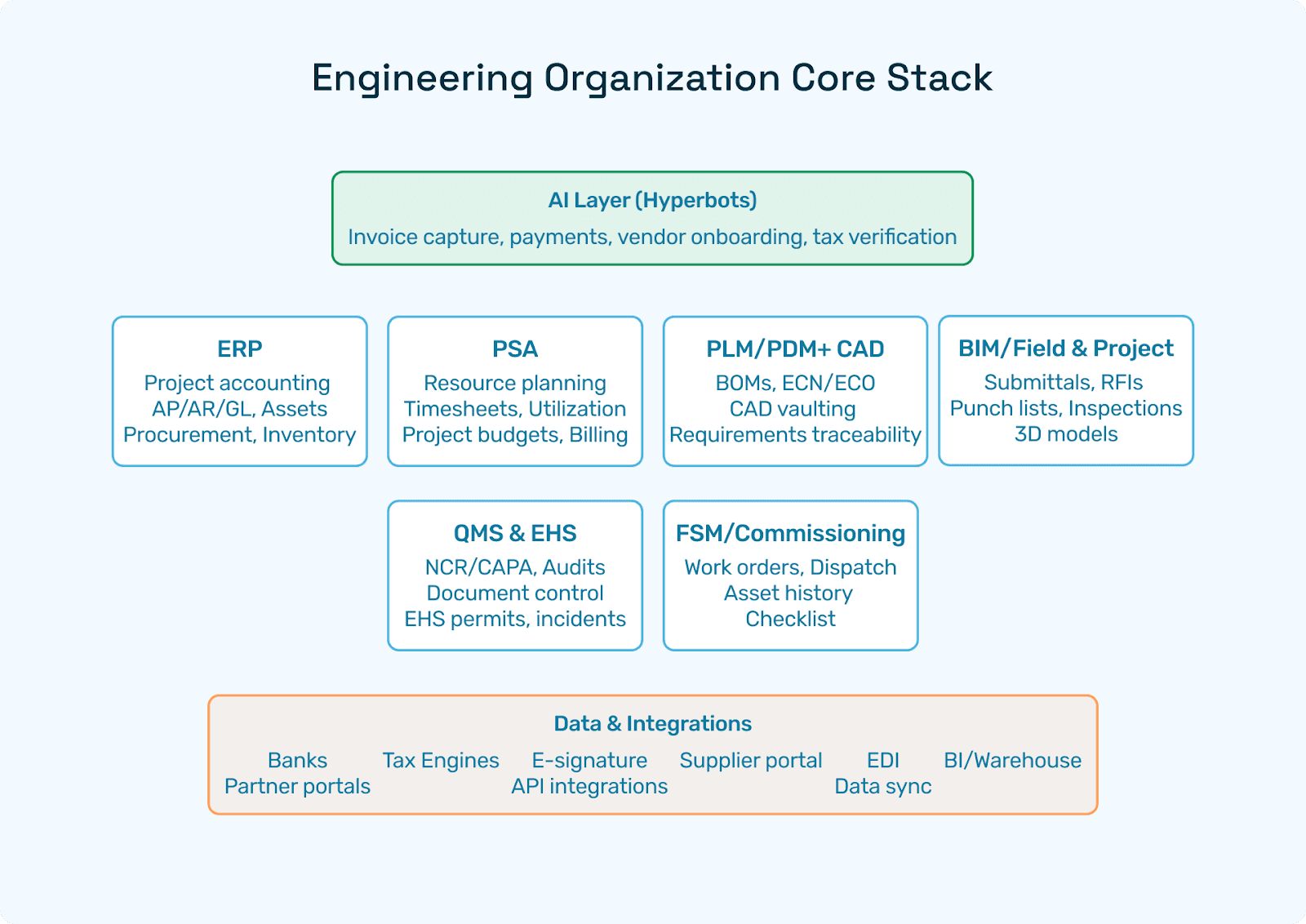
Below is a pragmatic capability stack for ERP systems for small manufacturing companies. Stage where most SMBs achieve value:
Stage 1 — Operate & Control
Items, BOMs (exploded and phantom), basic routings
Work Orders (release/issue/complete), backflush, scrap capture
WIP accounting, standard or average/FIFO costing
Inventory locations, receiving, putaway, cycle counting
Basic quality gates (incoming inspection, final checks)
AP/AR/GL, bank reconciliation, sales tax, period close
Stage 2 — Plan & Optimize
MRP/DRP (lead times, min/max, safety stock)
Vendor management and price breaks
Barcoding for issues/returns and completions
Landed cost allocation (freight, duty, tariffs)
Serial/lot traceability, RMAs, quarantine
Shop floor data capture (labor, downtime)
Stage 3 — Scale & Extend
Finite/constraint-aware scheduling (light APS)
Quality management (NCR/CAPA), SPC
Contract/outsourced operations (outside processing)
Customer and supplier portals, EDI, e-commerce
Multi-entity consolidation, multi-currency
Maintenance (TPM), tool/fixture tracking
You don’t need everything on day one. The best ERP system for small manufacturing lets you start with Stage 1 and progressively enable the rest without painful re-implementation.
Finance & Controls Essentials for SMB Plants
A small plant fails not from the lack of a clever scheduler but from weak financial hygiene. Your ERP software for a small manufacturing business must enable:
Clean Chart of Accounts (COA) with manufacturing-ready segments (site, product family, cost center, project).
WIP integrity— Every WO posts correctly; WIP clears at completion.
Three-way match where applicable (PO → receipt → bill), tolerance rules by vendor class.
Landed cost capture— No more freight in “miscellaneous expenses.”
Tax accuracy— Right jurisdiction and rates; audit-ready evidence.
Close checklist— WIP aging, unvouchered receipts, and accruals for in-transit/outsourced work.
Vendor banking controls— Maker-checker, validations.
This is exactly where Hyperbots excels, as an AI layer that automates extraction, validation, matching, accruals, payments, and vendor governance on top of any ERP.
Top Evaluation Criteria & Scorecard
Use this scorecard to compare ERP systems for small manufacturing companies. Weight each by importance (example weights in parentheses):
Manufacturing Core (25%)
BOM/routings depth; WO transactions; MRP/DRP; basic scheduling; outside processing
Inventory/WMS (15%)
Lots/serials; barcoding; ASN; returns; cycle count; multi-location
Quality (10%)
Incoming inspection; in-process controls; NCR/CAPA (basic)
Purchasing/Vendor (10%)
PR/PO; price breaks; approvals; vendor scorecards; landed costs
Finance (20%)
AP/AR/GL; bank feeds; tax; fixed assets; close tooling; reporting
Integration & Extensibility (10%)
REST/EDI connectors; e-commerce; 3PL/ship; CAD/BOM import
Usability & Adoption (5%)
Role-based UX; mobile scanning; dashboards; training content
TCO & Contracting (5%)
Subscription clarity; implementation estimate; admin overhead
Scorecard tip: Run a “fit lab” with 8–10 live scripts using your data (e.g., “2-operation WO with outside processing, landed cost on receipt, 3-way match on vendor bill”). Vendor demos only count when they execute your script.
TCO & Pricing Models for SMB ERPs
For a manufacturing software small business, plan a 3-year TCO that includes:
Licenses/subscription— Named or concurrent users, module packs, environments.
Implementation— Discovery, configuration, testing, data migration, training, cutover.
Integrations— e-commerce, 3PL/ship, EDI, tax, banks, quality/LIMS, PLM/CAD import.
Change management— Time to create SOPs, train, and adopt.
Support— Premium support or partner retainer.
Hardware/devices— Scanners, label printers, shop tablets, scales.
Contingency— 10–20% of services for surprises.
A realistic SMB implementation ranges ~12–24 weeks, depending on scope and data quality. Your TCO should also budget the AI layer (Hyperbots), which often pays for itself via duplicate-payment prevention, faster cycle times, and better discount capture.
Implementation Blueprint & Timeline
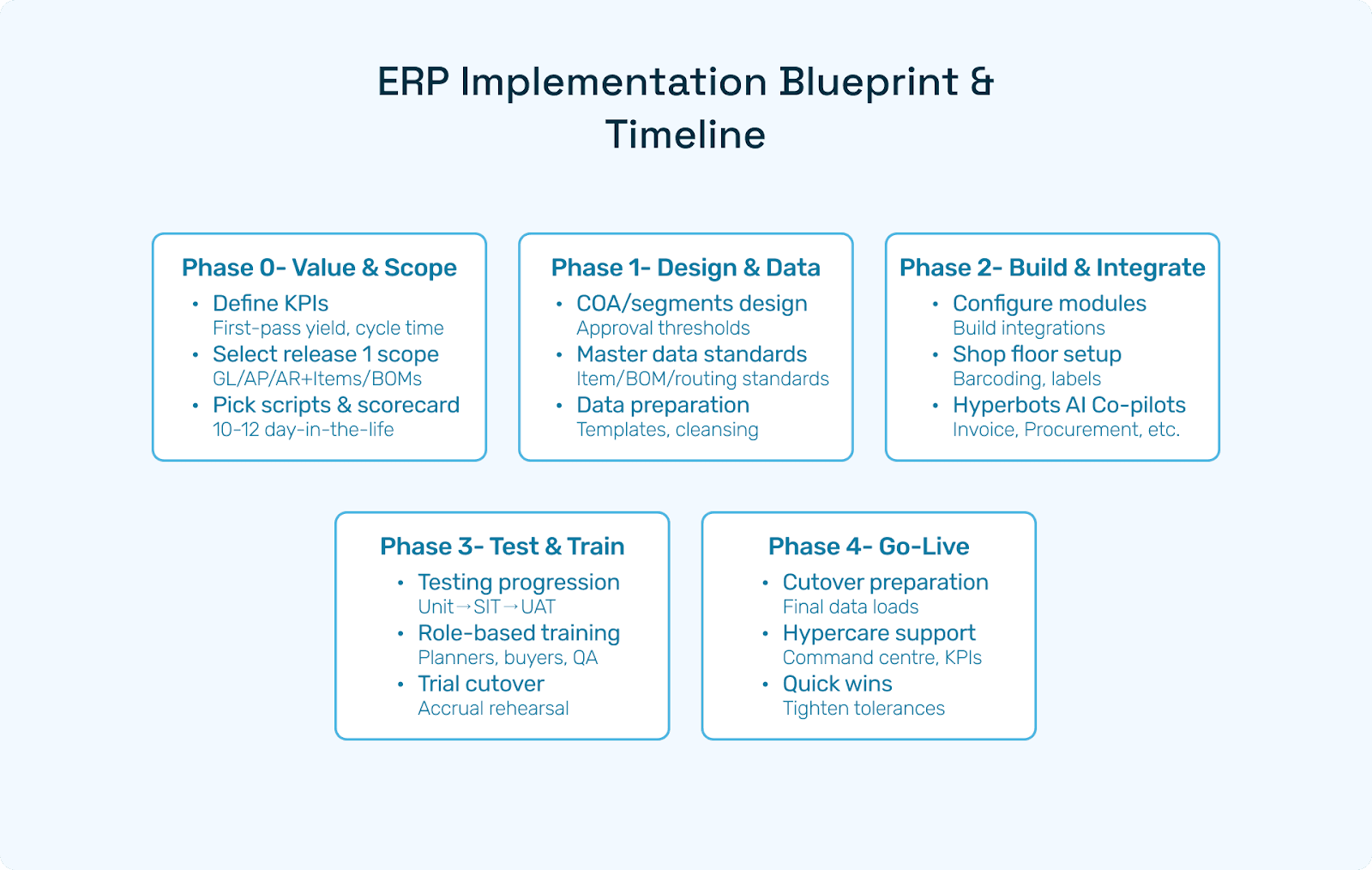
A no-nonsense blueprint for ERP for small business manufacturing success:
Phase 0 — Value & Scope (2–3 weeks)
Define KPIs (first-pass yield, cycle time, on-time ship, first-pass match %, DPO).
Select scope for Release 1 (GL/AP/AR + Items/BOMs/WOs + Receiving + Simple MRP + Quality gates).
Pick 10–12 day-in-the-life scripts; lock the scorecard.
Phase 1 — Design & Data (3–4 weeks)
COA/segments design; approval thresholds; tolerance rules; role matrix.
Item/BOM/routing standards; vendor master standards; location/bin strategy.
Data templates, cleansing, and mapping.
Phase 2 — Build & Integrate (4–8 weeks)
Configure modules; build light integrations (AP inbox, banks, tax, shipping).
Set up barcoding and labels; pilot shop floor capture.
Hyperbots Co-pilot configuration (Invoice, Procurement, Accruals, Payment, Sales Tax, Vendor).
Phase 3 — Test & Train (3–5 weeks)
Unit → SIT → UAT using your scripts; non-conformance handling.
Role-based training: planners, buyers, warehouse, QA, and controller.
Trial cutover; accrual rehearsal; WIP/receipts reconciliation.
Phase 4 — Cutover & Hypercare (2–4 weeks)
Freeze windows; final data loads; printer/bank/tax endpoints.
Command center; daily KPI huddles; defect burn-down.
Move quick wins: tighten tolerances, tweak approvals, improve vendor data.
Typical timeline: 12–24 weeks for a single-site small manufacturer with moderate integrations.
Data, Migrations & Quality Readiness
Bad data breaks good ERPs. Focus your ERP for the small manufacturers project on:
Masters— Items (UoM, lead time, reorder points), BOMs (rev-controlled), routings (standard times), vendors (terms, bank details), customers, locations/bins.
Transactions— Open POs, open WOs, on-hand inventory by lot/serial, open AR/AP.
Validation— Trial loads with record counts and control totals; reconcile with Finance and Operations.
Quality— Sampling plans for incoming inspections; lot/serial discipline; NCR/CAPA workflow.
Hyperbots improves data readiness by ingesting supplier docs (invoices, POs, ASNs), validating fields (dates, amounts, tax, bank), and nudging users when information is missing, long before it becomes an accounting problem.
Integration Patterns That Matter
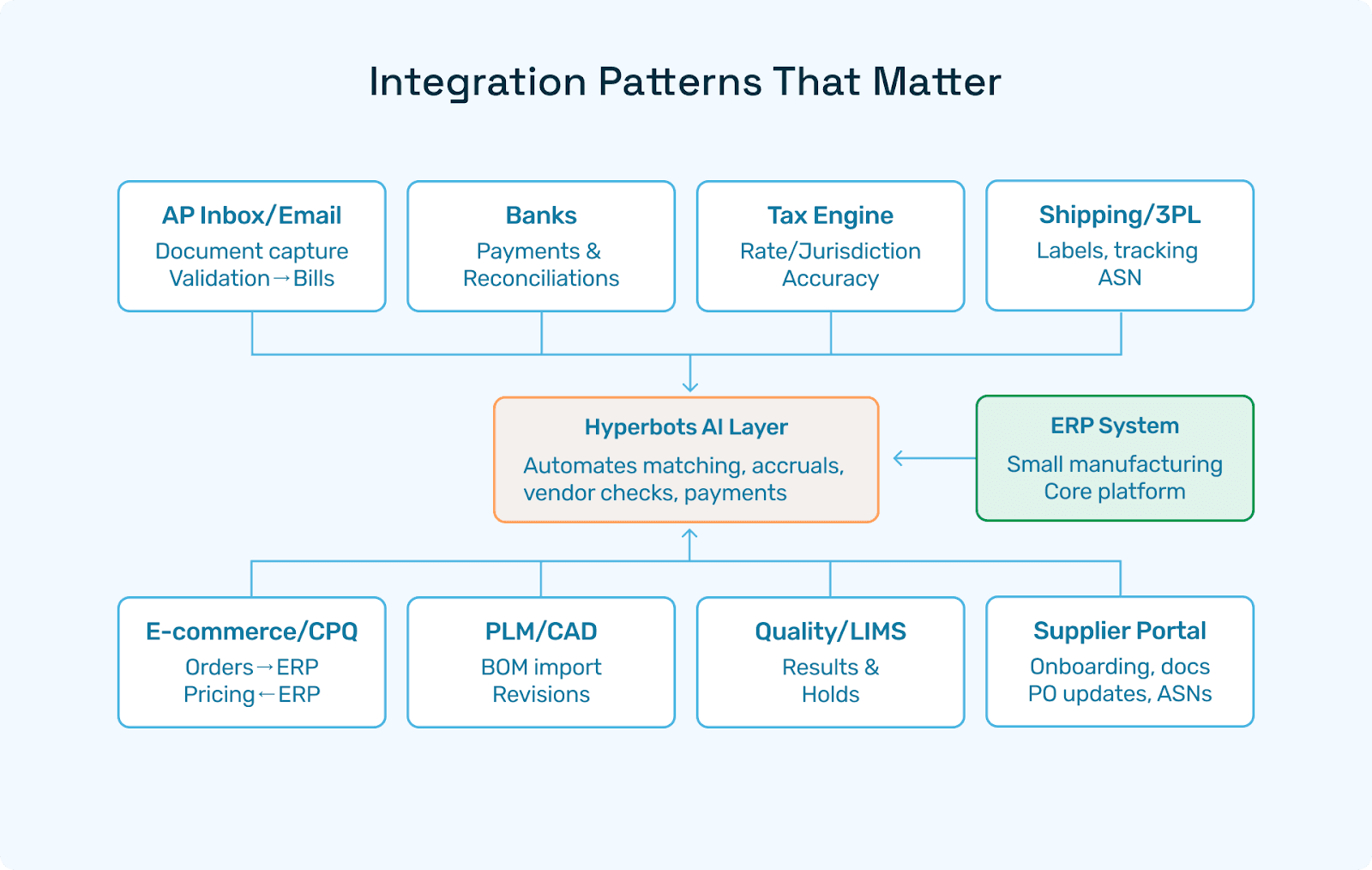
Your ERP system for small manufacturing should connect easily to:
AP inbox/email → Document capture & validation → Vendor bill posting
Banks → Payments and reconciliations
Tax engine → Rate/jurisdiction accuracy
Shipping/3PL → Labels, tracking, ASN
E-commerce/CPQ → Orders into ERP; pricing & availability calls out
PLM/CAD → BOM import and revs
Quality/LIMS → Results and holds
Supplier portal → Onboarding, docs, PO updates, ASNs
The Hyperbots layer shortens exception queues by automating matching, accruals, vendor checks, and payment proposals, reducing manual touches across these integrations.
Fit Patterns: Discrete, Batch/Process, Job Shop
Discrete/Assembly (electronics, machinery, consumer goods)
Needs: alternate BOMs, outside processing, serials, RMA, warranty.
Watch for: accurate backflush, labor capture, and landed costs.
Batch/Process (food, chemicals, cosmetics)
Needs: formulas/recipes, lot potency, QC/COA, expiration, FEFO.
Watch for: regulatory docs, rework/scrap, tank blending.
Job Shop/ETO (custom fabrication)
Needs: estimate→WO linkage, project accounting, milestones, purchasing by job.
Watch for: revision discipline, finite scheduling, and margin visibility by job.
Your candidate ERP systems for small manufacturing companies should show live how they handle these patterns with your data.
Contract & Outsourced Manufacturing in SMB ERPs
Even small firms use partners for a full build or a specific step. Your ERP must support:
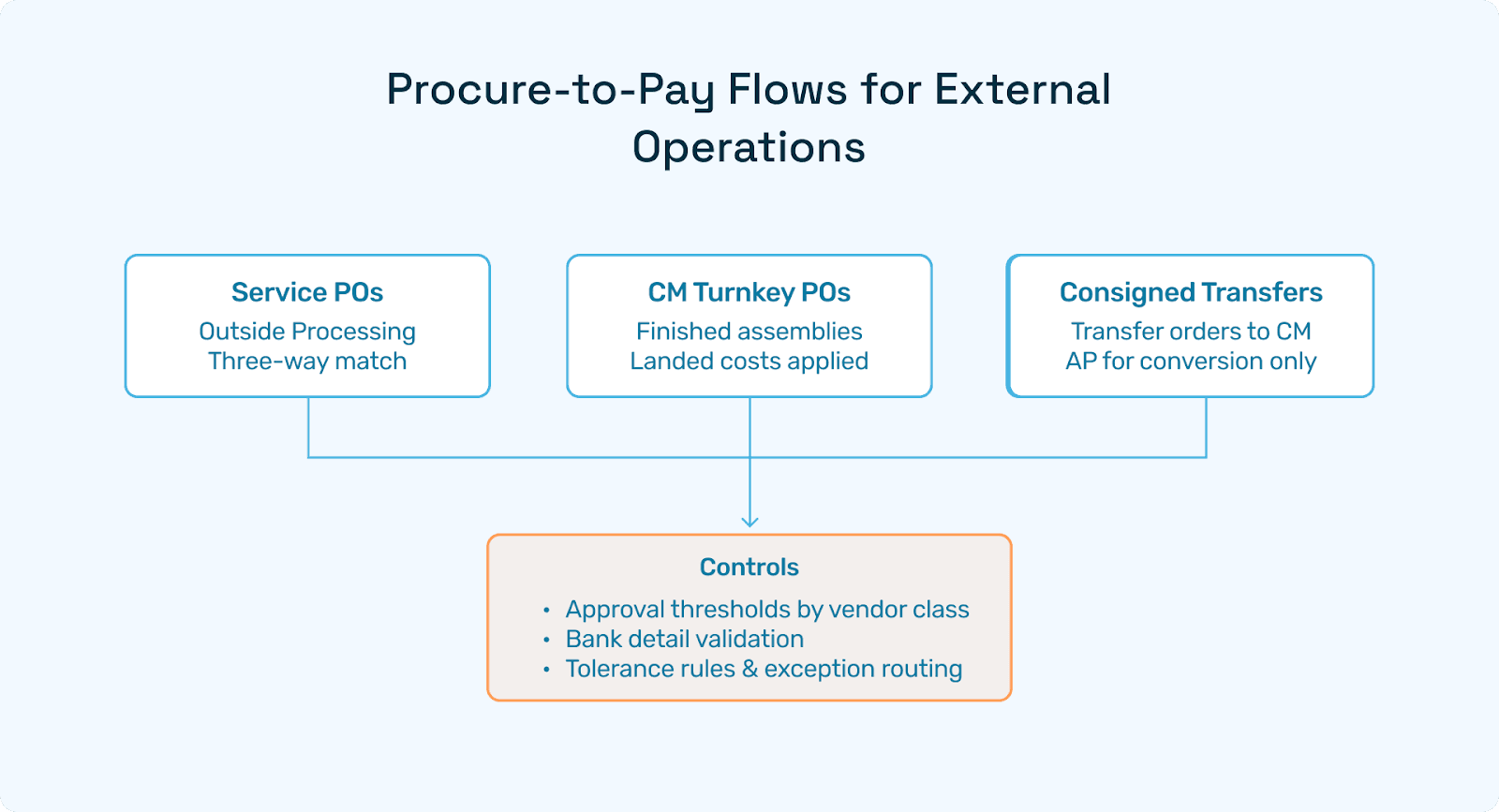
Contract manufacturing— Consigned vs. turnkey; CM locations; transfer orders; service items for conversion; landed costs; three-way match when applicable.
Outsourced steps— Outside processing operation in routing; ship WIP to vendor; receive and continue; vendor bills roll into WIP/FG.
This is a sweet spot for Hyperbots: vendor onboarding, bank validation, service PO matching, accruals for unbilled outside processing, and duplicate-bill prevention.
How Hyperbots AI Co-pilots Supercharge Any ERP
Hyperbots is an AI layer that runs on top of major SMB ERPs (cloud or on-prem) to automate finance operations end-to-end, ideal for ERPs for small manufacturing company setups with lean teams. The six Co-pilots are modular; start with one and add more.
Invoice Processing Co-pilot —
Ingests invoices from email/AP inbox; extracts headers and line-level detail (items, quantities, price, tax, freight).
Performs 2-way/3-way matches against POs/receipts or service operations; flags mismatches and duplicates.
Posts clean bills to ERP, nudges approvers only for true exceptions.
Procurement Co-pilot —
Auto-creates PRs from MRP/DRP signals or min/max breaches; recommends suppliers and price breaks.
Routes approvals by policy; writes POs to ERP; monitors ASN compliance.
Accruals Co-pilot —
Suggests period-end accruals for in-transit receipts, unbilled services, and landed costs; auto-reverses with evidence when bills arrive.
Payment Co-pilot —
Optimizes payment proposals (terms, cash position, discounts); validates vendor bank details; blocks duplicates/overpayments.
Sales Tax Verification Co-pilot —
Validates jurisdiction and rates line-by-line; flags anomalies before posting; supports audit trails.
Vendor Management Co-pilot —
Onboards vendors (KYC, W-9/W-8, insurance), keeps docs current, scores performance, and prevents risky master changes.
Why small manufacturers benefit most
Lean AP teams get 80%+ STP; controllers get faster, cleaner closes; CFOs see real cash benefits via discount capture and fewer leakages (freight/tariff, duplicates, tax).
Works with the best manufacturing software, small business platforms and scales as you grow.
Hyperbots Platform Capabilities (for Manufacturing)
Finance-Trained AI (HyperLM + MoE): Vision + layout + LLM ensemble specialized for finance docs (invoices, POs, GRNs, statements).
Connectors: Real-time read/write with major ERPs; Gmail/Outlook ingestion; bank rails; tax engines; shipping; 3PL; EDI; portals.
Reasoning & Policies: GL coding suggestions; tolerance rules; anomaly/duplicate detection; approval nudges.
Security & SoD: Role-based access, maker-checker workflows, audit logs, redaction.
Scalability: Microservices (Java, Postgres, React); high-volume docs; multi-entity & multi-currency.
Outcome-First: Built with CFO input to deliver automation you can measure—STP, cycle time, DPO, discount capture, duplicate prevention.
Pairing Hyperbots with an ERP for small business manufacturing turns your system of record into a system of results, without ripping and replacing the ERP you’ve chosen.
KPI Pack for Small Manufacturers
Track a balanced set across Operations, Inventory, Finance, and Risk:
Operations
On-time delivery (OTD), first-pass yield, throughput, schedule adherence, and rework rate.
Inventory/Warehouse
Inventory turns, days at CM/vendor, cycle count accuracy, shrink, lot/serial traceability.
Finance/AP
First-pass match %, STP %, invoice cycle time, duplicate rate, DPO, discount capture, and landed cost variance.
Cost/Profitability
PPV, usage variance, outside processing variance, standard vs. actual, margin by job/SKU/customer.
Risk/Compliance
Vendor KYC completeness, bank change validations, tax variance, and audit findings are closed.
Hyperbots automatically collect much of the evidence behind these KPIs and keep score for you.
Risk Register & How to Avoid Common Pitfalls
1) Over-customization
Symptom: You’re building features you haven’t used yet.
Fix: Favor configuration over customization; keep a clean core; use integrations/extensions sparingly.
2) Dirty masters
Symptom: Duplicate vendors, missing lead times, inconsistent UoM.
Fix: Cleanse before cutover; enforce standards; automate with Hyperbots validations.
3) Weak approvals & SoD
Symptom: Retrospectively “fixing” errors in AP or vendor banking.
Fix: Strict maker-checker; policy-based approvals; bank validations.
4) Unplanned landed costs
Symptom: Freight/duty scattered in OPEX, not inventory.
Fix: Landed cost rules and accruals; make it part of receiving.
5) No UAT scripts
Symptom: Go-live surprises.
Fix: 10–12 “day-in-the-life” scripts with your data; pass/fail criteria.
6) Over-ambitious first release
Symptom: Dates slip; team burns out.
Fix: Stage 1 first; Stage 2/3 in roadmap; measure value at each step.
7) Ignoring change management
Symptom: People revert to spreadsheets.
Fix: Role-based training, office hours, quick reference guides, visible wins.
FAQs
Q1: What’s the difference between “ERP” and “manufacturing software for small business”?
A: ERP is the integrated backbone (manufacturing + finance + purchasing + inventory + basic CRM). “Manufacturing software small business” can be lighter MRP/production tools; many SMBs start there, then graduate to ERP.
Q2: How do I choose the best ERP for a small manufacturing business quickly?
A: Write 10–12 scripts that reflect your daily work, cleanse core masters, run vendor demos on your data, score using the criteria above, and pick the solution that passes the scripts with the lowest TCO and fastest time-to-value.
Q3: Can I run lean with only Stage 1 and add later?
A: Yes. Start with operating control (BOMs, WOs, inventory, AP/AR/GL), then layer MRP/DRP, quality, and portals. Ensure your platform supports progressive enablement.
Q4: We use outsourced steps. Will SMB ERPs handle it?
A: Good ones will: outside-processing operations, WIP shipments/returns, service PO billing, and WIP/FG roll-ups. Hyperbots helps with vendor onboarding, accruals, and duplicate prevention.
Q5: Where does AI fit?
A: Right on top of your ERP. Hyperbots automates invoice capture/matching, PR/PO creation, accruals, payments, sales-tax checks, and vendor management, freeing your team for higher-value work.
Q6: How long will implementation take?
A: Single-site, moderate scope: 12–24 weeks. Clean data and disciplined UAT are the difference makers.
Q7: What KPIs should leadership watch?
A: OTD, first-pass yield, inventory turns, cycle time, first-pass match %, STP %, duplicate rate, DPO, discount capture.
Q8: Will this work if we’re “just a small shop”?
A: Yes, start tight and simple. With Hyperbots handling finance heavy-lifting, small teams run like big ones.
Conclusion & Call to Action
There is no single “best” label, only the best manufacturing software small business setup for your stage, complexity, and goals. Define success, script your day-in-the-life flows, cleanse the data, and run a tight evaluation. Once live, let Hyperbots sit on top of your chosen ERP for a small manufacturing company to automate finance, reduce errors, and accelerate value without adding headcount.
Ready to see how this works on your data, processes, and vendors?
Book a working session: Hyperbots Demo
Get the SMB Manufacturing ERP Toolkit: Templates & Checklists